

Table of Contents
Every parent wants to prevent cavities.
The challenge is figuring out which preventive treatments actually matter and which ones are simply adding to the bill.
One of the most common questions parents ask at Endicott Dental is:
"If I have to choose, should my child get fluoride treatments or dental sealants?"
It's a fair question.
Both are designed to prevent cavities.
Both are commonly recommended for children.
Both cost money.
But they work in very different ways.
The good news is that this isn't really a "sealants versus fluoride" debate.
For many children, they work best together.
The more important question is whether your child actually needs both.
The Fast Answer
Fluoride treatments and dental sealants prevent cavities in different ways.
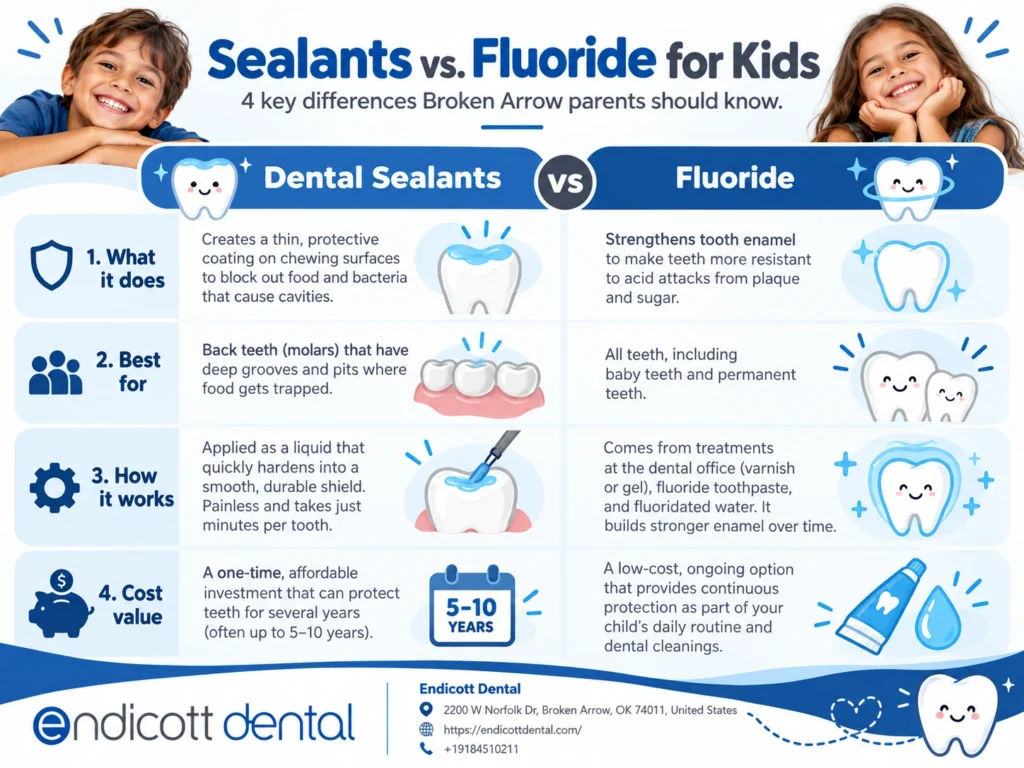
Fluoride helps strengthen tooth enamel and protect all tooth surfaces from decay.
Sealants physically cover the deep grooves on back teeth where cavities commonly develop.
For many school-aged children in Broken Arrow, fluoride is considered a foundational preventive treatment, while sealants become particularly valuable once permanent molars erupt.
If budget is a concern, the right choice often depends on your child's age, cavity risk, and which teeth are being protected.
What Are Fluoride Treatments?
Fluoride is a naturally occurring mineral that helps strengthen enamel.
Think of it as reinforcement for the outer layer of the tooth.
Professional fluoride treatments can help:
- Strengthen enamel
- Slow early decay
- Reduce cavity risk
- Protect newly erupted teeth
Most fluoride treatments take only a few minutes during a routine dental visit.
For many children, it's one of the simplest preventive services available.
What Does Fluoride Usually Cost?
Without insurance, professional fluoride treatments often range from approximately:
$20–$60 per visit
Many dental insurance plans cover fluoride treatments for children.
Coverage varies, so it's always worth checking your specific benefits.
What Are Dental Sealants?
Sealants work differently.
Instead of strengthening enamel, they create a protective barrier.
Dentists apply a thin coating to the chewing surfaces of molars.
These back teeth naturally contain deep grooves and pits where:
- Food gets trapped
- Bacteria accumulate
- Cavities commonly start
Sealants essentially cover those vulnerable areas.
Think of them as raincoats for cavity-prone grooves.
Why Molars Are Such a Problem
Parents often focus on the front teeth because they're easy to see.
Dentists worry about molars.
That's because the majority of childhood cavities occur on the chewing surfaces of back teeth.
Even children who brush well can struggle to clean these areas completely.
Those tiny grooves can be surprisingly deep.
What Do Sealants Usually Cost?
Without insurance, sealants often range from approximately:
$30–$80 per tooth
Many insurance plans cover sealants for children on permanent molars.
Because sealants can last for years, many parents view them as a strong preventive investment.
Which Prevents More Cavities?
This is where things get interesting.
The answer depends on the tooth.
Fluoride Protects All Teeth
Fluoride helps strengthen:
- Front teeth
- Back teeth
- Smooth surfaces
- Areas between teeth
It's a broad form of protection.
Sealants Target High-Risk Areas
Sealants focus specifically on the chewing surfaces where many childhood cavities develop.
They're highly targeted.
That's why dentists often recommend both rather than viewing them as competitors.
If You Can Only Choose One
Let's address the question many parents are really asking.
For Younger Children
Fluoride often provides the most overall benefit because:
- Multiple teeth are erupting
- Enamel is still maturing
- Protection is applied throughout the mouth
For Newly Erupted Permanent Molars
Sealants may provide exceptional value because those teeth are among the most cavity-prone in the entire mouth.
This is especially true around ages:
- 6–7 years old (first permanent molars)
- 11–13 years old (second permanent molars)
The Biggest Mistake Parents Make
Many parents assume:
"My child doesn't get cavities, so they don't need preventive treatment."
The problem is that prevention works before cavities appear.
Once decay develops, you're no longer talking about prevention.
You're talking about treatment.
And treatment is almost always more expensive.
A sealant that costs $50 may prevent a filling that costs several hundred dollars.
A fluoride treatment may help avoid future restorative care altogether.
What About Kids With Excellent Brushing Habits?
Even great brushers get cavities.
This surprises some parents.
Children often:
- Miss areas while brushing
- Rush through their routines
- Struggle with molars
- Consume cavity-promoting snacks and drinks
Preventive treatments aren't necessarily a reflection of poor hygiene.
They're often a reflection of reality.
Kids are still learning.
Factors That Increase Cavity Risk
Some Broken Arrow children benefit even more from fluoride and sealants because they have:
- Previous cavities
- Deep grooves in molars
- Orthodontic appliances
- Frequent snacking habits
- Limited fluoride exposure
- Family history of decay
These children often receive stronger preventive recommendations.
What We Tell Parents at Endicott Dental
The goal isn't to sell every preventive service.
The goal is helping parents understand risk.
Some children truly need both fluoride and sealants.
Others may have lower cavity risk and require a different approach.
A good recommendation should be based on:
- Age
- Eruption patterns
- Oral hygiene
- Cavity history
- Individual risk factors
Not a one-size-fits-all formula.
Which Is the Better Financial Investment?
For many families, sealants provide one of the strongest returns on investment in pediatric dentistry.
Why?
Because they target the exact surfaces where many childhood cavities occur.
That said, fluoride remains one of the most affordable and effective preventive tools available.
If we're talking about value rather than simply cost, many children benefit from having both.
The Bottom Line
Fluoride treatments and dental sealants aren't competing solutions.
They're different tools designed to prevent cavities in different ways.
Fluoride strengthens enamel across the entire mouth, while sealants protect the deep grooves of cavity-prone molars. For many children in Broken Arrow, the combination provides the best protection against future decay.
If you're trying to decide what's necessary, Dr. Drew Endicott and the team at Endicott Dental can evaluate your child's cavity risk, explain the benefits of each option, and help you make a decision based on your child's actual needs, not simply a generic recommendation.
Frequently Asked Questions
Are sealants worth the cost?
For many children, yes. Sealants can significantly reduce cavity risk on molars, which are among the most cavity-prone teeth in the mouth.
Does my child still need fluoride if they have sealants?
Usually yes. Sealants only protect specific chewing surfaces, while fluoride helps strengthen all teeth.
What age should children get sealants?
Many children receive sealants shortly after their first permanent molars erupt around age 6 and again when second molars erupt around age 12.
How long do dental sealants last?
Sealants often last several years but should be checked during regular dental visits for wear or damage.
Does insurance cover fluoride and sealants?
Many dental plans provide coverage for pediatric fluoride treatments and sealants, though benefits vary by plan.
