

Table of Contents
Your dentist tells you that an old filling is failing.
The cavity underneath it is too large for another simple filling.
Or maybe part of your molar has cracked.
You assume the next sentence will be:
“You need a crown.”
Sometimes that is exactly the right answer.
But not always.
Modern adhesive dentistry gives us another category of restoration that sits between a filling and a traditional full crown:
The difference may sound technical, but it comes down to a question that matters a great deal for your long-term dental health:
How much healthy natural tooth needs to be removed to repair the damaged part?
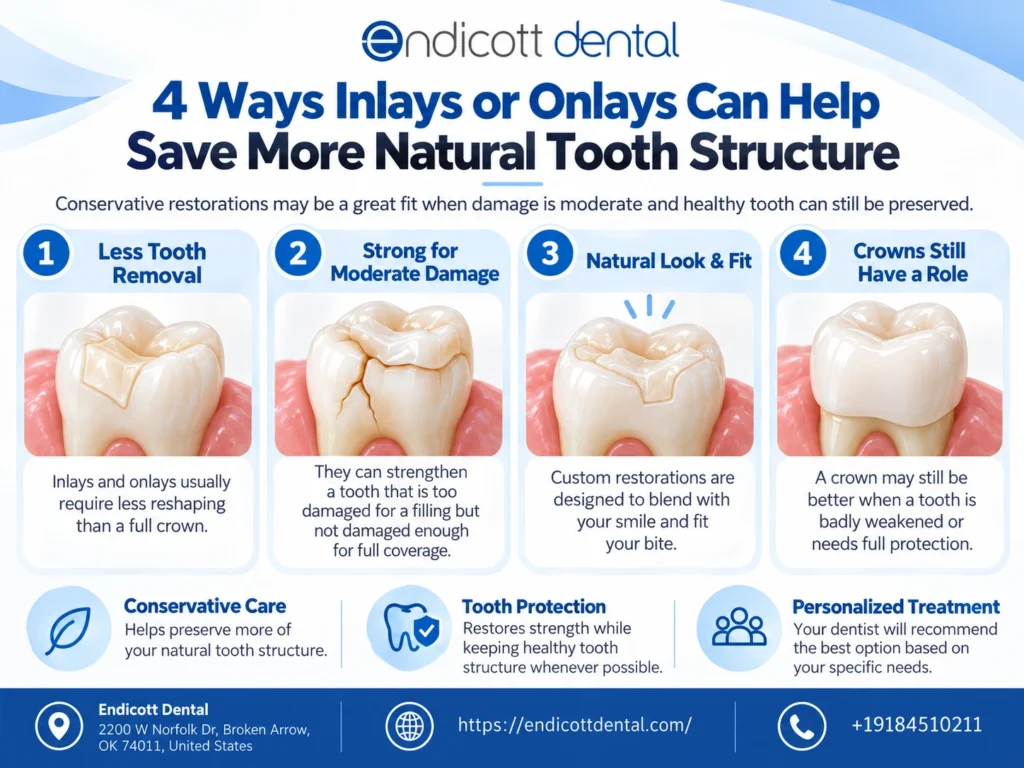
A traditional crown generally covers the entire visible portion of a tooth. To create room for that crown, the tooth usually has to be reduced around its circumference.
An inlay or onlay is more selective.
Instead of preparing every side of the tooth simply because one area is damaged, the dentist can design the restoration around the defect and preserve more healthy enamel and dentin when the remaining tooth is strong enough to support that approach.
That does not mean crowns are outdated or unnecessarily aggressive.
It means we no longer have to think in only two categories:
Small problem = filling.
Bigger problem = crown.
At Endicott Dental in Broken Arrow, inlays and onlays are among the restorative options we consider when a tooth has more damage than a conventional filling can predictably handle but still has enough healthy structure that a full crown may not be necessary. Our own guidance describes them as restorations that can strengthen moderately damaged teeth while preserving more natural teeth than a traditional crown.
The key word is may.
Sometimes saving more teeth means choosing an onlay.
Sometimes saving the tooth means choosing a full crown.
Here is how we make that distinction.
What Is the Difference Between a Filling, Inlay, Onlay, and Crown?
These restorations exist on a spectrum.
Understanding the spectrum makes the treatment conversation much easier.
A Filling Repairs a Smaller Defect Directly
With a traditional filling, the damaged or decayed area is removed and a restorative material, commonly composite resin, is placed directly into the tooth.
This works very well when enough strong natural teeth remain around the restoration.
The problem comes when the defect becomes too large.
If a filling replaces most of the chewing surface or leaves thin weakened cusps around it, simply placing a larger filling may not adequately protect the tooth from fracture.
That is where indirect restorations enter the discussion.
An Inlay Fits Inside the Cusps
An inlay is made outside the mouth often digitally or by a dental laboratory and then bonded into the prepared area of the tooth.
It repairs the damaged section without covering the tooth's cusps.
Think of it as a highly precise custom piece that fits into the tooth.
An inlay can make sense when the defect is too large or structurally demanding for an ordinary direct filling but the surrounding cusps remain strong.
An Onlay Covers One or More Cusps
An onlay goes one step further.
It repairs the internal portion of the tooth and covers one or more weakened cusps.
That can be extremely useful when:
- A large filling has weakened a cusp.
- One portion of the tooth has cracked.
- Decay has undermined part of the chewing surface.
- The tooth needs more structural reinforcement than an inlay can provide.
Modern literature often groups onlays with other partial-coverage restorations because they protect vulnerable parts of the tooth without necessarily covering every surface.
A Crown Covers the Entire Visible Tooth
A traditional crown surrounds essentially the entire clinical crown of the tooth above the gumline.
At Endicott Dental, crowns are commonly considered for teeth significantly weakened by severe decay, fractures, large failing restorations, or other structural problems.
A crown offers broad protection.
But that broader coverage also generally requires broader tooth preparation.
That is the tradeoff.
Why Does Saving Natural Tooth Structure Matter?
It can be easy to think:
“If the crown is strong, why should I care how much tooth is underneath it?”
Because your natural tooth is valuable.
Enamel and dentin are biological structures that you do not get back once they are removed.
Every restorative procedure should therefore have two goals:
- Remove the disease or damaged structure that genuinely needs to go.
- Preserve as much healthy structure as reasonably possible while still giving the restoration enough strength.
Modern restorative dentistry increasingly emphasizes defect-oriented treatment—preparing the damaged part rather than automatically reshaping the entire tooth. Research on partial-coverage restorations describes this shift as a move toward minimally invasive adhesive dentistry.
A Full Crown Usually Requires More Tooth Reduction
This is not just theoretical.
A recent review of partial-coverage restorations cited studies showing that conventional full-crown preparations may remove roughly 67.5% to 75.6% of coronal tooth structure, compared with approximately 35.5% to 46.7% for partial-coverage preparations in the referenced experimental designs. Those numbers vary by tooth, preparation, material, and clinical situation, so they should not be interpreted as what will happen to every patient.
Another clinical study involving root-canal-treated molars found that converting partial-coverage preparations into full-coverage preparations removed additional tooth volume, with the amount varying substantially among teeth.
The practical point is simpler than the percentages:
A full crown normally requires preparing more healthy teeth than an appropriately designed onlay.
If the full crown is needed, that tradeoff is worthwhile.
If it is not needed, preserving structure can be valuable.
Does Preserving More Tooth Automatically Make an Onlay Better?
No.
This is the most important limitation.
Minimally invasive dentistry does not mean choosing the smallest restoration at all costs.
Imagine a tooth where:
- Three of four cusps are badly weakened.
- A crack extends deeply.
- Very little enamel remains for bonding.
- Decay reaches around multiple surfaces.
- The tooth has already undergone extensive restorative work.
In that situation, trying to preserve every remaining millimeter may create a restoration that is conservative but not predictable.
That is not a victory.
The goal is:
Preserve as much healthy tooth as possible while giving the tooth enough protection to function for years.
Sometimes an onlay accomplishes that.
Sometimes a crown does.
What Is the Biggest Advantage of an Onlay?
For the right tooth, it can combine two things patients want:
structural protection and conservation of natural teeth.
An onlay can cover weakened cusps while leaving strong surfaces untouched.
For example, imagine a molar with an old large filling and a cracked chewing cusp.
The tooth's outer wall on one side may still contain excellent enamel.
A full crown might require reducing that healthy surface to create room for full circumferential coverage.
An adhesive onlay may instead cover the vulnerable chewing area and cracked cusp while preserving more unaffected enamel.
That is the appeal.
Do Onlays Last as Long as Crowns?
Current research is encouraging but this is an area where we need to be careful with certainty.
A systematic review comparing inlays, onlays, and crowns found that five-year survival was high across all categories, exceeding 90%. The authors reported average survival estimates of approximately 90.9% for inlays, 93.5% for onlays, and 95.4% for crowns, but they specifically cautioned that the included studies were too different from one another for strong direct comparison.
A separate systematic review and meta-analysis comparing onlays or partial crowns with full crowns found no statistically significant survival difference at one or three years, although the authors emphasized that better long-term randomized trials are still needed.
More recent research continues to find that modern ceramic partial-coverage restorations can be reliable for extended posterior defects, but long-term evidence remains less certain than short-term performance data.
So we would not tell a patient:
“Only last longer than crowns.”
The evidence does not support that claim.
We would say:
Properly selected and bonded partial-coverage restorations can perform very well while preserving more natural tooth structure.
When Is an Inlay a Good Choice?
An inlay is generally the most conservative of these indirect options because it stays within the cusps.
It may make sense when:
- The damaged area is larger than we want to restore with a direct filling.
- The cusps remain structurally strong.
- There is no significant crack requiring cusp coverage.
- Enough enamel remains for reliable adhesive bonding.
- The bite forces can be handled without covering the cusps.
When Would We Skip the Inlay and Use an Onlay?
When a cusp is already weakened.
If part of the chewing surface is thin, cracked, undermined by an old filling, or likely to fracture, protecting that cusp may be more important than preserving it uncovered.
That is where an onlay becomes useful.
When Is an Onlay Better Than Another Large Filling?
Large fillings can work very well.
But there is a point where asking composite filling material to replace most of a tooth becomes less predictable.
Imagine a molar with a wide old silver filling.
The filling itself occupies most of the center of the tooth.
The remaining cusps are essentially thin walls around it.
If recurrent decay develops beneath that restoration, removing the old filling and decay may leave even less tooth behind.
Putting another enormous filling into that space may restore the hole without adequately protecting the remaining cusps.
An onlay can cover those vulnerable areas and redistribute chewing forces.
When Is a Traditional Crown the Better Choice?
There are situations where a crown earns its additional tooth reduction.
The Tooth Is Extensively Broken Down
If damage involves most of the tooth, a partial restoration may have too little healthy structure available for support or bonding.
A crown can encircle the remaining tooth and provide broader protection.
Multiple Cusps Are Compromised
When nearly every major part of the chewing surface is weakened, the distinction between an extensive onlay and crown becomes smaller.
At that point, full coverage may offer a more predictable design.
A Deep Crack Changes the Prognosis
Cracks require careful evaluation.
A small fractured cusp and a deep structural crack are not the same problem.
Some cracks can be stabilized with partial coverage.
Others require full coverage.
And some extend so deeply that neither restoration can predictably save the tooth.
The restoration needs to match the crack, not the patient's preference for a particular procedure.
There Is Very Little Enamel Available for Bonding
Modern partial-coverage restorations depend heavily on adhesive bonding.
Preserving enamel is valuable partly because enamel provides an excellent bonding substrate.
If very little reliable enamel remains, other restorative strategies may become more predictable.
The Tooth Has Extensive Previous Restorations
Every time a tooth is restored, its structural starting point changes.
A molar that has been filled once is different from one that has:
- A huge filling
- Recurrent decay
- Multiple fractures
- Several replacement restorations
At some point, the amount and quality of the remaining tooth dictate the restoration.
What About a Tooth That Has Had a Root Canal?
This deserves an individualized answer.
Root-canal-treated posterior teeth often have substantial pre-existing structural loss because of the original cavity, fracture, previous filling, and access needed for treatment.
Traditionally, many of these teeth received full crowns.
Partial-coverage restorations are increasingly considered in selected cases because preserving sound tooth structure may be beneficial. Research has specifically examined partial versus complete coverage in root-treated molars and confirmed that full crown preparation generally removes more remaining coronal structure.
But a root canal does not automatically mean:
“An onlay is better.”
Nor does it always mean:
“You must have a full crown.”
The answer depends on:
- Which tooth it is
- How much structure remains
- Which cusps are intact
- Whether cracks are present
- The bite
- Available enamel
- The restorative material being considered
What Materials Are Inlays and Onlays Made From?
Endicott Dental currently notes that inlays and onlays may be made from materials including porcelain, composite resin, and gold, with the appropriate material selected based on the tooth and clinical situation.
Modern partial-coverage dentistry also makes heavy use of ceramic and CAD/CAM materials.
Ceramic
Ceramics can provide:
- Excellent appearance
- Strong wear resistance
- Stable shape
- Strong adhesive bonding in appropriate conditions
Lithium disilicate is one modern ceramic frequently studied for partial-coverage posterior restorations and has shown strong short-term survival in clinical research.
Resin-Based Ceramic or Composite
These materials may have different mechanical characteristics and can be appropriate in selected situations.
Current research does not support pretending one material wins every category.
The material should match:
- Restoration thickness
- Bite
- Tooth location
- Opposing teeth
- Available tooth structure
Gold
Gold is less popular cosmetically today but has a long history as a durable restorative material.
Some patients care much more about longevity and function on a back tooth than matching the restoration to enamel color.
That is a perfectly reasonable preference.
What Materials Are Traditional Crowns Made From?
At Endicott Dental, crown options include materials such as:
- Zirconia
- Porcelain or ceramic
- Gold
- Metal alloys
The best material depends on factors such as tooth position, chewing force, appearance, and patient priorities.
A zirconia crown on a heavily loaded molar and a highly esthetic ceramic crown on a visible tooth solve different problems.
There is no universally best crown material.
Is an Onlay Basically a “Three-Quarter Crown”?
Sometimes people use those terms loosely, but modern definitions are more nuanced.
Partial-coverage restorations are a broad category.
An onlay traditionally covers one or more cusps.
A partial crown may cover a larger portion of the tooth while intentionally leaving some surfaces unprepared.
The important concept for patients is not memorizing terminology.
It is understanding that coverage can be customized to the defect.
Why Isn't Every Dentist Using Onlays Instead of Crowns?
Several reasons.
Not Every Tooth Qualifies
Some teeth simply need full coverage.
Adhesive Technique Matters
Partial-coverage ceramic restorations rely on proper isolation, preparation, bonding, and material handling.
They are technique-sensitive.
Evidence Is Still Developing
Research is encouraging, but long-term comparisons with crowns are not as extensive as we would like.
A 2024 systematic review looking specifically at teeth with large MOD preparations found only three eligible publications and concluded that the evidence was still insufficient to make strong outcome comparisons between onlays and crowns. Interestingly, the studies suggested that failures involving crowns may sometimes be more catastrophic, while some onlay failures left teeth salvageable but the evidence was not strong enough for definitive conclusions.
Dentistry Has Historical Habits
Crowns have been a reliable restorative tool for generations.
As adhesive dentistry improves, the profession is reevaluating how frequently full coverage is truly necessary.
That does not make the old approach wrong.
It means the treatment toolbox has expanded.
Is a Crown Stronger Than an Onlay?
That question sounds simple but can be misleading.
A crown provides more coverage.
That does not automatically mean the tooth-crown system is superior in every situation.
Strength depends on:
- Remaining tooth structure
- Preparation design
- Bond quality
- Crown or onlay material
- Restoration thickness
- Bite forces
- Grinding
- Crack patterns
Current meta-analysis suggests onlays and partial crowns can have short-term survival and success comparable to full crowns in selected posterior teeth.
The answer should not be based on which restoration looks physically bigger.
What If You Grind Your Teeth?
Bruxism changes the calculation.
Someone who exerts heavy nighttime force can fracture:
- Natural teeth
- Fillings
- Onlays
- Crowns
No restorative material is indestructible.
If we see significant wear patterns, flattened teeth, broken restorations, or a history of repeated fractures, we need to consider those forces when selecting both restoration type and material.
In some patients, protecting the finished restoration with a nightguard may also be worth discussing.
Can an Inlay or Onlay Still Get a Cavity?
Yes.
The restoration itself does not decay.
The natural tooth around it can.
The same is true for crowns.
The systematic review comparing indirect restorations identified recurrent caries as one of the major biological complications across restoration types.
Good dentistry does not eliminate the need for:
- Brushing
- Fluoride toothpaste
- Interdental cleaning
- Dental checkups
- Managing sugar frequency
A beautiful ceramic onlay placed on a tooth that is never cleaned can still fail.
Can a Crown Get a Cavity Underneath It?
Yes.
The crown covers the visible tooth but does not make the underlying natural structure immune to decay.
The margin where restoration meets tooth remains important.
Endicott Dental specifically notes that crowned teeth can develop decay, particularly around the gumline, which is why home care and regular examinations remain important.
What Happens During an Inlay or Onlay Procedure?
The exact workflow can vary, but the process generally involves:
Step 1: Remove Decay and Failing Material
We remove the unhealthy tooth structure and any restoration that needs replacement.
Step 2: Evaluate What's Left
This is an important moment.
Before removing the old filling, a tooth may look as though it only needs another filling.
After the restoration and hidden decay are removed, we may discover:
- A strong tooth suitable for an inlay
- A weak cusp that needs an onlay
- A major crack requiring broader protection
- So little structure that a crown becomes the safer choice
Good treatment plans can occasionally change when the full extent of damage becomes visible.
Step 3: Prepare Only What the Restoration Requires
For a partial restoration, preparation can be designed around the defect rather than automatically preparing every wall.
Step 4: Capture the Tooth Shape
Digital scanning or another impression method records the prepared tooth.
Step 5: Fabricate the Restoration
The onlay or inlay is precisely created to restore the tooth's anatomy.
Step 6: Bond It in Place
Adhesive bonding is critical to many modern partial-coverage restorations.
The bite is then checked and adjusted.
What Happens During a Crown Procedure?
At Endicott Dental, a typical crown process includes examination, tooth preparation, digital impressions, a temporary crown when required, and placement of the final custom crown.
Because the crown surrounds the tooth, preparation generally extends around all sides rather than only the damaged area.
That is why a crown can provide broad protection but also why we want a clear reason before choosing full coverage.
Does Getting an Onlay Hurt Less Than Getting a Crown?
Both procedures are performed with local anesthesia when needed.
Most patients should feel pressure and vibration rather than sharp procedural pain.
Afterward, some temporary sensitivity can occur.
Endicott Dental's post-operative guidance notes that mild temperature or pressure sensitivity following an inlay or onlay may occur and should generally decrease over the following days.
Crown patients can also experience short-term sensitivity after preparation and placement.
Persistent or worsening pain deserves evaluation regardless of which restoration you received.
Does an Onlay Cost Less Than a Crown?
Not necessarily.
This surprises people.
An onlay covers less tooth, but that does not mean it is simply a smaller, cheaper crown.
Both may require:
- Advanced preparation
- Digital scanning
- Laboratory or CAD/CAM fabrication
- High-quality ceramic
- Adhesive materials
- Precise fitting
Cost depends on the restoration, material, insurance benefits, laboratory requirements, and clinical complexity.
At Endicott Dental, we would rather give you an estimate for your actual tooth than publish a universal number that may not resemble your case.
Insurance plans can also classify partial-coverage restorations differently.
Ask for the treatment estimate before deciding.
Will Insurance Pay for an Onlay?
Some dental insurance plans provide benefits for inlays and onlays when they meet the plan's clinical criteria.
Others may have limitations, downgrade provisions, waiting periods, or different reimbursement rules.
Coverage is not the same thing as clinical necessity.
There are situations where the restoration that preserves more teeth may not be the option your insurance company reimburses most favorably.
That is frustrating, but it is better to know before treatment.
Our team can review available benefits and estimated patient costs so you can make the decision with actual numbers.
How Long Do Inlays and Onlays Last?
There is no guaranteed lifespan.
Endicott Dental's current patient guidance notes that inlays and onlays can often last many years commonly 10 to 15 years or longer with proper care but individual longevity varies.
Research also shows strong medium-term survival for appropriately selected indirect restorations.
Longevity depends on:
- Material
- Tooth structure
- Bite
- Grinding
- Oral hygiene
- Cavity risk
- Restoration design
- Bond quality
- Diet
The same applies to crowns.
No restoration should be sold as permanent.
How Long Does a Crown Last?
Endicott Dental's current crown guidance gives a similar practical range of approximately 10 to 15 years for many crowns, with some lasting considerably longer when conditions and maintenance are favorable.
Again, averages are not expiration dates.
A well-maintained crown may serve for decades.
Another can fail much sooner because of decay, fracture, grinding, or other problems.
Can an Onlay Become a Crown Later?
Often, yes.
This is one philosophical reason for preserving tooth structure when partial coverage is predictable.
If an onlay eventually fails years later, there may still be sufficient tooth available for:
- Another partial restoration
- A full crown
- Another restorative approach
That does not mean every failed onlay is easily converted to a crown.
Decay or fracture can change the situation.
But keeping more teeth now can potentially preserve more restorative options later.
Dentistry is rarely one procedure for an entire lifetime.
We should think about the next treatment as well as today's.
Is an Onlay Always More “Minimally Invasive”?
Usually it requires less coverage than a traditional crown by definition, but the phrase minimally invasive can be abused.
A poorly designed onlay that fails quickly is not more conservative in the long run if it forces multiple replacements.
True minimally invasive care means:
Remove no more healthy structure than necessary while still creating a durable and biologically sound result.
Sometimes that is a tiny filling.
Sometimes an onlay.
Sometimes a crown.
Sometimes the tooth unfortunately cannot be predictably restored at all.
How Do We Decide Between an Inlay, Onlay, and Crown at Endicott Dental?
We look at the whole tooth.
Not just the size of the cavity.
Important questions include:
How Much Healthy Tooth Is Left?
This is one of the biggest factors.
Strong remaining enamel and dentin increase our options.
Are the Cusps Strong?
A compromised cusp may need coverage.
Is There a Crack?
The location and depth of the crack can change treatment dramatically.
Is There Enough Enamel for Reliable Bonding?
Modern partial restorations depend heavily on adhesive dentistry.
How Heavy Is Your Bite?
A patient with strong chewing forces or grinding may need a different design or material.
Has the Tooth Had a Root Canal?
That changes its structural situation.
How High Is Your Cavity Risk?
A patient with uncontrolled recurrent decay requires a broader preventive plan regardless of restoration choice.
What Does the Patient Value?
Some patients prioritize maximum conservation.
Some want gold.
Some want the most natural-looking ceramic possible.
Some have a tight insurance or financial constraint.
Those preferences matter once we establish which choices are clinically reasonable.
A Conservative Restoration Should Still Be Strong Enough Let Endicott Dental Help You Find the Balance
Saving natural tooth structure is one of the smartest goals in restorative dentistry.
But conservation should never become an excuse to leave a tooth under-protected.
At Endicott Dental in Broken Arrow, we offer both inlays/onlays and traditional crowns because different teeth need different solutions. Our cosmetic and restorative guidance specifically identifies inlays and onlays as an option for moderate damage and older fillings when more natural teeth can be preserved. Crowns remain a valuable treatment when a tooth is cracked, severely decayed, structurally weakened, or no longer predictable with partial coverage.
If you have been told:
“That old filling is too big. You need a crown.”
it is reasonable to ask:
“Is an onlay an option for this tooth?”
Sometimes the answer will be yes.
Sometimes we will show you exactly why a crown provides better protection.
Either answer is useful when you understand the reason.
Dr. Drew Endicott and our Broken Arrow team can evaluate how much healthy tooth remains, whether any cusps are cracked or weakened, and which restoration provides the best balance between conservation and long-term strength.
Our goal is not to remove more teeth than necessary. It is also not to remove too little and leave you with a restoration that cannot protect the tooth.
The right restoration sits between those two mistakes.
If you have a large filling, cracked molar, or tooth that needs more than another filling, Endicott Dental can help you understand whether an inlay, onlay, or traditional crown gives you the most predictable way to preserve your natural tooth.
If you want to keep as much natural tooth as possible and live east of us, here's what to know about seeing a restorative dentist near Tiawah, OK.
Frequently Asked Questions About Inlays, Onlays, and Crowns
What is the difference between an inlay and an onlay?
An inlay fits within the cusps of a tooth.
An onlay extends over one or more cusps to protect areas that are structurally weakened.
Both are usually fabricated outside the mouth and bonded to the prepared tooth.
What is the difference between an onlay and a crown?
An onlay provides partial coverage and preserves selected healthy tooth surfaces.
A crown provides full coverage around the visible portion of the tooth.
Because of that difference, crowns generally require removal of more tooth structure.
Is an onlay better than a crown?
Not universally.
An onlay may be preferable when enough strong tooth remains and partial coverage can predictably protect the damaged area.
A crown may be more appropriate when the tooth is extensively weakened or fractured.
Is a crown stronger than an onlay?
A crown provides more complete coverage, but overall clinical strength depends on the remaining tooth, restoration material, bonding, bite, and preparation design.
Short-term studies have found comparable survival between properly selected onlays/partial crowns and full crowns.
Do onlays preserve more teeth?
Generally, yes.
Partial-coverage restorations are specifically designed to conserve healthy structures that do not need to be prepared for the restoration. Research confirms that full-coverage preparations typically remove more coronal tooth structure.
How much more tooth does a crown remove?
There is no universal percentage for every patient.
Published preparation studies cited in recent reviews found substantial differences, with full-coverage designs requiring considerably more tooth reduction than partial-coverage designs in the models evaluated.
Your actual tooth preparation depends on the defect, material, tooth, and restoration design.
Can an onlay replace a large filling?
Often, yes.
Onlays are particularly useful when a large filling has left one or more cusps weakened and additional coverage is needed.
Why not just put another filling in?
Sometimes another filling is completely appropriate.
When too little strong tooth remains around a very large filling, an indirect restoration may provide better structural protection.
Can an onlay protect a cracked tooth?
In some cases.
If a crack involves a cusp that can be predictably covered, an onlay may be appropriate.
Deeper or more extensive cracks may require a crown, root canal treatment, or in severe cases extraction.
The crack has to be evaluated first.
Does a cracked tooth always need a crown?
No.
Treatment depends on the location and severity of the crack and the amount of healthy structure remaining.
Can you put an onlay on a root-canal-treated tooth?
Sometimes.
Partial coverage can be appropriate for selected root-canal-treated teeth with sufficient remaining structure. Other root-treated teeth need full crowns.
There is no universal rule for every tooth.
Do molars work well with onlays?
Yes, properly selected posterior teeth are one of the primary uses for onlays and partial crowns.
Modern systematic reviews support partial-coverage ceramic restorations as a reliable option for extended posterior defects, while noting that more long-term data are still needed.
Are inlays stronger than fillings?
They can provide excellent strength and wear resistance in appropriate situations, but “stronger” depends on material and defect size.
The bigger advantage is often the precision and ability to restore larger defects with an indirect restoration.
Are ceramic onlays durable?
Modern ceramic onlays has shown high survival in clinical studies.
Recent systematic reviews report good short-term performance for ceramic partial-coverage restorations.
Are crowns more durable?
Crowns have an extensive long-term clinical history and very strong survival data.
Older systematic evidence has shown high five-year survival for both crowns and inlays/onlays, with all major categories exceeding 90%.
Can an onlay fall off?
It can.
Loss of retention is one potential technical complication of partial-coverage restorations, along with ceramic fracture.
Modern adhesive techniques are designed to create a strong bond, but no restoration has a zero failure rate.
Can a crown fall off?
Yes.
Cement failure, decay, fracture, or other problems can cause a crown to loosen.
Can an onlay get decay underneath it?
The natural tooth can develop new decay around the restoration margin.
Good oral hygiene and regular examinations remain important.
Can a crowned tooth still decay?
Yes.
The natural tooth beneath a crown remains susceptible to decay, especially around the restoration margin.
What materials does Endicott Dental use for inlays and onlays?
Endicott Dental's current guidance notes that these restorations may be fabricated from materials such as porcelain, composite resin, and gold, depending on the clinical situation and patient needs.
What crown materials does Endicott Dental offer?
Endicott Dental currently lists zirconia, porcelain/ceramic, gold, and metal crown options.
How long does an onlay last?
Many can last 10 to 15 years or longer with proper care, although longevity varies substantially by tooth, material, bite, and oral-health factors. Endicott Dental gives that range as a practical expectation rather than a guarantee.
How long does a crown last?
Endicott Dental similarly notes that many crowns last around 10 to 15 years, with some lasting longer when well maintained.
Does an onlay hurt?
Local anesthetic is typically used as needed during treatment.
Some temporary sensitivity may occur afterward and should generally settle. Persistent or worsening pain needs evaluation.
Is a crown procedure painful?
Modern local anesthesia usually keeps crown preparation comfortable.
Short-term sensitivity can occur after treatment.
Does an onlay cost less than a crown?
Not always.
Both are custom indirect restorations that may require advanced materials and laboratory or digital fabrication.
Ask for a treatment estimate based on the tooth and insurance plan.
Does insurance cover onlays?
Coverage varies widely.
Some plans provide benefits when an onlay meets clinical criteria, while others have different reimbursement rules.
Your dental office can review expected benefits before treatment.
Why hasn't my previous dentist ever mentioned onlays?
Treatment philosophy, training, available technology, case selection, insurance factors, and the tooth itself all influence recommendations.
Modern adhesive dentistry has increased interest in partial-coverage restorations because they can preserve healthy teeth in selected cases.
If I already have a crown, can it be changed to an onlay?
Usually not in the way patients imagine.
Once a tooth has been prepared circumferentially for a traditional crown, that natural structure has already been removed.
You generally cannot reverse the tooth back into its original unprepared form.
This is one reason restoration choice matters before the first crown preparation.
Can an onlay be changed to a crown later?
Often, yes, if enough healthy teeth remain and the tooth is otherwise restorable.
That can be one advantage of preserving additional tooth structure initially.
Is minimally invasive dentistry always better?
Only when it is also predictable.
Saving tooth structure is valuable.
Leaving a severely weakened tooth inadequately protected is not.
The goal is the most conservative restoration that can reliably do the job.
How do I know whether I need an inlay, onlay, or crown?
You need an examination.
The dentist must evaluate:
- Amount of remaining tooth
- Decay
- Existing restorations
- Cusp strength
- Cracks
- Bite forces
- Enamel available for bonding
- Previous root canal treatment
- Grinding habits
A photograph alone usually cannot answer all of those questions.
What question should I ask if I'm being told I need a crown?
Ask:
“Is there enough strong natural tooth remaining for an onlay or another partial-coverage restoration instead?”
The answer may still be no.
But your dentist should be able to explain why.
That is the real goal of conservative restorative dentistry:
Do not automatically choose the biggest restoration. Choose the restoration the tooth actually needs.
