

Table of Contents
If you play sports long enough, you learn something quickly: injuries do not always happen during the biggest game of the season.
Sometimes it is an elbow during basketball practice. A collision going for a soccer ball. A baseball that takes a bad hop. A fall during cheer or gymnastics. A hit during football practice. A wrestling match where a face unexpectedly meets a shoulder, knee, or mat.
And when the impact involves your mouth, the difference between a sore lip and a broken or knocked-out tooth can be significant.
That is one of the main reasons we offer sports dentistry at Endicott Dental here in Broken Arrow.
Sports dentistry is not just about making mouthguards. It is about helping athletes reduce their risk of dental injuries, knowing what to do when an injury happens, and having a plan for restoring damaged teeth when prevention is not enough.
For us, this is also personal.
Before becoming a dentist, Dr. Drew Endicott competed in college baseball and eventually played professional baseball in the Kansas City Royals organization. He understands the athlete's mindset, the practices, competition, preparation, and desire to get back to playing as quickly as possible.
But our advice to athletes is straightforward:
Protecting your teeth should be part of your sports equipment, not something you think about after a tooth gets broken.
Here is why.
What Is Sports Dentistry?
Sports dentistry focuses on preventing, evaluating, and treating injuries involving an athlete's teeth, mouth, jaw, and surrounding oral structures.
For most patients, that means two major things:
- Preventing injuries with appropriate protection, especially a properly fitted mouthguard.
- Treating dental trauma quickly when a tooth becomes chipped, cracked, loose, displaced, or knocked out.
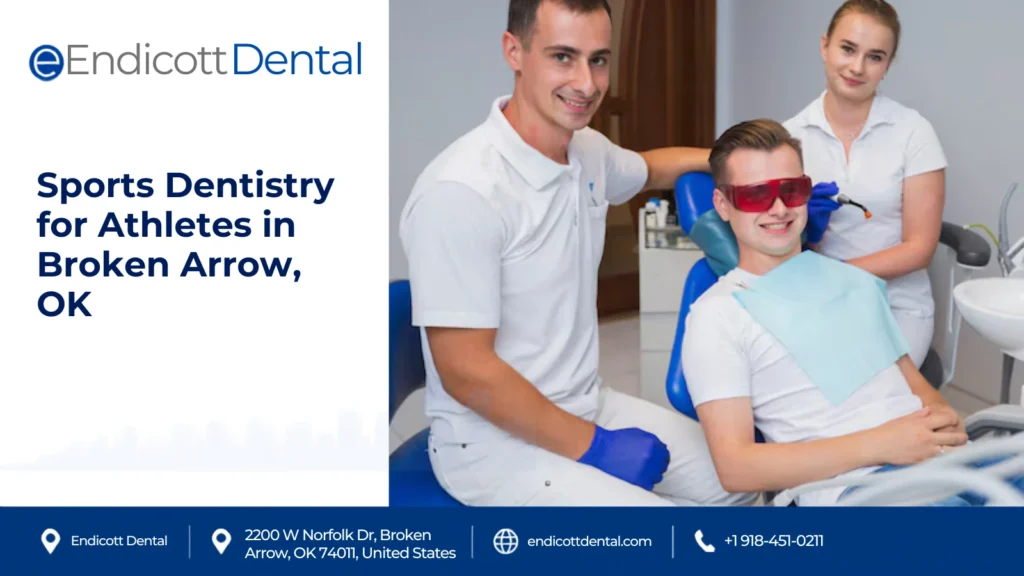
At Endicott Dental, our sports dentistry services include custom mouthguards, emergency evaluation of sports-related dental injuries, and treatment for damaged teeth when needed.
The Academy for Sports Dentistry also describes sports dentistry more broadly as involving proper mouthguard fabrication as well as the recognition and treatment of injuries involving teeth, soft tissues, the jaw, and temporomandibular joint.
That distinction matters.
Sports dentistry is not something an athlete needs only after getting hit.
The best sports dentistry often happens before an injury ever occurs.
Why Do We Offer Sports Dentistry in Broken Arrow?
The simple answer is that dental injuries are often preventable, while repairing a badly damaged tooth can be much more complicated than protecting it in the first place.
The American Dental Association recommends properly fitted mouthguards for sports and recreational activities where dental injuries are possible. Research summarized by the ADA has consistently supported mouthguards for reducing injuries to the teeth and surrounding oral structures.
We would rather help a Broken Arrow athlete protect a healthy front tooth today than have to rebuild that same tooth after an accident tomorrow.
Of course, no mouthguard makes someone invincible.
You can wear excellent protective equipment and still get hurt.
But sports are already full of risks you cannot completely control. If there is a practical step that can reduce one of those risks without interfering significantly with how you play, it deserves consideration.
We See Sports Dentistry as Preventive Dentistry
People usually associate preventive dentistry with cleanings, fluoride, brushing, flossing, and regular dental examinations.
Those things matter.
But prevention depends on the patient.
For an athlete, prevention may also mean protecting teeth from physical impact.
A perfectly healthy tooth can be damaged in a fraction of a second.
There does not have to be a cavity. There does not have to be gum disease. The athlete may have excellent oral hygiene.
One collision can still fracture that tooth.
That is why asking about sports participation should be part of thinking about an athlete's overall dental health.
The American Academy of Pediatric Dentistry specifically encourages dentists to educate patients and families about protective equipment, provide mouthguard protection for people at increased risk of oral and facial trauma, and support mouthguard use in organized sports with meaningful injury risk.
Who Should Consider a Sports Mouthguard?
Football is the obvious answer, but it is definitely not the only one.
If there is a realistic possibility of contact with another person, a ball, equipment, the ground, or another hard surface, there may be a reason to consider protecting your teeth.
That can include athletes participating in:
- Football
- Basketball
- Baseball and softball
- Wrestling
- Soccer
- Lacrosse
- Hockey
- Cheerleading
- Gymnastics
- Martial arts and combat sports
- Volleyball
- Skateboarding
- Cycling
- Other high-speed or contact recreational activities
Our sports dentistry service at Endicott Dental is designed for athletes participating in sports ranging from football and wrestling to baseball, basketball, soccer, cheer, lacrosse, and MMA.
The important question is not simply, "Does my league require a mouthguard?"
A better question is:
"Could I reasonably take an impact to my mouth while doing this activity?"
If the answer is yes, it is worth having the conversation.
A Mouthguard Can Make Sense Even When Your Sport Does Not Require One
This is where athletes sometimes get confused.
They assume that if a mouthguard is not mandatory, it must not be necessary.
Those are two different questions.
Sports organizations set minimum equipment requirements based on their own rules. Dental recommendations are based on the risk to your teeth and mouth.
The National Athletic Trainers' Association has noted that mouthguards are required in only certain organized sports even though dental and oral injuries can occur in many activities where mouthguards are not mandatory.
You do not need to wait for a rulebook to tell you that your front teeth are worth protecting.
Why Not Just Buy a Cheap Mouthguard at the Store?
You can.
And we want to be clear about that.
We are not going to tell every athlete that an over-the-counter mouthguard is useless just because we make custom ones.
A properly used store-bought guard may be a reasonable starting option, particularly when budget, timing, or access to dental care makes a custom guard impractical.
What matters is whether you will actually wear it and whether it provides appropriate coverage and stays in position.
The problem is that athletes frequently dislike bulky or poorly fitting guards.
If a guard moves constantly, makes communication difficult, triggers gagging, or feels uncomfortable, there is a greater chance it ends up attached to a helmet, shoved into a gym bag, or hanging halfway out of the athlete's mouth instead of being worn correctly.
What Is Different About a Custom Mouthguard?
A custom sports mouthguard is made around the athlete's own teeth rather than being manufactured as a one-size-fits-most appliance.
At Endicott Dental, custom mouthguards can be created using digital impressions or scans to provide a more individualized fit. Our goal is a guard that stays securely in place while remaining practical for breathing and communication during play.
The Academy for Sports Dentistry recommends properly fitted custom mouthguards and emphasizes several factors that should be considered when designing one, including:
- The athlete's dental condition
- Bite and jaw relationships
- Orthodontic or prosthetic appliances
- The sport being played
- Appropriate thickness
- Retention during impact
- Speech requirements
- Coverage of teeth and surrounding structures
The organization also recommends professional evaluation of the mouthguard's fit and function over time.
That is the real advantage.
The question is not whether a mouthguard says "custom" on the package.
The question is whether it fits your mouth and your sport.
Are Custom Mouthguards Worth the Additional Cost?
This depends on the athlete.
A custom guard costs more than picking up a basic stock or boil-and-bite mouthguard at a sporting-goods store.
There is no point pretending otherwise.
For a recreational athlete participating occasionally in a relatively low-risk activity, an appropriately fitted over-the-counter option may be enough.
For someone participating frequently in a contact or collision sport, someone who has previously suffered dental trauma, an athlete with orthodontic considerations, or someone who simply cannot tolerate a bulky store-bought guard, spending more for a properly fitted custom guard may make much more sense.
Think of it as an equipment decision.
Parents routinely spend money on helmets, pads, shoes, bats, gloves, uniforms, training, camps, and tournament fees.
Teeth are part of the athlete too.
That does not mean everyone needs the most expensive mouthguard available. It means protection should be evaluated based on actual risk rather than simply buying whatever happens to be cheapest.
Insurance coverage for mouthguards also varies by dental plan. If cost is a concern, ask the dental office for the actual price and whether your insurance offers any benefit before committing.
We would rather have that discussion upfront than leave you guessing.
Can a Sports Mouthguard Prevent a Concussion?
This is an important question, and it needs an honest answer.
You should not rely on a mouthguard as a concussion-prevention device.
Mouthguards have strong evidence supporting their role in reducing dental and orofacial injuries.
The evidence regarding concussion prevention is much less certain.
The ADA notes that research examining mouthguards and concussion reduction has produced mixed and inconsistent results. Some studies suggest a possible benefit, while others have not demonstrated a significant reduction. Further research is still needed.
The Academy for Sports Dentistry similarly supports continued research into whether properly fitted mouthguards can reduce concussion incidence while emphasizing their established role in protecting oral structures.
So we would never tell an athlete:
"Put this mouthguard in and you won't get a concussion."
That would be irresponsible.
Wear an appropriate mouthguard to protect your teeth and mouth. Use the helmet or head protection required for your sport. Follow concussion protocols. And if a significant head impact occurs, get appropriately evaluated.
Those are separate layers of protection.
What Dental Injuries Can Happen During Sports?
Some injuries look dramatic immediately.
Others seem minor at first and cause problems later.
That is one reason we encourage athletes to call after a meaningful dental impact even when they are unsure how serious it is.
Chipped Teeth
A small enamel chip may be mostly cosmetic.
A deeper fracture can expose more sensitive layers of the tooth and occasionally involve the dental pulp—the living tissue containing nerves and blood vessels.
Treatment depends on how much tooth structure was damaged.
A minor chip may need smoothing or bonding.
A larger fracture may require more extensive restoration.
Cracked or Fractured Teeth
Cracks can be tricky because they are not always obvious.
An athlete may notice:
- Pain when biting
- Sensitivity to cold
- A sharp edge
- Intermittent discomfort
- A visible line or missing piece of tooth
Some cracks are repairable. Others extend too deeply to predictably save the tooth.
The sooner we know what we are dealing with, the better we can explain the options.
Loose or Displaced Teeth
A tooth does not have to leave the mouth completely to suffer a serious injury.
An impact can push a tooth forward, backward, sideways, or deeper into its socket.
It may also become noticeably loose.
These injuries deserve prompt dental evaluation because treatment and prognosis depend on the type and severity of trauma.
Knocked-Out Teeth
A completely knocked-out permanent tooth is one of the clearest dental emergencies in sports.
This is not something to "see how it feels tomorrow."
Timing matters.
Guidelines from the International Association of Dental Traumatology and American Association of Endodontists emphasize immediate action for an avulsed permanent tooth.
What Should You Do If a Permanent Tooth Gets Knocked Out?
This is information every parent, coach, trainer, and athlete should know.
1. Find the Tooth
Pick it up carefully.
2. Hold It by the Crown
The crown is the white portion you normally see in the mouth.
Avoid handling the root.
3. If It Is Dirty, Rinse It Gently
Do not scrub the root.
Do not scrape it.
Do not clean it with soap, peroxide, alcohol, or household chemicals.
Current dental-trauma guidance recommends gentle rinsing using an appropriate solution such as milk, saline, or the patient's saliva when available.
4. For a Knocked-Out Permanent Tooth, Reposition It If Possible
If you are confident it is a permanent tooth and can safely do so, guidelines recommend immediate replantation when practical.
Gently place the tooth into the socket in the correct orientation and have the patient hold it in place by biting gently on gauze or another clean material.
Do not replant a knocked-out baby tooth.
5. If You Cannot Reinsert It, Keep It Moist
Milk is a practical storage option.
A dental tooth-preservation solution is another option when available.
The important point is not to allow the root to dry out.
6. Get to a Dentist Immediately
The American Association of Endodontists recommends acting quickly and, when possible, receiving professional care within about 30 minutes. Teeth may sometimes still be saved after longer periods, but quicker treatment generally offers a better opportunity.
At Endicott Dental, we offer same-day emergency appointments for sports-related dental trauma when availability allows, and we encourage patients to call immediately so we can help determine the appropriate next steps.
What If the Tooth Is Only Chipped and Does Not Hurt?
Still have it checked.
No pain does not automatically mean no damage.
Teeth can sustain fractures or trauma to the supporting structures without causing severe symptoms immediately.
Depending on the impact, we may simply examine the tooth and tell you everything looks stable.
That is a perfectly good outcome.
Not every sports injury requires a crown, root canal, or major dental procedure.
Sometimes monitoring really is the right treatment.
But we would rather make that decision after seeing the tooth than have an athlete assume everything is fine because it stopped hurting.
Why Athletes With Braces Need Extra Attention
Braces introduce another consideration.
A direct blow can injure the lips and cheeks against brackets and wires. Orthodontic movement also means the shape and position of the teeth are changing during treatment.
That can affect mouthguard fit.
If you or your child wears braces, do not simply assume an old mouthguard will continue fitting properly throughout treatment.
The Academy for Sports Dentistry specifically lists orthodontic appliances and developmental changes among the factors that should be considered when fitting an athletic mouthguard.
Talk with your dentist and orthodontic provider about an option that protects the teeth while allowing for expected movement.
Does a Custom Sports Mouthguard Last Forever?
No.
This is another area where we would rather set realistic expectations.
A mouthguard is protective equipment.
Protective equipment wears out.
How often it should be replaced depends on factors such as:
- Growth
- Changes in tooth position
- Orthodontic treatment
- Damage from chewing
- Material wear
- Changes to the athlete's bite
- How often the guard is used
- How demanding the sport is
Growing children and teenagers may need new guards more frequently because their mouths are changing.
An adult athlete with a stable bite may be able to use a well-maintained guard for longer.
The Academy for Sports Dentistry recommends routine professional examination of custom mouthguards, with the frequency determined according to factors such as the athlete's age, sport, and care of the appliance.
Replace a Mouthguard That No Longer Fits Properly
If the athlete has to bite down constantly just to hold the mouthguard in place, something is wrong.
The same applies if it:
- Has become loose
- Is visibly torn
- Has developed deep bite marks
- Feels dramatically tighter than before
- Causes irritation
- No longer fully covers the intended teeth
- Has changed after major dental or orthodontic treatment
Do not keep using worn-out protective equipment simply because it technically still fits in the mouth.
How Should Athletes Care for a Sports Mouthguard?
A good mouthguard still needs basic maintenance.
After use:
- Rinse it thoroughly.
- Clean it gently according to your dentist's instructions.
- Allow it to dry appropriately.
- Keep it in a ventilated protective case.
- Do not leave it sitting in a hot car or near another heat source, because heat can distort some mouthguard materials.
- Bring it to dental appointments periodically so the fit and condition can be checked.
And please do not toss a wet mouthguard loose into the bottom of a gym bag for three months and expect it to remain pleasant.
Protective equipment needs maintenance too.
Sports Dentistry Is Not Only for Elite Athletes
One misconception we would like to get rid of is the idea that sports dentistry is something only professional or college athletes need.
It is not.
In many ways, youth athletes can benefit even more from developing good habits early.
A middle-school basketball player has teeth worth protecting.
So does a high-school wrestler.
So does a recreational soccer player.
So does the 38-year-old Broken Arrow parent who plays in a weekend league and still believes every loose ball is Game 7 of the NBA Finals.
Your level of competition does not determine the value of your teeth.
Risk does.
When Is a Store-Bought Mouthguard Probably Enough?
There are situations where we may tell you that you do not necessarily need to spend more money on a custom appliance.
If an athlete:
- Participates infrequently,
- Has relatively low exposure to contact,
- Has no complicated dental or orthodontic considerations,
- Has found an appropriately fitted over-the-counter mouthguard,
- And reliably wears it,
then continuing to use that protection may be reasonable.
The goal is not to sell every athlete a dental appliance.
The goal is to reduce avoidable injuries.
If what you already have is comfortable, appropriately protective, and consistently worn, tell us.
We can help you evaluate it.
When Does a Custom Mouthguard Make More Sense?
We are more likely to recommend discussing a custom option when an athlete:
- Regularly participates in a contact or collision sport
- Has previously experienced dental trauma
- Cannot tolerate standard mouthguards
- Constantly chews through inexpensive guards
- Struggles to keep a guard securely positioned
- Needs to communicate frequently during play
- Has unusual bite or dental considerations
- Has restorative dental work that needs appropriate protection
- Has orthodontic treatment requiring special consideration
- Wants a more individualized fit for frequent training and competition
This is where sports dentistry should become personal.
We are not protecting a theoretical athlete.
We are protecting your teeth during your sport.
Why Does Dr. Endicott's Athletic Background Matter?
Being a former athlete does not automatically make someone a better dentist.
We want to be careful not to make that claim.
What it does provide is perspective.
Dr. Drew Endicott grew up playing sports, competed in college baseball, and later reached professional baseball in the Kansas City Royals organization before entering dentistry.
He understands that athletes care about questions such as:
"Will this interfere with breathing?"
"Can I talk while wearing it?"
"How soon can I get back to practice?"
"Do I really need this?"
"What happens if I get hit again?"
Those are reasonable questions.
Sports dentistry works best when the dentist respects the athlete's priorities while still being clear about the risks.
Our goal is not to tell athletes to stop competing.
It is to help them compete more intelligently.
Why Waiting After a Dental Sports Injury Can Be a Bad Idea
Athletes are trained to push through discomfort.
That can be useful on the field.
It is not always useful with dental trauma.
Waiting is particularly concerning when:
- A permanent tooth has been knocked out
- A tooth has moved from its normal position
- A tooth is significantly loose
- A large portion of the tooth fractured
- The bite suddenly feels different
- Bleeding will not stop
- There is significant swelling
- There may be a jaw injury
- Pain becomes severe
- The athlete has signs of a head injury
A dentist handles the dental side of the injury.
Possible concussion, loss of consciousness, severe facial trauma, uncontrolled bleeding, difficulty breathing, or suspected jaw fracture may require emergency medical evaluation as well.
Do not let concern about finishing the game delay appropriate care.
There will be another game.
You only get one set of permanent teeth.
Is Sports Dentistry Really Worth Thinking About Before the Season Starts?
Yes—because the middle of an emergency is a terrible time to learn your plan.
Before the season, know:
- Whether your athlete should wear a mouthguard
- Whether the current mouthguard still fits
- Where emergency dental care is available
- What to do if a permanent tooth is knocked out
- Who coaches or trainers should contact
- Whether recent dental or orthodontic treatment changes the athlete's protection needs
You hope none of this information ever becomes necessary.
That is exactly the point.
Preparation is useful because injuries are unpredictable.
What We Want Broken Arrow Athletes to Know
If there is one idea we want you to take away from this article, it is this:
Sports dentistry is less about fixing athletes after accidents and more about making smarter decisions before those accidents happen.
Mouthguards cannot prevent every injury.
Custom mouthguards are not necessary for every single person.
A mouthguard cannot guarantee protection from concussion.
And sometimes, despite doing everything correctly, an athlete will still chip, crack, loosen, or lose a tooth.
But preventable dental injuries are frustrating because, in hindsight, the protection is often much simpler than the repair.
That is why we offer sports dentistry.
Protect the Smile You Compete With at Endicott Dental
Broken Arrow has athletes at every level—from kids playing their first organized season to high-school competitors, college athletes, weekend warriors, runners, martial artists, and adults who have no intention of giving up the sports they love.
At Endicott Dental, our job is not to talk you out of playing.
It is to help you understand how to protect your teeth while you do it.
If you are wondering whether you or your child actually needs a custom mouthguard, bring the question to us. We can look at the sport, age, teeth, bite, existing dental work, orthodontic needs, and current mouthguard and tell you what makes sense.
Sometimes that may mean a custom sports mouthguard.
Sometimes the guard you already have may be sufficient.
And if an injury has already happened, the priority changes from prevention to getting the tooth evaluated quickly and understanding what can realistically be saved or repaired.
If you are a local athlete or parent and you are not sure what protection makes sense, Endicott Dental can help you understand your options before you commit to treatment or equipment.
Frequently Asked Questions About Sports Dentistry
What does a sports dentist do?
Sports dentistry focuses on preventing and treating injuries involving the teeth, mouth, and surrounding oral structures during athletic activities. It may include custom mouthguards, emergency dental care, evaluation of loose or displaced teeth, and repair of chipped, cracked, or missing teeth.
Do I need a custom mouthguard for basketball?
Not every basketball player needs a custom mouthguard, but basketball does involve collisions, elbows, falls, and other opportunities for facial injury. A properly fitted mouthguard may be worth considering, particularly for frequent or competitive players.
Is a custom mouthguard better than a boil-and-bite guard?
A dentist-made custom guard can be designed specifically around your teeth, bite, sport, and dental circumstances. That often improves retention and comfort. However, a properly fitted over-the-counter guard may still be reasonable for some athletes. The important thing is choosing appropriate protection that you will consistently wear.
Can children get custom sports mouthguards?
Yes. Children and teenagers who participate in sports can use custom mouthguards. Because their teeth and jaws are still developing, their mouthguard fit should be checked regularly and replacement may be needed as they grow.
Can you make a mouthguard if I have braces?
Athletes with braces can wear mouthguards, but their changing tooth positions and orthodontic appliances require additional consideration. Ask your dentist and orthodontic provider which design makes sense for your stage of treatment.
Does a mouthguard prevent concussions?
A mouthguard should not be treated as a guarantee against concussion. Evidence strongly supports mouthguards for reducing dental and oral injuries, while research on concussion prevention remains mixed. Athletes should continue using all recommended head protection and follow proper concussion evaluation protocols.
What should I do if my permanent tooth gets knocked out playing sports?
Pick the tooth up by the crown rather than the root. If dirty, rinse it gently without scrubbing. When appropriate, an avulsed permanent tooth should ideally be replanted immediately; otherwise keep it moist in an appropriate storage medium such as milk and seek emergency dental care immediately. Do not replant a knocked-out baby tooth.
How quickly should I see a dentist after a knocked-out tooth?
Immediately. The American Association of Endodontists recommends attempting to obtain professional treatment within approximately 30 minutes when possible. Faster treatment can improve the opportunity to save a permanent tooth.
Should I see a dentist for a small chipped tooth if it does not hurt?
Yes, it is worth having the tooth evaluated. A tiny superficial chip may require little or no treatment, but an examination can determine whether the damage extends deeper than it appears.
How often should a sports mouthguard be replaced?
There is no universal replacement schedule. Growing athletes, people undergoing orthodontic treatment, and athletes who chew or heavily wear their guards may need replacements more frequently. Have the fit and condition checked periodically and replace the guard when it becomes damaged, loose, uncomfortable, or no longer fits correctly.
Can adults benefit from sports dentistry?
Absolutely. Sports dentistry is based on injury risk, not age or competition level. Adult recreational athletes participating in basketball, martial arts, cycling, soccer, softball, hockey, or other activities may benefit from mouth protection as well.
Does Endicott Dental treat sports-related dental emergencies?
Yes. Endicott Dental's sports dentistry services include evaluation and treatment of dental trauma such as chipped, cracked, loose, displaced, and knocked-out teeth, with same-day emergency appointments available when possible.
