

Table of Contents
The best way to find a genuinely family-owned dentist is to look beyond the office name and verify who owns the practice, who provides the care, and whether the same dentist is consistently involved in treatment decisions. An About page, dentist biography, local business information, patient reviews, and a direct question to the office can usually tell you much more than the logo.
At Endicott Dental, we understand why patients ask. Dental practices can look local even when ownership or management happens somewhere else. Knowing who is behind the practice can help you choose the environment that feels right for your family.
What Does “Family-Owned Dentist” Actually Mean?
The phrase can mean slightly different things from one dental practice to another.
In the most straightforward sense, a family-owned or dentist-owned practice is one where the dentist or family operating the office maintains ownership and has a direct role in how the practice is run.
That might mean the dentist:
- Owns the practice
- Works in the office regularly
- Chooses the clinical team
- Makes treatment and technology decisions
- Develops long-term relationships with patients
- Remains directly involved in the community
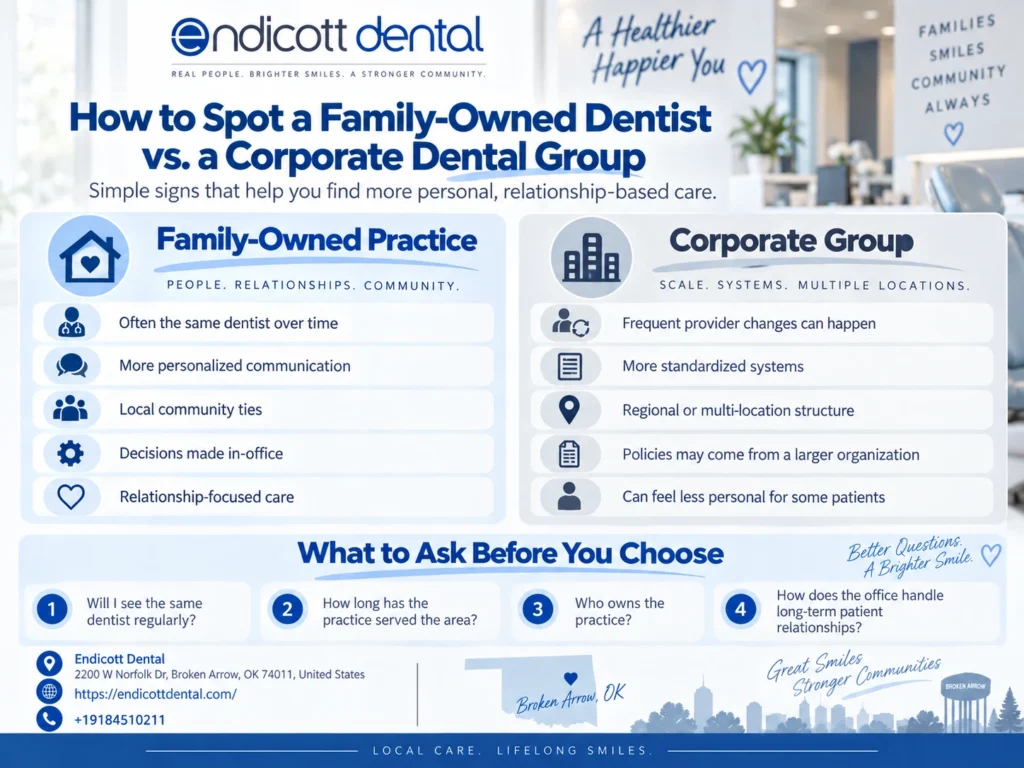
A corporate dental group may operate differently. Multiple offices can share management, branding, staffing resources, financial systems, marketing, or administrative functions.
That distinction does not automatically tell you whether the dental care will be good or bad.
Large dental organizations can employ excellent dentists, and independent practices can vary in quality just like any other healthcare business.
The point is transparency.
If having a locally owned dental office matters to you, you should be able to determine who owns and operates the practice before becoming a patient.
Why Is It Getting Harder to Tell Whether a Dentist Is Locally Owned?
Dental branding has changed.
A practice does not need to have a national chain name to belong to a larger dental organization.
An office may continue operating under the same community-focused name after ownership or management changes. Its website may still show local landmarks, individual dentists, and language about serving local families.
From a patient's perspective, it can therefore look almost identical to an independently owned practice.
This is why looking only at the practice name is not enough.
Names such as:
- Family Dentistry
- Hometown Dental
- Community Dental
- Dental Associates
- Neighborhood Dentistry
do not establish who actually owns the business.
You need to look a little deeper.
1. Start With the Dentist's “About” Page
One of the easiest places to start is the dental practice website.
Look for an About page, dentist biography, or practice history.
A genuinely locally owned dental practice will often be specific about:
- Who founded the office
- When the practice opened
- Who currently owns it
- How long the dentist has practiced locally
- Why the dentist chose the community
- Whether the owner actually treats patients there
Specific details are more useful than generic phrases such as:
“We treat you like family.”
Almost any dental office can use that language.
What matters is whether the website identifies the people who actually own and operate the practice.
For example, Endicott Dental identifies itself as a family-run and family-owned dental office in Broken Arrow and states that the practice has served the community since 2016.
That is substantially more specific than simply describing the office as “family friendly.”
2. Look for a Named Dentist Who Is Consistently Present
Another useful clue is continuity.
Ask yourself:
Is there a specific dentist clearly associated with this practice?
Independent practices frequently have an owner-dentist whose name and professional story are closely connected to the office.
You may see:
- A detailed biography
- Photos with the team
- Years of service in the community
- Information about professional training
- Patient testimonials mentioning the dentist by name
- The same dentist appearing across several years of reviews
Endicott Dental, for example, identifies Dr. Endicott directly throughout its website and describes his approach to caring for Broken Arrow patients.
That type of continuity gives patients a clearer idea of who is responsible for their care.
3. Ask the Office Directly Who Owns the Practice
Sometimes the easiest method is simply asking.
You can call the dental office and say:
“Is the practice independently owned by the dentist, or is it part of a larger dental organization?”
A clear question deserves a clear answer.
You do not need to make the conversation confrontational.
You are simply gathering information before selecting a healthcare provider.
You could also ask:
- Does the dentist working here own the practice?
- How long has the current owner been here?
- Is this your only location?
- Are treatment decisions made by the dentist in this office?
- Is the practice affiliated with a larger dental organization?
If local ownership is important to your family, these are perfectly reasonable questions.
4. Check Whether the Dentist's Name Matches the Practice History
Practice histories can reveal a lot.
Suppose a website claims the office has served a community for 25 years but the featured dentist joined six months ago.
That is not automatically a problem.
The practice may simply have changed ownership.
But it is worth understanding what “25 years serving the community” actually means.
Was the current dentist there during those years?
Did the office recently change ownership?
Was the original practice acquired but allowed to retain its old name?
Look for timelines and specific names instead of relying only on the age of the business.
5. Read Patient Reviews for Continuity
Reviews can provide useful clues about how a dental office operates.
Do not look only at the star rating.
Read older and newer reviews.
Pay attention to whether patients repeatedly mention the same:
- Dentist
- Hygienists
- Front-office team members
- Treatment philosophy
- Communication style
Long-term patients frequently say things such as:
- “Our family has gone here for years.”
- “Dr. ___ has treated all of my children.”
- “I've been seeing the same dentist for a decade.”
- “The staff knows our whole family.”
That kind of continuity can indicate a stable local practice.
Endicott Dental's website, for example, includes patient comments describing families who have remained with Dr. Endicott for several years.
Reviews should not be treated as proof of ownership, but they can help confirm whether the practice operates with the continuity you are looking for.
6. Search the Dentist's Name, Not Just the Practice Name
When researching a dental office, search the actual dentist.
For example:
“Dr. Jane Smith dentist Broken Arrow”
rather than only:
“Best dentist near me.”
Look for consistency across:
- The practice website
- Google Business Profile
- Professional biographies
- Dental association listings
- State licensing information
- Previous practices
- Local news or community involvement
If the same dentist has a long history connected to the practice and community, it becomes easier to understand who you are actually choosing.
7. Look Up the Dentist's Professional License
Dental licenses are generally issued at the state level.
A state dental board lookup can help confirm basic information such as:
- Dentist name
- License status
- Professional credentials
- Licensing history
A license lookup will not necessarily tell you who owns the dental office, but it can help verify that the dentist presented on the website is an actively licensed practitioner.
This is especially useful when researching an unfamiliar practice.
8. Check Business Records When Ownership Really Matters to You
If independent ownership is one of your highest priorities, public business records can sometimes provide additional information.
Secretary of State business databases may show the legal entity associated with a practice.
Depending on the state and business structure, records may include:
- Business entity name
- Registration date
- Registered agent
- Business status
- Filing information
These records are not always simple to interpret.
A dental office can operate under a trade name that differs from its legal entity, and a registered agent does not necessarily equal the owner.
Still, public business information can be useful when combined with other evidence.
Think of it as another clue rather than a single definitive test.
9. Pay Attention to the Website Footer
The bottom of the website can sometimes tell you something the homepage does not.
Look for:
- A corporate parent name
- Copyright ownership
- Links to multiple brands
- A management company
- Careers pages covering dozens of states
- Privacy policies referencing another organization
Again, none of these things means the practice provides poor care.
They simply help answer the ownership question.
If the practice describes itself as completely independent but its legal pages repeatedly reference a different national dental organization, it may be worth asking the office about that relationship.
10. Check the Careers Page
This is an overlooked trick.
A dental office website may look extremely local while its job listings connect to a much larger organization.
Click Careers and see where it goes.
Does it show:
- One local office?
- Several nearby offices owned by the same dentist?
- Dozens or hundreds of offices nationwide?
Recruitment pages can reveal organizational relationships that are less obvious on patient-facing pages.
11. Look at How Many Locations Share the Same Branding
Multiple locations do not automatically mean corporate ownership.
A dentist may own several offices.
A family may operate multiple practices.
Still, a large network deserves a closer look if independent ownership matters to you.
Search the practice name with phrases such as:
- “locations”
- “our offices”
- “careers”
- “parent company”
- “dental group”
If you discover 75 offices across multiple states, you have learned something important about the organization regardless of how locally branded the individual office appears.
12. Ask Who Will Actually Treat You
Ownership matters to some patients, but continuity of care may matter even more.
Before joining a practice, ask:
“Will I normally see the same dentist?”
Some patients prefer having one dentist follow their oral health over many years.
That continuity can help a dentist become familiar with:
- Your dental history
- Previous restorations
- Gum health
- Bite changes
- Dental anxiety
- Cosmetic priorities
- Previous treatment decisions
Endicott Dental describes its general dentistry approach as personalized care for children, teenagers, and adults, with family-friendly scheduling available for patients who want appointments together or back-to-back.
For families, that type of continuity can simplify dental care considerably.
13. Pay Attention to How Treatment Options Are Explained
One concern patients sometimes have when comparing dental practices is whether recommendations feel individualized.
Regardless of ownership structure, a good dental experience should include clear answers to questions such as:
- What is wrong?
- Does it need treatment now?
- What happens if I wait?
- Are there alternatives?
- What does treatment cost?
- What will insurance likely cover?
- Can I see the X-ray or photo?
- Why are you recommending this option?
Patients should understand what they are agreeing to.
Endicott Dental states that its approach includes transparent treatment discussions and payment options without pressuring patients during financing conversations.
That kind of communication may matter more to your experience than the size of the company behind the practice.
14. Do Not Assume “Corporate” Automatically Means Bad Care
It is worth being fair about this distinction.
A corporate dental office can have:
- Talented dentists
- Experienced hygienists
- Excellent technology
- Strong clinical protocols
- Convenient hours
- Multiple locations
- Specialized services
Likewise, being privately owned does not automatically guarantee outstanding dentistry.
Ownership tells you how a practice is structured.
It does not replace evaluating:
- Dentist qualifications
- Communication
- Treatment philosophy
- Patient safety
- Technology
- Reviews
- Pricing transparency
- Comfort
- Clinical results
Choosing a dentist should involve the whole picture.
15. Do Not Confuse “Family Dentistry” With “Family-Owned”
These phrases sound similar but mean different things.
Family Dentistry
Usually means the office treats patients across different age groups, potentially including children, teenagers, adults, parents, and grandparents.
Family-Owned Dentistry
Describes the ownership or operation of the dental practice.
A corporate practice can provide family dentistry.
A family-owned practice can also focus primarily on adults.
So if ownership matters to you, do not assume the phrase “family dentist” answers the question.
Ask directly.
What Are the Potential Advantages of Choosing a Family-Owned Dental Practice?
Every office operates differently, but patients who specifically seek independent practices often value several characteristics.
Familiar Faces
A stable owner-dentist may remain with the practice for many years.
Long-Term Relationships
The same dentist may care for several generations of one family.
Local Decision-Making
Practice decisions may be made directly by the dentist and team working in the office.
Community Connection
Locally owned dentists may live, work, raise families, sponsor organizations, and participate in the same community as their patients.
Consistency
Patients who prefer seeing the same dentist may find that model appealing.
These are possible benefits rather than guarantees.
The quality of the individual practice still matters.
What Should You Ask Before Choosing a New Dentist?
You do not need to perform an investigation worthy of a documentary.
A few questions can tell you a lot:
- Who owns the dental practice?
- Will I normally see the same dentist?
- How long has the dentist practiced here?
- How do you explain treatment alternatives?
- Can I review costs before treatment?
- Do you treat adults and children?
- What happens if I have a dental emergency?
- What comfort or sedation options are available?
- Can my family schedule appointments together?
The answers should give you a good sense of how the practice operates.
How Can You Tell Whether a Dentist Is Really Local?
There is no single test.
Look for several signals working together:
Named local owner + established practice history + consistent dentist + stable team + clear contact information + local patient reviews + direct confirmation from the office.
The more evidence you can verify, the easier the decision becomes.
A vague website combined with unclear ownership, constantly changing providers, and an unwillingness to answer basic questions may deserve further research.
FAQs About Finding a Family-Owned Dentist
How can I tell if a dentist is independently owned?
Start with the practice website and identify the dentist or owners. Then check the dentist's professional history, public business information when necessary, patient reviews, and ask the office directly whether it is independently owned.
Does “family dentist” mean the office is family-owned?
No. “Family dentistry” generally describes the types of patients an office treats. It does not necessarily describe who owns the business.
Are dental chains worse than independent dentists?
Not automatically. Quality varies among both independently owned and corporate practices. Evaluate the individual dentist, communication, treatment recommendations, transparency, and overall patient experience.
Why do some corporate dental offices have local names?
Ownership and management structures can change while a practice continues using an established local brand. That is one reason patients should verify ownership rather than rely on the name alone.
Is Endicott Dental family-owned?
Yes. Endicott Dental identifies itself as a family-run and family-owned dental practice serving Broken Arrow since 2016.
Does Endicott Dental see entire families?
Yes. Endicott Dental provides general dentistry for children, teens, and adults and offers family-friendly scheduling options for households that prefer coordinated appointments.
Looking for a Family-Owned Dentist in Broken Arrow?
Finding a family-owned dentist requires looking past slogans and finding out who actually stands behind the practice.
Check the dentist's story. Read reviews from long-term patients. Look at the practice history. Ask who owns the office and whether you can expect continuity with the same dentist. Most importantly, pay attention to whether the team communicates clearly and treats you as an individual rather than simply moving you through an appointment.
Endicott Dental has been family-run and family-owned in Broken Arrow since 2016. Dr. Endicott and our team provide preventive, restorative, cosmetic, implant, orthodontic, denture, emergency, and sedation dentistry while focusing on long-term relationships with the families we serve.
If you are looking for a dental home where you can know who is caring for you and build a relationship with the team over time, we would be happy to meet you.
