

Table of Contents
If you've ever stood in the dental aisle staring at a Waterpik display and wondered:
"Can this replace flossing?"
You're not alone.
It's one of the most common questions we hear from patients at Endicott Dental.
And honestly, it's easy to understand why.
A Waterpik feels easier. It's faster. It's less awkward. And for people with braces, implants, crowns, or tight teeth, it can feel like a miracle compared to wrestling with string floss every night.
But here's the answer most people don't want to hear:
For most patients, the best choice isn't Waterpik or floss. It's Waterpik and floss.
Let's talk about why.
Fast Answer
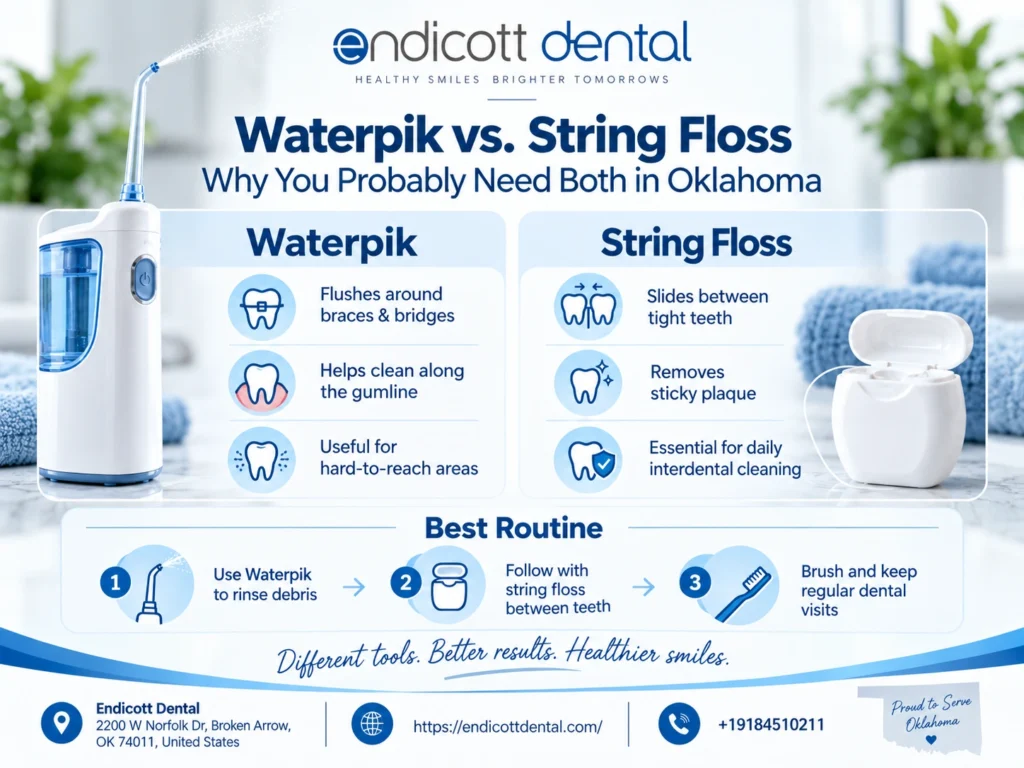
A Waterpik is excellent at flushing away food particles, plaque, and bacteria below the gumline.
String floss is excellent at physically scraping plaque off the sides of teeth.
They do different jobs.
If you're trying to build the healthiest smile possible, especially if you have gum disease, dental work, or crowded teeth, using both often provides the best results.
Why This Matters More Than Most People Realize
Many people think flossing is about removing food.
That's only part of the story.
The real goal is removing plaque.
Plaque is a sticky bacterial film that constantly forms on your teeth.
If it stays there long enough, it can lead to:
- Cavities
- Gum inflammation
- Bad breath
- Gum disease
- Bone loss
- Tooth loss
The challenge is that plaque loves to hide between teeth where your toothbrush can't reach.
That's where flossing and Waterpiks come into play.
What String Floss Does Better
Think of plaque like peanut butter stuck on a countertop.
Water alone might rinse some of it away.
But if you really want it gone, you need to wipe or scrub the surface.
That's what floss does.
String floss physically rubs against the tooth surface and removes plaque that's attached to the enamel.
This is one reason dentists have recommended flossing for generations.
When used correctly, floss:
- Cleans between teeth
- Removes sticky plaque
- Helps prevent cavities between teeth
- Reduces gum inflammation
- Reaches areas your toothbrush misses
The downside?
Many people don't do it correctly.
Or consistently.
Or at all.
What a Waterpik Does Better
A Waterpik uses a pressurized stream of water to clean around teeth and below the gumline.
It's especially effective at reaching places that can be difficult with floss alone.
Many patients love Waterpiks because they:
- Feel easier to use
- Remove trapped food effectively
- Reach around braces
- Clean around implants
- Flush bacteria from gum pockets
- Help reduce bleeding and inflammation
For patients with orthodontics, crowns, bridges, implants, or periodontal issues, a Waterpik can be a tremendous tool.
In many cases, patients who hate flossing become far more consistent with a Waterpik.
And consistency matters.
Where the Waterpik Falls Short
This is where some marketing claims can become misleading.
A Waterpik is excellent at flushing.
It's less effective at scraping.
Remember that peanut butter example?
The water removes some debris.
But it doesn't always remove every bit of sticky plaque attached to the tooth surface.
That's why many dental professionals still recommend traditional floss as part of a complete home care routine.
The Waterpik is powerful.
But it's not magic.
Why Oklahoma Patients Often Benefit From Both
Here in Oklahoma, we see many patients dealing with factors that increase their risk for gum disease and dental problems.
Common issues include:
- Dry mouth
- Orthodontic treatment
- Crowded teeth
- Existing dental work
- Early gum disease
- Busy lifestyles that make oral hygiene inconsistent
For these patients, combining Waterpik use with flossing often creates a more complete cleaning routine.
Think of it like this:
Floss Removes
- Sticky plaque
- Bacteria attached to teeth
- Debris between tight contacts
Waterpik Flushes
- Food particles
- Loose plaque
- Bacteria below the gumline
- Areas around dental work
Different tools.
Different strengths.
Better together.
What If You're Only Going to Use One?
Let's be realistic.
Some people aren't going to floss and Waterpik every day.
If that's you, the best tool is often the one you'll actually use consistently.
A patient who uses a Waterpik every night may achieve better results than someone who owns floss but never touches it.
Likewise, someone who flosses thoroughly every day is doing something far better than nothing.
Perfection isn't the goal.
Consistency is.
Who Benefits Most From a Waterpik?
You may want to strongly consider a Waterpik if you have:
Braces
Cleaning around brackets and wires becomes much easier.
Dental Implants
Water flossers can help clean hard-to-reach areas around implants.
Bridges
Water can access spaces traditional floss struggles to reach.
Gum Disease
Many periodontal patients benefit from the additional cleaning below the gumline.
Arthritis or Dexterity Challenges
A Waterpik may be significantly easier to use than traditional floss.
Common Mistakes We See
Using a Waterpik Instead of Brushing
You still need to brush.
Flossing Only Before Dental Appointments
Your gums know the difference.
Assuming No Bleeding Means Healthy Gums
Gum disease can exist even when symptoms are subtle.
Stopping When Bleeding Starts
In many cases, mild bleeding is a sign the gums need more consistent cleaning not less.
What Dr. Endicott Recommends Most Often
For many patients, the ideal routine looks something like this:
- Brush twice daily
- Floss once daily
- Use a Waterpik once daily
- Attend regular dental cleanings and exams
That doesn't mean every patient needs every tool.
But when patients ask whether they should choose floss or a Waterpik, the answer is often:
Why choose?
They work differently and complement each other extremely well.
The Bottom Line
The Waterpik versus floss debate is a little like asking whether a vacuum is better than a mop.
They solve different problems.
String floss excels at removing plaque attached to the sides of teeth.
A Waterpik excels at flushing bacteria and debris from areas traditional floss may miss.
For many patients in Broken Arrow, especially those with braces, implants, crowns, or gum disease concerns, using both provides the most thorough cleaning.
The goal isn't winning an argument between two oral hygiene tools.
The goal is keeping your teeth and gums healthy for decades to come.
FAQs
Can a Waterpik completely replace floss?
For most patients, no. A Waterpik is an excellent supplement, but traditional floss still provides mechanical plaque removal that water alone cannot fully replicate.
Is a Waterpik worth the money?
For many patients, especially those with braces, implants, bridges, or gum disease, a Waterpik can be a valuable investment in oral health.
What if I hate flossing?
You're not alone. If a Waterpik helps you maintain a more consistent cleaning routine, that's a positive step. Many patients find success using both.
Is a Waterpik good for gum disease?
Many studies suggest water flossers can help reduce gum inflammation and improve gum health when used as part of a comprehensive oral hygiene routine.
Should kids use a Waterpik?
Some older children and teens, particularly those with braces, may benefit from a Waterpik. Parents should discuss the best oral hygiene routine with their dentist.
If you're wondering whether a Waterpik, floss, or another oral hygiene tool makes the most sense for your specific situation, Dr. Drew Endicott and the team at Endicott Dental can help you build a routine that actually works in real life not just in a toothpaste commercial.
