

Table of Contents
Nobody wants to hear they need a crown.
Most patients hear the estimate and immediately ask:
"Can't we just do a filling instead?"
It's a reasonable question.
After all, a filling might cost a few hundred dollars, while a crown can cost $1,200 or more depending on the tooth, materials, and insurance coverage.
On the surface, the filling seems like the obvious money-saving choice.
But here's what many patients discover the hard way:
The cheapest treatment today isn't always the least expensive treatment long-term.
At Endicott Dental, Dr. Drew Endicott frequently helps patients understand the difference between a tooth that can safely be restored with a filling and one that's reached the point where a crown is the more predictable and often more economical solution.
The Fast Answer
A filling is usually the more affordable option when a tooth has a small to moderate amount of damage.
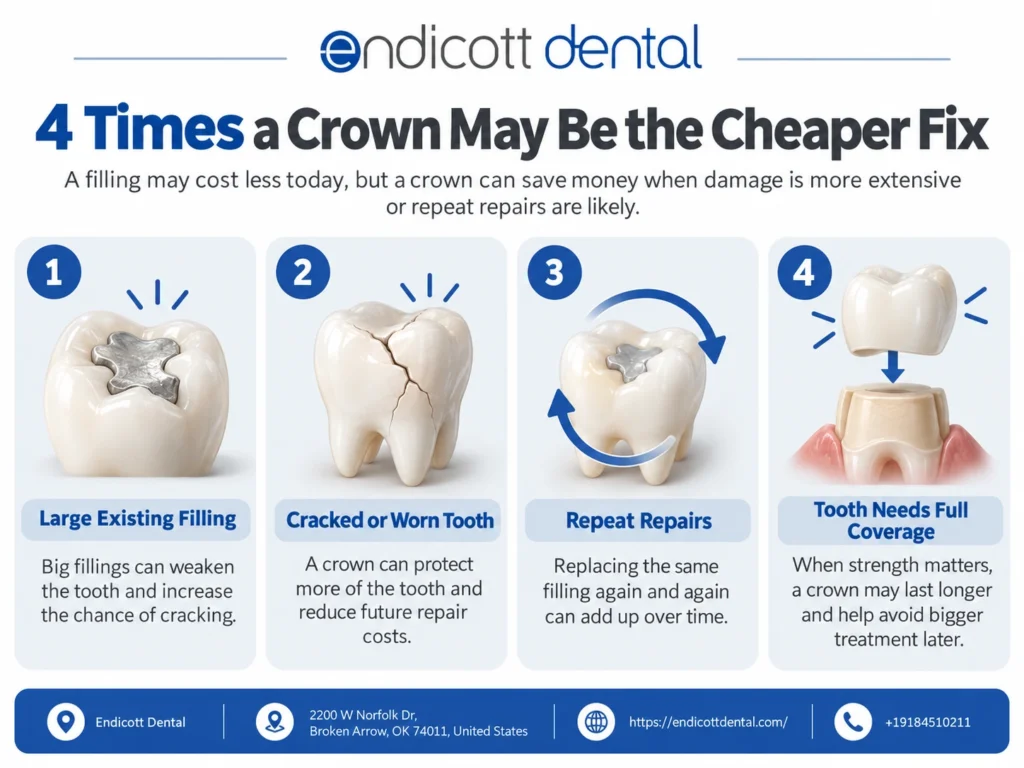
A crown is often the better investment when a tooth has lost significant structure, has a large existing filling, is cracked, or has undergone root canal treatment.
While a crown costs more upfront, it may prevent future fractures, root canals, extractions, and replacement dentistry that can ultimately cost much more.
The real question isn't:
"Which treatment costs less today?"
It's:
"Which treatment gives this tooth the best chance of lasting?"
What Is the Difference Between a Filling and a Crown?
A filling repairs a damaged portion of a tooth.
The dentist removes decay and fills the affected area with restorative material.
The rest of the tooth remains largely untouched.
A crown is different.
A crown covers the entire visible portion of the tooth like a protective helmet.
It's designed to strengthen teeth that have become too weak for a filling alone.
Think of it this way:
A Filling Repairs a Problem
A Crown Protects a Tooth From Future Problems
That's a major distinction.
When a Filling Usually Makes Sense
Most dentists prefer fillings when possible.
Why?
Because preserving natural tooth structure is generally a good thing.
A filling may be appropriate when:
- The cavity is relatively small
- Most of the tooth remains healthy
- The tooth isn't cracked
- Existing restorations are limited
- The tooth can still withstand normal chewing forces
In these situations, a crown would often be unnecessary.
And a good dentist should tell you that.
When a Crown Starts Making More Sense
There comes a point where a filling becomes less predictable.
The tooth may technically be repairable.
But that doesn't mean it's the best long-term decision.
Large Existing Fillings
One of the most common situations involves old fillings.
Imagine a tooth where:
- 60–70% of the chewing surface is already filling material
- The remaining tooth structure is thin
- New decay has developed around the edges
Could another filling be placed?
Possibly.
Would that be the strongest solution?
Probably not.
At some point, the remaining natural tooth becomes the weak link.
Cracked Teeth
This is where crowns often shine.
A filling doesn't hold a cracked tooth together.
A crown can help protect the tooth from further separation during chewing.
Without that protection, small cracks can become larger cracks.
And larger cracks sometimes become:
- Root canals
- Tooth loss
- Extractions
Teeth After Root Canal Treatment
This is one of the biggest areas of confusion.
Many patients think:
"The root canal fixed the tooth."
The infection may be gone.
But the tooth itself is often weaker afterward.
Root canal-treated teeth can become more brittle over time.
That's one reason crowns are frequently recommended afterward.
The goal isn't to sell another procedure.
The goal is to protect the investment you've already made.
The $300 Filling That Becomes a $4,000 Problem
Let's look at a hypothetical example.
A patient chooses a filling because it's cheaper today.
The tooth already has:
- A large cavity
- Existing restorations
- Thin remaining walls
The filling works.
For a while.
Then the tooth fractures.
Now treatment may involve:
- A crown
- A root canal
- A crown lengthening procedure
- Or even an extraction and implant
What started as an attempt to save money can quickly become much more expensive.
This is why dentists often think in terms of risk, not just cost.
The Most Common Misunderstanding
Patients often believe crowns are recommended because dentists prefer expensive treatment.
In reality, many dentists would rather preserve a tooth with a filling when it's appropriate.
The challenge is that some teeth simply outgrow fillings.
The question becomes:
"Can this tooth survive long-term with a filling?"
Not:
"Can a filling physically be placed today?"
Those are very different questions.
When a Filling Is Actually the More Expensive Choice
A filling may become the more expensive option when:
- The tooth has a crack
- Most of the tooth is already filling material
- A root canal has been completed
- Chewing forces are high
- The tooth is structurally compromised
In these situations, choosing a filling may increase the likelihood of future failure.
Not always.
But often enough that it's worth discussing.
What About Insurance?
Insurance can complicate the conversation.
Some patients discover:
- A filling has lower out-of-pocket costs
- A crown has higher out-of-pocket costs
Naturally, they gravitate toward the filling.
But insurance doesn't determine which treatment is best.
Insurance determines what the policy contributes.
Those aren't the same thing.
A treatment that costs less today may still cost more over the life of the tooth.
Questions to Ask Before Choosing
If you're deciding between a filling and a crown, ask:
How Much Tooth Structure Is Left?
This is often the most important factor.
Is the Tooth Cracked?
Even small cracks can change the equation.
Has a Root Canal Been Performed?
If so, additional protection may be necessary.
What Happens If the Filling Fails?
Understanding the downside risk helps clarify the decision.
What Would You Do If This Were Your Tooth?
Many patients find this question incredibly helpful.
The Bottom Line
A crown can feel expensive when compared to a filling.
But dentistry isn't just about today's cost.
It's about long-term value.
For small and moderate cavities, fillings are often the most conservative and cost-effective option. But when a tooth is heavily restored, cracked, weakened, or has undergone root canal treatment, a crown may actually be the less expensive choice over time because it helps reduce the risk of more extensive and more costly future treatment.
If you've been told you need a crown and you're wondering whether it's truly necessary, Dr. Drew Endicott and the team at Endicott Dental can help you understand the condition of the tooth, the risks of each option, and what makes the most sense for your situation. Sometimes spending more today is what helps you spend less tomorrow.
Frequently Asked Questions
Is a crown always better than a filling?
No. Many teeth are best treated with fillings. Crowns are generally recommended when the tooth has lost enough structure that a filling may no longer provide predictable long-term support.
Why is a crown so much more expensive?
Crowns involve additional planning, laboratory fabrication, materials, and time. They're designed to restore and protect significantly compromised teeth.
Can a large cavity be treated with a filling?
Sometimes. The decision depends on how much healthy tooth structure remains and whether the tooth can withstand normal chewing forces.
Do root canal teeth always need crowns?
Not always, but many posterior teeth that receive root canals benefit from crowns because they are more prone to fracture afterward.
How long do crowns last?
Many crowns last 10–15 years or longer, depending on oral hygiene, bite forces, materials used, and individual habits.
