

Table of Contents
A general dentist can often remove a wisdom tooth when it has fully erupted and the extraction is expected to be straightforward. An oral surgeon may be recommended when the tooth is deeply impacted, positioned near important nerves or other structures, requires extensive bone removal, or presents other surgical or medical complexities.
At Endicott Dental, we start with an examination and dental imaging rather than assuming every wisdom tooth needs a specialist. The right provider depends on the tooth’s position, root anatomy, symptoms, your health history, and the complexity of the planned procedure.
What Is the Difference Between a General Dentist and an Oral Surgeon?
Both general dentists and oral and maxillofacial surgeons begin their professional training in dental school, but their training paths differ after graduation.
A general dentist provides a broad range of dental care. Depending on the dentist's training, experience, and comfort level, that can include tooth extractions and other oral surgery procedures.
An oral and maxillofacial surgeon, or OMS, completes additional hospital-based surgical training after dental school. According to the American Association of Oral and Maxillofacial Surgeons, an OMS completes at least four years of residency training, including experience in areas such as surgery and anesthesia.
That additional training makes oral surgeons particularly suited to complex surgical cases.
However, it does not mean every wisdom tooth automatically has to be removed by an oral surgeon.
Can a General Dentist Remove Wisdom Teeth?
Yes.
General dentists routinely perform tooth extractions, and some have considerable experience with wisdom teeth.
At Endicott Dental, our general dentistry and oral surgery services include tooth extraction, digital imaging, local anesthesia, and sedation options when appropriate.
A general dentist may be able to remove a wisdom tooth when:
- The tooth has erupted through the gums
- Most or all of the crown is accessible
- The roots appear relatively straightforward
- The tooth is not deeply embedded in bone
- Imaging does not show unusual anatomical risks
- The patient's medical history does not substantially complicate the procedure
For example, an upper wisdom tooth that has fully erupted but developed severe decay may sometimes be removed much like another back tooth.
The situation changes when the tooth is trapped underneath gum or bone.
When Does an Oral Surgeon Usually Handle Wisdom Teeth?
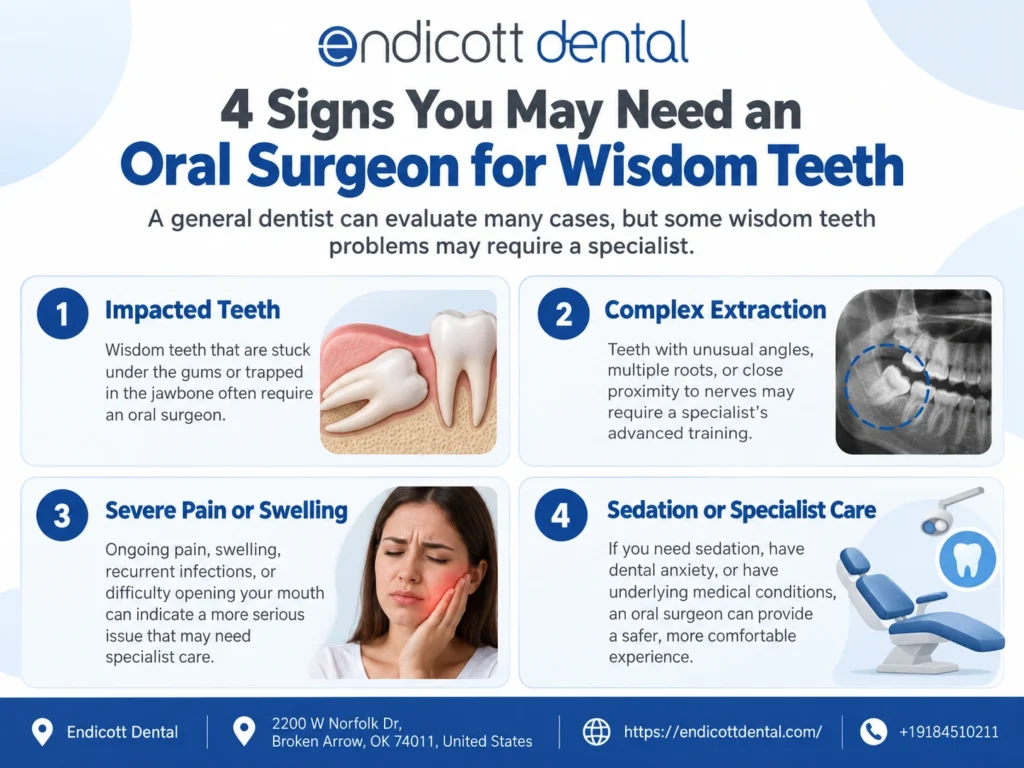
Oral surgeons frequently manage impacted and surgically complex wisdom teeth.
A wisdom tooth is impacted when it does not have enough room to erupt normally or remains partially or completely trapped beneath gum tissue or jawbone. The American Dental Association notes that impacted wisdom teeth may contribute to problems including infection, decay, gum disease, cyst formation, and damage to nearby teeth.
A dentist may recommend an oral surgeon when a wisdom tooth involves:
- Complete or deep bony impaction
- Unusual root anatomy
- Roots close to important nerves
- Difficult access
- Significant infection or pathology
- Multiple complicated wisdom teeth
- A need for more extensive surgical removal
- Complex medical considerations
- Anesthesia requirements better managed in a surgical setting
AAOMS specifically states that surgical treatment of impacted teeth should be performed by appropriately trained and skilled clinicians in an environment equipped for surgical and anesthetic care.
The decision is therefore less about the title of the provider and more about matching the complexity of the case with the appropriate training and setting.
What Makes a Wisdom Tooth Extraction “Simple”?
A simple extraction generally means that enough of the tooth is visible and accessible for the dentist to loosen and remove it without extensive surgical access.
A straightforward wisdom tooth may be:
- Fully erupted
- Relatively upright
- Easy to reach
- Surrounded by adequate healthy bone
- Free from complicated root anatomy
After local anesthesia has completely numbed the area, the dentist can loosen the tooth and carefully remove it from its socket.
Even a tooth that initially looks straightforward still needs proper evaluation.
Root shape cannot always be judged by looking inside the mouth. Dental X-rays allow us to see what is happening underneath the gums and bone before deciding how the extraction should be approached.
What Makes Wisdom Tooth Removal Surgical?
A surgical extraction may be necessary when the dentist cannot simply access and remove the entire tooth through its visible crown.
The procedure could involve:
- Making a small opening in the gum tissue.
- Exposing the underlying tooth and bone.
- Removing a controlled amount of bone when necessary.
- Dividing the tooth into smaller sections.
- Removing the sections individually.
- Cleaning the surgical area.
- Placing stitches when appropriate.
The extent of surgery varies considerably.
A partially impacted upper wisdom tooth may be relatively straightforward, while a deeply horizontal lower wisdom tooth can require much more careful planning.
This is why two people who are both told they need “wisdom teeth removed” may actually be facing very different procedures.
Why Does the Position of the Wisdom Tooth Matter?
Position can significantly affect surgical difficulty.
Wisdom teeth may grow:
- Straight upward
- Angled toward the second molar
- Angled toward the back of the mouth
- Nearly horizontal
- Partially through the gums
- Completely underneath the gums or bone
A tooth that has erupted normally is usually easier to reach.
A horizontal tooth trapped underneath the second molar may require surgical access and sectioning before it can be safely removed.
The ADA recommends evaluating wisdom teeth with a clinical examination and X-rays before determining the appropriate treatment.
Why Do the Roots Matter?
The visible part of the wisdom tooth is only part of the picture.
Underneath the gums, wisdom tooth roots can vary considerably.
They may be:
- Short
- Long
- Curved
- Fused together
- Widely separated
- Positioned close to anatomical structures
Lower wisdom tooth roots deserve particular attention because they can sometimes lie close to the inferior alveolar nerve, which provides sensation to areas including the lower lip and chin.
AAOMS identifies nerve injury involving the inferior alveolar or lingual nerves as an uncommon but potentially significant complication of impacted wisdom tooth surgery.
The relationship seen on dental imaging is therefore one factor used when deciding how and where removal should be performed.
Does an Impacted Wisdom Tooth Automatically Require an Oral Surgeon?
Not necessarily.
“Impacted” describes the position of the tooth. It does not by itself tell us exactly how difficult the surgery will be.
Some partially impacted teeth are relatively accessible.
Others are deeply embedded in bone, positioned horizontally, surrounded by complicated roots, or located close to nerves and neighboring teeth.
The dentist evaluates all of those factors together.
At Endicott Dental, impacted teeth are assessed based on their position and the dental problems they may be creating. Wisdom teeth are among the teeth most commonly affected by impaction.
If the extraction falls outside what is appropriate for general dental treatment, involving an oral surgeon provides access to additional specialty surgical training.
What About Broken Wisdom Teeth?
Broken wisdom teeth create another situation where complexity varies.
A broken tooth does not automatically require an oral surgeon.
If sufficient tooth structure is accessible and the root position is manageable, a dentist may be able to remove the remaining tooth.
At Endicott Dental, we evaluate broken wisdom teeth based on factors including how much of the tooth remains, whether it is impacted, and whether infection is present.
However, a tooth that has fractured below the gumline or has complicated roots may require a surgical approach.
Signs that a broken wisdom tooth deserves prompt evaluation include:
- Increasing pain
- Facial or gum swelling
- Drainage or pus
- Bad taste around the tooth
- Difficulty opening the mouth
- Pain when chewing
- Fever or feeling ill
These symptoms can indicate infection or another complication that should not simply be monitored at home.
Does Sedation Mean You Need an Oral Surgeon?
Not always.
Different dental practices offer different levels of sedation based on provider training, state regulations, facility capabilities, and the patient's needs.
At Endicott Dental, available sedation options include nitrous oxide, oral conscious sedation, and IV sedation or deeper relaxation when appropriate, including situations where care may be co-managed with a licensed anesthesia provider.
Oral and maxillofacial surgeons receive extensive anesthesia training as part of their specialty education, which can be particularly relevant for lengthy or complex surgical cases.
The right approach depends on:
- Procedure complexity
- Number of teeth being removed
- Expected surgery time
- Dental anxiety
- Medical history
- Medications
- Patient preference
- Appropriate anesthesia options
Sedation and pain control should be discussed during treatment planning rather than assumed based solely on who performs the extraction.
Do All Wisdom Teeth Need to Come Out?
No.
Wisdom teeth do not automatically need to be removed simply because they exist.
The ADA lists reasons removal may be recommended, including:
- Pain
- Infection
- Cysts
- Tumors
- Damage to neighboring teeth
- Gum disease
- Decay that cannot or should not be restored
Wisdom teeth that are healthy, functional, properly positioned, and cleanable may instead be monitored through routine examinations and appropriate imaging.
An impacted tooth that remains in place also requires continued observation because its condition can change.
The decision should therefore come after an individual evaluation rather than using a one-rule-fits-all approach.
Dentist vs. Oral Surgeon: A Quick Comparison
| Situation | General Dentist May Be Appropriate | Oral Surgeon May Be Considered |
| Fully erupted wisdom tooth | Often | Sometimes |
| Simple root structure | Often | Usually unnecessary unless other factors exist |
| Partially impacted tooth | Depending on complexity | Frequently |
| Deep bony impaction | Less commonly | Frequently |
| Horizontal wisdom tooth | Depends on training and anatomy | Frequently |
| Roots close to a major nerve | Specialist evaluation may be appropriate | Frequently |
| Multiple complex impacted teeth | Depends on case | Frequently |
| Significant surgical complexity | Referral may be appropriate | Frequently |
| Straightforward damaged tooth | Often | Sometimes |
| Advanced anesthesia needs | Depends on provider and facility | Often considered |
This table is only a general guide. Dental imaging, medical history, clinical findings, and the treating dentist's training ultimately determine the appropriate approach.
Should You See Your Dentist or an Oral Surgeon First?
For most patients, starting with a general dentist is reasonable.
Your dentist can examine the area, take appropriate X-rays, determine whether the wisdom teeth are contributing to your symptoms, and estimate the complexity of removal.
From there, one of several things may happen.
The tooth may not need extraction at all.
The dentist may determine that the extraction can be comfortably performed in the dental office.
Or the examination may reveal anatomical or surgical factors that make referral to an oral surgeon appropriate.
The ADA's professional guidance emphasizes that dentists should recognize their clinical limitations and seek consultation or referral when a patient's care would benefit from a professional with additional skills or experience.
That collaborative approach is an important part of safe dental care.
FAQs About Dentists, Oral Surgeons and Wisdom Teeth
Can my regular dentist pull my wisdom teeth?
Yes, depending on the position of the tooth, root anatomy, difficulty of the extraction, the dentist's training, and your overall health. Straightforward erupted wisdom teeth may often be handled by a general dentist.
Is an oral surgeon always better for wisdom teeth?
Not every wisdom tooth requires specialist surgery. Oral surgeons have additional surgical and anesthesia training that can be particularly valuable for impacted or complicated cases.
Who should remove an impacted wisdom tooth?
It depends on how deeply the tooth is impacted and its relationship to surrounding structures. More complicated bony impactions are commonly treated by oral and maxillofacial surgeons.
Can a dentist tell whether my wisdom tooth is close to a nerve?
Dental imaging helps the dentist evaluate the relationship between wisdom tooth roots and nearby anatomical structures. If the relationship appears complex or higher risk, additional imaging or specialist consultation may be recommended.
What if my wisdom tooth hurts but has not come through?
An unerupted or impacted wisdom tooth can still cause problems. Pain, swelling, infection, cysts, or damage to neighboring teeth can occur around impacted teeth, so the area should be examined rather than waiting for the tooth to erupt.
Can Endicott Dental evaluate my wisdom teeth?
Yes. Endicott Dental provides dental examinations, digital X-rays, tooth extractions, oral surgery services, and sedation options in Broken Arrow. The first step is evaluating the tooth and determining what level of treatment is appropriate.
Start With the Right Evaluation, Not the Right Title
Choosing between a general dentist and an oral surgeon for wisdom tooth removal is not simply about deciding which provider sounds more specialized.
A fully erupted wisdom tooth with uncomplicated roots may be well suited to removal by an experienced general dentist. A deeply impacted tooth, complicated root system, close relationship to a nerve, or procedure requiring more extensive surgery may call for an oral and maxillofacial surgeon.
At Endicott Dental, we begin by determining exactly what is happening below the gums before recommending how your wisdom tooth should be treated.
If you have wisdom tooth pain, swelling, a broken back tooth, or have been told that your wisdom teeth may need removal, schedule an evaluation with our Broken Arrow dental team. We can examine the area, review your imaging, discuss your comfort options, and determine the appropriate next step.
