Best Toothpastes for Sensitive Teeth (2026 Clinical recommendations)
Table of Contents
2026 Clinical Recommendations From the Endicott Dental Team
Tooth sensitivity is one of those problems people try to self-diagnose in the toothpaste aisle.
Cold water hurts. Whitening strips suddenly feel miserable. One tooth zings when you breathe in cold air. So you grab a “sensitive teeth” toothpaste and hope it fixes everything.
Sometimes it does.
Sometimes it does not.
Here’s the honest answer: the best toothpaste for sensitive teeth depends on what is causing the sensitivity. If the issue is exposed dentin, gum recession, enamel wear, or mild generalized sensitivity, the right toothpaste can help. If the issue is a cavity, cracked tooth, leaking filling, infection, or bite problem, toothpaste may only mask the warning sign.
Stop Sensitive Teeth From Holding You Back
Get professional recommendations for sensitive teeth relief. Call today to find the right toothpaste for your smile.
Fast answer: What toothpaste should you use for sensitive teeth?
For most adults with general tooth sensitivity, the best first choice is a fluoride toothpaste made specifically for sensitivity, usually with one of these active ingredients:
Ingredient
What it does
Best for
Potassium nitrate
Helps calm nerve sensitivity inside the tooth
Cold sensitivity, generalized sensitivity
Stannous fluoride
Helps protect against cavities and can help block exposed dentin tubules
Sensitivity plus gum issues, plaque, erosion risk
Sodium fluoride
Helps prevent cavities and strengthen enamel
Baseline cavity protection
The ADA says toothpastes may include ingredients that reduce sensitivity, prevent enamel erosion, reduce gingivitis, reduce tartar buildup, and protect against cavities; all ADA Seal toothpastes that claim cavity protection must contain fluoride.
Our practical recommendation:
Start with Sensodyne Pronamel, Sensodyne Rapid Relief, Crest Gum & Sensitivity, or Colgate Sensitive Prevent & Repair. Use it twice daily for at least 2–4 weeks before judging the result.
Do not bounce between toothpastes every three days. Sensitive toothpaste needs consistency.
Sensodyne Rapid Relief Sensitive Toothpaste
Price not available•Fast relief for sensitive teeth.
Crest Pro-Health Gum and Sensitivity Toothpaste
Price not available•Gum and sensitivity protection in one.
Colgate Sensitive Prevent & Repair Toothpaste
Price not available•Repair-focused toothpaste for sensitive teeth.
Sensodyne Pronamel Fresh Breath Enamel Toothpaste
Price not available•Supports enamel and freshens breath.
Sensodyne Sensitivity Gum & Enamel Toothpaste
Price not available•Gum recession support with sensitivity relief.
Sensodyne Sensitivity Gum & Enamel Triple Action
Price not available•Triple-action formula for sensitivity, gums, and enamel.
Sensodyne Sensitivity & Gum Toothpaste
Price not available•Daily support for sensitive gums and teeth.
Sensodyne Sensitivity & Gum Whitening Toothpaste
Price not available•Whitening option for sensitive teeth.
Professional teeth whitening at Endicott Dental in Broken Arrow delivers results that over-the-counter strips and trays simply can't match. Learn why professional whitening is safer, more effective, and longer-lasting than home kits.
The Endicott Dental verdict
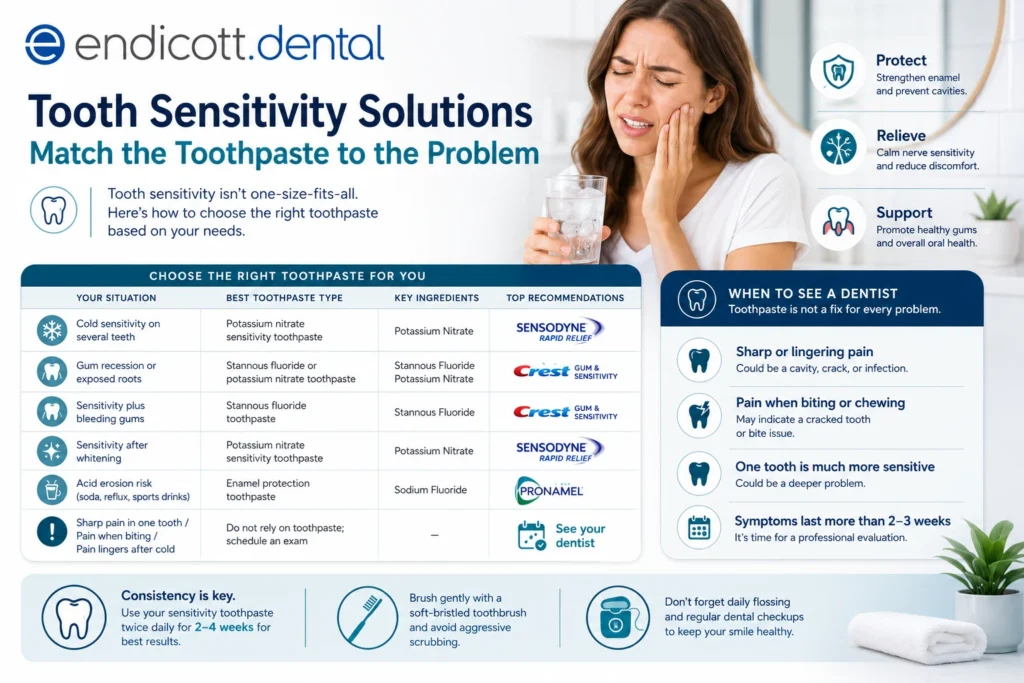
If we were recommending toothpaste to a patient in Broken Arrow after a cleaning, here is how we would break it down.
Patient situation
Best toothpaste type
Cold sensitivity on several teeth
Potassium nitrate sensitivity toothpaste
Gum recession or exposed roots
Stannous fluoride or potassium nitrate sensitivity toothpaste
Sensitivity plus bleeding gums
Stannous fluoride toothpaste, plus dental exam
Sensitivity after whitening
Sensodyne or similar potassium nitrate toothpaste before and after whitening
Acid erosion risk from soda, reflux, or sports drinks
Pronamel-style enamel protection toothpaste
One tooth has sharp pain
Do not rely on toothpaste; schedule an exam
Pain lingers after cold
Schedule an exam
Pain when biting
Schedule an exam
That last part matters.
Sensitive toothpaste is helpful when the problem is surface-level sensitivity. It is not a substitute for diagnosing a damaged tooth.
Best overall: Sensodyne Pronamel
Best for: Adults with sensitivity plus enamel wear, acid exposure, or cold sensitivity.
Sensodyne Pronamel is a strong everyday choice because it combines sensitivity relief with enamel-focused cavity protection. Some Pronamel Clinical Enamel Strength products list potassium nitrate 5% and sodium fluoride 0.25% as active ingredients, which is the classic sensitivity-plus-fluoride combination.
This is a good fit if your teeth feel sensitive after:
Cold drinks
Acidic foods
Soda
Sports drinks
Citrus
Reflux
Whitening
Gum recession
Possible drawback: It is not always the fastest-feeling option. Some patients need a couple of weeks before they notice meaningful improvement.
Best for gum sensitivity: Crest Gum & Sensitivity
Best for: Patients with sensitivity plus gum inflammation, bleeding, or plaque concerns.
Crest Pro-Health Sensitive and Gum uses stannous fluoride, an ingredient Crest says helps protect against cavities, acid erosion, gingivitis, plaque, bad breath, and tooth sensitivity.
A DailyMed label for Crest Pro-Health Sensitive and Gum describes it as an anticavity, antigingivitis, and sensitive-teeth toothpaste with stannous fluoride.
This is a good choice when sensitivity is not the only issue. If your gums bleed or feel tender, stannous fluoride may be a better fit than a basic whitening toothpaste.
Possible drawback: Stannous fluoride toothpastes can feel different in the mouth, and some people do not love the taste or texture.
Best fast-relief option: Sensodyne Rapid Relief
Best for: Patients who want quicker relief from exposed-dentin sensitivity.
Sensodyne describes its sensitivity formulas as using active ingredients such as potassium nitrate and stannous fluoride for sensitive tooth pain relief.
Rapid-relief products are usually aimed at patients who want faster improvement rather than waiting weeks. That can be useful if cold sensitivity is making you avoid normal eating or drinking.
Possible drawback: If one tooth is extremely sensitive, especially to biting or lingering cold, do not keep waiting for toothpaste to solve it. That may be a cracked tooth, cavity, or nerve problem.
Best budget-friendly sensitive toothpaste: Colgate Sensitive Prevent & Repair
Best for: Patients who want a mainstream sensitivity toothpaste without overcomplicating the choice.
Colgate Sensitive Prevent & Repair is a reasonable choice for generalized sensitivity, especially if you are looking for something easy to find and not overly expensive.
Possible drawback: Like most sensitivity toothpastes, it needs consistent use. It is not a one-brush fix.
Best whitening-sensitive compromise: Sensodyne Sensitivity & Gum Whitening
Best for: Patients who want some whitening help but cannot tolerate aggressive whitening toothpastes.
This is where people need to be careful.
Whitening toothpastes can help remove surface stain, but some formulas are too abrasive or irritating for already-sensitive teeth. If your teeth are sensitive, avoid chasing the strongest whitening claim on the shelf.
A sensitivity-focused whitening toothpaste is usually a safer compromise than a heavy-duty whitening paste.
Possible drawback: Do not expect dramatic whitening. Sensitive whitening toothpaste is usually more about stain control than major shade change.
Best for acid erosion risk: Sensodyne Pronamel Fresh Breath or Clinical Enamel Strength
Best for: Patients who drink soda, energy drinks, sparkling water, citrus drinks, or who have reflux.
Acid exposure can soften enamel and contribute to sensitivity. If your sensitivity shows up mostly with cold drinks or after acidic foods, an enamel-focused sensitivity toothpaste makes sense.
Pronamel-style formulas are built for this use case.
Possible drawback: Toothpaste cannot reverse major enamel loss. It can help protect and remineralize early weakened areas, but it cannot grow back enamel that is already gone.
Best for recession or exposed roots: Stannous fluoride or potassium nitrate formulas
Best for: Adults with gum recession, exposed root surfaces, or sensitivity near the gumline.
Exposed root surfaces are one of the most common reasons adults get sensitivity. The root is not protected by enamel the same way the crown of the tooth is.
This is where sensitive toothpaste can help, especially when used consistently and gently.
But there is a catch: if recession is caused by grinding, brushing too hard, gum disease, or bite stress, toothpaste alone will not fix the underlying problem.
What toothpaste should you avoid if you have sensitive teeth?
Avoid or be cautious with:
Charcoal toothpaste
Very abrasive whitening toothpaste
Toothpaste without fluoride
DIY baking soda and lemon mixtures
“Natural” toothpaste that skips cavity protection
Strong whitening pastes if they trigger pain
Anything that makes sensitivity worse after a week or two
This is one place where “natural” can backfire.
If you have sensitive teeth, you usually need more protection, not less.
How long does sensitive toothpaste take to work?
Most patients should give it 2–4 weeks of twice-daily use.
Some people feel improvement sooner. Others need longer. The key is consistency.
Use it this way:
Brush twice daily with a soft toothbrush.
Do not scrub hard.
Spit after brushing.
Do not rinse aggressively with water afterward.
Keep using the same toothpaste for a few weeks.
That last habit helps leave more active ingredient on the teeth.
The trick most people miss
At night, after brushing, you can put a small smear of sensitive toothpaste on the most sensitive area with a clean finger or cotton swab.
Do not eat or drink afterward.
This can help when the sensitivity is localized around the gumline.
But again, if one tooth has sharp, worsening, or lingering pain, get it checked.
When sensitive toothpaste is not enough
Sensitive toothpaste is not the answer if you have:
Pain in one specific tooth
Pain that lingers after cold
Pain when biting
Swelling
A pimple on the gum
A broken tooth
A loose filling or crown
Sensitivity that suddenly started after dental work and is getting worse
Why your teeth may be sensitive in the first place
Common causes include:
Gum recession
Enamel erosion
Brushing too hard
Whitening products
Cavities
Cracked teeth
Grinding or clenching
Gum disease
Old fillings leaking
Recent dental treatment
Acidic drinks
Dry mouth
Exposed root surfaces
This is why the same toothpaste does not work for everyone.
A patient with acid erosion may need a different plan than a patient with gum recession or a cracked molar.
What Endicott Dental would usually recommend first
For most Broken Arrow adults with mild to moderate generalized sensitivity, we would usually start with:
A fluoride sensitivity toothpaste
A soft electric toothbrush or soft manual brush
Lighter brushing pressure
Less frequent acidic drinks
No aggressive whitening for a few weeks
A dental exam if symptoms are one-sided, sharp, lingering, or worsening
That is the practical path.
Do the simple things first, but do not ignore warning signs.
Bottom line
The best toothpaste for sensitive teeth in 2026 is usually one with fluoride plus a proven sensitivity ingredient like potassium nitrate or stannous fluoride.
Our top practical picks are:
Sensodyne Pronamel for sensitivity plus enamel protection
Crest Gum & Sensitivity for sensitivity plus gum concerns
Sensodyne Rapid Relief for faster symptom relief
Colgate Sensitive Prevent & Repair for a solid mainstream option
Sensitivity-focused whitening toothpaste if you want stain control without making sensitivity worse
But toothpaste has limits.
If sensitivity is sharp, one-sided, lingering, or triggered by biting, do not keep trying new tubes for six months. Have it checked.
At Endicott Dental in Broken Arrow, Dr. Drew Endicott and the hygiene team can help you figure out whether your sensitivity is a toothpaste problem, a gumline problem, a bite problem, or a tooth problem before you spend more money guessing.
FAQs
What is the best toothpaste for sensitive teeth?
For most patients, a fluoride toothpaste with potassium nitrate or stannous fluoride is the best starting point. Sensodyne Pronamel, Sensodyne Rapid Relief, Crest Gum & Sensitivity, and Colgate Sensitive Prevent & Repair are all reasonable options.
Is potassium nitrate or stannous fluoride better?
It depends. Potassium nitrate is commonly used to calm nerve sensitivity. Stannous fluoride can help with sensitivity while also supporting gum health, plaque control, and cavity prevention. Crest describes stannous fluoride as helping protect against sensitivity, cavities, plaque, gingivitis, acid erosion, and bad breath.
How long should I use sensitive toothpaste before deciding it does not work?
Give it at least 2–4 weeks of twice-daily use unless symptoms are severe, worsening, or isolated to one tooth.
Should I rinse after brushing with sensitive toothpaste?
It is usually better to spit and avoid heavy rinsing right afterward. That leaves more active ingredients on the teeth.
Can sensitive toothpaste fix a cavity?
No. It may temporarily reduce symptoms, but it will not repair a cavity that needs dental treatment.
Is whitening toothpaste bad for sensitive teeth?
Not always, but aggressive whitening toothpaste can make sensitivity worse for some people. Choose a sensitivity-focused whitening option if your teeth are already sensitive.
Should I use fluoride-free toothpaste for sensitive teeth?
Usually no. If you are dealing with sensitivity, fluoride is often important for cavity prevention and enamel support. The ADA states that toothpastes with an ADA Seal cavity-prevention claim must contain fluoride.
When should I see a dentist for sensitive teeth?
Schedule an exam if pain is sharp, one-sided, lingering, triggered by biting, associated with swelling, or not improving after a few weeks of consistent sensitive-toothpaste use.
Sensitive Teeth Need the Right Protection
Cold drinks and hot foods shouldn’t make you hesitate. Get expert guidance on toothpaste for sensitive teeth today.
Dr. Endicott, a dentist in Broken Arrow OK, brings a lifelong pursuit of excellence shaped by his Midwestern upbringing and time playing professional baseball in the Kansas City Royals organization. At Endicott Dental, he pairs that dedication with a family-first approach, providing compassionate care and helping patients improve their smiles, health, and overall quality of life.