

Table of Contents
Most people ask this question because they want the truth before spending $80 to $250 on a toothbrush.
Fair.
An electric toothbrush sounds better. It feels more high-tech. It may even make your bathroom counter look like you have your life together.
But is it actually better?
Here’s the honest hygienist-style answer.
Fast answer: Electric toothbrushes usually win — but only if you use them correctly
For most adults and kids, a good electric toothbrush will remove plaque more consistently than a manual toothbrush.
That does not mean a manual toothbrush is useless. The ADA says either a manual or powered toothbrush can be used effectively, as long as you brush twice a day for two minutes with soft bristles and replace the brush every three to four months, or sooner if the bristles are frayed.
But if we are giving a straight verdict, here it is:
If your brushing is already excellent, a manual toothbrush can be enough. If your brushing is average, rushed, too hard, too soft, inconsistent, or you miss the gumline, an electric toothbrush is usually the better tool.
That describes a lot of people.
The Endicott hygienist’s practical verdict
If we were sitting across from you after a cleaning at Endicott Dental in Broken Arrow, here is what we would likely say:
| Situation | Best choice |
| You have healthy gums and great brushing habits | Manual or electric |
| You get plaque buildup between cleanings | Electric |
| Your gums bleed when brushing or flossing | Electric, plus a dental exam |
| You brush too hard | Electric with a pressure sensor |
| You have braces, retainers, bridges, implants, or crowns | Electric is usually easier |
| Your child rushes brushing | Electric with a timer |
| You hate charging things or won’t replace brush heads | Manual |
| You are on a tight budget | Soft manual brush used well |
The toothbrush is not the whole solution.
But the right toothbrush can make good brushing easier.
What the research says
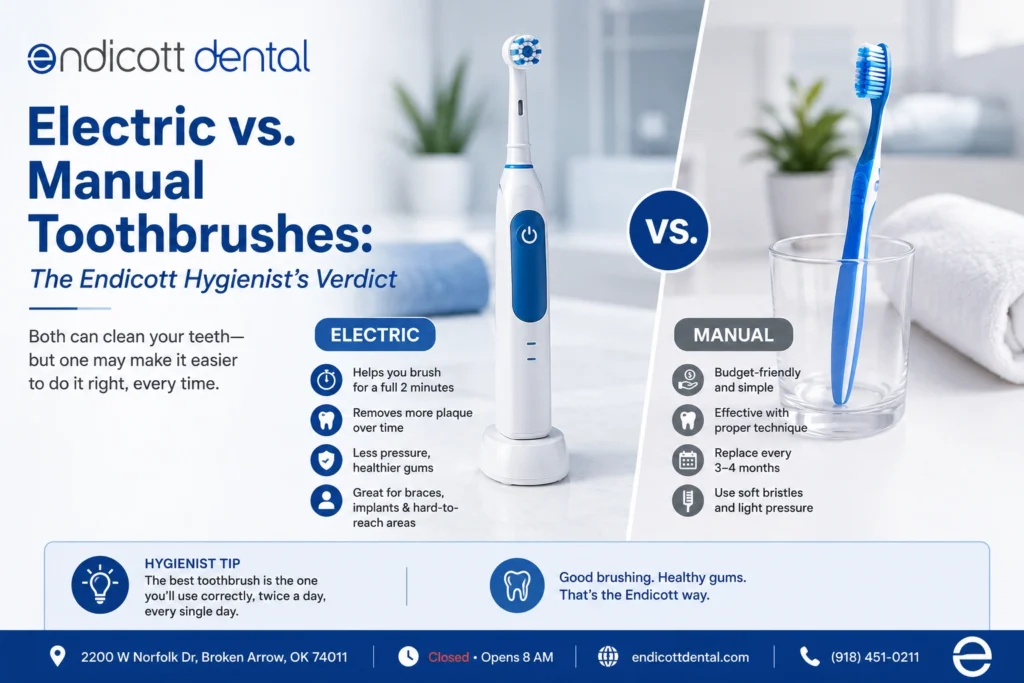
The best-known evidence review from Cochrane found that powered toothbrushes reduce plaque and gingivitis more than manual toothbrushes over time. Over more than three months, powered brushes reduced plaque by about 21% and gingivitis by about 11% compared with manual brushes.
That is not marketing fluff. That is a real difference.
It also matches what hygienists tend to see in the chair. Patients who switch to an electric brush and actually use it correctly often come back with less plaque around the gumline.
Not always.
But often enough that we notice.
Why electric toothbrushes usually work better
Electric toothbrushes are not better because they are magical.
They are better because they fix common human problems.
1. They help with timing
Most people do not brush for a full two minutes.
They think they do.
They do not.
Many electric toothbrushes have built-in timers. That alone helps.
2. They reduce technique mistakes
With a manual brush, you have to create all the motion yourself. Small circles, correct angle, light pressure, every surface, every tooth.
With an electric brush, the brush does more of the movement. Your job is to guide it slowly along the gumline.
That is easier for many people.
3. They can protect against brushing too hard
A lot of patients think aggressive brushing means cleaner teeth.
It does not.
Brushing too hard can contribute to gum recession, tooth sensitivity, and enamel wear. An electric toothbrush with a pressure sensor can warn you when you are scrubbing instead of cleaning.
4. They help people with limited dexterity
For adults with arthritis, mobility issues, disability, tremors, or grip problems, an electric toothbrush can make brushing much easier. The ADA’s consumer guidance notes that people who have difficulty using a manual toothbrush may find a powered brush more comfortable.
Where manual toothbrushes still make sense
A manual toothbrush can absolutely work.
You do not need a luxury toothbrush subscription to have healthy teeth.
A manual brush is a good choice if:
- You brush carefully for two full minutes
- You use soft bristles
- You reach the gumline
- You replace it regularly
- You do not scrub too hard
- You floss or clean between teeth daily
- You do not have heavy plaque buildup between cleanings
The ADA’s basic recommendation is simple: soft bristles, two minutes, twice a day, and replacement every three to four months.
That is the foundation.
The problem is not manual toothbrushes.
The problem is rushed manual brushing.
The mistake we see most often
The biggest mistake is using a manual toothbrush like a scrub brush.
People saw back and forth hard across the teeth, especially near the gumline.
That can miss plaque and irritate the gums at the same time. Bad combination.
With either brush, the goal is controlled, gentle cleaning — not pressure.
If your toothbrush bristles look flattened after a few weeks, you are brushing too hard.
Which electric toothbrush is best?
You do not need the most expensive model.
Most people should look for:
- Soft brush heads
- A two-minute timer
- A pressure sensor
- Easy-to-replace heads
- Comfortable grip
- ADA Seal of Acceptance, when available
Fancy app tracking is optional. Bluetooth brushing reports are optional. A toothbrush that nags you through your phone is not required.
The features that matter most are the timer and pressure sensor.
Sonic vs. oscillating: does it matter?
There are two common electric toothbrush styles:
| Type | How it works |
| Sonic | Vibrates side to side at high speed |
| Oscillating-rotating | Small round head rotates back and forth |
Both can work.
Some research suggests oscillating-rotating brushes may have an advantage for plaque and gingivitis reduction, but the bigger issue for most patients is whether they use the brush correctly and consistently. A recent meta-analysis found oscillating-rotating toothbrushes offered superior gingivitis and plaque reduction compared with manual and sonic brushes, but real-world habits still matter.
Our practical advice: do not overthink the technology. Choose one you will actually use for two minutes twice a day.
What about kids?
Electric toothbrushes can be great for kids, especially the ones who brush for 19 seconds and swear it was two minutes.
A built-in timer helps. A smaller brush head helps. Some kids also brush better because the electric brush feels more fun.
But parents still need to supervise.
For younger kids, the brush does not replace adult help. The ADA says caregivers should begin brushing as soon as teeth erupt and should continue helping or supervising until the child can reliably spit out excess toothpaste.
For kids, the best toothbrush is:
- Age-appropriate
- Soft-bristled
- Small enough for their mouth
- Easy for them to hold
- Used with the right amount of fluoride toothpaste
- Supervised until they can do a good job
What about braces or FASTBRACES®?
If you have braces, including FASTBRACES®, an electric toothbrush is usually a smart choice.
Brackets and wires create more places for plaque to hide. Food gets trapped more easily. Gumline cleaning becomes more important.
A manual brush can still work, but it takes more patience.
For most orthodontic patients, an electric brush plus floss threaders, interdental brushes, or a water flosser can make home care much easier.
What about implants, crowns, bridges, or veneers?
Electric toothbrushes are generally safe for crowns, veneers, bridges, and implants when used properly with a soft brush head and light pressure.
The real risk is not the electric brush.
The risk is poor plaque control around the gumline, especially around implants and bridges.
If you have dental work, your hygienist may recommend specific tools for the areas that trap plaque.
What about sensitive teeth or gum recession?
Electric can still be a good choice, but use the right settings.
Look for:
- Soft or extra-soft brush heads
- Sensitive mode
- Pressure sensor
- Gentle technique
Do not jam the brush into your gums. Let the bristles contact the tooth and gumline lightly.
If sensitivity is new, worsening, or isolated to one tooth, do not assume it is just brushing. It could be recession, grinding, decay, a cracked tooth, or an old filling problem.
Is an expensive electric toothbrush worth it?
Sometimes, but not always.
You usually do not need the top-of-the-line model.
A mid-range electric toothbrush with a timer and pressure sensor is enough for most people.
Spending more may get you:
- Multiple brushing modes
- App tracking
- Travel cases
- Longer battery life
- More refined pressure feedback
- Premium brush heads
Those features are nice, but they are not the main thing.
A $60 electric brush used correctly beats a $250 brush sitting uncharged in a drawer.
The best toothbrush for your budget
Here is the no-nonsense version.
Best low-cost option
A soft manual toothbrush, replaced every three to four months.
This is enough if you brush well.
Best value option
A rechargeable electric toothbrush with a two-minute timer and pressure sensor.
This is the best fit for many adults.
Best for gum problems
An electric toothbrush with soft heads, pressure sensor, and a gentle mode.
Also schedule a dental visit if bleeding persists.
Best for kids
A child-sized electric toothbrush with a timer, used with parent supervision.
Best for braces
Electric toothbrush plus additional cleaning tools for between brackets and wires.
What toothbrush will not fix
A better toothbrush will not fix everything.
It will not remove hardened tartar. Once plaque becomes tartar, it has to be removed professionally.
It will not clean fully between teeth. You still need floss, floss picks, interdental brushes, or another between-the-teeth tool.
It will not cure gum disease by itself.
It will not make up for sipping soda all day.
It will not fix cavities that are already present.
So yes, the brush matters. But it is one part of the system.
When to ask your hygienist for a specific recommendation
Ask at your next cleaning if:
- Your gums bleed
- You build tartar quickly
- You have gum recession
- You have braces or aligners
- You have implants or bridges
- You brush too hard
- You have arthritis or trouble gripping
- Your child keeps getting cavities
- You are not sure whether you are missing certain areas
A hygienist can usually tell where your brushing is working and where it is not.
That is more useful than reading 300 online reviews from strangers.
Bottom line
The Endicott hygienist’s verdict is this:
Electric toothbrushes are usually the better choice for the average patient because they make good brushing easier and more consistent.
But a manual toothbrush is still perfectly acceptable if you use it correctly.
The real standard is not electric vs. manual.
The real standard is: soft bristles, gentle pressure, two minutes, twice a day, daily cleaning between teeth, and regular dental cleanings.
If you are not sure which brush is right for your mouth, ask your hygienist at Endicott Dental in Broken Arrow. They can look at your gums, plaque patterns, dental work, and brushing habits and give you a recommendation that actually fits you.
FAQs
Are electric toothbrushes really better than manual toothbrushes?
For many people, yes. Cochrane found powered toothbrushes reduced plaque and gingivitis more than manual brushes over time. But manual toothbrushes can still work well when used properly.
Do dentists recommend electric toothbrushes?
Often, especially for patients with plaque buildup, gum inflammation, braces, dexterity issues, or brushing inconsistency. The ADA says both manual and powered brushes can be effective.
Can an electric toothbrush damage gums?
It can if you press too hard or use a stiff brush head. Choose soft bristles, use light pressure, and consider a brush with a pressure sensor.
Is a manual toothbrush enough?
Yes, if you brush thoroughly for two minutes twice daily, use soft bristles, clean the gumline, replace the brush regularly, and clean between your teeth.
How often should I replace my toothbrush or brush head?
Every three to four months, or sooner if the bristles are frayed or matted.
Should kids use electric toothbrushes?
Many kids do well with electric toothbrushes, especially if the timer helps them brush longer. Younger children still need parent help or supervision.
Do I still need to floss if I use an electric toothbrush?
Yes. Toothbrushes do not fully clean between teeth. You still need floss, floss picks, interdental brushes, or another between-the-teeth tool.
What is the best electric toothbrush feature?
A pressure sensor and two-minute timer. Those two features solve two of the most common problems: brushing too hard and not brushing long enough.
