

Table of Contents
Nobody in Broken Arrow usually says, “I’m under extreme psychological strain.”
They say:
“I’m just busy.”
“It’s been a season.”
“I’m fine.”
“I’ll sleep when things calm down.”
“I only drink coffee because I have to.”
“My jaw just feels tight lately.”
That is what we mean by Midwestern stress.
It is the quiet, high-functioning kind of stress. The kind where you keep showing up, keep answering emails, keep taking care of everyone, keep making decisions, and keep telling yourself it is not that bad.
Then your teeth start paying for it.
Fast answer: Can stress really cause teeth grinding?
Yes. Stress, anxiety, anger, frustration, concentration, poor sleep, caffeine, certain medications, and sleep disorders can all contribute to teeth grinding or clenching, also called bruxism. Mayo Clinic lists stress and anxiety as risk factors for bruxism, and notes that awake bruxism may happen when someone is concentrating, while sleep bruxism is linked with brief disturbances during sleep.
The American Dental Association also connects everyday stress with teeth grinding and notes that many people grind without realizing it.
For local professionals, the pattern often looks like this:
| What you notice | What may be happening |
| Morning headaches | Nighttime clenching or grinding |
| Tight jaw at work | Daytime clenching during focus or stress |
| Sensitive teeth | Enamel wear, gum recession, or exposed dentin |
| Chipped edges | Tooth-to-tooth pressure over time |
| Neck or temple soreness | Overworked jaw muscles |
| Worn front teeth | Long-term grinding pattern |
| Broken fillings or crowns | Excessive bite force |
The frustrating part is that many people do not know they grind.
They just wake up sore, crack a tooth, or hear it from their hygienist.
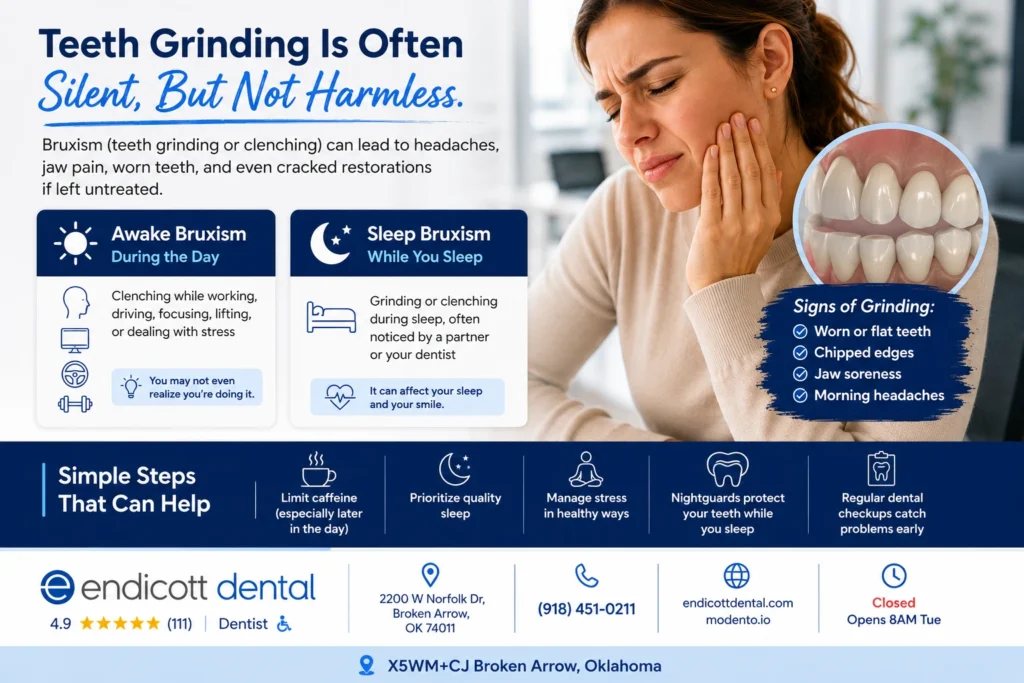
What is bruxism?
Bruxism is the habit of clenching, grinding, or bracing the teeth and jaw.
It can happen in two main ways:
| Type | When it happens | Common pattern |
| Awake bruxism | During the day | Clenching while working, driving, focusing, lifting, or dealing with stress |
| Sleep bruxism | While asleep | Grinding or clenching during sleep, often noticed by a partner or dentist |
The ADA describes bruxism as grinding, clenching, or thrusting the jaw, and notes that it can cause headaches, muscle pain, and damage to teeth or gum tissues.
That matters because a lot of people picture teeth grinding as loud, obvious, and dramatic.
But clenching can be silent.
You can be doing it at your desk right now and not know it.
Why local professionals are especially prone to it
This is not unique to Broken Arrow, but it does show up in a very local way.
Many professionals around Broken Arrow, Tulsa, Bixby, Coweta, and Jenks are carrying a mix of:
- Long commutes or heavy traffic windows
- Business ownership pressure
- Healthcare, education, finance, legal, sales, or leadership stress
- Family obligations
- Kids’ sports and school schedules
- Aging-parent responsibilities
- Church, volunteer, or community commitments
- Inflation and cost-of-living pressure
- Too much caffeine
- Not enough sleep
- The habit of saying “I’m fine” when they are not
That is Midwestern stress.
It is not always loud. It is often responsible, polite, and productive.
But your jaw does not care whether your stress looks impressive from the outside.
The “I’m fine” problem
A lot of grinding patients are not falling apart.
They are high performers.
They are the people everyone depends on. They answer the late email. They remember the school form. They manage employees. They hit deadlines. They keep the household running.
Then their body finds a pressure-release valve.
For some people it is a headache. For others it is stomach issues, insomnia, neck tension, or back pain.
For a lot of dental patients, it is jaw clenching.
Mayo Clinic notes that bruxism may be a coping strategy or habit during deep thinking or concentration. That explains why some people clench all day without feeling “emotionally stressed.” They are simply focused, tense, and braced.
Signs you may be grinding or clenching
You may be grinding if you notice:
- Morning jaw soreness
- Headaches near the temples
- Teeth that feel sore when you wake up
- Clicking, popping, or tired jaw muscles
- Tooth sensitivity
- Chipped or flattened teeth
- Cracked fillings
- Gum recession
- Worn biting edges
- Pain when chewing
- A partner hears grinding at night
- Your dentist or hygienist sees wear patterns
Johns Hopkins Medicine notes that a dentist may first notice bruxism during a regular dental visit by seeing wear and tear on the teeth.
That is common.
Patients often say, “I don’t grind my teeth.”
Then we show them the wear.
Why teeth grinding is not just a tooth problem
Bruxism can affect more than enamel.
It can irritate the jaw muscles, overload the jaw joints, contribute to headaches, crack restorations, and make teeth more sensitive.
Cleveland Clinic notes that bruxism can cause tooth erosion, jaw pain, headaches, dental damage, and TMJ-related problems.
That is why we take it seriously.
Not because every grinder needs major treatment.
But because untreated grinding can quietly create expensive problems.
A nightguard is a lot less frustrating than a cracked molar.
The caffeine connection
This is where many professionals feel personally attacked.
Coffee is not evil.
But if you are drinking coffee all morning, energy drinks in the afternoon, and maybe alcohol at night to “come down,” your sleep and jaw muscles may not love that routine.
Bruxism is multifactorial, meaning it usually has more than one cause. A 2025 narrative review describes sleep bruxism as involving multiple influences, including genetics, central nervous system mechanisms, sleep architecture, and psychosocial factors such as stress sensitivity and coping.
So no, coffee alone may not be “the cause.”
But in a tired, stressed, high-output adult, caffeine can be part of the load.
The sleep connection
Sleep bruxism is not always just “stress coming out at night.”
It can also be linked with sleep disruption, snoring, airway issues, alcohol use, medications, and other factors.
That is why a dentist may ask questions that seem unrelated:
- Do you snore?
- Do you wake up tired?
- Do you have morning headaches?
- Has anyone noticed pauses in breathing?
- Do you use alcohol before bed?
- Do you take antidepressants, ADHD medication, or other prescriptions?
- Do you wake up with dry mouth?
This is not small talk.
It helps separate simple tooth wear from a bigger sleep or airway issue.
Can stress grinding crack teeth?
Yes.
Teeth are strong, but they are not built for hours of repeated clenching pressure.
Over time, grinding or clenching may contribute to:
- Cracked teeth
- Fractured fillings
- Broken crowns
- Worn enamel
- Gum recession
- Tooth mobility
- Bite soreness
- Sensitivity
- TMJ symptoms
This is especially true if you already have large fillings, crowns, missing teeth, an uneven bite, or old dental work.
A healthy tooth can tolerate a lot.
A heavily restored tooth under nighttime grinding force may not.
What you can safely try first
If symptoms are mild and you have no sharp tooth pain, swelling, or broken teeth, start with the basics.
1. Notice daytime clenching
During the day, your teeth should usually not be touching unless you are chewing.
A simple reminder is:
Lips together, teeth apart, tongue relaxed.
Set a phone reminder if needed. Put a sticky note on your monitor. This sounds too simple, but it helps awake clenching.
2. Reduce evening stimulation
Try reducing:
- Late caffeine
- Alcohol before bed
- Doom-scrolling
- Work email at night
- Heavy late-night meals
- High-stress conversations right before sleep
You do not need a perfect wellness routine.
You need fewer signals telling your nervous system to stay braced.
3. Use heat and gentle stretching
Warm compresses on the jaw muscles may help with soreness.
Gentle jaw relaxation can help.
Do not aggressively stretch or force your jaw open. That can make symptoms worse.
4. Avoid chewing overload
When your jaw is sore, skip:
- Gum chewing
- Chewy candy
- Ice chewing
- Tough meats
- Constant snacking
- Nail biting
- Pen chewing
Your jaw muscles need a break.
5. Check your workstation
Forward-head posture, neck tension, and jaw tension often travel together.
If your shoulders live near your ears all day, your jaw may be clenching too.
When a nightguard makes sense
A custom nightguard does not necessarily stop the grinding habit.
That is important.
Its job is usually to protect the teeth and reduce damage while your dentist evaluates the bigger pattern.
Mayo Clinic lists splints and mouthguards among dental approaches used to keep teeth separated and avoid damage from clenching and grinding.
A custom guard may be recommended if you have:
- Visible tooth wear
- Morning jaw pain
- Cracked teeth
- Broken fillings or crowns
- Repeated chipping
- Tooth soreness on waking
- Clenching headaches
- Signs of heavy bite force
Store-bought nightguard vs. custom dental nightguard
A store-bought guard may be okay as a very short-term experiment for some people.
But it is not the same as a custom guard.
| Option | Pros | Watch out for |
| Store-bought boil-and-bite guard | Cheaper, easy to access | Bulky, poor fit, may change bite feel, not ideal long term |
| Custom dental nightguard | Better fit, more controlled, designed for your bite | Higher upfront cost |
| Sports mouthguard | Good for sports impact | Not designed for nighttime grinding |
The mistake is buying a bulky guard, sleeping worse, chewing on it all night, and deciding “nightguards don’t work.”
Sometimes the problem is not the idea of a guard.
It is the fit.
When you should call a dentist
Do not wait if you have:
- Pain in one specific tooth
- Pain when biting
- A cracked or broken tooth
- Swelling
- A filling or crown that broke
- Sensitivity that lingers after cold
- Jaw locking
- Worsening headaches
- Ear-area pain that does not improve
- Severe morning jaw soreness
- Tooth wear you can see in the mirror
Those are not “just stress” symptoms until someone checks.
What Endicott Dental looks for
At Endicott Dental in Broken Arrow, Dr. Drew Endicott and the hygiene team may check for:
- Flattened or chipped biting edges
- Cracks in teeth or fillings
- Gum recession
- Tooth mobility
- Bite imbalance
- TMJ tenderness
- Muscle soreness
- Wear facets
- Signs of acid erosion
- Signs that sleep or airway issues may be involved
The goal is not to scare you.
The goal is to answer one practical question:
Is this harmless tension, or is it starting to damage your teeth?
What treatment may involve
Depending on what is found, treatment may include:
- Monitoring mild wear
- A custom nightguard
- Bite adjustment in select cases
- Replacing broken fillings or crowns
- Treating cracked teeth
- Managing gum recession or sensitivity
- Referral for sleep evaluation if sleep apnea signs are present
- Physical therapy or medical evaluation for persistent jaw problems
- Stress and habit-awareness strategies
There is no single bruxism treatment that fits everyone.
That is because grinding is not always caused by one thing.
The big mistake: waiting until something breaks
Most professionals delay care because they are busy.
That is understandable.
But grinding tends to get attention only after a tooth chips, a crown breaks, or pain shows up.
That is the expensive way to find out your jaw has been working overtime.
If your dentist catches bruxism early, the plan may be simple: monitor, adjust habits, protect the teeth, and prevent bigger problems.
If you wait until a tooth fractures, the options may become more involved.
Bottom line for Broken Arrow professionals
“Midwestern stress” is not dramatic. That is why it is easy to ignore.
It looks like responsibility. Long hours. Full calendars. Coffee. Tight shoulders. Bad sleep. Quiet pressure. Getting through the day.
But your mouth may be telling the truth your schedule is trying to hide.
If you are waking up with jaw soreness, headaches, tooth sensitivity, or chipped teeth, do not just blame stress and move on. Have your teeth and bite checked.
At Endicott Dental in Broken Arrow, Dr. Drew Endicott and the team can help you figure out whether grinding is causing damage, whether a nightguard makes sense, and what you can do before a small problem turns into a cracked tooth.
If you’re dealing with this and you’re not sure what to do next, Endicott Dental can help you understand your options before you commit to treatment.
FAQs
Can stress cause teeth grinding?
Yes. Stress and anxiety are known risk factors for teeth grinding and clenching. Mayo Clinic specifically lists stress, anxiety, anger, and frustration as factors that can raise the risk of bruxism.
How do I know if I grind my teeth at night?
Common signs include morning jaw soreness, headaches, sensitive teeth, worn enamel, chipped teeth, and a partner hearing grinding. Sometimes your dentist notices wear before you notice symptoms.
Can I stop grinding my teeth completely?
Sometimes habits improve with stress management, sleep changes, caffeine reduction, and awareness. But some sleep bruxism is not fully under conscious control. A nightguard may protect the teeth even if it does not stop the habit.
Is a nightguard worth it?
It can be, especially if there is visible wear, tooth soreness, cracked teeth, or broken dental work. A nightguard is usually meant to protect teeth from damage, not cure stress.
Are over-the-counter nightguards okay?
They may help short term for some people, but they can be bulky or poorly fitted. If symptoms continue, a custom dental guard is usually a better long-term option.
Can grinding cause headaches?
Yes. Bruxism can contribute to headaches, especially around the temples, because the jaw muscles are overworked.
Can teeth grinding damage crowns or fillings?
Yes. Heavy clenching or grinding can chip porcelain, crack fillings, loosen restorations, or fracture teeth, especially if the dental work is large or older.
When should I see a dentist for grinding?
Schedule an exam if you have morning jaw pain, headaches, tooth sensitivity, visible wear, broken dental work, pain when biting, or a tooth that feels sore after waking up.
