

Table of Contents
You are sitting in traffic somewhere between Broken Arrow and Tulsa.
Your shoulders are tight.
Your hands are gripping the steering wheel.
Someone cuts across three lanes.
You realize your back teeth have been pressed together for the last 20 minutes.
Then you yawn at a stoplight and hear it:
Click.
Maybe your jaw has clicked for years.
Maybe it recently started popping on one side.
Or maybe you have moved beyond the noise and now notice morning headaches, soreness around your temples, an aching jaw during the drive home, or a tired feeling in your face by the end of the workday.
It is easy to call all of this “TMJ.”
Technically, though, TMJ is the joint itself—the temporomandibular joint that connects your lower jaw to your skull.
The group of conditions that cause pain or dysfunction in that joint and the surrounding chewing muscles are called temporomandibular disorders, or TMDs. The National Institute of Dental and Craniofacial Research recognizes more than 30 conditions within the TMD category.
Here is the first thing we want Tulsa-area commuters to know:
A jaw that clicks does not automatically need treatment.
Painless clicking and popping are common. NIDCR specifically states that jaw-joint sounds without pain are generally considered normal and do not require treatment.
What deserves more attention is clicking accompanied by:
- Jaw pain
- Morning facial soreness
- Headaches
- Difficulty opening your mouth
- A jaw that catches or locks
- Pain while chewing
- Ear-area discomfort
- Neck or shoulder tension
- Tooth wear or broken dental work
- A bite that suddenly feels different
At Endicott Dental in Broken Arrow, we see patients who spend a significant portion of their day working in Tulsa, driving around the metro, sitting at computers, taking calls, managing deadlines, and unknowingly holding tension in their jaws.
According to current Census data, the average Broken Arrow worker's one-way commute is about 21.9 minutes, while the Tulsa metropolitan area's average is roughly 22 minutes.
That does not mean a 22-minute commute causes TMD.
It does mean that if you clench for 20 minutes going to work and another 20 minutes coming home—then continue clenching at your desk and grind your teeth during sleep—your jaw may be getting much less rest than you realize.
Here is how to tell when a click is probably just a click and when your jaw is asking for help.
Why Does Your Jaw Click When You Open It?
The temporomandibular joint is more complicated than a simple door hinge.
There is a small disc of cartilage-like tissue inside the joint that helps the jaw move smoothly between the lower jawbone and skull.
One common reason for a click is that this disc moves slightly out of its usual position when the mouth closes and then slips back into position as you open.
That movement can produce the familiar:
Click. Pop. Snap.
This is often called disc displacement with reduction.
Merck Manual describes this as a common type of internal TMJ derangement. The disc is displaced when the mouth is closed and moves back into position as the jaw opens, which can create an audible or palpable click.
Why Does It Sound So Loud?
Patients sometimes tell us:
“It sounds like everyone in the room can hear my jaw crack.”
Usually, it sounds much louder to you than it does to everyone else.
The joint sits directly in front of the ear.
Sound and vibration from that area can travel efficiently through surrounding tissues, making a small joint noise seem surprisingly dramatic.
The volume of the click does not necessarily tell us how serious the condition is.
Pain and function matter much more.
Is a Clicking Jaw Bad?
Not necessarily.
This is where a lot of online TMJ content scares people unnecessarily.
NIDCR specifically states that clicking or popping without pain is common, considered normal, and does not require treatment.
Merck also notes that painless disc displacement with reduction occurs in a substantial portion of the population.
So if your jaw:
- Clicks occasionally,
- Does not hurt,
- Opens normally,
- Does not lock,
- Does not interfere with eating,
- And has not changed significantly,
the appropriate response may simply be:
Monitor it.
We do not need to “fix” every sound your body makes.
When Does Clicking Become More Concerning?
We pay more attention when clicking is accompanied by:
- Pain
- Increasing stiffness
- Limited mouth opening
- Locking
- Difficulty chewing
- New bite changes
- Significant tenderness
- Increasing frequency or severity
Those are signs that something beyond harmless joint noise may be happening.
What Does Stress Have to Do With TMJ Pain?
Stress does not explain every TMD.
And saying:
“You're stressed. Just relax.”
Is not a useful treatment.
But stress can absolutely be part of the picture.
NIDCR notes that psychological and life stressors may play a role in the development and persistence of some TMDs. It also recommends becoming aware of habits such as jaw clenching as part of conservative management.
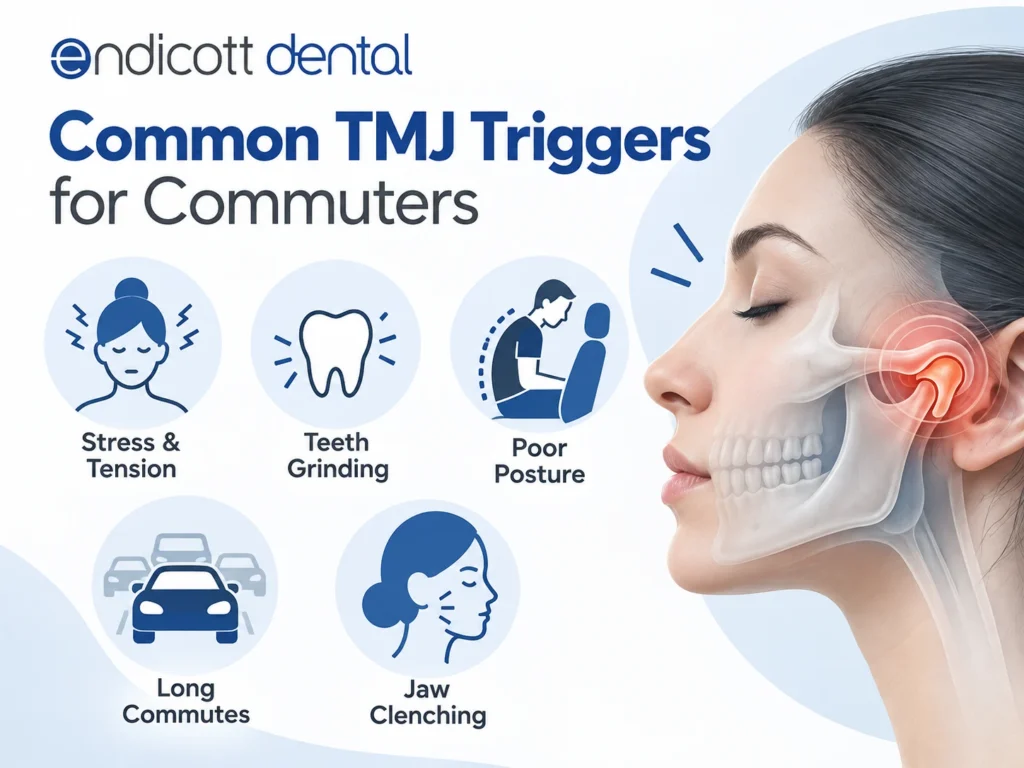
For commuters, the connection is often behavioral.
Traffic gets frustrating.
You brace.
Your shoulders rise.
Your grip tightens.
Your jaw follows.
You may not actually grind your teeth.
You may simply hold them together with sustained pressure.
That is clenching.
And it can happen silently.
The Commuter Habit Most People Don't Notice: Daytime Clenching
Try this right now.
Are your upper and lower teeth touching?
If you are not chewing or swallowing, they generally do not need to be.
A relaxed jaw usually has a small amount of space between the upper and lower teeth.
Yet people who are focused, stressed, driving, working, lifting weights, concentrating, or staring at a deadline often find themselves pressing their teeth together.
At Endicott Dental, our existing guidance on bruxism describes this as awake bruxism daytime clenching, grinding, or jaw bracing that may occur during work, driving, concentration, or stress.
You may spend hours doing it without realizing it.
Try the “Teeth Apart” Check During Your Commute
Every time you stop at a red light, check three things:
Shoulders down.
Teeth apart.
Jaws relaxed.
You do not need to drive around with your mouth hanging open.
Simply stop holding the back teeth together.
A useful reminder is:
Lips together. Teeth apart. Jaws relaxed.
It sounds almost too simple.
For daytime clenchers, awareness is often an important first step.
Why Does Your Jaw Hurt More After Work?
The chewing muscles can become tired just like any other muscles.
Think about holding a dumbbell in one position for several hours.
You do not need to move it dramatically for the muscle to fatigue.
Sustained contraction is enough.
Jaw clenching can work the same way.
By late afternoon, you may notice:
- Facial fatigue
- Temple pressure
- A dull ache near the ears
- Tender cheeks
- Neck tension
- Headaches
- A feeling that your bite is “tired”
TMD can involve both the joint and the muscles controlling the jaw. NIDCR distinguishes joint disorders from disorders involving the masticatory muscles, and patients can have more than one type simultaneously.
That is why not everyone with “TMJ pain” has exactly the same problem.
What If Your Jaw Is Worse in the Morning?
Morning symptoms shift our attention toward what may be happening while you sleep.
Possible signs of nighttime clenching or grinding include:
- Morning jaw soreness
- Temple headaches
- Facial muscle fatigue
- Tooth sensitivity
- Flattened teeth
- Chipped edges
- Broken fillings
- Broken crowns
- A partner hearing grinding sounds
NIDCR defines bruxism as clenching, grinding, or bracing the jaw and notes that dentists may look for damaged teeth and restorations as well as tender jaw muscles when evaluating it.
But there is an important caution.
Not every patient who wakes with jaw pain is grinding.
And not every person who grinds develops TMD.
Diagnosis still matters.
Can Commuting Posture Make Jaw Pain Worse?
It may contribute to the overall muscle-tension pattern.
Think about how many people drive:
Head pushed forward.
Chin slightly elevated.
Shoulders rounded.
One hand gripping the steering wheel.
Upper body tense.
Then they arrive at work and spend another eight hours leaning toward a monitor.
TMD evaluations often include the neck because jaw, head, and cervical symptoms can overlap. The American Academy of Family Physicians identifies neck pain and tenderness in surrounding cervical muscles among common findings in people presenting with TMD.
That does not mean poor posture is proven to be the sole cause of your jaw problem.
It means jaw pain should not always be treated as though the joint exists in isolation from the rest of your head and neck.
Why Does My Jaw Click but Not Hurt?
A painless click often represents movement of the disc within the joint without significant painful inflammation or functional limitation.
You may have had it for years.
And you may continue having it for years without needing treatment.
Research following people with disc displacement and clicking has found that many clicking joints do not automatically progress to severe locking or dysfunction.
That is reassuring.
The mistake is assuming:
Click = inevitable joint destruction.
That is not supported by current evidence.
If there is no pain or limitation, aggressive treatment is usually difficult to justify.
What If the Clicking Suddenly Stops?
This sounds like good news.
Sometimes it is.
But there is one situation where a suddenly quiet jaw deserves attention:
Your jaw used to click, and now it no longer clicks but you cannot open normally.
A joint disc that previously clicked back into position may sometimes remain displaced instead.
Merck describes this as disc displacement without reduction. Patients may suddenly experience limited opening or a “closed lock,” often after having a history of clicking.
If your clicking disappears and your opening simultaneously becomes restricted, do not celebrate the silence.
Have it evaluated.
What Does Jaw Locking Feel Like?
Patients describe it in different ways:
- “My jaw gets stuck.”
- “I can't open all the way.”
- “It catches halfway.”
- “I woke up and my mouth wouldn't open.”
- “I have to wiggle it until it releases.”
An occasional brief catch may be different from persistent locking.
But repeated or significant locking deserves attention.
NIDCR lists limited movement and locking among symptoms that can signal a TMD.
A jaw that becomes fully dislocated and remains stuck open is a different situation and requires urgent care.
Can TMJ Problems Cause Headaches?
They can be associated with headaches.
The chewing muscles extend into the temple area, and muscle-related TMD can overlap with headache symptoms.
AAFP's evidence review lists headache among commonly reported symptoms in TMD patients.
But this needs a warning:
Not every headache is a TMJ headache.
Migraines, sinus problems, vision issues, sleep problems, medication effects, neurologic conditions, tension-type headaches, and many other problems can cause head pain.
If you develop new, severe, unusual, or neurologically concerning headaches, dental treatment should not substitute for appropriate medical evaluation.
Can TMJ Feel Like an Ear Problem?
Yes.
The TMJ sits directly in front of the ear.
Some TMD patients report:
- Ear-area pain
- A feeling of pressure or fullness
- Ringing
- Discomfort near the ear
NIDCR lists tinnitus, hearing symptoms, and dizziness among symptoms reported in some people with TMD.
But again, your dentist cannot assume an ear symptom comes from your jaw.
Ear infections and other medical conditions require their own evaluation.
Can Clenching Damage Your Teeth Too?
Yes.
This is one reason we care even when the joint itself is not severely painful.
Repeated clenching or grinding forces can contribute to:
- Worn enamel
- Chipped tooth edges
- Cracked teeth
- Damaged fillings
- Broken crowns
- Tooth sensitivity
- Muscle soreness
Endicott Dental's existing bruxism guidance specifically notes that local professionals may first recognize the problem through chipped edges, worn teeth, morning headaches, cracked restorations, or jaw soreness rather than obvious grinding sounds.
Sometimes the jaw is not what gets the patient's attention.
A crown breaking does.
Should You Buy a Nightguard if Your Jaw Clicks?
Not simply because it clicks.
This is where product marketing gets ahead of diagnosis.
NIDCR notes that intraoral appliances often called splints or nightguards may protect teeth or help with clenching habits, but evidence for improving TMD pain is limited. It also warns against appliances designed to permanently change the bite.
So:
Painless click only?
A nightguard may not be necessary.
Clear nighttime grinding with damaged teeth?
Protecting the teeth may make sense.
Jaw pain plus grinding?
An appliance may be one part of a broader management plan.
At Endicott Dental, current TMJ services include night guards and therapeutic splints when they are appropriate for the patient's diagnosis.
The important word is appropriate.
A guard should not be prescribed as a universal cure for every jaw noise.
Store-Bought Nightguard or Custom Guard?
For a person with obvious tooth grinding, a drugstore guard can seem like an inexpensive experiment.
But it is not equivalent to a properly designed dental appliance.
Store-bought guards may be:
- Bulky
- Poorly retentive
- Uncomfortable
- Easy to chew on
- Difficult to sleep with
A custom appliance is designed around your teeth and bite.
That does not mean every custom splint fixes TMD pain.
It means that if an appliance is clinically appropriate, fit and design matter.
If any appliance makes your pain or bite feel worse, stop using it and contact the clinician who provided it. NIDCR specifically recommends discontinuing an intraoral appliance and seeking professional advice if it causes pain.
What Can You Safely Try at Home for Mild Jaw Soreness?
For mild symptoms without significant locking, swelling, injury, or severe pain, conservative care is usually where experts recommend starting.
NIDCR emphasizes simple, reversible approaches before invasive treatment.
Reduce Clenching During the Day
This is especially relevant for commuters.
Use your red lights as reminders:
Teeth apart.
You could also place a small sticker on your steering wheel or dashboard—not somewhere distracting—as a visual cue.
Stop Chewing Gum for a While
If the joint and muscles are already irritated, an hour of gum chewing is basically an extra workout.
Give the jaw a break.
Temporarily Choose Easier Foods
You do not need to live on soup unless advised.
But during a flare, consider avoiding:
- Tough steak
- Jerky
- Very chewy bread
- Hard candy
- Ice
- Huge sandwiches that require extreme opening
NIDCR includes temporary soft-food choices among initial conservative strategies.
Use Heat or Cold if It Feels Helpful
Heat may be comfortable for tight muscles.
A cold may feel better for certain painful or inflamed areas.
NIDCR includes heat or cold as reasonable conservative measures.
Avoid Extreme Jaw Opening
If the jaw is irritated, do not repeatedly test it by opening as wide as possible to see whether it still clicks.
Support the jaw during a large yawn if necessary.
Take smaller bites.
Work on Sleep
Poor sleep and pain can reinforce each other.
If you grind at night and also snore heavily, wake gasping, or experience excessive daytime sleepiness, tell your healthcare provider. Sleep-related conditions may need evaluation beyond a nightguard.
Should You Take Ibuprofen for TMJ Pain?
Over-the-counter anti-inflammatory medications such as NSAIDs may be useful for some patients with short-term TMD pain, and NIDCR lists them among common conservative options.
But medication needs to be appropriate for you.
NSAIDs are not suitable for everyone, particularly people with certain gastrointestinal, kidney, bleeding, cardiovascular, medication, pregnancy, or allergy considerations.
If you are unsure whether you can safely take an anti-inflammatory, ask your physician, dentist, or pharmacist.
And if you need pain medication continuously just to make it through the workday, that is a reason to have the underlying problem evaluated.
What About Jaw Exercises?
The right exercise can help some patients.
The wrong exercise or doing the right exercise aggressively can make an irritated joint worse.
Physical therapy and gentle exercises are included among conservative approaches to TMD, although evidence varies depending on the exact diagnosis and technique.
We would not recommend finding the most dramatic “TMJ adjustment” on social media and forcing your jaw through it.
If movement is limited or painful, get a diagnosis first.
Does Your Bite Cause TMJ?
This is another area where dentistry has changed.
For years, TMD was frequently blamed on a “bad bite,” and treatments sometimes attempted to permanently change the teeth to correct it.
Current evidence is much more cautious.
NIDCR states that research does not support the belief that malocclusion or orthodontic treatment is a general cause of TMD. It also warns that irreversible bite-changing treatments such as grinding down teeth, crowns performed specifically to alter the bite, or orthodontics used as TMD therapy are not supported by strong evidence and may make problems worse.
That matters.
If someone proposes permanently changing healthy teeth solely to cure a jaw click, ask questions.
Conservative, reversible treatment should generally come first.
Does Botox Fix TMJ?
Botulinum toxin gets a lot of attention online.
The evidence is less definitive than the marketing.
NIDCR notes that botulinum toxin type A is not FDA-approved specifically for TMD and that studies have produced mixed results, leaving uncertainty about its effectiveness for TMD symptoms.
That does not mean nobody ever benefits.
It means patients should understand that it is not a universally proven solution for every jaw problem.
Diagnosis first.
Procedure second.
When Does TMJ Need Surgery?
Far less often than patients fear.
Most TMD management begins conservatively.
NIDCR recommends trying simple and reversible approaches first and approaching treatments that permanently alter the joint with considerable caution.
Surgical or joint-invasive approaches may be appropriate in selected patients with significant structural problems that do not respond to conservative treatment.
A commuter with a mild click and tight jaw muscles is a very different patient from someone with severe joint disease and major functional limitation.
They should not receive the same treatment plan.
How Does a Dentist Evaluate Jaw Clicking?
There is no single universal blood test or X-ray that diagnoses every TMD.
NIDCR specifically notes that diagnosis can be difficult because several TMD conditions exist and symptoms can overlap with other problems.
Your evaluation may include questions about:
- When the clicking started
- Whether it hurts
- Whether the jaw locks
- Morning versus evening symptoms
- Grinding or clenching
- Headaches
- Neck pain
- Past jaw injuries
- Sleep
- Stress patterns
- Tooth damage
The dentist may also examine:
- Jaw range of motion
- Joint sounds
- Muscle tenderness
- Jaw movement
- Tooth wear
- Cracked teeth or restorations
Imaging is not necessary for every clicking jaw.
MRI or CT may be considered when the diagnosis is unclear or when significant joint pathology is suspected.
What Does Endicott Dental Look for in a High-Stress Commuter?
For someone arriving from Broken Arrow, Tulsa, Bixby, Coweta, or another part of the metro with jaw complaints, we are not just asking:
“Does your jaw click?”
We want to understand the pattern.
Do you clench in traffic?
Do you wake with pain?
Are your teeth wearing down?
Have you broken fillings?
Is the discomfort muscular?
Does the joint itself hurt?
Can you open normally?
Does it lock?
Did the problem start after an injury?
Are there signs that nighttime grinding may be involved?
Endicott Dental's current TMJ services include evaluation and personalized care for symptoms such as jaw pain, clicking or popping, headaches, neck tension, and grinding, with appliances available when clinically appropriate.
The goal is not to sell every patient the same device.
It is to figure out which structure is actually causing the problem.
When Should You Make an Appointment?
A painless click can usually wait for a routine discussion.
We would schedule an evaluation sooner if you experience:
- Persistent jaw pain
- Increasing pain
- Pain every time you chew
- Jaw locking
- Difficulty opening
- Significant facial tenderness
- Morning headaches with heavy tooth wear
- Broken teeth, fillings, or crowns
- A sudden change in your bite
- Symptoms after trauma
- A click that has suddenly changed alongside loss of movement
Jaw pain can overlap with dental problems, ear problems, headaches, nerve conditions, and other medical concerns, so persistent symptoms deserve diagnosis rather than assumptions.
When Is Jaw Pain an Emergency?
Typical TMD is usually not a hospital emergency.
Seek urgent evaluation when you have:
- Significant facial swelling
- A serious recent injury
- A jaw that is dislocated and stuck open
- Difficulty breathing or swallowing
- Severe infection symptoms
- Chest pain or other symptoms suggesting a medical emergency
Do not label every pain around the jaw as “TMJ.”
Location alone does not tell us the cause.
Don't Let Your Commute Become a Daily Jaw Workout—Let Endicott Dental Help
If you drive from Broken Arrow into Tulsa every morning, your commute may be unavoidable.
Clenching through all of it is not.
At Endicott Dental, we can help determine whether your clicking jaw is simply making noise or whether the joint, muscles, teeth, or dental restorations are beginning to show signs of overload.
Sometimes the answer is reassuring:
“It clicks, but it doesn't hurt and everything is functioning normally. We can monitor it.”
Sometimes the best first step is habit awareness, softer foods during a flare, heat, and reducing clenching.
For patients with clear grinding-related tooth damage, a properly designed appliance may be worth discussing.
And if the symptoms suggest a more complex joint or muscle problem, we can help determine whether imaging, physical therapy, medical evaluation, or specialty care makes sense.
The important thing is not to chase every click.
It is to know the difference between noise and dysfunction.
If your jaw is clicking, aching during the commute, waking you with soreness, or starting to affect the way you eat and work, Endicott Dental can help you understand what's happening before you commit to treatment.
Sometimes your jaw needs treatment.
Sometimes it simply needs you to stop using every traffic jam as an isometric exercise.
Frequently Asked Questions About Clicking Jaws and TMJ
Why does my jaw click when I open my mouth?
A common cause is movement of the small disc inside the temporomandibular joint.
With disc displacement with reduction, the disc may sit slightly out of position when the mouth is closed and move back into place during opening, creating a click or pop.
Is the jaw clicking normal?
Painless jaw clicking is common.
NIDCR states that clicking or popping without pain generally does not require treatment.
When should I worry about a clicking jaw?
Have it evaluated if clicking is accompanied by pain, locking, limited opening, difficulty chewing, a change in your bite, or other worsening symptoms.
Can stress cause TMJ?
TMD usually does not have one simple cause.
Research suggests that psychological and life stressors may contribute to the development or persistence of symptoms in some patients, and stress may also increase behaviors such as daytime jaw clenching.
Can driving make TMJ worse?
Driving itself has not been established as a direct cause of TMD.
However, some people clench their jaws while driving, especially when stressed or concentrating. Sustained clenching can fatigue the jaw muscles and may aggravate symptoms.
How long is the average commute in Broken Arrow?
Current U.S. Census data report a mean one-way travel time to work of approximately 21.9 minutes for Broken Arrow workers.
How long is the average commute in the Tulsa metro?
Recent ACS data put the Tulsa metropolitan area's mean travel time at roughly 22 minutes one way.
Individual commutes may be much shorter or longer.
Should my teeth be touching when I'm driving?
Normally, when you are relaxed and not chewing or swallowing, your teeth generally should not be held tightly together.
If you notice constant contact, consciously relax the jaw.
Can TMJ cause headaches?
TMD can be associated with headaches, particularly when the chewing and temple muscles are involved.
Headaches have many other causes, so persistent or concerning headaches deserve appropriate evaluation.
Can TMJ cause ear pain?
Pain near the TMJ may be perceived around the ear because of the joint's location.
TMD can also be associated with ear-area symptoms, but actual ear disease needs to be ruled out when appropriate.
Why does my jaw hurt in the morning?
Morning soreness may be associated with nighttime clenching or grinding, although other conditions can cause similar symptoms.
A dentist may look for tooth wear, damaged restorations, muscle tenderness, and other signs of bruxism.
Why does my jaw hurt more at night?
For some people, daytime jaw clenching gradually fatigues the muscles, making symptoms more noticeable after work.
This is especially relevant if you notice yourself clenching while driving or concentrating.
Can jaw clenching crack teeth?
Repeated heavy clenching and grinding may contribute to tooth wear, cracks, chipped teeth, and damaged restorations.
Endicott Dental's current bruxism guidance includes cracked teeth, broken fillings, and worn enamel among problems that may occur with excessive clenching forces.
Should I use a nightguard for jaw clicking?
Not solely because the joint makes a painless clicking sound.
A nightguard may be more appropriate when there is evidence of grinding, clenching, or tooth damage.
NIDCR notes that evidence for oral appliances as a TMD pain treatment is limited, so appliances should be selected for the individual diagnosis.
Can a nightguard cure TMJ?
A nightguard should not be considered a universal cure.
It may protect teeth from grinding forces or help selected patients, but TMD includes many different conditions requiring different management.
Does Endicott Dental offer TMJ treatment?
Yes. Endicott Dental currently offers TMJ and jaw-pain evaluation in Broken Arrow, with options that can include night guards and therapeutic splints when appropriate.
Should a TMJ appliance change my bite permanently?
NIDCR recommends avoiding appliances or treatments intended to permanently alter the bite for routine TMD management because evidence of benefit is inadequate and irreversible treatment may cause harm.
Does Invisalign or orthodontics fix TMJ?
Orthodontics should not be assumed to treat TMD.
Current NIDCR guidance states that evidence does not support orthodontic treatment or malocclusion as a general explanation for TMD, and irreversible bite-changing treatments should not be used casually for jaw-joint symptoms.
Can TMJ be caused by a bad bite?
The relationship is much less straightforward than people were historically taught.
Current evidence does not support a strong general link between malocclusion and TMD.
Does TMJ always get worse?
No.
Many TMD symptoms are temporary, improve without extensive treatment, or remain stable. NIDCR notes that many TMDs are short-lived and may resolve on their own.
Can a jaw click disappear?
Yes.
A click can change or disappear over time.
If it disappears and everything still moves comfortably, that may not be concerning.
If it disappears at the same time your jaw becomes difficult to open, schedule an evaluation because the joint disc may no longer be returning to its previous position.
What should I eat during a TMJ flare?
Temporarily choosing softer foods that require less chewing can reduce jaw workload.
NIDCR includes a soft-food diet among simple initial management strategies.
This does not necessarily mean a long-term liquid diet.
Should I stop chewing gum if my jaw hurts?
Yes, at least temporarily.
Repeated gum chewing creates additional work for already sore chewing muscles and joints. NIDCR specifically recommends reducing habits such as gum chewing when managing TMD discomfort.
Can heat help a sore jaw?
Heat is one conservative measure commonly used for muscle-related jaw discomfort. Some patients prefer cold.
NIDCR includes both heat and cold among simple approaches that may be considered.
Is Botox approved for TMJ?
Botulinum toxin type A is not FDA-approved specifically for TMD. Research results are mixed, and NIDCR states that it remains unclear whether it effectively relieves TMD symptoms.
Do most TMJ patients need surgery?
No.
Experts recommend starting with conservative, reversible treatments because many TMDs improve without invasive procedures. Surgery is generally reserved for selected patients with significant problems that have not responded to simpler management.
What is the easiest habit for a Tulsa commuter to change today?
Check whether you are clenching at red lights.
Relax your shoulders.
Let the teeth separate.
Keep the jaw loose.
It costs nothing, takes seconds, and can help you discover whether your commute has quietly become several extra jaw workouts every week.
When should I make an appointment with Endicott Dental?
Schedule an evaluation if jaw symptoms are painful, worsening, interfering with eating, causing locking or limited opening, or occurring alongside visible tooth wear, broken restorations, or significant morning soreness.
A painless click can usually be discussed at a routine visit.
Pain or loss of function deserves a closer look.
