

Table of Contents
Parents are getting mixed messages about fluoride right now.
One person says fluoride is one of the best tools we have to prevent cavities. Another says children are getting too much. Then you hear about fluoride in toothpaste, fluoride in city water, fluoride varnish at the dentist, and prescription fluoride drops or tablets.
It gets confusing fast.
So let’s make this practical for Broken Arrow parents.
Fast answer: Most kids in Broken Arrow probably do not need fluoride supplements
If your child drinks regular Broken Arrow municipal tap water, they likely do not need prescription fluoride supplements.
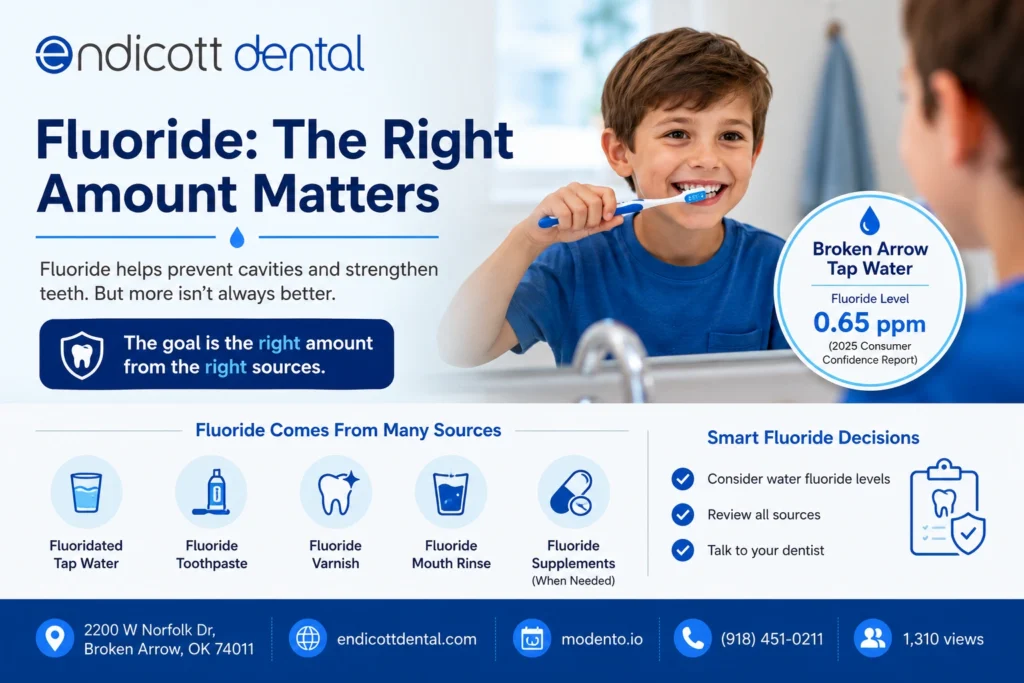
Why? Because Broken Arrow’s 2025 Consumer Confidence Report shows fluoride detected in the municipal water supply at 0.65 ppm, and water purchased from Tulsa showed fluoride at 0.78 ppm, with a reported range of 0.63–0.78 ppm. That is close to the commonly recommended community water fluoridation target of 0.7 ppm.
The American Academy of Pediatric Dentistry says the standard level for community water fluoridation is 0.7 ppm, and that fluoride supplement decisions should consider drinking water fluoride levels, other fluoride sources, toothpaste use, diet, and the child’s cavity risk.
So for most Broken Arrow kids drinking city water, the better question is not:
“Should my child be taking fluoride?”
It is:
“Is my child already getting the right amount from water, toothpaste, and dental visits?”
For many families here, the answer is yes.
What are fluoride supplements?
Fluoride supplements are prescription fluoride drops, tablets, or lozenges that a child swallows.
They are different from:
- Fluoride toothpaste
- Fluoride varnish painted on teeth at the dentist
- Fluoride mouth rinse
- Fluoridated tap water
That difference matters.
Most parents are not really debating fluoride toothpaste. They are asking whether their child needs extra swallowed fluoride on top of everything else.
That should not be a guess.
Why fluoride is used in the first place
Fluoride helps prevent cavities by strengthening enamel, helping remineralize early weak spots, and reducing acid activity from cavity-causing bacteria. The AAPD states that fluoride helps prevent caries in these ways and recognizes drinking fluoridated water and brushing with fluoride toothpaste twice daily as among the most effective methods for reducing cavities in children.
That does not mean “more fluoride is always better.”
It means the right amount, used the right way, can be helpful.
That is the part that gets lost in the public debate.
The local factor: Broken Arrow water is already fluoridated
This is where local guidance matters.
A family in rural Oklahoma on well water may need a different answer than a family in central Broken Arrow on city water.
Broken Arrow’s published water quality report shows fluoride at 0.65 ppm in Broken Arrow Municipal Authority testing, and the report also lists water supplied from Tulsa with fluoride at 0.78 ppm and a range of 0.63–0.78 ppm.
Tulsa’s own 2025 Annual Water Quality Report lists an average fluoride level of 0.69 ppm and notes that the U.S. Public Health Service recommends 0.7 mg/L to maintain cavity-prevention benefits while reducing fluorosis risk.
That means most kids drinking municipal tap water in Broken Arrow are already getting fluoride exposure from water.
Adding supplements without checking the child’s full exposure may be unnecessary.
When might a child need fluoride supplements?
Fluoride supplements may be considered when a child has low fluoride exposure and higher cavity risk.
Examples may include:
| Situation | Supplement discussion may make sense? |
| Child drinks Broken Arrow city water daily | Usually no |
| Child drinks mostly bottled water with little or no fluoride | Maybe |
| Family uses reverse osmosis filtration for drinking water | Maybe |
| Child lives on private well water | Maybe, after water testing |
| Child has frequent cavities despite brushing | Maybe |
| Child has special health needs or high decay risk | Maybe |
| Child is under age 3 | Be especially cautious; ask the dentist or pediatrician |
The AAPD says supplements should be based on fluoride levels in drinking water, other dietary fluoride sources, toothpaste use, and cavity risk. It also says families should review all sources of fluoride before supplements are prescribed, including home water, daycare or school water, bottled water, other beverages, prepared foods, infant formula, and toothpaste.
That is the responsible approach.
Not automatic supplementation.
Not automatic rejection.
A risk-based decision.
The 2025 FDA update parents should know about
In 2025, the FDA announced actions to restrict the sale of certain unapproved ingestible fluoride prescription drug products for children. The FDA specifically targeted products labeled for children under age 3 and older children at low or moderate risk for tooth decay.
The ADA responded by noting that the FDA recommendation said ingestible fluoride products should not be given to children under age 3 or to children at low or moderate risk for tooth decay. The ADA also stated that earlier plans to remove fluoride supplements from the market were replaced with a warning approach instead of a full ban.
Here is what that means in plain English:
Fluoride supplements are not something parents should casually add because they heard fluoride prevents cavities.
They are prescription products that should be used selectively.
That has actually been the sensible dental approach for a long time.
What if your family uses bottled water?
This is one of the most common situations where Broken Arrow parents may accidentally reduce their child’s fluoride exposure.
If your child drinks mostly bottled water, they may not be getting the same fluoride exposure as a child drinking city tap water.
Some bottled waters contain fluoride. Some do not. Some labels are unclear.
The practical move is simple: bring the brand names to your child’s dental visit and ask whether their total fluoride exposure looks appropriate.
What if you use a reverse osmosis filter?
Reverse osmosis systems can remove a lot from drinking water, including much of the fluoride.
That does not mean reverse osmosis is “bad.” Some families choose it for taste or other water concerns.
But if your child drinks mostly RO-filtered water, the dentist needs to know that.
A child drinking Broken Arrow tap water straight from the faucet and a child drinking RO-filtered water every day may not have the same fluoride exposure.
Same city. Different real-world intake.
What if you have well water?
If your child drinks private well water, do not guess.
Test it.
Private well water is not the same as municipal water. Fluoride levels can be low, adequate, or high depending on the source. Before giving a child fluoride supplements, you need to know the fluoride level in the water they actually drink.
This is especially important because too little fluoride may raise cavity risk, but too much fluoride during early tooth development can increase the chance of dental fluorosis.
What is dental fluorosis?
Dental fluorosis is a change in the appearance of developing enamel caused by too much fluoride intake while adult teeth are forming.
Mild fluorosis may look like faint white streaks or spots. More significant fluorosis can affect appearance more noticeably.
This is why dosing matters.
The goal is not “as much fluoride as possible.”
The goal is enough fluoride to reduce cavities without unnecessarily increasing fluorosis risk. The AAPD specifically notes that the 0.7 ppm standard helps balance cavity prevention with the possibility of fluorosis from excessive ingestion during the early years of tooth development.
What about fluoride toothpaste?
For most kids, fluoride toothpaste is still one of the most useful tools at home.
The AAPD encourages brushing with the appropriate amount of fluoride toothpaste twice daily for all children. It recommends a grain-of-rice-sized amount for children younger than 3 and no more than a pea-sized amount for children ages 3 to 6.
That is where parents can make a real difference.
A small amount, used consistently, beats occasional overuse.
What should Broken Arrow parents do?
Here is the practical decision tree.
If your child drinks Broken Arrow city water
They probably do not need fluoride supplements unless they are unusually high risk for cavities and a dentist or pediatrician specifically recommends them.
If your child drinks mostly bottled water
Ask your dentist to review fluoride exposure. Bring the water brand if possible.
If your child drinks reverse-osmosis filtered water
Tell your dentist. Your child may be getting less fluoride than expected.
If your child is on well water
Test the water before making any supplement decision.
If your child has frequent cavities
Do not assume supplements are the answer. The bigger issue may be brushing habits, sugar frequency, snacking, dry mouth, enamel defects, crowded teeth, reflux, medications, or missed preventive visits.
If your child is under 3
Be extra careful with swallowed fluoride supplements. The 2025 FDA update specifically warned against certain ingestible fluoride products for children under age 3.
The most common mistake parents make
The biggest mistake is treating fluoride like a yes-or-no identity issue.
It is not.
For kids, fluoride is a dose-and-risk question.
A child who drinks fluoridated city water, brushes twice daily with fluoride toothpaste, and has low cavity risk probably does not need extra swallowed fluoride.
A child on well water with very low fluoride and repeated cavities may be a different story.
Same ingredient. Different child. Different answer.
Questions to ask your child’s dentist
Ask these before starting supplements:
- How much fluoride is in the water my child actually drinks?
- Is my child low, moderate, or high risk for cavities?
- Are we using the right amount of toothpaste?
- Does my child need fluoride varnish?
- Would supplements help, or would they be unnecessary?
- What are the risks of too much fluoride at my child’s age?
- Should we test our well water or filtered water?
- What should we change first: brushing, snacks, drinks, varnish, sealants, or supplements?
A good dentist should be able to answer without making you feel foolish for asking.
Bottom line for Broken Arrow families
Most Broken Arrow kids drinking municipal tap water probably do not need fluoride supplements.
The local water supply already appears to be near the recommended fluoride range based on the most recent published reports.
But some children may need a closer look, especially if they drink mostly bottled water, use reverse osmosis water, live on well water, or have a history of cavities.
At Endicott Dental in Broken Arrow, Dr. Drew Endicott and the team can help parents sort through the practical question: not “Is fluoride good or bad?” but “Is my child getting the right amount for their actual risk?”
If you’re not sure what your child needs, Endicott Dental can help you review their cavity risk, water source, brushing habits, and preventive options before you commit to anything.
FAQs
Do kids in Broken Arrow need fluoride supplements?
Most kids drinking Broken Arrow municipal tap water probably do not need fluoride supplements because the local water supply already contains fluoride near the commonly recommended level. Children who drink mostly bottled, reverse-osmosis, or well water may need a more individualized review.
What is the fluoride level in Broken Arrow water?
Broken Arrow’s 2025 Consumer Confidence Report lists fluoride at 0.65 ppm for Broken Arrow Municipal Authority testing and 0.78 ppm for water supplied from Tulsa, with a range of 0.63–0.78 ppm.
What fluoride level is considered optimal?
The AAPD and Tulsa’s water report both reference 0.7 ppm as the standard or recommended level used to balance cavity prevention with fluorosis risk.
Are fluoride supplements the same as fluoride toothpaste?
No. Supplements are swallowed prescription products. Toothpaste is topical and should mostly be spit out. The risk and purpose are different.
Should my child take fluoride if we use bottled water?
Maybe, but not automatically. Some bottled waters have fluoride and some do not. Ask your dentist to review your child’s water source, cavity risk, and toothpaste use.
Should we test well water before giving fluoride supplements?
Yes. If your child drinks well water, test the water first. You need to know the actual fluoride level before deciding whether supplements are appropriate.
Is fluoride varnish different from supplements?
Yes. Fluoride varnish is professionally applied to the teeth. Supplements are swallowed. Varnish may be recommended for children at cavity risk without necessarily adding swallowed fluoride.
Can too much fluoride be a problem?
Yes. Too much fluoride during early tooth development can increase the risk of dental fluorosis. That is why fluoride supplement decisions should be based on water fluoride levels, other fluoride sources, age, and cavity risk.
