

Table of Contents
Most people do not ask, “Are FASTBRACES® better than traditional braces?” just because they want a straighter smile.
They ask because they are trying to figure out the real investment.
Not just the price.
The time. The appointments. The discomfort. The food restrictions. The school photos. The wedding is coming up. The job interview. The “Can I really do this for two years?” question.
So let’s compare FASTBRACES® and traditional braces the way a real patient in Broken Arrow would think about it: what you pay, how long it takes, what you give up, and when faster treatment is not automatically the better choice.
Fast answer: Which costs less, FASTBRACES® or traditional braces?
In many cases, FASTBRACES® can cost less than traditional braces because treatment time may be shorter and may require fewer visits. But that is not guaranteed.
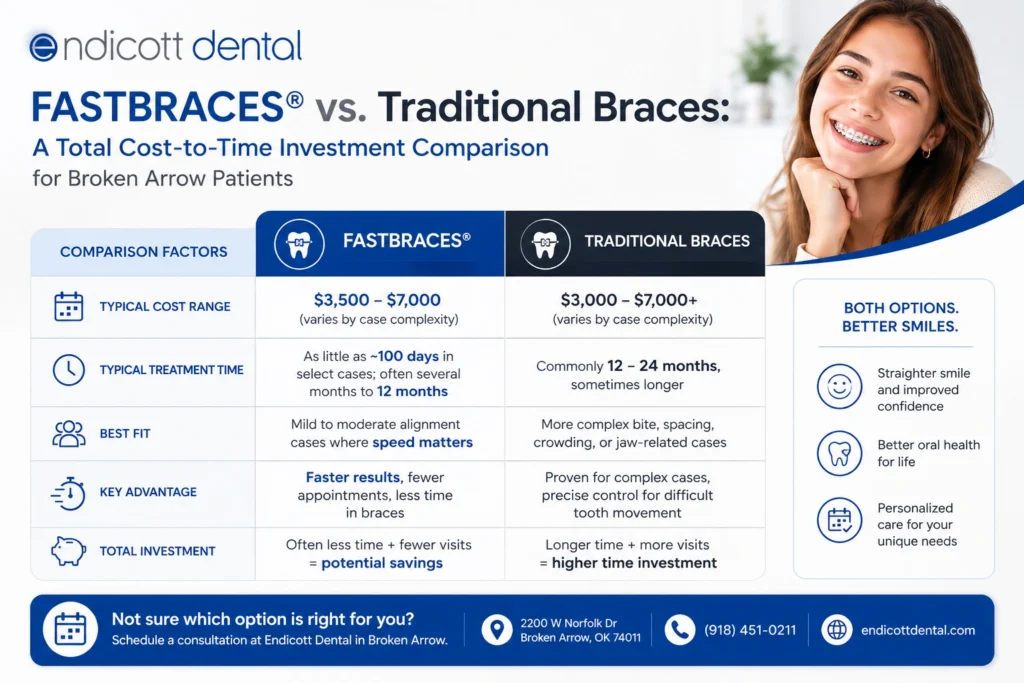
Traditional braces often range from about $3,000 to $7,000 nationally, depending on case complexity, treatment length, location, and appliance type. The American Association of Orthodontists notes that orthodontic cost is affected by the type of treatment, complexity, and duration.
FASTBRACES pricing is harder to quote nationally because fees vary by provider and case, but consumer dental cost sources commonly place FASTBRACES® somewhere around $3,500 to $7,000, with some cases lower or higher depending on complexity.
Here is the practical comparison:
| Treatment option | Typical cost range | Typical treatment time | Best fit |
| FASTBRACES® | Often around $3,500–$7,000 | As little as about 100 days in select cases; often several months to 12 months | Mild to moderate alignment cases where speed matters |
| Traditional braces | Often around $3,000–$7,000+ | Commonly 12–24 months, sometimes longer | More complex bite, spacing, crowding, or jaw-related cases |
At Endicott Dental, FASTBRACES® are presented as a faster orthodontic option, with some cases moving teeth in as little as 100 days and more complicated cases taking up to 12 months. Endicott Dental also notes that most traditional braces take about 12–24 months.
That does not mean every patient is a 100-day case.
That is the part patients need to hear clearly.
What are FASTBRACES®?
FASTBRACES® are a type of braces designed to move teeth differently than traditional braces. The company describes the system as patented braces technology that can straighten teeth quickly, in some cases around 100 days.
Endicott Dental describes FASTBRACES® as using a unique bracket and archwire system intended to move teeth faster than traditional braces.
The basic idea is this:
Traditional braces often move the visible part of the tooth first and then work on root movement over time. FASTBRACES® are designed to move the crown and root together earlier in treatment.
That is why the main selling point is not “invisible” or “removable.” It is speed.
What are traditional braces?
Traditional braces use brackets attached to the teeth and wires that are adjusted over time to gradually move the teeth and bite into better alignment. The ADA explains that braces usually involve small brackets cemented to the teeth and connected by a wire that is periodically adjusted by a dentist or orthodontist.
Traditional braces have been around for a long time because they work. They are not trendy, but they are reliable, especially for more complex orthodontic cases.
That matters because not every orthodontic problem is just “crooked front teeth.”
Some patients have:
- Crowding
- Rotated teeth
- Overbite
- Underbite
- Crossbite
- Open bite
- Spacing
- Midline problems
- Jaw relationship issues
- Teeth that need careful root positioning
For those patients, faster is not always safer, cheaper, or more complete.
The real comparison: cost per month vs. total investment
A common mistake is comparing braces only by total price.
That misses the point.
A $5,500 treatment that takes six months and a $5,500 treatment that takes 24 months are not the same experience.
They may cost the same on paper, but the life disruption is very different.
Example comparison
| Factor | FASTBRACES® example | Traditional braces example |
| Total treatment fee | $5,000 | $5,500 |
| Treatment length | 6 months | 20 months |
| Monthly “time cost” | Higher intensity, shorter period | Lower intensity, longer period |
| Appointment burden | Usually fewer total visits | Usually more total visits |
| Food restrictions | Shorter duration | Longer duration |
| Appearance concerns | Shorter duration | Longer duration |
| Risk of missed visits extending treatment | Still possible | Higher simply because treatment lasts longer |
This is why FASTBRACES® can be attractive to adults and teens who care about time as much as money.
For some patients, six to twelve months in braces is much easier to accept than two years.
But is FASTBRACES® always cheaper?
No.
This is where some marketing gets a little too simple.
FASTBRACES® may be less expensive if your case is straightforward and the shorter treatment time reduces the number of visits and adjustments. But the fee still depends on your diagnosis, how much movement is needed, the provider’s pricing, whether records are included, whether retainers are included, and whether additional treatment is needed before or after.
A FASTBRACES® case can become less of a “deal” if:
- You need extensive bite correction
- You need extra refinement after treatment
- You have gum or bone concerns
- You need extractions or restorative work first
- Your case is not ideal for accelerated movement
- Retainers or follow-up care are priced separately
The honest answer is this: FASTBRACES® may save time first, and money second.
If it saves both, great. But the time savings are usually the more dependable advantage.
The appointment cost nobody talks about
Patients often think about the dental bill but forget the cost of showing up.
Every orthodontic visit may mean:
- Missing work
- Pulling a child out of school
- Driving across Broken Arrow or Tulsa traffic
- Rearranging childcare
- Taking PTO
- Paying for gas
- Dealing with broken brackets or poking wires
- Planning around sports, band, vacations, weddings, and school events
A treatment that takes 18–24 months can create a lot of friction, even if each visit is manageable.
That is where a shorter treatment plan may have real value.
Not because the brackets are magical.
Because your life is busy.
Time comparison: FASTBRACES® vs. traditional braces
Endicott Dental states that most braces take 12–24 months, while FASTBRACES® may move teeth in as little as 100 days and up to 12 months for more complicated cases.
Here is the practical version:
| Case type | FASTBRACES® possible timeline | Traditional braces possible timeline |
| Minor cosmetic alignment | About 3–6 months in select cases | 6–12+ months |
| Mild to moderate crowding or spacing | 6–12 months | 12–24 months |
| More complex bite correction | May not be ideal or may require longer treatment | 18–30+ months |
| Severe skeletal or jaw-related issues | Usually not the simple answer | May require orthodontist and possibly surgical planning |
The key phrase is “possible timeline.”
Nobody should promise your exact treatment time without an exam, X-rays, bite evaluation, and orthodontic records.
Who is usually a good candidate for FASTBRACES®?
FASTBRACES® may be a good fit if you:
- Want faster treatment
- Have mild to moderate crowding or spacing
- Mainly want visible smile alignment improved
- Do not have severe bite problems
- Have healthy gums and bone support
- Can keep your teeth clean during treatment
- Can show up for appointments
- Understand retainers are still required afterward
This can be especially appealing for adults who have delayed braces for years because they do not want to spend two years in treatment.
It can also be appealing for teens who want to finish treatment before senior pictures, graduation, or college. For families exploring FASTBRACES® for BA students, the shorter potential treatment period can make orthodontic care easier to plan around school activities and major milestones.
Who may be better off with traditional braces?
Traditional braces may be the better fit if you have a more complex case.
That includes patients with:
- Significant bite problems
- Severe crowding
- Large gaps
- Jaw growth concerns
- Impacted teeth
- Complex root positioning needs
- Prior orthodontic relapse
- Missing teeth that affect spacing
- Cases needing very controlled tooth movement
This is not a knock against FASTBRACES®.
It is just dentistry.
The best treatment is not the fastest treatment. The best treatment is the one that solves the actual problem without cutting corners.
Cost comparison: what you are really paying for
With either option, you are not just paying for brackets and wires.
You are paying for:
- Diagnosis
- Treatment planning
- Records and imaging
- Tooth movement supervision
- Adjustments
- Emergency visits if something breaks
- Progress checks
- Bite management
- Retainers
- Follow-up care
That is why two offices may quote very different prices for what sounds like “braces.”
One quote may include records, retainers, and follow-up. Another may not.
Before you compare prices, ask what is included.
Questions to ask before choosing FASTBRACES® or traditional braces
Ask these before starting treatment:
- Am I a good candidate for FASTBRACES®, or would traditional braces give a better result?
- Is my issue mostly cosmetic alignment, or is my bite involved?
- How long do you realistically expect my case to take?
- What happens if treatment takes longer than expected?
- Are retainers included in the fee?
- Are X-rays, scans, records, and follow-up visits included?
- What costs extra?
- How often will I need appointments?
- What happens if a bracket breaks?
- Will insurance cover part of this?
A good provider should not be annoyed by these questions.
These are exactly the questions you should ask before spending several thousand dollars.
Insurance and financing: will dental insurance cover FASTBRACES®?
Possibly.
Most dental insurance plans that include orthodontic benefits do not simply pay because something is called braces. They pay based on the plan’s orthodontic coverage rules, age limits, lifetime maximums, waiting periods, and whether the provider is in network.
Some plans cover orthodontics for children but not adults. Some have a lifetime orthodontic maximum. Some cover a percentage up to a cap. Some cover nothing.
So the better question is not, “Does insurance cover FASTBRACES®?”
The better question is:
“Do I have orthodontic benefits, and how do they apply to this treatment plan?”
Endicott Dental notes that it works with patients on affordable dental care and financing options, which can matter when orthodontic treatment is not fully covered by insurance.
The biggest downside of choosing FASTBRACES®
The biggest downside is not that FASTBRACES® are bad.
The biggest downside is choosing them for the wrong reason.
If you choose FASTBRACES® only because you want the shortest timeline, you may overlook whether your bite, roots, gums, or long-term stability need a different plan.
Fast tooth movement still has to be biologically appropriate.
You want straight teeth, yes. But you also want teeth that fit together, stay stable, and are healthy long after the braces come off.
The biggest downside of traditional braces
The biggest downside is time.
Traditional braces are proven and versatile, but they can be a long commitment. For some patients, 18 to 24 months feels like too much.
That longer timeline can also mean:
- More appointments
- More chances for broken brackets
- Longer food restrictions
- More time cleaning around hardware
- More months feeling self-conscious
- More opportunities for treatment delays
Traditional braces are often worth it for complex cases. But if your case is simpler, it is fair to ask whether a faster option could get you where you want to go.
What about Invisalign or clear aligners?
Clear aligners are another option, and Endicott Dental lists Invisalign and clear aligners as part of its orthodontic offerings.
Aligners can be great for the right patient, especially adults who want removable and less visible treatment. Patients comparing orthodontic options may also want to understand how long Invisalign takes, since treatment timelines can vary depending on case complexity and how consistently the aligners are worn.
But aligners depend heavily on compliance. If you do not wear them as instructed, they do not work as planned.
Braces, including FASTBRACES® and traditional braces, are fixed to the teeth. That can be an advantage for patients who do not want to worry about losing trays or remembering to wear them 20-plus hours per day.
So which is the better investment?
Here is the simplest way to think about it.
Choose FASTBRACES® if:
You are a good candidate, your case is mild to moderate, speed matters, and you want a shorter treatment experience without jumping into a removable aligner system.
Choose traditional braces if:
Your case is more complex, your bite needs more correction, or your dentist believes slower, more controlled movement gives you a better long-term result.
Do not choose either until:
You have had a real orthodontic evaluation and know what the fee includes.
That is where the decision gets much clearer.
Bottom line for Broken Arrow patients
FASTBRACES® may offer a strong cost-to-time advantage for the right patient. If you can finish treatment in months instead of years, that may reduce not only the dental timeline but also the life burden that comes with braces.
But faster is not automatically better.
Traditional braces still have a place, especially for complex bite problems and cases that need more controlled movement.
At Endicott Dental in Broken Arrow, Dr. Drew Endicott and the team offer FASTBRACES®, traditional braces, clear braces, lingual braces, Invisalign, and hybrid orthodontic approaches, which means the conversation does not have to be forced into one option.
If you are trying to decide between FASTBRACES® and traditional braces, the right first step is not guessing based on price. It is finding out what your teeth actually need, how long each option would realistically take, and what your total out-of-pocket cost would be before you commit.
If you’re dealing with this decision and you’re not sure what to do next, Endicott Dental can help you understand your options before you commit to treatment.
FAQs
Are FASTBRACES® cheaper than traditional braces?
Sometimes, but not always. FASTBRACES® may cost less when treatment is shorter and less complex. But total cost depends on your case, the provider’s fee, what is included, and whether extra treatment or refinements are needed.
How fast do FASTBRACES® work?
Some cases may move in as little as about 100 days, but more complicated cases can take longer. Endicott Dental notes that FASTBRACES® cases may range from as few as 100 days up to 12 months depending on complexity.
How long do traditional braces take?
Traditional braces commonly take about 12 to 24 months, though some cases are shorter and complex cases can take longer. Endicott Dental describes most traditional braces treatment as taking 12–24 months.
Are FASTBRACES® only for adults?
No. FASTBRACES® may be used for teens or adults, depending on the case. The better question is whether the patient’s teeth, bite, gums, and goals fit the treatment.
Do FASTBRACES® hurt more because they move teeth faster?
Not necessarily, but any braces can cause soreness after placement or adjustments. Faster treatment does not mean there should be unsafe force. Tooth movement still needs to be monitored properly.
Can FASTBRACES® fix bite problems?
They may help some alignment and bite-related issues, but more complex bite problems may be better suited for traditional braces, orthodontic specialist care, or a more comprehensive plan.
Do I still need retainers after FASTBRACES®?
Yes. Retainers are required after any orthodontic treatment. Teeth can shift after FASTBRACES®, traditional braces, or Invisalign if retainers are not worn as directed.
Is the 100-day claim realistic?
It can be realistic for select cases, but it should not be treated as a promise for every patient. Your actual timeline depends on your starting point, goals, biology, hygiene, appointment consistency, and case complexity.
