

Table of Contents
If brushing your child’s teeth has somehow become the most difficult two minutes of your evening, you are not the only parent dealing with it.
You say, “Time to brush.”
Your child disappears.
You find them under a blanket.
They suddenly need water.
Then they need to use the bathroom.
Then the toothpaste is “too spicy.”
Then they insist they can brush by themselves.
Thirty seconds later, the toothbrush is wet, the front two teeth have been polished aggressively, and every back tooth has apparently been forgotten.
By that point, everyone is frustrated.
Here is the first thing we would tell parents at Endicott Dental:
The goal is not to convince your child to love brushing every single night. The goal is to create a routine that gets the teeth clean without turning brushing into a nightly negotiation.
That distinction changes how you approach the problem.
Children naturally want independence. Unfortunately, young children usually want control over toothbrushing before they have the coordination, patience, or attention span to do a thorough job themselves.
Current pediatric guidance recommends brushing twice daily with fluoride toothpaste, and many children continue to need an adult’s help until around age 7 or 8, sometimes longer depending on the child’s coordination and abilities.
So how do you respect a child’s growing independence without handing a 4-year-old complete responsibility for cavity prevention?
That is where what we call The Endicott Method comes in.
This is not a published dental protocol or complicated behavioral program. It is the practical approach we would want parents to use at home:
- Make brushing predictable.
- Give choices that do not change the outcome.
- Let your child take the first turn.
- Let the parent finish.
- Keep the interaction calm and short.
- Praise cooperation and repeat the same routine tomorrow.
The child gets some control.
The parent keeps responsibility for clean teeth.
And brushing stops being a debate that starts from zero every morning and night.
Here is how to make it work.
Why Do Kids Fight Toothbrushing in the First Place?
Before trying to solve the problem, it helps to understand what the problem actually is.
Most young children are not thinking:
“I have carefully reviewed the evidence regarding fluoride toothpaste and have decided to reject preventive dentistry.”
They are thinking:
“I don’t want to stop playing.”
“I want to do it myself.”
“I’m tired.”
“That toothpaste tastes weird.”
“I don’t like someone touching my mouth.”
“I figured out that if I refuse long enough, bedtime gets delayed.”
That is very different.
Toothbrushing Often Becomes a Control Battle
Preschoolers and young children are learning independence.
They want to choose what they wear.
They want to pour their own drink.
They want to buckle themselves into the car seat.
They want to brush their own teeth.
That desire for independence is healthy.
The problem is that wanting independence and being physically capable of doing a good job are not the same thing.
Young children often do not have the fine motor control needed to consistently reach the gumline, backs of the front teeth, chewing surfaces, and difficult back molars.
The American Academy of Pediatrics notes that children generally still need help brushing until around age 8.
So when your 5-year-old says, “I can do it myself,” the answer does not need to be:
“No, you can’t.”
A better answer is:
“Absolutely. You get a turn, and then I get a turn.”
That one sentence solves a surprising amount of conflict.
What Is the Endicott Method for Toothbrushing?
The Endicott Method is built around one principle:
Give children control over the parts of brushing that do not compromise the result.
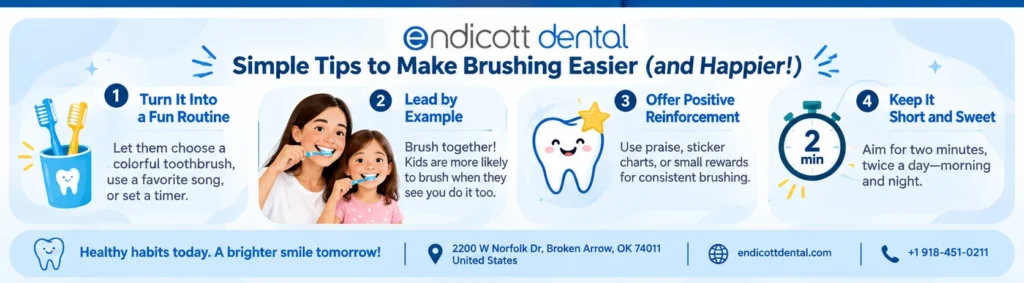
Your child can choose the toothbrush.
They can choose which approved fluoride toothpaste flavor to use.
They can decide whether Mom or Dad helps.
They can choose the song.
They can decide whether to brush the top or bottom teeth first.
They can take the first turn.
What they do not get to decide is whether the teeth get brushed.
This is what psychologists sometimes call limited choice: instead of asking an open-ended question that invites refusal, you offer two acceptable options.
So rather than:
“Do you want to brush your teeth?”
Try:
“Do you want the blue toothbrush or green toothbrush?”
Rather than:
“Can I brush your teeth now?”
Try:
“Do you want to brush first, or should I go first?”
The difference is subtle but important.
You are not negotiating whether brushing happens.
You are giving the child some control over how it happens.
Step 1: Make Brushing Predictable
The first part of the Endicott Method is consistency.
If brushing happens at a different point every night, children have another opportunity to negotiate.
One night it happens before pajamas.
The next night after a snack.
Another night after three books.
The next night someone remembers brushing just as the child is falling asleep.
That inconsistency makes resistance easier.
Instead, attach brushing to events that already happen.
For example:
Dinner → play → bath → brush → book → bed
Or:
Pajamas → brush → story → bed
The exact sequence matters less than repeating it.
The American Academy of Pediatrics promotes a similar predictable bedtime framework through its “Brush, Book, Bed” approach. Consistent routines can help children understand what comes next and reduce some of the stress surrounding bedtime transitions.
Stop Asking Whether They Want to Brush
This is one of the easiest mistakes parents make.
“Are you ready to brush?”
“Do you want to brush now?”
“Can we brush your teeth?”
Those sound polite.
To a 3-year-old, however, they sound like legitimate yes-or-no questions.
And sometimes the answer is going to be:
“No.”
Then the negotiation begins.
Instead, state the routine calmly:
“It’s brushing time.”
There is nothing angry about that.
There is also nothing to debate.
Step 2: Give Your Child Two Good Choices
This is where you give some control back.
Offer choices you are genuinely comfortable with.
For example:
- “Red toothbrush or blue toothbrush?”
- “Strawberry toothpaste or mint?”
- “Do you want to stand on the stool or sit on my lap?”
- “Top teeth first or bottom teeth first?”
- “Do you want the dinosaur timer or the song?”
- “Do you want Mom to help or Dad?”
- “Your turn first or my turn first?”
Notice what is missing.
“Do you want to brush?”
That decision has already been made.
Why Choices Work Better Than Bribes Every Night
There is nothing inherently wrong with using a sticker chart or occasional reward to build a new habit.
The ADA even provides brushing calendars children can use to track daily brushing, and pediatric guidance supports positive reinforcement as one way to help children cooperate with health routines.
But parents can accidentally create a bigger problem if every brushing session requires a new negotiation:
“If you brush, you can have another show.”
“If you brush, I’ll give you candy tomorrow.”
“If you brush, you can stay up ten minutes later.”
Now the child learns that brushing has a price.
Instead, use praise and simple rewards to establish the habit while keeping brushing itself non-negotiable.
Step 3: Let Your Child Brush First
Children need practice.
So give it to them.
Let your child hold the toothbrush and brush independently.
Do not hover over every movement saying:
“You missed that tooth.”
“Not like that.”
“Move the brush.”
“You’re doing it wrong.”
That makes independence frustrating.
Let them practice.
Then say:
“Good. Now it’s my turn to check and finish.”
This accomplishes two things.
Your child develops brushing skills.
You still make sure the teeth actually get cleaned.
Why the Parent Should Still Finish
A wet toothbrush is not evidence of clean teeth.
Neither is toothpaste foam around the mouth.
Young children tend to clean the easiest teeth to reach, especially the front teeth, while missing the gumline and back molars where plaque can accumulate.
Parents should assist or supervise young children during brushing. Current ADA recommendations call for twice-daily brushing for two minutes using fluoride toothpaste.
Think of independence as something you gradually transfer.
At age 3, the child may do 20% and you do 80%.
At age 5, maybe the balance changes.
At age 7 or 8, you may mostly supervise and touch up missed areas.
The goal is not to suddenly declare, “You’re old enough now. Good luck.”
It is to gradually teach the skill while protecting the teeth.
Step 4: Use the Right Amount of Fluoride Toothpaste
Parents sometimes focus so much on getting their child to brush that they overlook what is actually on the toothbrush.
Fluoride toothpaste matters because fluoride helps strengthen enamel and reduce cavity risk.
The amount depends on your child’s age.
Children Younger Than 3
Use a smear of fluoride toothpaste approximately the size of a grain of rice once teeth begin appearing.
Children Ages 3 to 6
Use a pea-sized amount of fluoride toothpaste.
Parents should place or supervise the toothpaste amount and encourage children to spit out the excess rather than swallowing it.
More toothpaste is not better.
A giant ribbon like you see in toothpaste commercials is unnecessary for a preschooler.
What If My Child Hates Mint Toothpaste?
Do not make toothpaste flavor the hill you choose to die on.
Many children dislike strong mint.
If your child refuses to brush because the toothpaste feels “spicy,” look for an age-appropriate fluoride toothpaste in a flavor they tolerate.
Check the label.
The important part is that it contains fluoride and that you use an age-appropriate amount.
A child-friendly flavor that actually gets used twice a day is more useful than a tube of adult mint toothpaste that causes an argument every night.
Step 5: Make the Two Minutes Easier to Understand
“Brush for two minutes” makes sense to an adult.
For a preschooler, two minutes is an abstract concept.
Give the time a beginning and an end.
You can use:
- A two-minute song
- A visual timer
- A sand timer
- A brushing timer
- A short brushing video
- A parent counting different sections of the mouth
The ADA recommends brushing twice daily for two minutes.
Divide the Mouth Into Sections
Instead of saying, “Keep brushing,” divide the job.
For example:
- Upper right
- Upper left
- Lower right
- Lower left
- Front surfaces
- Inside surfaces and tongue
You can give the sections names younger children understand:
“Let’s clean the dinosaur teeth in the back.”
“Now the smile teeth.”
“Now the hidden teeth behind the front ones.”
That gives a child something concrete to follow.
Step 6: Let the Parent Finish Calmly and Efficiently
This is usually the most important part.
Your child had a turn.
Now you finish.
For younger children, positioning can make a huge difference.
Try Brushing With Their Head Supported
Many parents try to brush while standing face-to-face with a small child who is moving backward, turning sideways, and looking everywhere except toward the toothbrush.
That is unnecessarily difficult.
For toddlers and preschoolers, it can be easier to have the child recline with their head supported in your lap or against your body so you can actually see the teeth.
Pediatric guidance specifically notes that lying down can make brushing easier for infants and toddlers because the adult gets a clearer view of the mouth.
Good lighting helps too.
You cannot clean what you cannot see.
Keep Your Hands Gentle
Brushing harder does not make teeth cleaner.
Use a soft-bristled child-sized toothbrush and gentle movements along the teeth and gumline.
If brushing hurts every night, your child is going to resist every night.
If you notice bleeding, obvious pain, swelling, sores, or an area your child consistently refuses to let you touch, that may deserve a dental examination rather than assuming the behavior is simply defiance.
Step 7: Praise the Behavior You Want Repeated
After brushing, tell your child exactly what went well.
Not:
“You’re such a good boy.”
Try:
“You opened really wide. That made it easy for me to clean the back teeth.”
Or:
“You stayed still while I finished. That was helpful.”
Or:
“You remembered the bottom teeth yourself tonight.”
Specific praise teaches children which behavior you want repeated.
Sticker Charts Can Help If You Use Them Correctly
For children who respond well to visual progress, try a simple calendar.
One sticker for morning brushing.
One sticker for nighttime brushing.
After a certain number of stickers, perhaps the child chooses:
- The family movie
- Saturday breakfast
- The bedtime book
- A trip to the park
- A small non-food reward
The reward does not have to be expensive.
In fact, it probably should not be.
You are building a habit, not creating a dental compensation package.
What Should You Do When Your Child Flat-Out Refuses?
Some nights will still be difficult.
The Endicott Method does not magically transform every toddler into an enthusiastic dental hygienist.
When refusal happens, avoid escalating unless necessary.
Keep your language short.
“It’s brushing time.”
“You can pick the toothbrush, or I can.”
“You can go first, or I can.”
Then follow through.
Avoid the 20-Minute Debate
The longer you argue, the more attention the refusal receives.
A two-minute hygiene task has now turned into the main event of the evening.
Stay bored.
Stay predictable.
Finish the routine.
Move on.
Tomorrow, repeat it.
Consistency is usually more useful than creating a completely new strategy every three days.
Should You Force a Child to Brush Their Teeth?
Parents sometimes ask this after a truly miserable evening.
There is an important difference between providing necessary parental assistance and turning brushing into an aggressive physical struggle.
Young children do need an adult to help clean their teeth.
But if brushing repeatedly involves extreme distress, gagging, panic, aggressive resistance, or a level of struggle that feels unsafe, stop assuming the problem is simply bad behavior.
There may be something else going on.
Look for Pain First
A child who suddenly begins resisting after previously brushing well may have:
- A cavity
- A loose tooth
- A mouth ulcer
- Gum irritation
- A tooth coming in
- An injury
- Sensitivity
- Orthodontic irritation
If the behavior changes suddenly, look for a reason.
Consider Sensory Sensitivity
Some children are much more sensitive to:
- Toothpaste flavors
- Foaming
- Toothbrush vibration
- Pressure
- Textures inside the mouth
- Strong smells
- Water temperature
Children with sensory processing differences, autism, developmental conditions, or anxiety may require a more individualized approach.
There is no prize for forcing one specific toothpaste or toothbrush if another safe option works better.
Talk with your child’s dentist about adaptations that can make the routine more tolerable.
What If My Child Only Wants to Use an Electric Toothbrush?
That may be perfectly reasonable.
Manual and powered toothbrushes can both clean teeth effectively when used properly.
For some children, an electric toothbrush is exciting.
For others, the vibration is intolerable.
Use the option your child accepts and can use safely.
The expensive toothbrush is not automatically the better toothbrush.
Technique, consistency, fluoride toothpaste, and adult supervision matter more than whether the brush has a charging cable.
When Can Kids Brush Completely by Themselves?
Parents are understandably eager to retire from brushing duty.
Unfortunately, age alone is not the best test.
A common rule of thumb is that children need help until roughly age 7 or 8, although some may need supervision longer. The American Academy of Pediatrics notes that when children develop the fine motor ability needed for tasks such as tying shoelaces or writing well, they are more likely to have the coordination required for effective brushing.
Instead of asking:
“Is my child old enough?”
Ask:
“Can my child consistently clean every surface without me reminding them?”
Watch them.
Check the back teeth.
Look along the gumline.
Have your dentist show you where plaque is being missed.
Independence should be earned by ability, not granted because someone had a birthday.
What About Flossing?
Brushing does not clean every surface.
When neighboring teeth touch, toothbrush bristles cannot effectively clean the contact area between them.
That is when flossing becomes important.
The American Academy of Pediatrics recommends beginning to clean between teeth once two teeth touch and notes that children commonly need adult help flossing well beyond the age when they begin brushing more independently.
Floss picks may be easier for some families than traditional string floss.
The important thing is actually cleaning the contact not winning an argument about which flossing tool is morally superior.
What If We Miss a Night?
Brush the next morning.
Do not turn one missed brushing into a crisis.
Parents are human.
Kids fall asleep in the car.
Flights land late.
Someone gets sick.
A bedtime routine occasionally falls apart.
The problem is not one imperfect night.
The problem is when skipping becomes the routine.
Aim for twice-daily brushing with fluoride toothpaste and get back on schedule at the next opportunity.
Consistency over time matters more than parental perfection.
Why Is the Bedtime Brush So Important?
Bedtime is the brushing session we would be particularly reluctant to skip.
During sleep, saliva flow decreases.
You do not want food debris, plaque, and sugars from the day sitting on the teeth overnight without brushing.
After the nighttime brushing, keep the rule simple:
Water only.
The American Academy of Pediatrics recommends making the toothbrush the last thing to contact the teeth at night, with no snacks or sugary drinks afterward.
This is another area where consistency prevents negotiation.
If brushing is followed by crackers, milk, juice, or another snack, you have effectively restarted the process.
Should Children Rinse After Brushing?
Once your child can spit reliably, have them spit out excess toothpaste.
They generally do not need to rinse repeatedly with water afterward.
Keeping some fluoride from the toothpaste in contact with the teeth helps maximize its topical benefit. Current AAPD guidance recommends minimizing or avoiding rinsing immediately after brushing.
For young children, use only the recommended small amount of fluoride toothpaste and supervise closely.
What If My Child Says Brushing Hurts?
Believe them enough to investigate.
Children sometimes use “it hurts” to avoid things they do not enjoy.
They also sometimes say “it hurts” because something actually hurts.
Look for:
- Red or swollen gums
- Cavities
- Dark areas on teeth
- Food trapped between teeth
- A loose baby tooth
- Mouth sores
- Broken teeth
- Sensitivity
- Bleeding
- Swelling
If the same area hurts repeatedly, have it checked.
Brushing should not routinely be painful.
What Mistakes Make Toothbrushing Battles Worse?
Mistake 1: Starting When Everyone Is Exhausted
If bedtime is 8:00 and brushing begins at 8:17 while your child is already melting down, you have selected hard mode.
Move brushing earlier in the routine.
Mistake 2: Giving Too Many Warnings
“In ten minutes we brush.”
“Five more minutes.”
“Two minutes.”
“Okay, seriously now.”
“One more minute.”
By the time brushing happens, you have already negotiated six times.
One warning may be useful.
Ten warnings are negotiations.
Mistake 3: Expecting a Young Child to Do the Entire Job
Independence is good.
Untreated cavities are not.
Let them practice, then finish.
Mistake 4: Using Too Much Toothpaste
For children younger than 3, use a rice-grain-sized smear.
For ages 3 through 6, use a pea-sized amount.
Covering the entire toothbrush head is unnecessary.
Mistake 5: Making Every Session Emotional
If brushing becomes a major confrontation twice every day, the child learns that toothbrushing is a highly charged event.
Keep your tone boringly calm.
Mistake 6: Threatening Them With the Dentist
Please do not say:
“If you don’t brush, the dentist is going to drill your teeth.”
Or:
“The dentist will give you a shot.”
That may get cooperation tonight.
It can also create a child who becomes terrified of dental care.
Dentists should not be used as the villain in your bedtime routine.
The Endicott Method by Age
Babies and Young Toddlers
As soon as the first tooth erupts, begin brushing twice daily with a soft child-sized toothbrush and a rice-grain-sized smear of fluoride toothpaste.
At this age, the parent does essentially all the brushing.
Make it routine.
Keep it quick.
Do not wait for the child to request dental hygiene.
They will not.
Ages 3 to 5
This is prime “I do it myself” territory.
Perfect.
Let them.
Then you finish.
Use a pea-sized amount of fluoride toothpaste. Introduce songs, timers, sticker calendars, and limited choices.
Ages 6 to 8
Give more responsibility but continue supervising.
Ask them to demonstrate how they clean:
- Outside surfaces
- Inside surfaces
- Chewing surfaces
- Gumline
- Back molars
Check their work and help where needed.
Older Children
At this stage, the challenge often changes.
It is no longer:
“I hate brushing.”
It becomes:
“I forgot.”
Tie brushing to established routines.
Morning: breakfast, brush, school.
Night: brush, charge phone, bed.
For children with braces or higher cavity risk, your dentist may recommend additional preventive steps based on their individual needs.
How Do You Know if the Method Is Working?
Do not judge success based on whether your child cheers when you announce brushing time.
That is an unnecessarily high standard.
Success looks like:
- Less arguing
- Less delaying
- Brushing happening twice most days
- The child understanding the sequence
- Parents getting a final turn
- Better brushing skills over time
- Less plaque being missed
- Dental visits showing healthy teeth and gums
Your child does not need to consider brushing the highlight of their evening.
They need to understand:
This is simply what our family does.
That is how many healthy habits are built.
If Brushing Is Still a Battle, Let Endicott Dental Help You Find Out Why
Sometimes parents are doing everything right and brushing is still difficult.
That is worth talking about.
Your child may be avoiding one painful tooth.
They may have extremely sensitive gums.
They may dislike a particular toothpaste.
They may need a smaller toothbrush.
They may have areas you are consistently missing.
Or you may simply need someone other than Mom or Dad to show them what good brushing looks like.
At Endicott Dental, we provide preventive and family-focused dental care for children, teens, and adults in Broken Arrow.
We can look at your child’s teeth, check for cavities or irritation, show you where plaque is collecting, and help you build a home-care routine that fits your actual child rather than an imaginary child who calmly follows every instruction the first time.
Sometimes the most valuable thing we can tell a parent is:
“You’re doing fine. Keep going.”
Other times, a small change in technique can make the routine significantly easier.
If brushing has become a twice-daily argument in your house, Endicott Dental can help you figure out whether the problem is technique, routine, discomfort, or something happening with your child’s teeth.
The goal is not perfect parenting.
It is healthy teeth and a routine your family can actually maintain.
Frequently Asked Questions About Getting Kids to Brush Their Teeth
How many times a day should children brush?
The ADA recommends brushing twice a day for two minutes with fluoride toothpaste.
For most families, that means once in the morning and once before bed.
How much toothpaste should my child use?
For children younger than 3, use a smear of fluoride toothpaste approximately the size of a grain of rice.
For children ages 3 through 6, use a pea-sized amount.
Parents should supervise young children so excess toothpaste is not repeatedly swallowed.
What age should children start brushing their own teeth?
Children can begin practicing very young, but practice is different from taking full responsibility.
Many children still need hands-on help or careful supervision until approximately age 7 or 8, and some need help longer.
What is the Endicott Method for brushing?
The Endicott Method described here is our practical approach for reducing brushing battles:
- Make brushing predictable.
- Give two acceptable choices.
- Let the child brush first.
- Let the parent finish.
- Keep the interaction short and calm.
- Praise cooperation and repeat consistently.
It is not a separate dental treatment or formally published clinical protocol. It is a simple framework for applying established oral-health recommendations in a way that works better with real children.
Should I let my toddler brush alone if they insist?
Let them take a turn.
Then take your turn.
Toddlers benefit from practicing, but they generally do not have the coordination required to thoroughly clean every tooth without adult help.
Is an electric toothbrush better for children?
Not necessarily.
Both manual and powered toothbrushes can work well when used correctly. Choose an age-appropriate brush your child tolerates and use proper technique with fluoride toothpaste.
If your child likes an electric toothbrush and it makes brushing easier, that may be a good choice.
If the vibration bothers them, a manual toothbrush is perfectly reasonable.
What can I do if my child hates toothpaste?
First determine what they dislike.
Is it the flavor?
Foaming?
Texture?
Strong mint?
Try another age-appropriate fluoride toothpaste rather than giving up on toothpaste completely.
Allowing a child to choose between two acceptable flavors can also give them useful control.
What if my child will only brush for 30 seconds?
Build gradually, but keep working toward the recommended two minutes.
Try dividing the mouth into sections, using a timer, playing a song, or letting the child brush first before you finish.
The parent’s final turn is especially important when the child’s own attempt is short.
Should kids floss every day?
Once neighboring teeth touch, those contact areas need to be cleaned because toothbrush bristles cannot adequately reach between them.
Young children often need substantial adult help with flossing.
Floss picks may make this easier for some families.
Should my child rinse with water after brushing?
Once children can reliably spit, they should spit out excess toothpaste. Current pediatric recommendations generally suggest minimizing or avoiding immediate water rinsing so fluoride remains in contact with the teeth longer.
My child’s gums bleed when I brush. Should I stop?
Do not simply stop cleaning the area indefinitely.
Bleeding can occur when gums are inflamed from plaque buildup, but it can have other causes as well.
Use a soft toothbrush and gentle technique.
If bleeding is frequent, significant, painful, or does not improve, schedule a dental examination.
What should my child have after the nighttime brushing?
Ideally, only water.
After the bedtime brush, avoid additional snacks, milk, juice, sports drinks, or other sugary beverages. Pediatric guidance recommends making brushing the final tooth-related step of the nighttime routine.
What if brushing suddenly becomes painful?
A sudden change deserves attention.
Look for a loose tooth, mouth sore, swelling, cavity, injury, erupting tooth, or irritated gum.
If your child repeatedly points to the same area or brushing continues to hurt, have the area evaluated by a dentist.
When should children first visit a dentist?
The American Academy of Pediatric Dentistry recommends establishing a dental visit by the child’s first birthday.
Early visits allow parents to get guidance on brushing, fluoride, diet, tooth development, and cavity prevention before a problem becomes painful.
What if nothing we try stops the brushing fights?
If brushing regularly causes extreme distress, gagging, pain, panic, or an unsafe physical struggle, ask your dentist for help.
Sometimes there is a dental problem.
Sometimes the issue is sensory.
Sometimes the routine needs to change.
And sometimes a child listens much more closely when the person holding the toothbrush is wearing scrubs instead of pajamas.
That is perfectly normal too.
