

Table of Contents
If you’re missing one tooth, you’ll usually hear two main options: a dental implant or a dental bridge.
Both can work. Both can look good. Both can restore chewing.
But over 15 years, they are not the same investment.
Quick answer: a bridge often costs less upfront, while an implant often makes more sense long-term if you have enough bone, healthy gums, and want to avoid drilling down the neighboring teeth. When considering dental bridge vs. dental implants, the long-term impact on the surrounding teeth is an important part of the decision.
At Endicott Dental in Broken Arrow, we usually look at this decision through one question:
Are we replacing one missing tooth, or are we also putting the two neighboring teeth at risk?
The Basic Difference
A dental implant replaces the missing tooth root with a titanium implant, then restores it with an abutment and crown.
A bridge fills the space by placing crowns on the teeth beside the gap, with a false tooth connected between them.
That means a bridge depends on the neighboring teeth.
An implant stands on its own.
Upfront Cost: Bridge Usually Wins
In many cases, a dental bridge costs less at the beginning.
That matters. If budget is the main concern, a bridge may be the more realistic choice.
A typical single-tooth implant from diagnosis to final crown may cost more because it can include imaging, surgery, healing time, the implant post, abutment, and final crown.
A bridge usually involves fewer phases and no implant surgery.
So if we only look at year one, the bridge often looks like the cheaper option.
But year one is not the whole story.
The 15-Year Problem With Bridges
A bridge can last many years, but it has one major tradeoff:
The neighboring teeth have to carry the load.
To place a traditional bridge, those teeth are reshaped for crowns. If they already need crowns, that may not be a big downside.
But if those teeth are healthy, you are removing natural tooth structure from two good teeth to replace one missing tooth.
Over 15 years, bridges can also run into problems like:
- Decay under one of the supporting crowns
- Gum recession around the bridge
- Difficulty flossing underneath
- Wear or fracture of the bridge
- Failure of one supporting tooth
- Need for bridge replacement
When a bridge fails, the cost is not always just “replace the bridge.”
Sometimes one of the anchor teeth now needs a root canal, buildup, crown, or extraction.
That is where the long-term math changes.
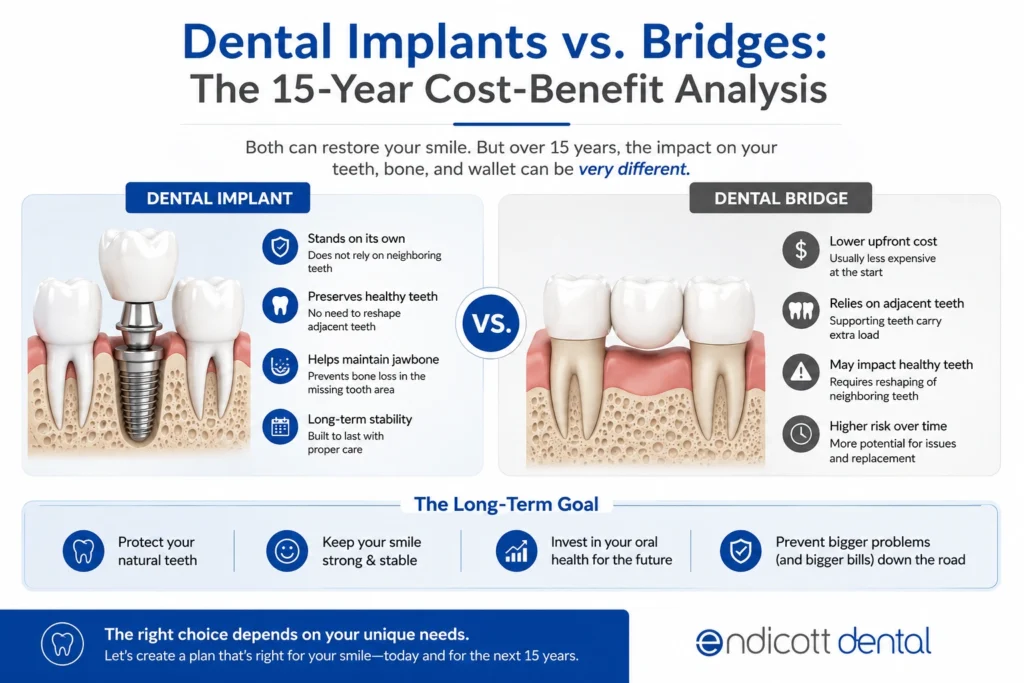
The 15-Year Advantage of Implants
The biggest advantage of an implant is that it does not rely on the teeth next to it.
That means:
- No shaving down healthy neighboring teeth
- Easier flossing compared with many bridges
- Better preservation of jawbone in the missing tooth area
- A fixed tooth replacement that functions independently
- Less risk of turning a one-tooth problem into a three-tooth problem
This is why implants often look expensive upfront but reasonable over time.
The implant crown may eventually need maintenance or replacement, but the neighboring teeth are usually left alone.
That matters over 15 years.
When a Bridge May Be the Better Choice
Implants are not automatically best for everyone.
A bridge may make more sense if:
- The neighboring teeth already need crowns
- You do not have enough bone for an implant
- You do not want surgery
- You need a faster solution
- Your medical history makes implant treatment less predictable
- Your budget does not allow for implant treatment
This is where honest dentistry matters.
If the two adjacent teeth are already heavily filled, cracked, or crowned, a bridge may be very reasonable.
In that case, we are not damaging two perfect teeth. We may be restoring teeth that already need help.
When an Implant Usually Makes More Sense
An implant is often the better long-term option if:
- The neighboring teeth are healthy
- You want the most tooth-conservative option
- You have enough bone for implant placement
- You want easier cleaning
- You are thinking in 10- to 15-year terms
- You want to reduce stress on nearby teeth
For many single missing teeth, especially when the teeth beside the gap are healthy, an implant is usually the stronger long-term choice.
For patients comparing dental implants, bridges, and dentures, factors like comfort, durability, maintenance, and the condition of the surrounding teeth can help determine which option is best.
The Real Cost Question
The better question is not:
“Which option is cheaper?”
The better question is:
“Which option is least likely to create more dental problems over the next 15 years?”
Sometimes that is the bridge.
Often, it is the implant.
The right answer depends on your bone, bite, gum health, budget, timeline, and the condition of the neighboring teeth.
What We Tell Patients in Broken Arrow
Here’s the plain answer.
If you are missing one tooth and the teeth on both sides are healthy, we usually want to talk seriously about an implant.
If those neighboring teeth already need crowns, a bridge may be a smart and cost-effective option.
If cost is the deciding factor, we will help you compare the realistic numbers, not just the cheapest starting price.
At Endicott Dental, Dr. Drew Endicott and our team help patients understand the tradeoffs before they commit to treatment. The goal is not to push the most expensive option. It is to help you choose the option that makes the most sense for your mouth over time.
FAQs
Is a dental implant always better than a bridge?
No. Implants are often better when the neighboring teeth are healthy, but bridges can be a good choice when those teeth already need crowns.
Which lasts longer?
Implants often have better long-term potential, but both options can last many years with proper care.
Is a bridge faster than an implant?
Usually, yes. Implants require healing time before the final crown is placed.
Can a bridge be replaced with an implant later?
Sometimes, but it depends on bone levels, gum health, and the condition of the neighboring teeth.
What is the biggest downside of a bridge?
A traditional bridge usually requires reshaping the two teeth beside the missing tooth, even if they are healthy.
