

Table of Contents
If you're nervous about going to the dentist, you're far from alone.
In fact, dental anxiety is one of the most common reasons people postpone treatment. We've seen patients in our Broken Arrow offices who haven't been to a dentist in five years, ten years, or even longer not because they didn't care about their teeth, but because they were afraid of the experience.
Some worry about pain.
Some hate the sounds.
Some had a bad experience years ago.
Others simply feel embarrassed about how long it's been.
The good news is that modern dentistry has come a long way. And one of the simplest things we do at Endicott Dental to help anxious patients is something we call the Stop Signal Protocol.
It's exactly what it sounds like.
At any point during treatment, you remain in control.
Quick Answer: What Is the Stop Signal Protocol?
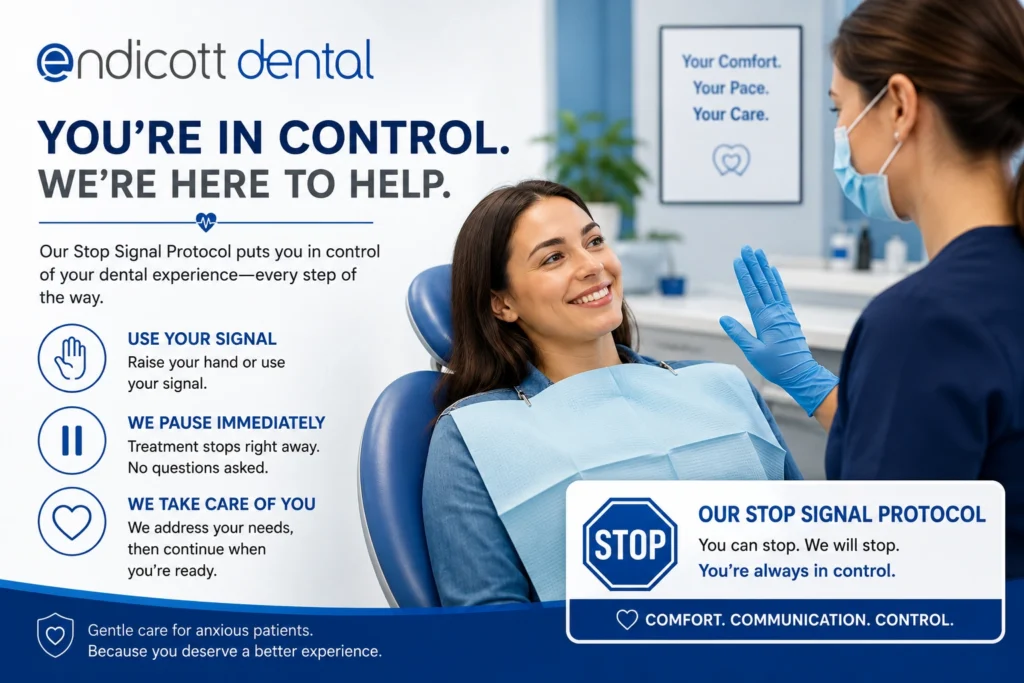
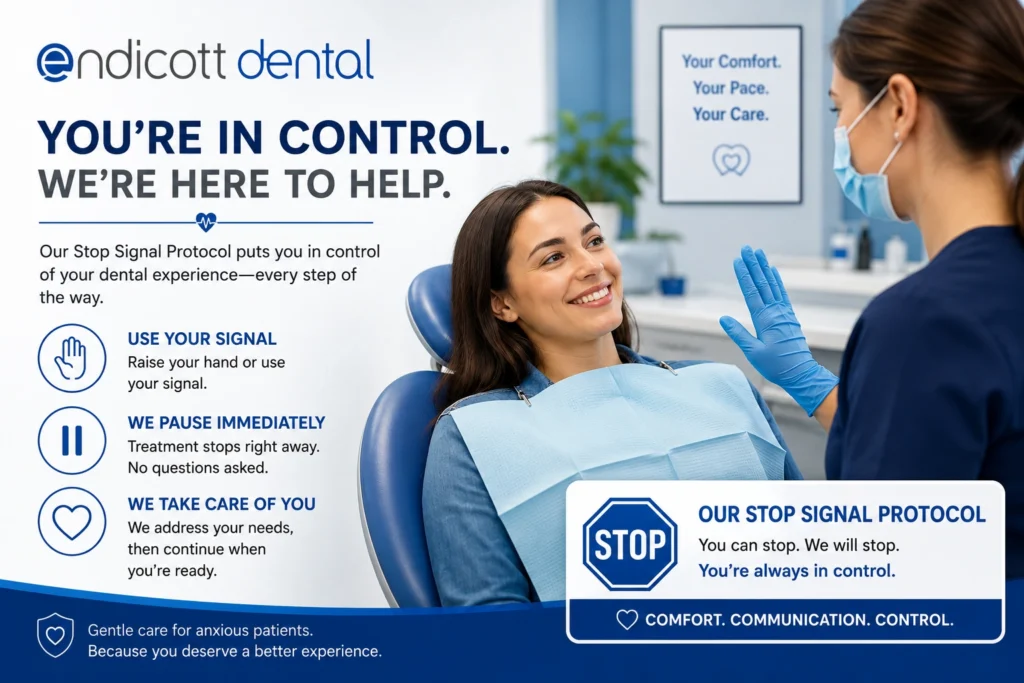
The Stop Signal Protocol is a simple agreement between you and your dental team before treatment begins.
If you need a break, feel uncomfortable, have a question, or simply need a moment to regroup, you give the agreed-upon signal typically raising your hand and treatment stops.
Immediately.
No questions asked.
No pushing through.
No feeling trapped in the chair.
The goal is simple:
You should never feel like something is happening to you. You should feel like you're participating in your care.
Why Dental Anxiety Often Comes Down to Control
Many people assume dental anxiety is primarily about pain.
Sometimes it is.
But more often, patients tell us something different.
They say things like:
- "I don't like not knowing what's happening."
- "I feel trapped."
- "I hate feeling like I can't talk."
- "I worry I'll panic once treatment starts."
Notice the common theme?
Control.
For many anxious patients, the fear isn't necessarily the procedure itself. It's the feeling of losing control once they're in the chair.
That's why something as simple as a stop signal can make such a dramatic difference.
What Happens During an Appointment?
Before treatment begins, we discuss:
- What we're doing
- How long it should take
- What sensations you may feel
- When you can expect breaks
- What your stop signal will be
That way, there are no surprises.
If at any point you need:
- More anesthetic
- A short break
- Water
- A chance to ask a question
- A moment to calm down
you simply use the signal.
The procedure pauses.
Then we address whatever you need before continuing.
Why This Helps Nervous Patients
When patients know they can stop treatment at any time, something interesting often happens:
They rarely need to.
The anxiety decreases because the fear of being stuck disappears.
We've found that many patients who describe themselves as "terrified of the dentist" become much more comfortable once they realize they're in control of the pace.
Dental Anxiety Is More Common Than You Think
One of the biggest misconceptions about dental anxiety is that it's rare.
It's not.
Every week, we meet patients who:
- Need extra reassurance
- Feel anxious about needles
- Have strong gag reflexes
- Worry about discomfort
- Feel embarrassed about their dental health
- Haven't seen a dentist in years
None of that surprises us.
And none of it is something you need to apologize for.
Our job is to help you move forward, not make you feel guilty for waiting.
What If You've Had a Bad Dental Experience Before?
Many anxious patients can trace their fear back to a specific experience.
Maybe:
- A procedure hurt
- A provider rushed treatment
- You felt ignored
- Someone didn't listen when you said you were uncomfortable
Unfortunately, those experiences can stay with people for years.
One of the reasons we use protocols like the stop signal is because rebuilding trust often starts with communication.
You deserve to know what's happening.
You deserve to be heard.
And you deserve the ability to pause treatment if you need to.
When Anxiety Keeps You From Getting Care
This is where dental anxiety becomes more than just an inconvenience.
Many patients delay treatment because they're nervous.
The problem is that small issues often become larger issues over time.
A minor cavity can become a root canal.
A cracked tooth can become an extraction.
Gum inflammation can progress into more advanced periodontal disease.
The longer anxiety keeps you away, the more likely treatment becomes more complicated.
That's why finding ways to make appointments manageable is so important.
You Don't Have to Be "Brave" to Come to the Dentist
Here's what we'd honestly tell you if you asked us in person:
You don't need to stop being anxious before scheduling an appointment.
You don't need to "get over it."
And you certainly don't need to pretend you're comfortable when you're not.
Just tell us.
We work with anxious patients every day.
The goal isn't to force you through treatment.
The goal is to help you receive the care you need in a way that feels manageable.
Looking for a Dentist Who Understands Dental Anxiety?
If fear, stress, or past experiences have kept you away from the dentist, Dr. Drew Endicott and the team at Endicott Dental are here to help.
Our Stop Signal Protocol is just one of the ways we help patients feel more comfortable, informed, and in control during their visits.
Sometimes the hardest part is scheduling the appointment.
After that, we'll take it one step at a time at a pace that works for you.
Frequently Asked Questions
What if I panic during treatment?
That's exactly why the stop signal exists. If you need a break, we'll stop and help you get comfortable before moving forward.
Will the dentist be frustrated if I ask for breaks?
Not at all. We'd much rather pause for a few minutes than have a patient feel overwhelmed.
Is dental anxiety common?
Extremely common. Many adults experience some level of anxiety about dental treatment.
Should I tell the office I'm nervous before my appointment?
Yes. The more we know about your concerns, the better we can tailor the experience to your needs.
Can I still receive treatment if I haven't been to a dentist in years?
Absolutely. We regularly see patients who are returning after long gaps in care. Our focus is helping you move forward not judging where you've been.
