

Table of Contents
If you've recently been diagnosed with sleep apnea or your sleep doctor says you likely need treatment you've probably heard one recommendation more than any other:
CPAP.
For many patients, that's where the conversation ends.
But it shouldn't.
Because while CPAP is often considered the gold standard for sleep apnea treatment, it's not the only option. And for some patients, an oral appliance may be more realistic, more comfortable, and ultimately more successful.
The question isn't:
"Which treatment is best on paper?"
The better question is:
"Which treatment will you actually use?"
If you're a patient working with a local sleep physician or sleep lab and trying to decide between CPAP and an oral appliance, here's what you should know.
Fast Answer
CPAP is generally the most effective treatment for moderate to severe obstructive sleep apnea when used correctly.
However, oral appliance therapy can be an excellent option for many patients with mild to moderate sleep apnea, patients who cannot tolerate CPAP, or patients looking for a more portable treatment option.
The best treatment isn't necessarily the one that lowers apnea events the most in a sleep study.
It's the one that successfully treats your condition and fits your lifestyle well enough that you'll use it consistently.
First: What Is Sleep Apnea?
Obstructive sleep apnea (OSA) occurs when the airway repeatedly collapses during sleep.
This can cause:
- Loud snoring
- Gasping during sleep
- Poor sleep quality
- Morning headaches
- Daytime fatigue
- Difficulty concentrating
- Increased cardiovascular risk
Many patients don't realize they have sleep apnea until a spouse notices the symptoms or a sleep study reveals the problem.
How CPAP Works
CPAP stands for Continuous Positive Airway Pressure.
The machine delivers pressurized air through a mask while you sleep.
That pressure helps keep the airway open and prevents collapse.
Advantages of CPAP
CPAP is extremely effective when used properly.
Benefits include:
- High success rates
- Effective treatment for severe sleep apnea
- Immediate reduction in apnea events
- Extensive clinical research
- Non-invasive treatment
For many patients, CPAP works exactly as intended.
The challenge is often not effective.
It's compliance.
The Biggest Problem With CPAP
Most sleep doctors will tell you the same thing:
A CPAP machine only works when it's being worn.
That sounds obvious, but it's one of the biggest challenges in sleep medicine.
Common complaints include:
- Mask discomfort
- Air leaks
- Dry mouth
- Claustrophobia
- Skin irritation
- Noise concerns
- Difficulty traveling
Some patients adapt quickly.
Others never fully adjust.
And a perfectly effective treatment doesn't help much if it sits on a nightstand.
How Oral Appliance Therapy Works
An oral appliance is a custom-made device worn during sleep.
It looks somewhat similar to an athletic mouthguard or orthodontic retainer.
The appliance gently repositions the lower jaw and tongue to help keep the airway open.
Unlike CPAP, there are:
- No hoses
- No masks
- No electrical components
- No pressurized air
For many patients, that's a major advantage.
Advantages of Oral Appliances
Many sleep apnea patients choose oral appliance therapy because it feels less intrusive.
Benefits often include:
Easier Travel
The appliance fits in a small case and travels easily.
Greater Comfort
Many patients find oral appliances easier to tolerate than masks.
Quiet Treatment
There is no machine noise.
Better Compliance
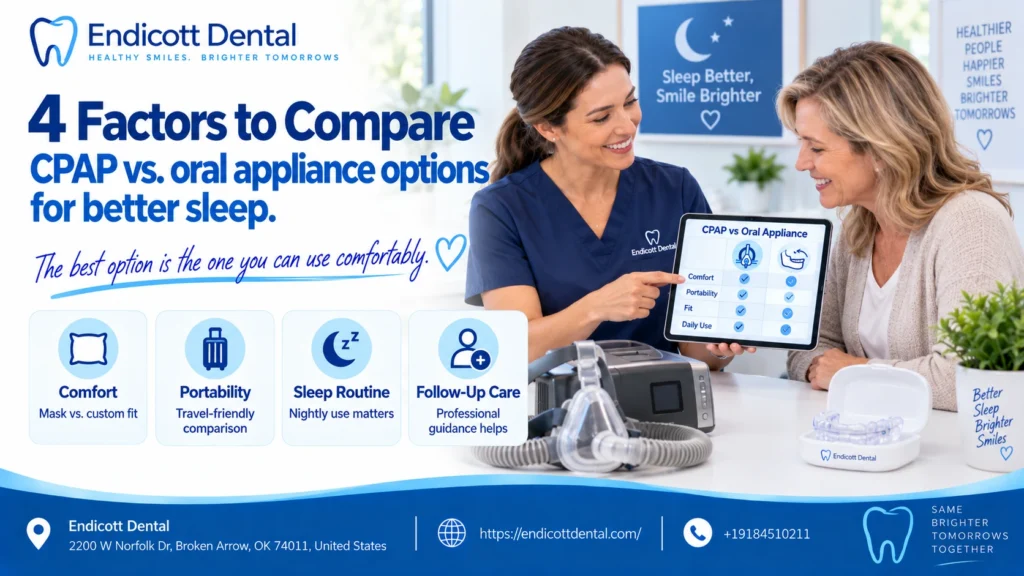
Some studies suggest that while CPAP may be more effective per night, oral appliances often achieve higher real-world usage because patients are more likely to wear them consistently.
Where CPAP Usually Wins
To be fair, CPAP remains the most effective treatment for many moderate and severe cases.
CPAP typically provides:
- Greater reduction in apnea events
- More predictable results
- Better treatment of severe airway collapse
- Greater effectiveness for complex cases
For some patients, CPAP is clearly the best choice.
The goal isn't replacing CPAP.
The goal is finding the treatment that works best for your specific situation.
Where Oral Appliances Often Shine
Oral appliances may be especially attractive for patients who:
- Have mild to moderate sleep apnea
- Cannot tolerate CPAP
- Travel frequently
- Have positional sleep apnea
- Want a less invasive option
- Need a portable backup to CPAP
Many patients come to oral appliance therapy after multiple unsuccessful attempts with CPAP.
The Question Most Patients Never Ask
Many people assume the decision is:
CPAP or oral appliance.
In reality, some patients benefit from both.
Examples include:
- Oral appliance for travel
- CPAP at home
- Combination therapy
- Backup treatment when CPAP isn't practical
Sleep apnea treatment isn't always an either-or decision.
What About Snoring?
This is where many patients become interested in oral appliances.
While not all snoring is caused by sleep apnea, oral appliances often reduce snoring by improving airway stability.
That can be life-changing for both the patient and their spouse.
However, snoring alone should not be used to diagnose or rule out sleep apnea.
A proper sleep evaluation is still necessary.
Cost Considerations
Many patients immediately ask:
"Which option costs less?"
The answer depends on:
- Insurance coverage
- Medical necessity
- Device type
- Follow-up care
- Sleep study requirements
Both CPAP and oral appliance therapy may be covered by medical insurance when prescribed appropriately.
The important thing is understanding your specific benefits before making assumptions.
How to Decide Which Treatment Is Right for You
Ask these questions:
How severe is my sleep apnea?
Severity often influences treatment recommendations.
Have I already tried CPAP?
If so, what challenges did you experience?
Am I likely to wear this every night?
Consistency matters.
Do I travel frequently?
Lifestyle matters more than many patients realize.
What does my sleep physician recommend?
Sleep apnea treatment works best when your dentist and sleep physician collaborate.
The Bottom Line
CPAP is often considered the gold standard because it can be incredibly effective.
But effectiveness on paper and effectiveness in real life are not always the same thing.
A treatment that you use every night is generally more valuable than a treatment you abandon after three weeks.
For many patients, oral appliance therapy provides a comfortable, convenient alternative that improves sleep quality and helps manage obstructive sleep apnea successfully.
The right choice depends on your sleep study results, health history, lifestyle, and ability to tolerate treatment.
That's why a personalized evaluation matters more than any online comparison chart.
FAQs
Is CPAP better than an oral appliance?
CPAP is generally more effective at reducing apnea events, especially in severe cases. However, oral appliances may be easier for some patients to use consistently.
Can an oral appliance replace CPAP?
For some patients, yes. For others, CPAP remains the preferred treatment. The decision depends on sleep apnea severity and physician recommendations.
Are oral appliances comfortable?
Most patients adapt well after an adjustment period. Custom-fitted appliances are significantly more comfortable than over-the-counter devices.
Does insurance cover oral appliance therapy?
Many medical insurance plans provide coverage when oral appliance therapy is prescribed for diagnosed obstructive sleep apnea.
Do I need a sleep study first?
Yes. A sleep study is typically necessary to diagnose sleep apnea and determine the most appropriate treatment approach.
If you've been diagnosed with sleep apnea and are exploring alternatives to CPAP, Dr. Drew Endicott and the team at Endicott Dental can work alongside your sleep physician to help you understand whether oral appliance therapy may be a good fit. The goal isn't simply choosing a device, it's finding a treatment you'll actually use so you can sleep better and protect your long-term health.
