

Table of Contents
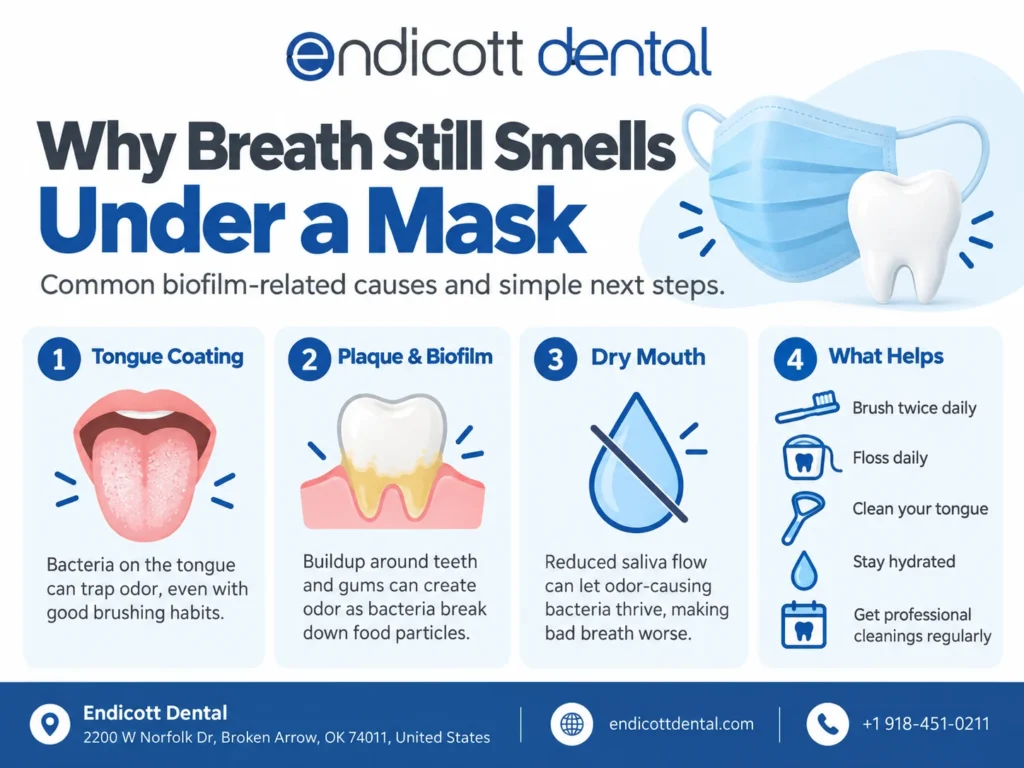
You put on a mask for work, a medical appointment, travel, or another situation where face covering makes sense.
A few minutes later, you notice something you would rather not notice.
Your breath.
You brush your teeth.
You use mouthwash.
You keep mints nearby.
Maybe you even switch toothpaste.
Yet the moment your own exhaled air is contained close to your nose, you start thinking:
“Is my breath really this bad all the time?”
Possibly.
But there is an important correction to make before blaming the mask.
A mask is usually not creating chronic bad breath. It may simply make you more aware of odor that was already present.
A large study performed during widespread mask use found that many people reported changes in how they perceived their own breath while wearing masks. Those changes were associated with factors such as dry mouth and tongue coating as well as mask-wearing duration. The study showed an association with self-perception of breath odor; it did not prove that masks themselves created chronic halitosis.
The American Dental Association similarly reported that dentists did not see a meaningful pandemic-era increase in bad breath or dry mouth that would support the popular idea of a new condition called “mask mouth.”
So if your breath smells unpleasant under a mask, the more useful question is not:
“What is the mask doing to my mouth?”
It is:
“Where is the odor actually coming from?”
For most people with persistent bad breath, the answer is somewhere inside the mouth.
And one of the biggest pieces of that answer is biofilm.
At Endicott Dental in Broken Arrow, this is how we want patients to think about persistent bad breath:
Mints cover odor.
Mouthwash may temporarily reduce it.
But if bacteria are living in a thick biofilm on your tongue, between your teeth, along the gumline, or inside periodontal pockets, you have to address the source.
Here is how.
What Is Oral Biofilm?
Biofilm sounds like a technical dental word.
The concept is simple.
Bacteria in your mouth do not just float around individually waiting for mouthwash to kill them.
They organize.
They attach to surfaces.
They interact with each other.
They become embedded in a protective matrix.
That organized bacterial community is a biofilm.
Dental plaque is one example of oral biofilm.
The coating on the back of your tongue contains another complex microbial community.
Periodontal pockets around teeth with gum disease can contain biofilms as well.
The ADA's current oral-malodor standards specifically describe bad breath as being primarily associated with oral biofilms, particularly those found on the back of the tongue and in periodontal areas, where microorganisms produce volatile sulfur compounds.
That is why simply making your mouth taste minty does not always solve the problem.
You changed the flavor.
You may not have changed the biofilm.
What Actually Makes Bad Breath Smells Bad?
Bacteria metabolize material inside the mouth.
As they break down proteins and other substances, certain bacteria produce foul-smelling gases.
Some of the most important are called volatile sulfur compounds, or VSCs.
Examples include:
- Hydrogen sulfide
- Methyl mercaptan
- Dimethyl sulfide
The ADA identifies VSCs as major contributors to oral malodor. They can arise from dental plaque, bacterial activity, breakdown of food, and oral disease.
You do not need to remember the chemical names.
You need to understand the process:
Bacteria + the right environment + material for those bacteria to break down = odor-producing compounds.
If you continue providing the environment without physically disrupting the bacterial community, the bad breath tends to return.
That is the biofilm reality.
Why Is the Tongue Such a Big Part of Bad Breath?
Most people brush their teeth.
Far fewer pay meaningful attention to their tongue.
That can be a problem.
The top surface of your tongue is not smooth.
It has papillae, grooves, and microscopic irregularities that create an enormous surface area where bacteria, shed cells, proteins, food debris, and other material can collect.
The back portion is particularly difficult to clean naturally.
Reviews of halitosis research identify tongue coating as one of the major and often the dominant sources of oral bad breath. Periodontal disease is another major source.
What Does Tongue Coating Look Like?
It may appear:
- White
- Grayish-white
- Yellowish
- Thick
- Patchy
Some tongue coating is normal.
A visible coated tongue does not automatically mean you have a disease.
The concern is that the coating creates an environment where odor-producing microorganisms can thrive.
A recent review describes tongue coating as a mixture that may include bacteria, food debris, shed epithelial cells, and other biological material. Its rough surface makes the posterior tongue especially difficult for saliva alone to clean effectively.
That is why you can brush every tooth beautifully and still have an unpleasant breath.
You cleaned 28 or 32 teeth.
You ignored one enormous microbial surface sitting in the middle of your mouth.
Does That Mean You Should Aggressively Scrape Your Tongue?
No.
Clean it.
Do not attack it.
A tongue scraper or toothbrush can help physically remove coating and reduce oral malodor in some people.
But harder is not necessarily better.
You do not need to scrape until the tongue turns bright red or starts bleeding.
Repeated trauma can make the tongue sore and turn oral hygiene into something you dread.
A Better Approach
Once daily, or as recommended for your individual needs:
- Extend your tongue comfortably.
- Place a tongue scraper or soft toothbrush toward the back as far as you can tolerate without triggering excessive gagging.
- Gently draw forward.
- Rinse the device.
- Repeat a few times as needed.
If your tongue remains heavily coated despite good hygiene, let your dentist evaluate it.
Not every coating is simply normal plaque.
Why Doesn't Brushing Your Teeth Fix Bad Breath?
Because brushing mainly cleans the surfaces the toothbrush reaches.
It does not thoroughly clean:
- Between tightly contacting teeth
- Deep under the gumline
- Periodontal pockets
- The posterior tongue
The ADA recommends brushing twice daily and cleaning between the teeth every day as basic ways to reduce the bacterial load associated with bad breath and gum disease.
If you brush twice daily but never floss or use another appropriate interdental cleaner, significant biofilm may remain between the teeth.
The “My Teeth Feel Clean” Problem
The smooth front surfaces may feel fantastic.
Meanwhile, plaque is sitting:
- Between molars
- Under contacts
- Along the gumline
- Around crowded teeth
- Around bridges or implants
Your tongue cannot necessarily tell you those areas are dirty.
Bacteria can.
Can Gum Disease Cause Persistent Bad Breath?
Yes.
This is one of the biggest reasons not to solve chronic bad breath exclusively with mints.
Persistent malodor or a constant bad taste can be a warning sign of periodontal disease. The ADA lists persistent bad breath among possible gum-disease symptoms.
Why Does Gum Disease Affect Breath?
In periodontal disease, pockets can form between the gums and teeth.
Those spaces can harbor:
- Bacterial biofilm
- Inflammatory material
- Food debris
- Compounds generated by bacterial metabolism
Reviews of the evidence have found a meaningful association between periodontal disease and oral malodor. The organisms associated with periodontal disease can produce many of the same volatile compounds responsible for unpleasant breath.
Other Gum-Disease Warning Signs
Pay attention if your bad breath occurs alongside:
- Bleeding when brushing or flossing
- Red or swollen gums
- Gum recession
- Tender gums
- Loose teeth
- Teeth shifting position
- A persistent bad taste
Gum disease can be relatively painless.
Do not wait for significant pain before asking about it.
What Is the Difference Between Plaque and Tartar?
This distinction matters for treating bad breath.
Plaque Is a Biofilm You Can Disrupt at Home
Daily brushing and interdental cleaning physically break it up.
If you remove it consistently, you make it harder for a mature bacterial community to stay established.
Tartar Is Hardened Buildup
When plaque mineralizes, it becomes calculus commonly called tartar.
You generally cannot brush hardened tartar away at home.
That requires professional removal.
Endicott Dental's preventive-care approach includes professional scaling to remove plaque and tartar from areas patients cannot adequately clean themselves.
If tartar is sitting along or below your gumline while you are trying five different mouthwashes at home, you may be treating the smell while leaving a major source untouched.
Why Does Mouthwash Help for an Hour and Then Stop Working?
Because not all mouthwash does the same thing.
Some rinses mainly produce a pleasant flavor.
Your mouth tastes fresh.
You smell mint.
You feel better.
Then the mint disappears.
The underlying bacterial environment is still there.
The ADA distinguishes cosmetic mouthrinses, which may temporarily mask odor, from therapeutic formulations containing active ingredients designed to affect bacteria or odor-producing compounds.
Therapeutic ingredients used in different products may include:
- Cetylpyridinium chloride
- Certain essential oils
- Chlorine dioxide
- Zinc compounds
- Chlorhexidine in selected clinical situations
But there is an important warning.
Mouthwash Is an Addition, Not a Replacement
A rinse does not physically remove all established plaque.
It does not floss between teeth.
It does not professionally scale tartar off a root surface.
It does not cure untreated periodontitis.
And prescription-strength products are not necessarily intended for indefinite unsupervised use.
For example, chlorhexidine can be useful in selected situations but can also contribute to staining and altered taste.
More aggressive mouthwash is not always the answer.
Why Does Dry Mouth Make Breath Worse?
Saliva is one of your mouth's built-in cleaning systems.
It helps:
- Wash food debris away
- Keep oral tissues moist
- Control microorganisms
- Support swallowing
- Protect teeth from decay
The National Institute of Dental and Craniofacial Research notes that persistent dry mouth can increase the risk of tooth decay and oral infections because saliva normally helps keep harmful germs under control. Bad breath is also a recognized dry-mouth symptom.
Why Does Breath Smell Worse in the Morning?
Saliva production naturally decreases during sleep.
That gives bacteria more opportunity to produce odor.
It is one reason morning breath is so common.
Once you drink water, eat, brush, clean between your teeth, and saliva flow increases, morning odor usually improves.
Persistent strong odor throughout the day is different.
Does Wearing a Mask Cause Dry Mouth?
Not necessarily.
Some people may change their breathing or drinking habits while wearing one.
For example, they may:
- Drink less water because taking the mask on and off is inconvenient
- Mouth-breathe more
- Drink more coffee during long shifts
- Spend hours talking
- Become more aware of existing dryness
But we should not turn that into:
“Masks cause dry mouth and dental disease.”
The ADA previously found no meaningful reported increase in bad breath or dry mouth among dentists that supported the popular “mask mouth” claim.
The more practical question is whether your mouth is actually dry, regardless of what you are wearing.
What Causes Dry Mouth?
Common contributors can include:
- Medications
- Dehydration
- Mouth breathing
- Certain medical conditions
- Salivary gland disorders
- Cancer treatments
- Nerve injury
- Tobacco
- Alcohol use
NIDCR notes that hundreds of medications can reduce salivary flow, including medications used for conditions such as high blood pressure, depression, and bladder-control problems.
If your mouth is chronically dry, do not simply buy stronger gum and accept it.
Find out why.
Can Coffee Make Your Breath Worse?
It can contribute.
Coffee has a strong odor of its own, and caffeinated drinks can be part of a dry-mouth pattern in some people.
NIDCR advises people with persistent dry mouth to consider limiting caffeine because it may worsen dryness.
For a busy Broken Arrow professional, a typical morning may look like:
Coffee on the commute.
Another cup at the office.
Very little water.
Lunch was eaten quickly.
Another coffee mid-afternoon.
Now put a mask on.
You may suddenly become very aware of a breath problem that has been building all day.
The solution is not necessarily another mint.
It may start with water and better biofilm control.
Do Mints and Gum Fix Bad Breath?
They can help temporarily.
Sugar-free gum can actually be useful because chewing stimulates saliva flow.
That is different from simply covering odor.
NIDCR recommends sugar-free gum or sugar-free candy as one way to stimulate saliva for some people with dry mouths.
Avoid Constant Sugary Mints
If you are eating sugar-containing mints all day to manage breath, you may be trading one dental problem for another.
Frequent sugar exposure feeds cavity-related bacteria.
Use a sugar-free option when appropriate.
Better yet, figure out why you need breath mints every 15 minutes.
Can Cavities Cause Bad Breath?
They can contribute, particularly when decay creates areas where bacteria and food collect.
But cavities are not the only or necessarily the main cause of chronic oral malodor.
The tongue and periodontal tissues deserve particular attention.
If a cavity has become large enough that food repeatedly traps in the area or the tooth has become infected, odor or bad taste may occur.
That needs actual dental treatment.
No mouthwash can rebuild decayed tooth structure.
Can an Infected Tooth Cause a Bad Taste or Smell?
Yes.
A dental infection may produce:
- Foul taste
- Drainage
- Gum swelling
- A gum “pimple”
- Tooth pain
- Pressure
- Facial swelling
Sometimes an abscess drains through the gum and creates a persistent unpleasant taste while the tooth itself is not extremely painful.
That still requires treatment.
If bad breath is accompanied by significant swelling, fever, severe pain, or spreading facial swelling, contact a dentist promptly.
What About Food Stuck Around Crowns, Bridges, or Implants?
This is another commonly overlooked biofilm source.
A restoration can look beautiful from the front while food and plaque repeatedly collect around it.
Potential problem areas include:
- Under bridges
- Around implant crowns
- Between connected crowns
- Around orthodontic retainers
- Around braces
- Beneath removable appliances
- Along poorly fitting restorative margins
These areas may require:
- Floss threaders
- Interdental brushes
- Water flossers
- Specialized implant-cleaning tools
The best tool depends on the restoration.
Ask your hygienist to show you rather than guessing.
Do Dentures Cause Bad Breath?
Dentures themselves do not inherently create bad breath.
Poorly cleaned dentures can harbor biofilm.
The ADA recommends removing and thoroughly cleaning removable dentures rather than treating them like permanent teeth that never leave the mouth.
If you wear a removable appliance and your breath has changed, bring it to your dental visit.
We may need to evaluate both your mouth and the appliance.
Could Your Tonsils Be Causing the Smell?
Yes.
Not every case of bad breath originates from the teeth or gums.
Tonsil stones can collect in crypts within the tonsils and produce a noticeably unpleasant smell.
Some people can see small white or yellowish deposits.
Others simply notice:
- Foul breath
- Bad taste
- Throat irritation
- A sensation of something being stuck
A dentist may recognize that the mouth appears healthy and recommend evaluation by an appropriate medical provider when the likely source is outside dentistry.
Is Bad Breath Usually Coming From the Stomach?
Much less often than people assume.
This is one of the biggest myths surrounding halitosis.
Research reviews generally estimate that roughly 80% to 90% of persistent halitosis has an oral source, particularly tongue coating, plaque, and periodontal disease.
So before starting an elaborate digestive cleanse because your breath smells bad, have the mouth evaluated.
But Medical Causes Are Real
The ADA notes that persistent bad breath can sometimes be associated with conditions involving:
- Sinuses
- Gastric reflux
- Diabetes
- Liver disease
- Kidney disease
If your dentist evaluates your mouth and cannot find an oral explanation, medical evaluation may be appropriate.
That is a rational sequence.
Start where most cases originate.
Expand the investigation when necessary.
Does Acid Reflux Cause Bad Breath?
It can be associated with unpleasant taste and odor in some people.
But do not assume every case of halitosis means you have reflux.
If you also experience:
- Frequent heartburn
- Sour taste
- Regurgitation
- Chronic throat clearing
- Hoarseness
- Nighttime symptoms
mention those symptoms to your healthcare provider.
Your dentist may also notice patterns of enamel erosion consistent with repeated acid exposure.
Can Smoking or Vaping Contribute to Bad Breath?
Yes.
Smoking has its own distinctive odor and also affects gum health.
The ADA notes that tobacco use contributes to bad breath and increases the risk for gum disease.
Vaping can also contribute to dry mouth and oral irritation in some users.
If the mouth becomes drier, saliva's natural cleaning action decreases.
Covering tobacco-related breath with mint does not address those effects.
Why Does Floss Smell Bad When You Use It?
This is a very useful clue.
Floss between your back teeth.
Then smell the floss.
If one particular area consistently produces a foul odor, there may be significant bacterial buildup or trapped material there.
Possible explanations include:
- Inconsistent interdental cleaning
- Gingival inflammation
- Periodontal disease
- Food impaction
- A problematic restoration
- Decay
The smell itself does not tell you which diagnosis is correct.
But it tells you the area deserves attention.
How Do We Actually Treat Biofilm-Related Bad Breath?
There is no single magic product.
Treatment depends on where the bacterial load is coming from.
Step 1: Brush Thoroughly Twice Daily
Use fluoride toothpaste and spend enough time actually reaching:
- Gumlines
- Inside surfaces
- Chewing surfaces
- Back teeth
A 20-second scrub of the front teeth is not thorough brushing.
Step 2: Clean Between Your Teeth Every Day
Use whatever appropriate method you can use correctly and consistently:
- Floss
- Interdental brushes
- Water flosser
- Specialized tools for bridges or implants
Your hygienist can help determine what makes sense for your mouth.
Step 3: Clean Your Tongue
Gently remove visible coating, particularly toward the posterior tongue.
Remember:
You are trying to disrupt biofilm.
Not scrape off your taste buds.
Step 4: Manage Dry Mouth
Drink water regularly.
If appropriate, try sugar-free gum.
Review medications and medical conditions with your healthcare providers.
NIDCR specifically recommends measures such as water, sugar-free gum, good oral care, and professional evaluation when dry mouth persists.
Step 5: Get Professional Cleaning When Needed
If tartar is present, home brushing cannot simply dissolve it.
Endicott Dental provides preventive cleanings that remove plaque and hardened tartar and recommends more frequent maintenance for patients with factors such as gum disease, heavy buildup, braces, diabetes, or dry mouth.
Step 6: Treat Gum Disease
If periodontal pockets are harboring bacteria, the answer may be periodontal therapy and ongoing maintenance—not a different flavor of mouthwash.
Step 7: Treat Dental Disease
Repair decay.
Address infected teeth.
Fix areas where food traps because of a dental problem.
Step 8: Investigate Non-Oral Causes if the Mouth Is Healthy
If the dental evaluation does not explain the odor, involve the appropriate medical professional.
How Quickly Should Your Breath Improve?
That depends on the cause.
If the problem is mainly:
Morning biofilm and tongue coating:
You may notice improvement quickly after better cleaning.
Dry mouth:
Improvement depends on the cause and how well it can be managed.
Heavy tartar and gingivitis:
Professional cleaning plus consistent home care may improve breath as gum inflammation settles.
Periodontitis:
The situation may require more significant periodontal treatment and maintenance.
An abscess or decay:
You need treatment for the actual dental problem.
A medical source:
The timeline depends on the underlying condition.
That is why buying a product without knowing the cause can become frustrating.
Can You Test Your Own Breath Accurately?
Not very well.
Your sense of smell adapts quickly to odors around you.
That includes your own breath.
A mask may make you more conscious of exhaled odor, but self-perception is still imperfect.
The 2022 mask study specifically focused on self-perceived breath odor rather than proving objective halitosis in every participant who became concerned.
You can get clues from:
- Smelling used floss
- Looking for tongue coating
- Asking a trusted partner
- Noticing a persistent bad taste
But if the concern is significant, professional evaluation is better than repeatedly checking your own breath every five minutes.
What If You Think You Have Bad Breath but Nobody Else Notices It?
This deserves compassion and accuracy.
Some people become extremely worried about their breath even after dental and medical evaluation finds no significant odor.
If several appropriate evaluations have found no objective problem, endlessly increasing brushing, scraping, rinsing, and chewing gum can actually irritate the mouth without solving the anxiety.
The next step should be discussing the concern honestly with your healthcare providers rather than escalating self-treatment indefinitely.
There is no benefit in making your gums bleed trying to clean away an odor that may not objectively be present.
When Should Persistent Bad Breath Be Checked by a Dentist?
Schedule an evaluation if bad breath:
- Persists despite good brushing and interdental cleaning
- Returns very quickly after cleaning
- Occurs with bleeding gums
- Comes with a persistent bad taste
- Is associated with gum swelling
- Occurs with loose teeth
- Comes with tooth pain or drainage
- Is accompanied by significant dry mouth
- Has recently changed for no obvious reason
The ADA recommends dental evaluation for persistent halitosis because the dentist can check for conditions such as gum disease and dry mouth and recommend medical evaluation when the mouth is healthy.
What Can You Do Before Putting Your Mask on for a Long Shift?
Keep it simple.
Before work:
- Brush thoroughly with fluoride toothpaste.
- Clean between the teeth.
- Gently clean your tongue.
- Drink water.
- Take water with you.
- Use sugar-free gum when appropriate if dryness develops.
And please do not try to solve chronic halitosis by continuously sucking on sugary breath mints for eight hours.
If the breath still smells despite a genuinely good routine, that is useful information.
It tells us it may be time to look deeper.
Stop Chasing Mint Let Endicott Dental Find the Source
Persistent bad breath can be embarrassing.
That embarrassment is exactly why people often try to handle it privately.
They change toothpaste.
Buy stronger mouthwash.
Chew gum.
Carry mints.
Brush four times a day.
And still wonder whether everyone else notices.
At Endicott Dental in Broken Arrow, we would rather help you answer the question directly:
Where is the odor coming from?
During an examination and professional cleaning, we can evaluate your teeth, gum health, plaque and tartar buildup, tongue coating, areas where food is trapped, dry-mouth symptoms, restorations, and other possible oral causes.
Endicott Dental's preventive approach includes professional cleanings, dental examinations, appropriate imaging, and more frequent gum maintenance when a patient's periodontal condition requires it.
Sometimes the answer is straightforward:
“You have a lot of tongue coating. Let's improve how you clean it.”
Sometimes we find gingivitis that needs better plaque control.
Sometimes there is tartar below the gumline that no toothbrush can remove.
Sometimes dry mouth is the bigger issue.
And sometimes your mouth looks healthy, which tells us it is reasonable to investigate a possible medical source.
If your breath keeps returning no matter how much mint you throw at it, Endicott Dental can help you stop masking the symptom and identify what is actually feeding the odor.
Fresh breath is not really about smelling like peppermint.
It is usually about creating a healthier oral environment.
Frequently Asked Questions About Bad Breath and Oral Biofilm
What is biofilm in the mouth?
Oral biofilm is an organized community of microorganisms attached to surfaces inside your mouth.
Dental plaque is one form.
Biofilm can also build up on the tongue and within periodontal pockets.
The ADA identifies oral biofilms particularly on the tongue and in periodontal areas as major sources of compounds responsible for oral malodor.
Does wearing a mask cause bad breath?
Current evidence does not support simply saying masks cause chronic halitosis.
Research found that wearing masks was associated with changes in people's perception of their breath, particularly alongside factors such as dry mouth and tongue coating.
A mask may make you more aware of existing breath odor.
Why can I suddenly smell my own breath inside a mask?
Exhaled air remains closer to your nose, which may make odor easier for you to notice.
That does not necessarily mean the mask created the odor.
What causes most cases of bad breath?
Most chronic halitosis originates inside the mouth.
Common contributors include tongue coating, plaque, periodontal disease, dry mouth, and inadequate oral hygiene. Research reviews commonly estimate oral causes account for approximately 80% to 90% of cases.
What part of the mouth causes the most bad breath?
The tongue is a major source.
Its rough surface can hold bacteria and biological debris, particularly toward the back. Tongue coating is considered one of the most important sources of intraoral halitosis.
Should I brush my tongue?
Gentle tongue cleaning may help reduce tongue coating and oral malodor.
Use a toothbrush or tongue scraper without applying enough pressure to injure the tissue.
How often should I scrape my tongue?
For someone with noticeable coating or oral malodor, once-daily gentle cleaning may be reasonable.
Do not repeatedly scrape throughout the day until the tongue becomes painful or bleeds.
Why does the back of my tongue smell worse?
The posterior tongue has a rough surface with niches where bacteria and debris can accumulate.
It is also harder for natural self-cleaning and routine brushing to reach effectively.
Why does my floss smell terrible?
Odor on used floss suggests bacterial activity or trapped material between those teeth.
If one area consistently smells bad, bleeds, traps food, or feels unusual, mention it at your dental examination.
Does bad breath mean I have gum disease?
Not automatically.
But persistent bad breath can be one sign of gingivitis or periodontitis, particularly when accompanied by bleeding, swollen gums, recession, or loose teeth.
Can gingivitis cause bad breath?
Yes.
Gingivitis involves plaque-related gum inflammation and may be accompanied by bad breath. The ADA lists halitosis among possible symptoms.
Will a dental cleaning cure bad breath?
It can make a substantial difference when plaque, tartar, or gum inflammation is contributing.
However, bad breath has many causes.
If tongue coating, dry mouth, an infection, or a non-dental condition is responsible, cleaning alone may not completely solve it.
Why can't I brush tartar off?
Tartar is mineralized plaque that has hardened on the teeth.
Once it is established, professional instruments are generally needed to remove it effectively.
Does mouthwash cure halitosis?
Not necessarily.
Cosmetic mouthwash can temporarily mask odor.
Some therapeutic formulations contain ingredients that reduce bacteria or volatile sulfur compounds, but mouthwash does not replace brushing, interdental cleaning, professional treatment, or management of the underlying cause.
What mouthwash is best for bad breath?
The correct choice depends on the cause.
Therapeutic products may contain antimicrobial agents or ingredients that neutralize odor compounds.
If persistent halitosis is your concern, ask your dentist which active ingredient makes sense rather than selecting a product based only on how strongly it burns or tastes.
Does mouthwash need to burn to work?
No.
Burning is not a measurement of effectiveness.
If a rinse badly irritates or dries your mouth, it may actually make your routine harder to maintain.
Can dry mouth cause bad breath?
Yes.
Saliva helps clean the mouth and control microorganisms. Persistent dry mouth is associated with bad breath as well as increased risk for cavities and oral infections.
Why is my mouth so dry at work?
Possible contributors include medications, dehydration, mouth breathing, heavy caffeine intake, medical conditions, long periods of talking, and other factors.
Persistent dry mouth should be evaluated rather than assumed to be normal.
Does drinking more water help bad breath?
It can help when dehydration or dry mouth contributes.
Water also helps rinse food debris from the mouth.
But water alone will not treat periodontal disease, cavities, tartar, or a dental infection.
Does sugar-free gum help?
It can.
Chewing sugar-free gum stimulates saliva, which can be particularly helpful for mild dry mouth.
Are breath mints bad for your teeth?
Sugar-containing mints used frequently can increase repeated sugar exposure and cavity risk.
If you use mints, a sugar-free product is generally a better option.
Can a cavity make your breath smell?
Decay can contribute, particularly when it creates an area where bacteria and food accumulate.
A cavity needs dental treatment rather than repeated mouthwash.
Can an infected tooth cause bad breath?
Yes.
Dental infections can create a foul taste or odor, particularly if drainage is present.
Pain, swelling, a gum bump, fever, or facial swelling deserves prompt dental attention.
Can crowns cause bad breath?
A well-made healthy crown should not inherently cause bad breath.
Odor may occur when plaque or food collects around a restoration, a margin becomes problematic, decay develops, or gum disease is present.
Can dental implants cause bad breath?
The implant itself does not create odor.
Biofilm can accumulate around an implant just as it does around teeth. Inflammation or disease affecting tissues around an implant deserves professional evaluation.
Can braces cause bad breath?
Braces create additional places where plaque and food can be collected.
Good brushing, appropriate interdental cleaning, and regular professional care become especially important during orthodontic treatment.
Are tonsil stones responsible for bad breath?
They can be.
Tonsil stones can trap biological material and produce a strong odor.
If your dental examination is healthy and tonsil symptoms are present, medical evaluation may be useful.
Is bad breath usually a stomach problem?
No.
Most persistent halitosis originates in the mouth.
Gastrointestinal and other medical conditions can contribute in some cases, but an oral evaluation is usually a logical starting point.
Can acid reflux cause bad breath?
Reflux may contribute to unpleasant taste or breath in some people.
If you have frequent reflux symptoms alongside halitosis, discuss them with an appropriate medical provider.
Can diabetes cause bad breath?
Certain medical conditions, including diabetes, can be associated with changes in breath. The ADA recommends medical evaluation when persistent halitosis remains unexplained after oral causes have been addressed.
Why does my breath smell bad in the morning?
Saliva production decreases while you sleep, reducing the mouth's natural cleansing action.
Bacterial activity overnight can therefore produce typical morning breath.
Why does my breath smell bad even though I brush twice a day?
Possible reasons include:
- You are not cleaning between the teeth.
- Your tongue has a significant coating.
- Tartar is present.
- Gum disease is developing.
- Your mouth is dry.
- Food is trapped around dental work.
- A tooth is decayed or infected.
- The odor has a non-oral cause.
Brushing is necessary.
It is not the only part of oral hygiene.
Should I brush after every meal if I have bad breath?
Not necessarily.
Twice-daily thorough brushing with fluoride toothpaste plus daily interdental cleaning is the standard foundation for most people.
Additional cleaning may be useful depending on your dental situation, but repeatedly aggressive brushing can irritate gums and wear tooth surfaces.
What if I use mouthwash constantly but my breath is still bad?
That is a good reason to stop treating the problem only as an odor issue and have the source evaluated.
Mouthwash cannot professionally remove tartar or treat every cause of halitosis.
How do I know if other people can smell my breath?
Self-assessment is imperfect.
A trusted partner may provide useful information, but if the concern is persistent, dental evaluation is more productive than repeatedly checking your breath yourself.
When should I see a dentist about bad breath?
Make an appointment when bad breath persists despite good home hygiene or occurs alongside:
- Bleeding gums
- Gum swelling
- A bad taste
- Dry mouth
- Loose teeth
- Tooth pain
- Drainage
- Significant tartar buildup
The goal is not simply to make the breath smell better.
It is to determine why it smells in the first place.
