

Table of Contents
If you have a silver filling that was placed 15, 20, or even 30 years ago, there is a good chance you have wondered:
How do I know when this thing needs to be replaced?
That is a reasonable question.
But there is also a lot of bad advice surrounding old silver fillings.
Some websites make it sound as though every amalgam filling becomes dangerous once it reaches a certain age.
That is not accurate.
Dental amalgam has been used for more than 150 years because it is strong, durable, and capable of lasting a very long time. The American Dental Association still describes amalgam as a durable restorative material, and the FDA specifically advises against removing an intact amalgam filling simply because it contains mercury when there is no decay or other clinical reason to replace it.
At Endicott Dental in Broken Arrow, we still see old silver fillings that are doing their job after decades.
If the filling is sealed, the surrounding tooth is healthy, there is no significant fracture, and you are having no symptoms, the best treatment may be:
Leave it alone and monitor it.
The problem starts when either the filling or, more importantly, the tooth surrounding it begins to break down.
That can happen gradually enough that you do not notice anything at first.
The three signs we pay the most attention to are:
- Cracks or broken tooth structure around the filling
- New pain or sensitivity in a tooth that used to feel normal
- Open margins, dark gaps, or new decay around or underneath the filling
Those warning signs do not automatically mean you need a crown or major dental treatment.
They do mean the tooth deserves a closer look.
And with an aging heavily restored tooth, catching the problem sooner can be the difference between replacing a filling and trying to save a tooth after a major fracture.
First, What Exactly Is a Silver Filling?
What most patients call a silver filling is technically a dental amalgam restoration.
Dental amalgam is made from a combination of metals that traditionally includes silver, tin, copper, and elemental mercury. The material is mixed, placed into a prepared cavity, shaped, and allowed to harden.
For generations, amalgam was one of the most common ways to repair cavities, particularly in back teeth.
There were good reasons for that.
Amalgam is:
- Strong
- Durable
- Relatively inexpensive
- Able to tolerate heavy chewing forces
- Less sensitive to moisture during placement than some tooth-colored materials
The ADA notes that evidence has generally shown strong longevity and survivability for amalgam restorations.
So if you have a silver filling that has lasted 25 years, that is not necessarily evidence that something is wrong.
Quite the opposite.
It may have served you extremely well.
The question is what condition the filling and the remaining tooth are in now.
Do Silver Fillings Automatically Need to Be Replaced After a Certain Number of Years?
No.
There is no expiration date stamped underneath an amalgam filling.
You may hear estimates such as 10 years, 15 years, or 20 years for the expected life of a filling.
Those numbers can be useful for averages.
They are not a countdown clock.
One amalgam restoration may fail relatively early because the tooth develops recurrent decay.
Another may function well for several decades.
Its lifespan depends on much more than age, including:
- The original size of the cavity
- How much natural tooth remained after treatment
- Where the filling is located
- How hard you bite
- Whether you clench or grind
- Whether new decay develops
- Whether the filling's edges remain sealed
- Whether the tooth has developed a crack
- Your oral hygiene
- Your diet
- Your overall cavity risk
That is why we do not recommend replacing a filling simply because someone tells us:
“I think I got this in high school.”
Age tells us to inspect it carefully.
Age alone does not diagnose failure.
Sign #1: Cracks, Chips, or Broken Tooth Around the Silver Filling
This is often the problem patients do not expect.
They assume an old filling will eventually fall out.
Sometimes it does.
But another common scenario is that the filling remains sitting in place while part of the natural tooth around it cracks or breaks.
Why Can a Heavily Filled Tooth Become Vulnerable?
A healthy molar is one solid biological structure.
When a large cavity develops, some of that natural structure has to be removed.
The larger the original cavity and restoration, the less intact tooth may remain to absorb chewing forces.
Now consider what that tooth does for 20 years.
It may go through hundreds of thousands of chewing cycles.
It encounters hot coffee.
Cold water.
Hard foods.
Occasional ice chewing.
Maybe nighttime grinding.
Maybe years of clenching during stressful workdays.
That does not mean amalgam itself inevitably splits the tooth.
In fact, a 2025 case-control study specifically examining amalgam restorations and dental fractures found no statistically significant association between the presence of amalgam itself and fracture risk in the study population.
That is an important correction to a common oversimplification.
We should not tell patients:
“Metal expands, therefore your silver filling is definitely cracking your tooth.”
The real situation is more complicated.
A large restored tooth can be vulnerable because of the amount of natural structure already lost, years of functional stress, grinding, recurrent decay, restoration size, and the condition of the remaining cusps.
Older clinical research on failed large amalgam restorations has also found tooth fracture to be an important reason those restorations ultimately fail.
So when we examine an old filling, we are not just staring at the silver.
We are inspecting the tooth around it.
What Does a Crack Around a Filling Look Like?
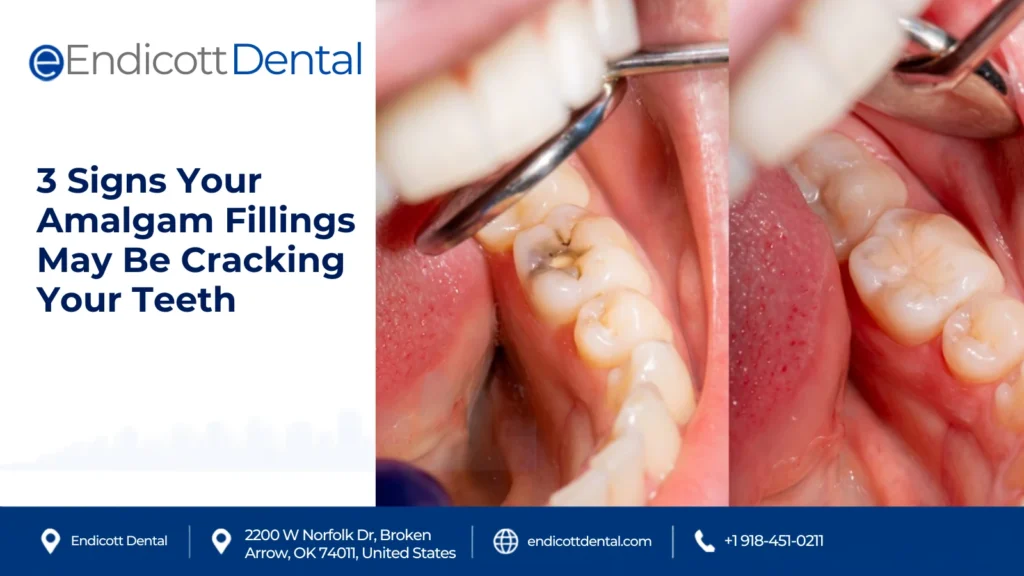
You may see:
- A visible line running through the tooth
- A small section of enamel missing beside the filling
- A cusp that looks chipped
- A dark line extending beyond the filling
- A piece of tooth suddenly breaking while eating
- A filling that suddenly looks larger because part of the tooth surrounding it broke away
But many cracks are difficult for patients to see.
Some are tiny.
Others run underneath a filling.
Some are visible only after the tooth is dried, magnified, illuminated, or examined from several angles.
That is why a tooth can look normal in your bathroom mirror and still have a meaningful fracture.
Are All Cracks Dangerous?
No.
Tiny superficial enamel lines called craze lines are extremely common in adult teeth and may require no treatment at all.
The American Association of Endodontists describes craze lines as shallow enamel cracks that generally cause no pain and are mostly a cosmetic concern.
A crack running deeper through a heavily restored tooth is different.
That type of crack may worsen under repeated chewing force.
A fractured cusp around a filling may sometimes be repaired with a new restoration or crown.
A deeper crack that enters the nerve may require root canal treatment.
And a severe crack that extends too far below the gumline can sometimes make a tooth impossible to predictably save.
That is why the word crack by itself is not a diagnosis.
We need to know how deep it goes and what part of the tooth it involves.
Sign #2: New Pain, Cold Sensitivity, or Pain When You Bite
This is the symptom we would not ignore.
You have had the same silver filling for 18 years.
It never bothered you.
Then suddenly:
Cold water gives you a sharp jolt.
You bite into something and feel a quick stab.
The tooth hurts when you release your bite.
Sweets suddenly bother it.
Or you develop an ache that seems to come and go.
A filling that has been comfortable for years should not suddenly start hurting without a reason.
The challenge is figuring out what changed.
Pain When Biting Can Be a Classic Crack Symptom
Cracked teeth can produce an unusual pattern of discomfort.
The American Association of Endodontists notes that cracked teeth may cause erratic pain while chewing, sometimes particularly when biting pressure is released. They can also become sensitive to hot and cold temperatures.
That pain may not happen every time.
You bite one way: nothing.
You hit the tooth at a slightly different angle: sharp pain.
That inconsistency can make cracked teeth frustrating to diagnose.
Why Does a Crack Hurt?
Under the hard enamel and dentin of your tooth is a living tissue called the pulp.
That is where the nerves and blood vessels are.
When a tooth is cracked, biting pressure can cause microscopic movement between the cracked sections.
That movement can irritate the pulp.
As the crack progresses, the nerve can become increasingly inflamed.
The AAE explains that an untreated crack may eventually damage the pulp enough that it cannot recover, potentially leading to infection.
Sensitivity Can Also Mean a Loose or Leaking Filling
A crack is not the only possibility.
A tooth with an old filling may become sensitive because:
- The filling has loosened
- The edge has broken down
- New decay has developed
- The tooth has cracked
- The nerve is becoming inflamed
- Gum recession has exposed part of the root
- Grinding has stressed the tooth
The AAE notes that sharp biting pain can be associated with decay, a loose filling, a crack, or damage involving the pulp.
That is why buying sensitive toothpaste is not always enough.
Sensitive toothpaste may be appropriate for exposed roots or generalized sensitivity.
It cannot repair a cracked cusp or remove decay hiding under an old filling.
The Type of Sensitivity Matters
Brief cold sensitivity that disappears almost immediately may represent a relatively minor issue.
Lingering pain deserves more attention.
If you drink something cold and the tooth continues aching after the cold is gone, the nerve may be more significantly irritated.
The AAE identifies lingering hot or cold sensitivity, significant biting pain, cracked teeth, swelling, and deep decay as symptoms that can sometimes indicate a need for root canal treatment.
That does not mean every sensitive old filling needs a root canal.
It means you should not wait six months hoping the tooth stops complaining.
Sign #3: Dark Gaps, Broken Edges, or New Decay Around the Filling
Fillings do not get cavities.
Natural teeth do.
That seems obvious, but it explains one of the most common problems we see around older dental work.
A filling may remain hard while the tooth directly beside or underneath it develops new decay.
Dentists call this recurrent or secondary caries.
How Does Decay Develop Around an Existing Filling?
Ideally, a restoration has a well-sealed margin where the filling meets healthy tooth.
Over time, things can change.
An edge may chip.
Part of the restoration can fracture.
Decay can develop along the neighboring tooth surface.
The tooth itself can crack.
A margin may become open.
Plaque and bacteria can then collect around areas that are harder to clean.
Eventually, decay can progress under the restoration.
The difficult part is that you may not be able to see it.
What Might You Notice at Home?
Possible signs include:
- A dark gap beside the filling
- Food consistently catching in one area
- Floss shredding or hanging up beside the tooth
- Part of the filling feeling rough
- A new hole or depression
- A chipped edge
- A filling that feels loose
- A bad taste in one particular area
- New cold or sweet sensitivity
But none of those signs proves there is decay.
Does a Dark Line Always Mean a Cavity?
No.
This is another reason we do not recommend replacing restorations based on photographs or mirror inspections alone.
Amalgam can tarnish.
Teeth can pick up stain around restoration margins.
Old fillings can look dark and unattractive while still functioning adequately.
Conversely, a filling may look surprisingly normal from the top while an X-ray reveals decay beneath one edge.
Appearance matters.
It is not the whole diagnosis.
How Could an Old Filling Contribute to a Bigger Tooth Fracture?
The phrase “the filling cracked my tooth” sounds simple.
Real dental mechanics are not.
A better way to think about it is this:
A tooth containing a large old restoration may have less natural structure available to withstand years of biting force.
The filling exists because tooth structure was already lost to decay.
If the restoration is large enough to involve multiple surfaces of the tooth, the remaining cusps may become more vulnerable.
Then add:
- Decades of chewing
- Clenching
- Grinding
- Hard foods
- Recurrent decay
- Normal fatigue of dental tissues
- Existing microscopic cracks
Eventually a cusp can fracture.
Sometimes the filling comes out with it.
Sometimes the filling remains almost perfectly intact while the natural tooth breaks beside it.
That last scenario surprises patients.
They look at the piece of silver and say:
“The filling looks fine.”
It may be.
The tooth may be the part that failed.
Do Silver Fillings Expand and Contract?
Dental materials and natural tooth structure respond differently to changes in temperature.
That fact has sometimes been turned into an overly simple internet explanation:
“Amalgam expands and contracts until it cracks every tooth.”
Current clinical evidence does not support making that absolute claim.
As noted earlier, a 2025 case-control study specifically investigating the issue did not find a significant association between amalgam restorations themselves and tooth fracture.
The responsible way to explain the concern is:
Large restored teeth experience complicated mechanical forces.
The size of the restoration, remaining tooth structure, wear patterns, decay, bite force, and patient habits all influence fracture risk.
The material is one factor in a much bigger system.
We would rather give patients that nuanced answer than a dramatic explanation that sounds convincing but oversimplifies the science.
Should You Replace All of Your Silver Fillings Before They Break?
Usually, no.
This is where preventive dentistry can turn into overtreatment if we are not careful.
The FDA's current patient guidance says that when an amalgam filling is in good condition and there is no decay beneath it, removing it is not recommended simply for preventive health reasons. Removal can sacrifice additional healthy tooth structure, and removing amalgam temporarily increases mercury-vapor exposure during the procedure.
So if you have eight silver fillings, that does not automatically mean you need eight replacements.
We would rather examine them individually.
One may be perfectly stable.
Another may have a broken margin.
Another may have recurrent decay.
Another may sit inside a tooth with a developing crack.
Treat the tooth, not the color of the restoration.
What About Mercury in Silver Fillings?
This is usually the next question.
Dental amalgam does contain elemental mercury.
The FDA currently advises certain higher-risk groups to discuss non-amalgam alternatives when a new restoration is needed, including people with certain neurological or kidney conditions, people with known sensitivity to amalgam components, pregnant or nursing patients, and young children.
But the FDA does not recommend routinely removing intact existing amalgam fillings in people simply to prevent illness.
That is an important distinction.
If an old filling is failing because of a crack, decay, or structural problem, replacement may make sense.
If it is healthy, stable, and functional, mercury concerns alone do not automatically justify drilling it out.
How Do We Check Whether an Old Silver Filling Is Failing?
There is no single test.
Diagnosing an aging restoration means putting several pieces together.
Visual Examination
We inspect:
- The filling margins
- The remaining tooth
- Chips
- Fracture lines
- Open edges
- Areas where food collects
- Signs of recurrent decay
Dental X-Rays
Radiographs may help identify decay that is not visible from the chewing surface.
They can also help us assess the tooth beneath and around a large restoration.
X-rays have limitations, though.
A crack does not always show up clearly on an X-ray.
Bite Testing
If a crack is suspected, the dentist may apply pressure to individual portions of the tooth to see whether a specific cusp reproduces the symptoms.
Magnification and Lighting
Some cracks become easier to identify when the tooth is dry and examined under magnification or specialized illumination.
Your Description of the Pain
This matters more than patients sometimes realize.
Tell us:
- What causes the pain
- Whether hot or cold triggers it
- How long it lasts
- Whether biting hurts
- Whether releasing the bite hurts
- Whether the tooth wakes you up
- Whether the pain is becoming more frequent
Those details can help distinguish ordinary sensitivity from a damaged tooth.
What Happens if We Catch a Failing Filling Early?
This is why routine examinations matter.
A relatively small problem may have a relatively conservative solution.
Treatment could involve:
- Monitoring
- Smoothing a rough edge
- Repairing part of a restoration in selected cases
- Replacing the filling
The exact treatment depends on how much healthy tooth structure remains.
Early does not always mean simple.
But it usually gives us more choices.
When Is a New Filling Enough?
A replacement filling may be appropriate when:
- Decay is relatively limited
- The remaining tooth structure is strong
- No major cusp is compromised
- There is no significant crack
- The restoration does not need to cover a large portion of the tooth
Tooth-colored composite resin is commonly used today.
The FDA notes that composite has advantages including tooth-colored appearance and the ability to place certain restorations while removing relatively little healthy tooth structure.
But composite is not magically superior in every possible situation.
Material choice depends on the tooth, size of the restoration, moisture control, bite forces, and other factors.
When Does an Old Filling Need a Crown Instead?
Sometimes replacing a giant old filling with another giant filling does not give the tooth enough protection.
That is where a crown may come into the discussion.
A crown covers the visible portion of a weakened tooth and redistributes chewing forces around it.
At Endicott Dental, crowns are among the options we consider when a tooth is significantly cracked, fractured, decayed, or weakened by a large existing filling.
That does not mean:
Old amalgam = crown.
It means:
Not enough strong natural tooth remaining = we may need more protection than another filling provides.
What About an Onlay?
In some situations, an onlay or other partial-coverage restoration may protect weakened cusps without covering as much of the tooth as a traditional crown.
Whether that is appropriate depends on the crack pattern, remaining enamel, bite, and location of the damage.
The goal should be to preserve healthy tooth structure while protecting the parts that are vulnerable.
When Does a Cracked Tooth Need a Root Canal?
A crack does not automatically mean a root canal.
If the crack remains outside the pulp and the nerve is healthy, stabilizing the tooth may be enough.
If the crack extends far enough to inflame or infect the pulp, root canal treatment may become necessary.
The AAE notes that cracked teeth involving the pulp may be treated with root canal therapy followed by a crown to help protect the tooth from further crack propagation.
Symptoms that make us more concerned about pulp involvement include:
- Lingering temperature sensitivity
- Significant spontaneous pain
- Severe biting pain
- Nighttime pain
- Increasing symptoms
- Swelling or infection
Again, the earlier a crack is diagnosed, the better chance we have of choosing the most conservative predictable treatment.
Can a Cracked Tooth Always Be Saved?
Unfortunately, no.
This is why ignoring biting pain for a year can become expensive.
A crack confined to a repairable part of the tooth may have a good prognosis.
A fracture that extends deeply below the gumline or splits the tooth into separate segments may leave us with no predictable way to restore it.
The American Association of Endodontists notes that cracks extending below the gumline may make a tooth nonsalvageable and require extraction.
That is the outcome we would rather prevent.
If a crown now can help protect a compromised but salvageable tooth, that may be preferable to waiting until the tooth fractures too deeply to restore.
But that decision needs evidence.
We should not crown every old filling “just in case.”
What If the Filling Falls Out Completely?
Do not panic.
But do not ignore it either.
A lost filling leaves exposed tooth structure that may be sensitive and more vulnerable to fracture.
Call your dentist.
Until you are evaluated:
- Keep the area reasonably clean
- Avoid chewing hard foods on that side
- Avoid extremely sticky foods
- Do not attempt to permanently glue the filling back yourself
If there is no pain, it may not be a hospital-level emergency.
It still deserves timely dental attention.
What If Part of the Tooth Breaks but the Filling Stays?
This is surprisingly common with heavily restored teeth.
Save the broken piece if you can.
Call your dentist.
Try not to chew on that tooth.
Whether the tooth needs a filling, onlay, crown, root canal, or another treatment will depend on how much tooth broke and where the fracture extends.
A fractured cusp is often treatable. The AAE notes that when a piece of the chewing surface breaks around a filling, dentists may often restore the area with a new filling or crown depending on the damage.
Does Teeth Grinding Make Old Fillings More Risky?
Grinding and clenching can absolutely matter.
Those habits place repetitive forces on teeth and restorations.
Someone with a small filling and a gentle bite is not in the same mechanical situation as someone with a huge MOD amalgam filling who clenches intensely every night.
Grinding can contribute to:
- Worn enamel
- Fractures
- Cracked restorations
- Broken cusps
- Jaw soreness
- Morning headaches
The AAE recommends addressing clenching and grinding when trying to reduce the risk of cracked teeth.
If we see old restorations plus heavy wear facets, we may also want to discuss what your bite is doing at night.
Replacing a filling without addressing severe grinding may only solve half the problem.
Does It Matter How Large the Silver Filling Is?
Very much.
Imagine two teeth.
One has a small silver filling occupying a tiny groove.
The other has a massive restoration replacing much of the chewing surface and extending down both sides of the molar.
Calling both of them “silver fillings” makes them sound equivalent.
Structurally, they are not.
The second tooth has less natural structure remaining.
That does not guarantee failure.
It does mean we pay closer attention to the cusps, cracks, bite forces, and overall amount of supporting tooth.
The bigger question is not:
How much metal do you have?
It is:
How much strong natural tooth is left?
What If Your Old Silver Filling Looks Ugly but Is Healthy?
Then you have a cosmetic decision, not necessarily a disease problem.
Some patients want silver fillings replaced because they dislike the appearance.
That is a valid concern.
But elective cosmetic replacement should still involve an honest discussion about the tradeoff.
Removing an existing restoration usually means removing at least some additional tooth structure.
A replacement restoration will also eventually age.
So if the only problem is appearance, you should understand that before making the choice.
There is a meaningful difference between:
“This filling is failing and threatens the tooth.”
and:
“This filling is healthy, but I would prefer a tooth-colored restoration.”
Both conversations are legitimate.
They are not the same diagnosis.
Is It Better to Replace Old Silver Fillings Before They Hurt?
Sometimes.
That depends entirely on what we see.
If we identify:
- Significant cracks
- Active recurrent decay
- Open margins
- A weakened cusp
- A partially fractured tooth
waiting for pain may be a poor strategy.
Pain is not the first stage of dental disease.
It can be the stage where a smaller problem has already reached the nerve.
On the other hand, if a 25-year-old filling looks stable and the tooth is healthy, replacing it preemptively may sacrifice healthy tooth for no clear clinical benefit.
That is why the best answer is not:
“Always replace old amalgams.”
or:
“Never replace old amalgams.”
It is:
Replace them when the condition of the tooth gives you a reason.
What Would We Tell a Broken Arrow Patient With 30-Year-Old Fillings?
We would tell you to have them checked.
We would not tell you to assume they all need to come out.
During the examination, we want to know:
- Are the margins intact?
- Is there recurrent decay?
- Is the tooth cracked?
- How large is the restoration?
- Is there enough healthy tooth remaining?
- Are you grinding?
- Are you having symptoms?
- What does the X-ray show?
- Has anything changed since your last examination?
From there, each tooth gets its own recommendation.
You may leave with three completely different answers:
Tooth one: Leave it alone.
Tooth two: Replace the filling before the decay gets larger.
Tooth three: The tooth is significantly cracked and needs more structural protection.
That is what individualized dental treatment should look like.
When Should You Call Rather Than Wait for Your Next Cleaning?
Schedule an evaluation sooner if you notice:
- New pain when biting
- A sharp pain when releasing your bite
- Lingering cold or heat sensitivity
- Part of a tooth breaking off
- A loose filling
- A missing filling
- Swelling
- A sharp edge cutting your tongue
- Food constantly trapping beside one filling
- A visible crack extending through the tooth
- Pain that wakes you at night
You do not need to panic.
But these are poor symptoms to monitor indefinitely on your own.
Protect the Tooth Before the Filling Becomes the Least of the Problem
The most expensive part of an old silver filling is usually not replacing the filling.
It is waiting until the tooth surrounding it breaks beyond a simple repair.
At Endicott Dental, that is why we evaluate aging restorations rather than automatically removing them.
Dr. Drew Endicott and our Broken Arrow team can look at the filling, the remaining tooth structure, your bite, symptoms, and appropriate dental imaging to determine whether anything actually needs to be done.
Sometimes the answer is:
“That silver filling is old, but it still looks solid. Let's keep watching it.”
Sometimes it is:
“There is decay starting around the edge. Replacing it now makes sense.”
And sometimes it is:
“The filling is still sitting there, but the tooth around it is beginning to crack. We need to protect the tooth before the fracture gets larger.”
That is the distinction that matters.
If you have older silver fillings and you are experiencing biting pain, sensitivity, visible cracking, or you simply have not had them evaluated in several years, Endicott Dental can help you understand what is happening before you commit to replacing anything.
The goal is not to remove every old filling.
It is to preserve as many healthy natural teeth as we reasonably can.
Frequently Asked Questions About Old Silver Fillings
How do I know if my silver filling is failing?
The most important warning signs include cracks or broken tooth structure around the filling, new sensitivity or biting pain, and open or decayed margins.
A failing restoration may also become loose, rough, chipped, or develop food-trapping areas.
However, some failing fillings cause no noticeable symptoms, which is why dental examinations and appropriate imaging matter.
How long can a silver filling last?
There is no fixed expiration date.
Amalgam is a durable restorative material, and some fillings function for decades. The ADA notes that amalgam has historically demonstrated strong longevity.
Size, tooth location, bite forces, oral hygiene, decay risk, and remaining tooth structure all influence lifespan.
Should I replace a silver filling just because it is 20 years old?
No.
Age alone is not a reason to replace a functional restoration.
If it remains sealed and the tooth is healthy, monitoring may be the better option.
Are old silver fillings dangerous because they contain mercury?
Dental amalgam does contain mercury.
However, the FDA does not recommend removing an intact amalgam restoration solely to prevent disease when there is no decay or other medical indication.
The FDA recommends discussing non-amalgam alternatives for new restorations in certain higher-risk populations.
Can silver fillings crack teeth?
It is more accurate to say that heavily restored teeth can become vulnerable to fracture over time.
A recent 2025 case-control study found no statistically significant association between simply having an amalgam restoration and dental fracture.
Restoration size, remaining tooth structure, bite forces, grinding, decay, and age all affect fracture risk.
Why do teeth break around fillings?
A tooth with a large restoration has already lost some natural structure.
Repeated chewing forces, grinding, decay, and existing cracks can weaken the remaining cusps over time.
Eventually, a portion of the tooth may fracture even while the restoration itself remains intact.
What does a cracked tooth feel like?
Common symptoms include intermittent sharp pain when chewing, pain when biting pressure is released, and hot or cold sensitivity.
Some cracks cause no symptoms initially.
Does biting pain always mean the tooth is cracked?
No.
Sharp biting pain can also be associated with decay, a loose restoration, or problems involving the dental pulp.
A dental examination is needed to determine the cause.
Does a dark line around a silver filling mean decay?
Not necessarily.
Amalgam can tarnish, and stain may accumulate around restoration margins.
Darkness alone does not prove recurrent decay.
Your dentist may need an examination and X-ray to determine whether the margin is healthy.
Can cavities grow underneath silver fillings?
Yes.
The natural tooth around or beneath a restoration can develop recurrent decay.
Fillings themselves do not get cavities.
If there is decay underneath my filling, will I feel it?
Not always.
Decay can develop without significant pain.
By the time a tooth becomes painful, the decay may already be relatively deep.
Should I replace all my amalgam fillings with white fillings?
Usually not simply because they are silver.
Each restoration should be evaluated individually.
A stable filling may be best left alone, while a restoration with recurrent decay, fracture, or structural problems may reasonably need replacement.
Are white composite fillings always better than amalgam?
No material is best for every clinical situation.
Composite offers excellent esthetics and can allow conservative tooth preparation in many situations. Amalgam has historically offered strong durability, especially in demanding posterior areas.
The appropriate choice depends on the tooth and treatment situation.
Can an old silver filling be replaced with composite?
Often, yes.
If enough healthy tooth remains and the area can be predictably restored, tooth-colored composite may be an option.
Large or significantly weakened teeth may require a different restoration.
Why would I need a crown instead of another filling?
A crown may be recommended when there is not enough strong natural tooth remaining for another filling to predictably support the chewing forces.
Crowns are commonly used for teeth weakened by large fillings, cracks, fractures, or substantial decay.
Can a cracked tooth heal by itself?
No.
Unlike bone, a cracked tooth does not naturally fuse back together.
Treatment can stabilize and protect certain cracks, but it does not biologically erase them.
Will a crown stop a crack from getting worse?
A crown can provide significant protection by holding a weakened tooth together and redistributing chewing forces, but no treatment can guarantee that every crack will stop progressing.
The prognosis depends on the depth and location of the fracture.
Does a cracked tooth always need a root canal?
No.
A crack that has not significantly affected the pulp may sometimes be managed without root canal treatment.
If the crack causes irreversible pulp damage or infection, root canal treatment may become necessary.
When is a cracked tooth too damaged to save?
A crack extending deeply below the gumline or a split tooth may be impossible to predictably restore.
The AAE notes that some cracks that extend below the gumline require extraction.
That is one reason early diagnosis matters.
What happens if I ignore a failing filling?
Nothing may happen immediately.
But if there is active decay or a progressing crack, waiting can result in:
- A larger cavity
- More tooth structure being lost
- A broken cusp
- Nerve involvement
- Root canal treatment
- A larger restoration
- Eventual loss of the tooth in severe cases
The appropriate timeline depends on what is actually wrong.
Is a loose silver filling an emergency?
It usually deserves prompt dental attention.
It may not require a hospital emergency department if you have no severe pain, swelling, trauma, or other urgent symptoms.
Avoid chewing hard foods on the tooth and call your dentist.
What if my filling fell out but my tooth doesn't hurt?
Still have it evaluated.
Lack of pain does not mean the tooth is healthy or protected.
The exposed tooth may be more vulnerable to additional decay or fracture.
Should I have old fillings checked even if they don't hurt?
Yes.
Many cracks and areas of recurrent decay cause no symptoms in their early stages.
Routine examinations allow your dentist to monitor older restorations and compare changes over time.
What's the best way to prevent a heavily filled tooth from cracking?
You cannot prevent every fracture, but you can reduce avoidable stresses by:
- Not chewing ice
- Avoiding extremely hard objects
- Addressing grinding or clenching
- Treating active decay
- Maintaining good oral hygiene
- Keeping regular dental examinations
- Following recommended treatment when a tooth becomes structurally compromised
What is the biggest warning sign I should not ignore?
New pain when biting on a tooth with an old large filling deserves attention.
It does not prove the tooth is cracked, but it is one of the classic reasons we would want to examine it sooner rather than later.
