

Table of Contents
You brushed your teeth.
You used mouthwash.
Maybe you even popped a mint before heading into work.
Then you put on a mask for a few hours, took a sip of coffee, and suddenly noticed something unpleasant.
Your breath smells bad.
Many people assume that means they aren't brushing well enough.
Usually, that's not the real problem.
In many cases, persistent bad breath or halitosis isn't caused by food, coffee, or forgetting to brush. It's caused by something most people have never heard of: oral biofilm.
And until that biofilm is addressed, the smell often keeps coming back no matter how many mints, mouthwashes, or gum packs you go through.
The Fast Answer
If your breath smells bad despite brushing regularly, the most common culprit is bacterial biofilm living on your tongue, between your teeth, along the gumline, or in periodontal pockets.
These bacteria produce sulfur compounds that create unpleasant odors. Masks don't cause bad breath, but they do make you more aware of it because you're repeatedly breathing your own exhaled air.
At Endicott Dental, one of the most common things patients discover is that chronic bad breath is often a sign of an underlying oral health issue not a hygiene failure.
What Is Biofilm?
Think of biofilm as a bacterial neighborhood.
It's a sticky, organized layer of bacteria that attaches to surfaces in your mouth.
Unlike loose food particles, biofilm doesn't simply rinse away.
It forms on:
- Teeth
- Tongue surfaces
- Gum tissue
- Dental restorations
- Orthodontic appliances
- Areas between teeth
Dental plaque is actually a type of biofilm.
When left undisturbed, these bacterial colonies become thicker, more complex, and harder to remove.
Unfortunately, many of the bacteria living inside biofilm produce volatile sulfur compounds, the primary source of chronic bad breath.
Why Masks Made So Many People Notice Their Breath
During the pandemic, dentists across the country heard a surprisingly common complaint:
"I've never noticed my breath before, but now I can smell it all day."
Masks didn't create bad breath.
They simply removed the usual escape route.
Instead of exhaled air dispersing into the environment, it circulated back toward the nose.
For many people, masks acted like a diagnostic tool.
They revealed an odor that had likely been present for months or even years.
The Most Common Sources of Biofilm-Related Bad Breath
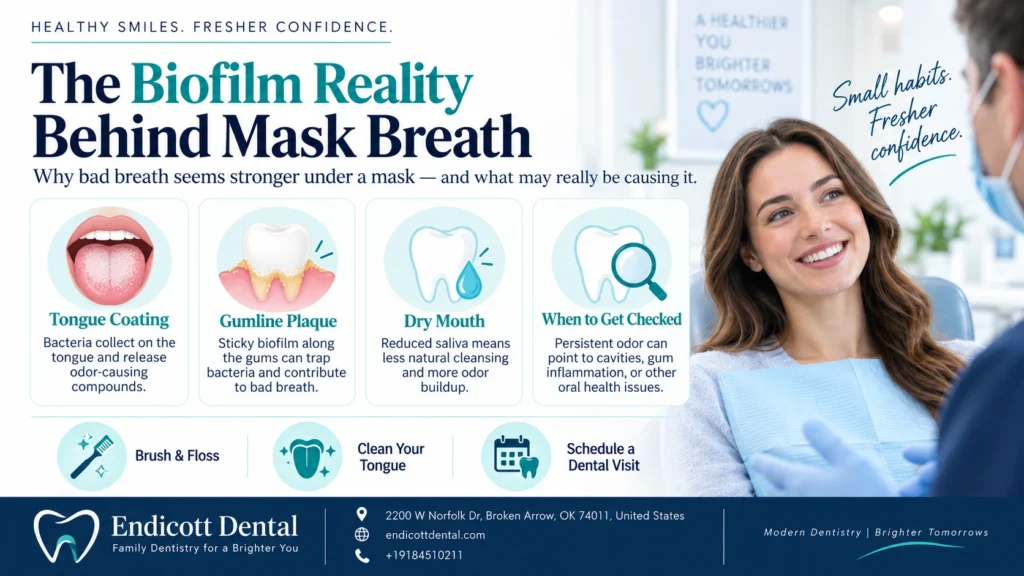
Your Tongue
This is the biggest offender for many people.
The tongue isn't smooth.
It's covered in tiny grooves and papillae that trap:
- Bacteria
- Food debris
- Dead cells
Even patients who brush twice daily often ignore their tongue completely.
That's one reason tongue cleaning can dramatically improve breath.
Between Your Teeth
If you're brushing but not cleaning between your teeth, you're leaving bacteria behind every day.
Those bacteria continue feeding, multiplying, and producing odor-causing compounds.
This is why flossing isn't just about preventing cavities.
It's also about controlling bacterial growth.
Gum Disease
Persistent bad breath is one of the most common warning signs of gum disease.
As gums become inflamed, deeper pockets can form around the teeth.
These pockets create ideal environments for odor-producing bacteria.
Many patients don't realize they have gum disease until symptoms become more obvious.
Why Mouthwash Often Doesn't Solve the Problem
Mouthwash can help temporarily.
But many people use it like air freshener.
The odor improves for an hour or two, then returns.
Why?
Because the source remains.
If biofilm is still attached to the tongue, teeth, or gums, the bacteria continue producing odor-causing compounds after the mouthwash wears off.
It's similar to spraying air freshener in a room while ignoring the garbage can.
The smell may improve briefly, but the underlying source is still there.
Signs Biofilm May Be the Real Problem
You may be dealing with biofilm-related bad breath if:
- Your breath returns quickly after brushing
- Mints only help temporarily
- You notice a bad taste in your mouth
- Your gums bleed when brushing or flossing
- You have visible plaque buildup
- Your tongue appears coated or white
- Other people have commented on your breath
These signs don't automatically mean you have gum disease, but they do suggest it's worth investigating.
The Mistakes We See Most Often
Brushing Longer Instead of Better
Many people assume they simply need to brush harder.
That usually isn't the answer.
Biofilm often survives because it's hiding in areas your toothbrush doesn't effectively reach.
Skipping Tongue Cleaning
Some patients spend two full minutes brushing their teeth and zero seconds cleaning their tongue.
That's like washing your car but ignoring the windshield.
Using Mouthwash as a Substitute for Cleaning
Mouthwash can be helpful.
It cannot replace physical disruption of biofilm through brushing, flossing, and professional cleanings.
What Actually Helps
For most patients, controlling biofilm requires a combination of:
Consistent Home Care
- Brushing twice daily
- Daily flossing
- Tongue cleaning
- Staying hydrated
Professional Dental Cleanings
Some biofilm eventually hardens into tartar.
Once that happens, it cannot be removed with a toothbrush alone.
Professional cleanings become necessary.
Treating Gum Disease
If periodontal disease is present, treating the infection often improves breath significantly.
Identifying Other Causes
Not all bad breath originates in the mouth.
Other possible contributors include:
- Dry mouth
- Sinus infections
- Certain medications
- Acid reflux
- Tonsil stones
- Medical conditions
A dental evaluation can help determine whether the source appears oral or whether additional medical evaluation may be appropriate.
When Bad Breath Is More Than an Embarrassment
Most people think of bad breath as a social issue.
Sometimes it's actually a health issue.
Persistent bad breath can be one of the earliest signs of:
- Gum disease
- Chronic inflammation
- Untreated dental decay
- Oral infection
The sooner those problems are identified, the easier they are typically to manage.
The Bottom Line
If your breath still smells despite brushing regularly, the issue may not be your effort.
It may be a biofilm.
Masks caused many people to notice odors that were already present, bringing attention to bacterial buildup that often goes undetected during daily routines.
The good news is that chronic bad breath is usually treatable once the underlying cause is identified.
If you've noticed persistent bad breath, bleeding gums, a coated tongue, or an unpleasant taste that won't go away, Dr. Drew Endicott and the team at Endicott Dental can help determine whether biofilm, gum disease, or another oral health issue is contributing to the problem. Understanding the cause is the first step toward fixing it.
Frequently Asked Questions
Does wearing a mask cause bad breath?
No. Masks don't create bad breath. They simply make existing odors more noticeable because you're breathing your own exhaled air.
What is oral biofilm?
Biofilm is a structured layer of bacteria that attaches to surfaces in the mouth, including teeth, gums, and the tongue.
Is bad breath a sign of gum disease?
It can be. Persistent bad breath is one of the most common symptoms associated with gum disease and periodontal infections.
Does tongue scraping really help?
For many patients, yes. Since large amounts of odor-causing bacteria live on the tongue, regular tongue cleaning can significantly improve breath.
Why does my breath smell bad even after brushing?
Brushing alone may not remove bacteria living on the tongue, between the teeth, or below the gumline. That's why a comprehensive oral hygiene routine and sometimes professional treatment is necessary.
