

Table of Contents
The appeal is easy to understand.
You see an ad promising straighter teeth without office visits, without braces, and often for a fraction of the cost of Invisalign. A few impressions, some photos, a treatment plan in your inbox, and you're on your way.
At least that's the promise.
The reality is that some patients end up spending thousands of dollars fixing problems that started with trying to save money.
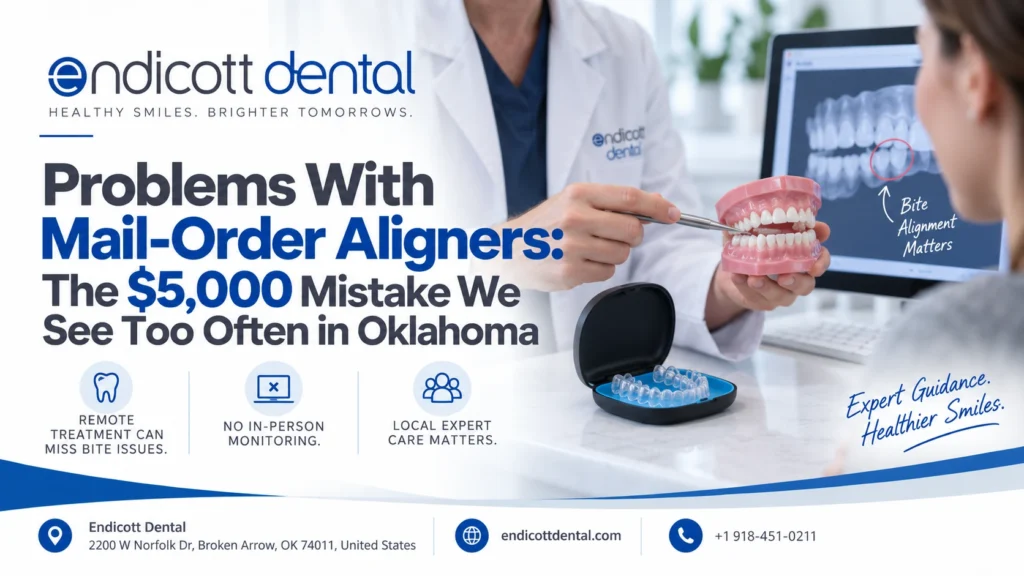
At Endicott Dental, we've seen patients from Broken Arrow and throughout the Tulsa metro come in after using mail-order aligners, frustrated that their bite feels off, their teeth don't fit together properly, or their teeth simply didn't move the way they expected.
Not every mail-order aligner case ends badly.
But the risks are real, and they're often not discussed until after something goes wrong.
The Fast Answer
Mail-order aligners can work for very minor cosmetic tooth movements in carefully selected cases.
The problem is that most people don't know whether they're a good candidate.
Without a comprehensive dental exam, X-rays, and ongoing monitoring, important issues can be missed including gum disease, tooth decay, bite problems, impacted teeth, bone loss, and tooth movement that looks straight but creates new problems.
For some patients, what started as a $2,000 shortcut becomes a $5,000 or $10,000 correction later.
Why Mail-Order Aligners Became So Popular
The marketing is compelling.
Most companies promise:
- Lower cost
- Fewer appointments
- Faster treatment
- Greater convenience
- Similar results to Invisalign
For busy professionals, parents, and college students, that sounds attractive.
The problem is that straight teeth and a healthy bite are not always the same thing.
The Biggest Difference Most People Don't Understand
When patients compare Invisalign to mail-order aligners, they usually focus on price.
Dentists focus on diagnosis.
That's because tooth movement isn't the treatment.
Diagnosis is.
Before moving teeth, a dentist wants to understand:
- Is there enough bone support?
- Are the gums healthy?
- Are there cavities?
- Is there existing tooth wear?
- Is the bite already unstable?
- Are there jaw joint concerns?
- Are teeth moving in a predictable way?
Mail-order systems often rely heavily on photographs, impressions, and computer simulations.
But a computer simulation can only work with the information it's given.
If important information is missing, the treatment plan may be missing important information too.
Teeth Can Look Straighter While Your Bite Gets Worse
This is one of the most common issues we see.
Patients are often thrilled when the front teeth appear straighter.
Then they notice:
- Back teeth don't touch correctly
- Chewing feels awkward
- Front teeth hit too early
- Jaw soreness develops
- Teeth feel unstable
From a distance, the smile may look improved.
Functionally, however, the bite may have become less stable.
That's not a tradeoff most patients would knowingly choose.
The Problems We See Most Often
Bite Changes
A beautiful smile isn't much help if eating becomes uncomfortable.
When tooth movement isn't carefully monitored, bite relationships can change unexpectedly.
Correcting those problems may require additional orthodontic treatment.
Gum Recession
Moving teeth outside the available bone can increase the risk of gum recession.
Once gum tissue recedes, restoring it can be difficult and expensive.
Root Damage
Orthodontic movement always involves biological changes.
That's one reason professional monitoring matters.
When teeth move in unexpected ways, intervention may be needed before damage becomes significant.
Undiagnosed Dental Problems
One of the biggest risks isn't the aligners themselves.
It's what wasn't diagnosed before treatment started.
We've seen patients discover:
- Cavities
- Cracked teeth
- Gum disease
- Existing bite issues
Only after treatment was underway.
Those problems don't pause simply because aligners are being worn.
Why "Remote Monitoring" Isn't the Same as an In-Person Exam
Some companies advertise dentist oversight.
Patients often assume that means the same level of care they would receive in a dental office.
Those are not necessarily the same thing.
An in-person evaluation allows a dentist to:
- Examine the gums
- Check tooth mobility
- Assess bite function
- Evaluate jaw joints
- Review X-rays
- Monitor changes that photos may miss
Remote monitoring can be helpful.
But it has limitations.
And understanding those limitations is important before making a decision.
Are Mail-Order Aligners Ever Appropriate?
Sometimes.
For adults with extremely minor cosmetic concerns and healthy teeth, gums, and bite relationships, limited tooth movement may be successful.
The challenge is determining whether you actually fall into that category.
Most people are not qualified to make that assessment on their own.
That's where professional evaluation becomes valuable.
Why Invisalign Costs More
One of the most common questions patients ask is:
"Why would I pay more for Invisalign?"
The answer isn't simply the trays.
It's everything surrounding them.
With Invisalign treatment, you're generally paying for:
- Diagnosis
- Treatment planning
- X-rays
- Monitoring
- Adjustments
- Refinements
- Problem-solving if teeth don't track properly
The aligners are only one part of the process.
The expertise guiding the treatment is often what makes the difference.
The Real Cost Comparison
Many people compare:
Mail-Order Aligners: $1,500–$3,000
vs.
Invisalign: $3,500–$7,000+
The comparison sounds straightforward.
But it becomes much different if complications require:
- Additional orthodontic treatment
- Bite correction
- Restorative dentistry
- Replacement retainers
- Gum treatment
Suddenly the cheaper option isn't necessarily cheaper.
The most expensive orthodontic treatment is often the one that has to be done twice.
How to Know Which Option Is Right for You
You may be a good candidate for professionally supervised aligner treatment if:
- You want predictable results
- You have moderate crowding or spacing
- You have bite concerns
- You grind your teeth
- You've never had a comprehensive orthodontic evaluation
You may not need extensive treatment if:
- The issue is truly minor
- Your bite is healthy
- Your gums are healthy
- Your dentist confirms you're a good candidate
The key word is confirmed.
No guesses.
The Bottom Line
Mail-order aligners appeal to people for the same reason online DIY solutions appeal in every industry: they promise convenience and savings.
Sometimes they work.
Sometimes they don't.
The problem is that most patients don't know which group they'll fall into until treatment is already underway.
At Endicott Dental, Dr. Drew Endicott believes patients deserve to understand both the benefits and limitations before making a decision. If you're considering Invisalign, mail-order aligners, or another orthodontic option, an evaluation can help you understand what treatment is actually necessary and whether a lower-cost option is truly the right fit for your situation.
Frequently Asked Questions
Are mail-order aligners the same as Invisalign?
No. Both use clear aligner trays, but Invisalign treatment includes in-person diagnosis, treatment planning, and ongoing monitoring by a dental professional.
Can mail-order aligners damage your teeth?
In some cases, complications such as bite changes, gum recession, or unwanted tooth movement can occur if treatment is not appropriately planned or monitored.
Why are mail-order aligners cheaper?
They generally reduce or eliminate many of the clinical services associated with traditional orthodontic care, including in-person examinations and ongoing supervision.
Can Invisalign fix problems caused by mail-order aligners?
Often yes, but the complexity and cost depend on the extent of the issues created during the original treatment.
Is Invisalign worth the extra cost?
For many patients, the additional cost reflects professional diagnosis, monitoring, and the ability to address problems as they arise, factors that can significantly improve predictability and outcomes.
