

Table of Contents
Most dental problems make themselves known pretty quickly.
A cavity hurts.
A cracked tooth becomes sensitive.
An infection causes swelling.
But every so often, a patient walks into our Broken Arrow office with a completely different concern:
"One of my front teeth is turning gray."
What's strange is that it often isn't painful.
Sometimes the color changed gradually.
Sometimes it seemed to happen overnight.
And in many cases, the patient can't think of any reason why it's happening.
Then we ask a simple question:
"Did you ever hit that tooth?"
Suddenly they remember.
A baseball to the mouth in high school.
A basketball collision years ago.
A bike accident as a kid.
A fall off a skateboard.
An elbow during a football game.
The injury happened years ago—sometimes decades ago.
The gray tooth is just now showing up.
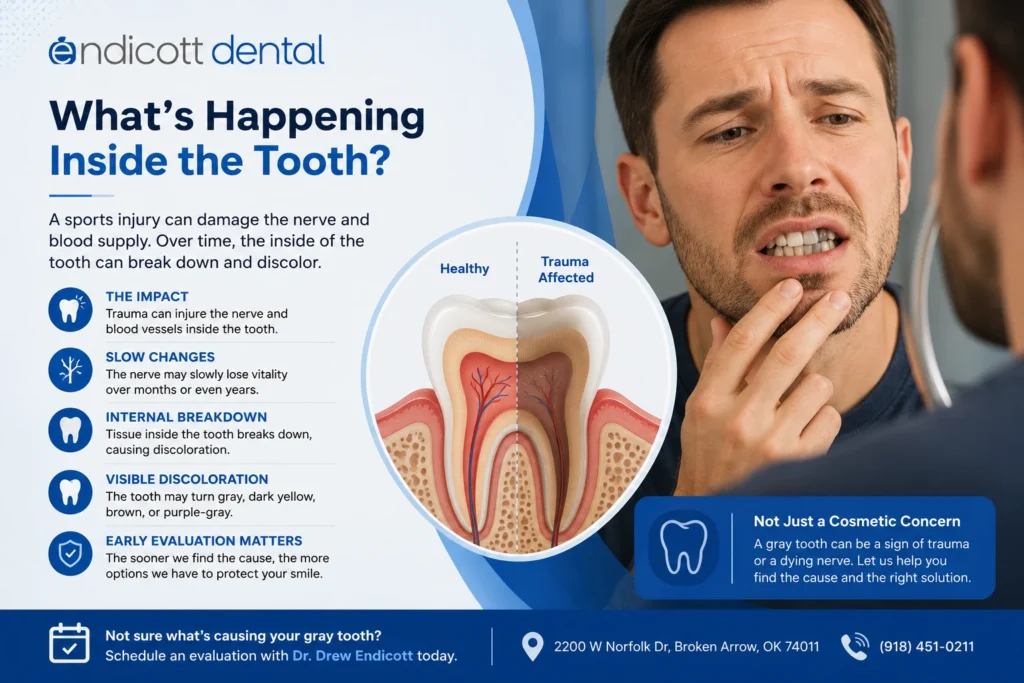
Quick Answer: Why Does a Tooth Turn Gray?
A gray tooth is often a sign that the nerve inside the tooth has been damaged or died.
One of the most common causes is dental trauma.
The surprising part is that the injury doesn't always cause immediate problems.
A tooth can experience trauma and remain symptom-free for years before changes begin to appear.
That's why patients are often shocked when a seemingly healthy tooth starts changing color long after the original accident.
What Actually Happens Inside the Tooth?
Every tooth contains a living nerve and blood supply.
When a tooth experiences a significant impact, several things can happen:
- The nerve may become inflamed
- Blood vessels may be damaged
- The nerve may slowly lose vitality
- Internal bleeding may occur
- The pulp tissue may begin breaking down
Sometimes the tooth recovers completely.
Sometimes it doesn't.
When the nerve dies, the internal tissue begins to discolor, causing the tooth to appear:
- Gray
- Dark yellow
- Brown
- Purple-gray
- Duller than neighboring teeth
This discoloration comes from inside the tooth, which is why brushing won't remove it.
Why Can It Take Years to Appear?
This is the part that confuses most patients.
If the injury happened ten years ago, why is the tooth changing color now?
The answer is that dental trauma doesn't always create immediate nerve death.
In some cases, the nerve slowly deteriorates over time.
The tooth may continue functioning normally for years before the damage finally becomes visible.
We've seen patients discover an old sports injury was responsible for a gray tooth decades after the original impact.
Does a Gray Tooth Mean You Need a Root Canal?
Not always.
But it often means the tooth needs evaluation.
A gray tooth can indicate:
- Previous trauma
- A dying nerve
- A dead nerve
- Internal resorption
- Previous dental treatment
- Rare developmental conditions
The only way to know for sure is through an examination and appropriate imaging.
If the nerve has died, root canal treatment is frequently recommended to prevent infection and preserve the tooth.
What If the Tooth Doesn't Hurt?
This is one of the biggest misconceptions in dentistry.
Many patients assume that if a tooth isn't painful, it must be healthy.
Unfortunately, dead teeth often don't hurt.
In fact, some of the most severely infected teeth we see caused little or no pain until the problem became advanced.
Color changes are often one of the earliest warning signs.
Other Signs a Sports Injury May Be Catching Up With You
A gray tooth isn't the only clue.
Patients may also notice:
- Increased sensitivity
- Mild pressure when chewing
- Gum swelling near the tooth
- A small bump on the gums
- Occasional discomfort
- A tooth that feels "different"
Sometimes discoloration is the only symptom.
Can a Gray Tooth Be Whitened?
Usually not with traditional whitening.
This is important because many patients spend money on whitening strips, whitening toothpaste, or professional whitening treatments before discovering the real issue.
When discoloration comes from inside the tooth, conventional whitening often has little effect.
Treatment depends on the cause.
Options may include:
- Internal bleaching
- Root canal therapy
- Bonding
- Veneers
- Crowns
The right solution depends on the condition of the tooth and the extent of the discoloration.
What Happens If You Ignore It?
Sometimes nothing happens immediately.
Sometimes an untreated dead tooth develops an infection.
That's the challenge.
You can't predict which direction things will go without an evaluation.
A tooth that changes color is telling you something has changed internally.
Ignoring it doesn't make the underlying cause disappear.
The Athlete Who Doesn't Realize They're an Athlete Anymore
One interesting pattern we see is that patients often don't think of themselves as having had a sports injury.
They're 40, 50, or 60 years old now.
The baseball accident happened in eighth grade.
The football collision happened in college.
The bike crash happened when they were twelve.
They've completely forgotten about it.
But their teeth haven't.
Noticed a Tooth Turning Gray?
If one tooth looks darker than the others even if it doesn't hurt it's worth having it evaluated.
At Endicott Dental, Dr. Drew Endicott and our team can determine whether the discoloration is cosmetic, trauma-related, or a sign of a deeper issue that needs treatment.
Sometimes it's simply an old injury finally making itself known.
The sooner you know what's causing it, the more options you'll typically have for protecting both the health and appearance of your smile.
Frequently Asked Questions
Can a tooth turn gray years after an injury?
Yes. Dental trauma can damage the nerve inside a tooth, and discoloration may not appear until years or even decades later.
Does a gray tooth always mean the nerve is dead?
Not always, but it is one of the most common causes. An examination is needed to determine the exact reason.
Why doesn't my gray tooth hurt?
A tooth with a damaged or dead nerve may have little or no pain, even when significant changes have occurred internally.
Can whitening fix a gray tooth?
Usually not. When discoloration originates inside the tooth, traditional whitening treatments are often ineffective.
Is a gray tooth an emergency?
Not usually, but it should be evaluated. The sooner the cause is identified, the more treatment options are typically available.
