

Table of Contents
If you need a filling, you’ll usually hear two options:
Composite, also called a white filling.
Amalgam, also called a silver filling.
Most patients ask the same question:
“Which one lasts longer?”
The honest answer: silver fillings often last longer in high-pressure back teeth, but white fillings look better and preserve more natural tooth structure in many cases.
So this is not just a beauty contest. It is a tradeoff.
Quick Answer
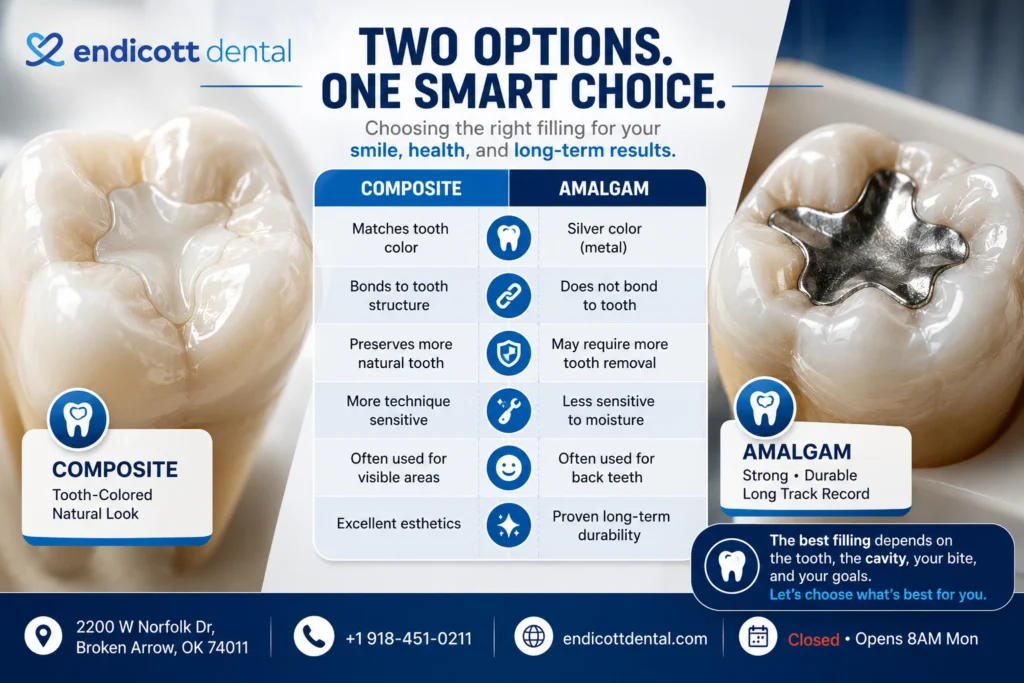
If we are talking strictly about longevity, amalgam has a long track record. Many silver fillings last 15, 20, or even 30 years.
Composite fillings have improved dramatically, but they are usually more technique-sensitive. A well-placed white filling can last many years, but moisture control, bite forces, filling size, and home care matter a lot.
At Endicott Dental in Broken Arrow, we do not choose filling material based on habit. We choose based on the tooth, the size of the cavity, your bite, your cosmetic concerns, and what gives you the best long-term result.
Why Silver Fillings Last So Long
Amalgam fillings are strong.
That is why dentists used them for generations, especially on molars that take heavy chewing force.
They are less sensitive to moisture during placement and can handle pressure well.
The downside is that they are metal-colored, can darken the tooth over time, and old large silver fillings may contribute to cracks in the surrounding tooth structure.
That last part matters.
Sometimes the silver filling survives, but the tooth around it does not.
Why White Fillings Are So Popular
Composite fillings match your tooth color.
For front teeth or visible areas, that is a major advantage.
They also bond directly to the tooth, which can allow a more conservative preparation in many cases. That means less healthy tooth structure may need to be removed.
The downside is that composite is more technique-sensitive. If the tooth cannot be kept dry during placement, or if the filling is very large, it may not last as predictably.
Which One Actually Lasts Longer?
In broad terms:
Small to medium fillings: composite often performs very well.
Large back-tooth fillings: amalgam may have a longevity advantage.
Highly visible teeth: composite usually makes more sense.
Teeth already weakened by cracks or large old fillings: a crown may be a better option than either filling.
This is where patients get misled. The question is not always “white or silver?”
Sometimes the better question is:
“Is this tooth still strong enough for a filling?”
The Hidden Problem With Large Fillings
A filling replaces missing tooth structure.
But it does not make the tooth brand-new.
When a filling gets large, the remaining tooth becomes weaker. That is true whether the material is white or silver.
If too much tooth structure is gone, a larger filling can become a short-term patch instead of a long-term solution.
In that case, a crown may protect the tooth better.
What About Safety?
Many patients ask if silver fillings are unsafe.
For most patients, existing amalgam fillings are not something we recommend removing just because they are silver.
If they are functioning, sealed, and not causing cracks or decay, leaving them alone may be the best option.
Replacing healthy fillings unnecessarily can remove more tooth structure and create problems that did not need to exist.
When Composite Is Usually Better
White fillings are often the better choice when:
- The cavity is small or moderate
- The tooth is visible when you smile
- You want a natural appearance
- Preserving tooth structure is important
- The bite forces are manageable
When Amalgam May Still Make Sense
Silver fillings may still be reasonable when:
- The cavity is in a back molar
- Chewing forces are heavy
- Moisture control is difficult
- Longevity matters more than appearance
- Cost is a major concern
That said, many patients today prefer composite because they do not want visible metal in their mouth.
What We Tell Patients in Broken Arrow
Here is the plain answer.
If you want the longest possible track record in a heavy chewing area, amalgam has history on its side.
If you want a natural-looking, conservative restoration, composite is usually the more appealing choice.
But the best filling is not decided by the material alone.
It is decided by the condition of the tooth.
At Endicott Dental, Dr. Drew Endicott and our team help patients compare the real tradeoffs before choosing treatment. Sometimes a white filling is perfect. Sometimes an old silver filling should be left alone. Sometimes the tooth needs more protection than any filling can provide.
Frequently Asked Questions
Do white fillings last as long as silver fillings?
Sometimes, especially when they are small or moderate in size. For large back-to-tooth fillings, silver fillings may last longer.
Are silver fillings bad for you?
For most patients, existing silver fillings do not need to be removed unless they are failing, cracked, leaking, or causing other problems.
Can I replace my silver fillings with white fillings?
Yes, but replacement should be based on condition, not just appearance. Removing a healthy filling can remove additional tooth structure.
Which filling looks better?
Composite fillings look better because they are tooth-colored and blend with natural enamel.
When is a crown better than a filling?
A crown may be better when the tooth has a large filling, cracks, weak cusps, or not enough healthy structure left to support another filling.
