

Table of Contents
If you've had silver fillings for 10, 20, or even 30 years, there's a good chance you've wondered whether they eventually need to be replaced.
The answer is: sometimes.
Contrary to what you may read online, silver fillings (also called amalgam fillings) are incredibly durable. Many last for decades. In fact, we still see patients in our Broken Arrow offices with silver fillings that are functioning perfectly after 25 years or more.
But like any dental restoration, they don't last forever.
And when an old silver filling begins to fail, the problem often isn't the filling itself.
It's the tooth around it.
Quick Answer: How Do You Know a Silver Filling Is Failing?
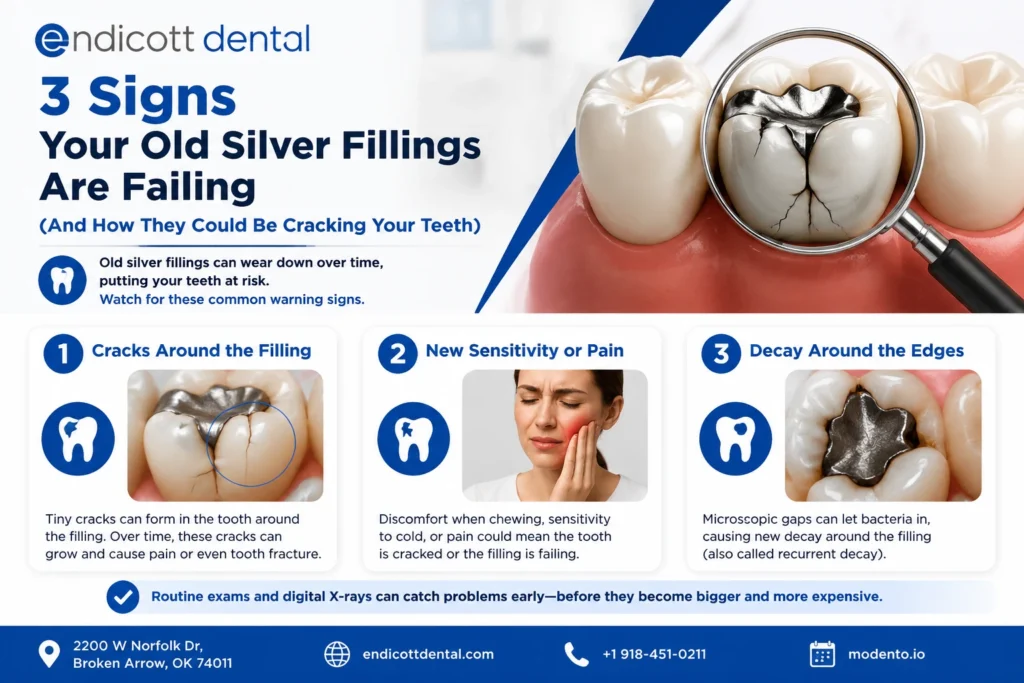
The three biggest warning signs are:
- Cracks forming around the filling
- New sensitivity or pain
- Dark spaces, decay, or breakdown around the edges
The challenge is that many failing fillings don't hurt immediately.
That's why routine dental exams often catch problems before patients realize anything is wrong.
Why Old Silver Fillings Can Become a Problem
Silver fillings were the standard of care for generations because they are strong, durable, and cost-effective.
The downside?
Amalgam expands and contracts differently than natural tooth structure.
Over years of chewing, temperature changes, and normal wear, that constant stress can sometimes contribute to small fractures developing in the surrounding tooth.
Think of it like repeatedly wedging a piece of metal into a block of wood.
The filling may remain intact while the tooth begins to weaken around it.
This doesn't happen with every silver filling.
But it is one of the most common reasons we recommend replacement.
Sign #1: Cracks Around the Filling
This is the biggest concern we see with aging amalgam restorations.
Many patients assume the filling is what breaks.
More often, it's the tooth.
As silver fillings age, the surrounding enamel can develop:
- Hairline fractures
- Small chips
- Deep cracks
- Weakened cusps (the pointed parts of the tooth)
At first, these cracks may cause no symptoms at all.
Over time, they can lead to:
- Pain while chewing
- Sensitivity to cold
- Food getting trapped
- Larger fractures requiring more extensive treatment
In some cases, a cracked tooth can eventually require a crown or even a root canal if the damage progresses far enough.
Sign #2: New Sensitivity or Pain
A filling that has been comfortable for years should not suddenly become sensitive.
If you notice:
- Pain when chewing
- Sensitivity to cold drinks
- Sensitivity to sweets
- Sharp discomfort when biting down
the filling itself may not be the issue.
Instead, the tooth may be:
- Cracked
- Developing decay underneath the filling
- Separating slightly from the restoration
- Experiencing nerve irritation
Many patients assume they simply need a new filling.
Sometimes they do.
Sometimes the problem has progressed beyond that point.
The sooner it's evaluated, the more conservative the treatment tends to be.
Sign #3: Decay Around the Edges
Fillings don't get cavities.
Teeth do.
Over time, microscopic gaps can develop where the filling meets the tooth.
When that happens, bacteria can find their way underneath the restoration and begin creating new decay.
This is called recurrent decay, and it's one of the most common reasons older fillings need replacement.
Unfortunately, patients often can't see it themselves.
That's why digital X-rays and regular exams are so important.
By the time recurrent decay becomes visible, the cavity may already be fairly advanced.
Should Every Silver Filling Be Replaced?
No.
This is one of the biggest misconceptions in dentistry.
We do not recommend replacing silver fillings simply because they are old.
If a filling is:
- Functioning properly
- Free of decay
- Not causing cracks
- Not creating symptoms
it may continue serving you well for years.
Replacing perfectly healthy fillings can actually remove additional tooth structure unnecessarily.
A good dentist should recommend replacement based on condition not age alone.
What Happens If a Failing Filling Is Ignored?
This is where treatment can become more expensive.
A small failing filling may only require:
- A new filling
- A bonded restoration
- Preventive treatment
But when cracks deepen or decay spreads underneath the restoration, treatment can escalate to:
- Crowns
- Root canals
- Tooth extraction
- Dental implants
The goal is to intervene before that happens.
What About White Fillings?
Many patients choose to replace failing silver fillings with tooth-colored composite restorations.
The benefits include:
- Natural appearance
- Less noticeable when smiling
- Conservative bonding techniques
- No dark metal appearance
However, white fillings are not automatically better in every situation.
The right restoration depends on:
- Tooth location
- Bite forces
- Amount of remaining tooth structure
- Overall condition of the tooth
The best solution is the one that protects the tooth for the long term.
How Do You Know If Your Silver Fillings Need Attention?
Here's what we'd tell you if you asked us during a cleaning.
If your silver fillings are decades old, it's worth having them evaluated but don't assume replacement is necessary.
Some old fillings look terrible and function perfectly.
Others look fine but are hiding cracks or decay underneath.
The only way to know for sure is with an examination and appropriate imaging.
Concerned About an Old Filling?
If you have silver fillings and you're noticing sensitivity, pain, visible cracks, or simply haven't had them checked in years, Dr. Drew Endicott and the team at Endicott Dental can evaluate their condition and help you understand your options.
Sometimes the best recommendation is to leave the filling alone.
Sometimes replacing it now can help prevent a much bigger problem later.
Our job is to help you understand the difference before you commit to treatment.
Frequently Asked Questions
Are silver fillings dangerous?
Major dental organizations consider existing amalgam fillings safe for most patients. The most common reason for replacement today is structural concerns, not safety concerns.
How long do silver fillings last?
Many silver fillings last 15–30 years or longer. Their lifespan depends on the size of the filling, bite forces, oral hygiene, and the condition of the surrounding tooth.
Can a silver filling crack a tooth?
In some cases, long-term expansion and stress can contribute to cracks developing in the surrounding tooth structure.
Should I replace all my silver fillings at once?
Usually not. Treatment decisions should be based on the condition of each individual tooth.
What is the biggest sign a silver filling is failing?
Cracks in the surrounding tooth and decay developing around the edges are often the most significant warning signs.
