

Table of Contents
A gap between your front teeth can be one of those things you barely notice or the first thing you see every time you look in the mirror.
For some people, it's part of their smile's character.
For others, it's something they've wanted to change for years.
If you're considering closing a gap between your front teeth, you'll typically hear about two cosmetic options:
Dental bonding and porcelain veneers.
Both can work.
Both can create a beautiful result.
But they're not designed for the same person, budget, or long-term goals.
Here's what we tell patients at Endicott Dental when they're trying to decide between the two.
Quick Answer: Bonding Costs Less, Veneers Last Longer
If you only want the fast answer:
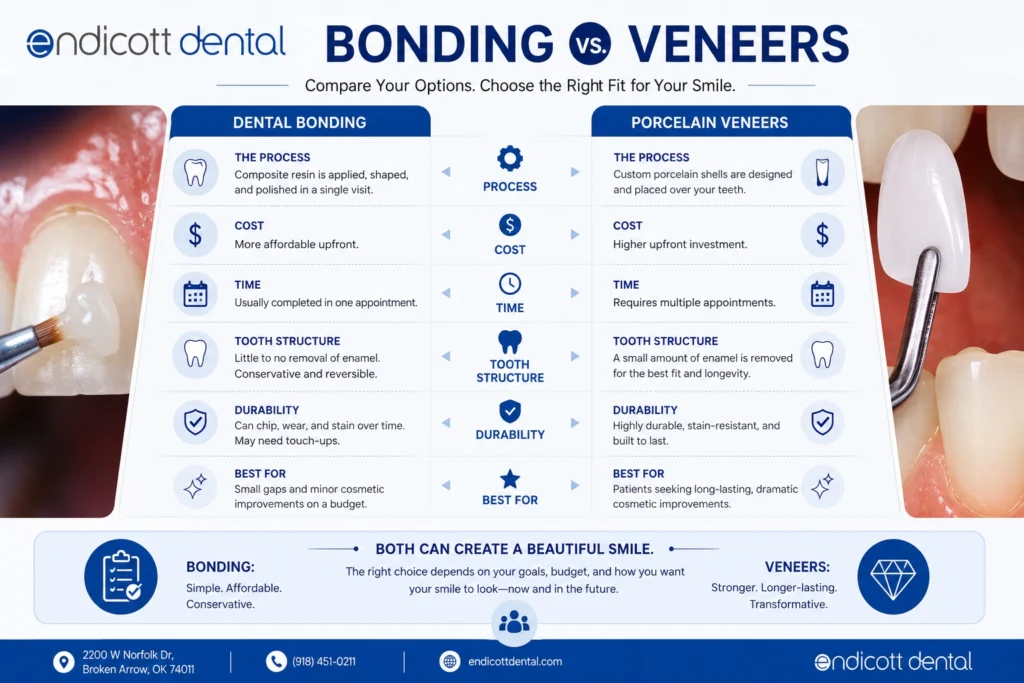
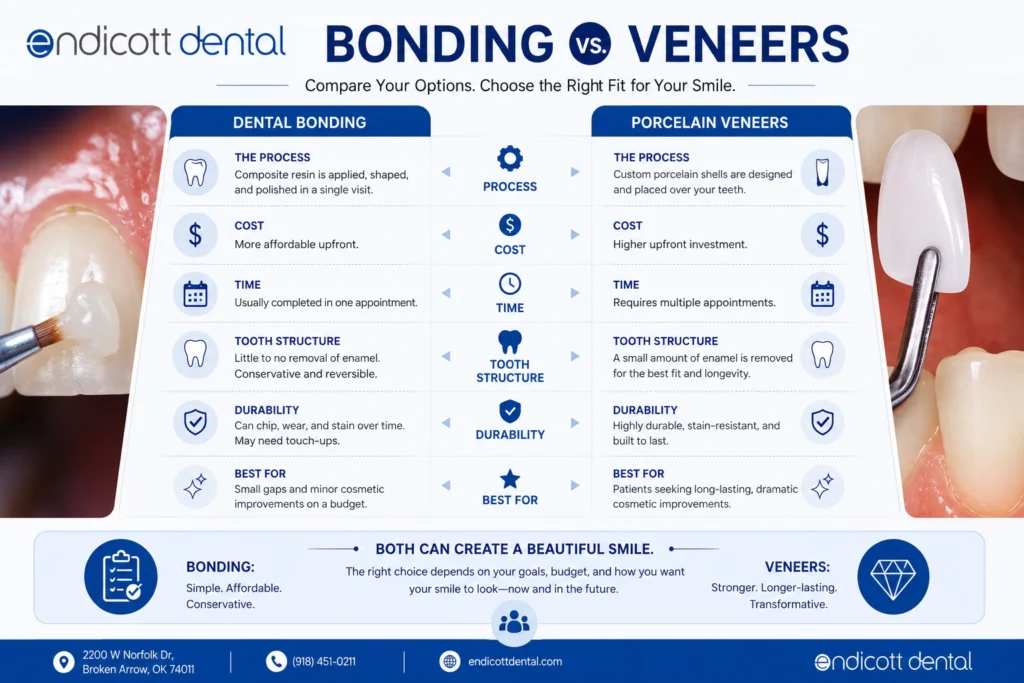
- Dental bonding is usually the more affordable option and can often be completed in a single visit.
- Porcelain veneers typically cost more upfront but offer greater durability, stain resistance, and longevity.
For a small front tooth gap, bonding is often the simplest place to start.
For patients seeking a complete smile transformation, veneers may provide a better long-term solution.
The right answer depends on much more than the size of the gap.
What Is Dental Bonding?
Dental bonding uses a tooth-colored composite resin to reshape the teeth and close the space between them.
Think of it as artistic sculpting.
The material is carefully applied, shaped, and polished directly onto your teeth.
Benefits of bonding include:
- Lower upfront cost
- Usually completed in one appointment
- Little to no removal of tooth structure
- Can often be reversed or modified later
- Natural-looking results
For many patients with a small gap, bonding provides an excellent cosmetic improvement without extensive treatment.
What Are Veneers?
Porcelain veneers are thin custom-made shells that cover the front surface of the teeth.
Unlike bonding, veneers are fabricated in a dental laboratory and designed specifically for your smile.
Benefits of veneers include:
- Exceptional cosmetic appearance
- Greater stain resistance
- Longer lifespan
- Ability to address multiple cosmetic concerns at once
- Consistent color and shape
Many patients choose veneers not just to close a gap but also to improve:
- Tooth shape
- Tooth size
- Discoloration
- Minor alignment concerns
- Worn edges
Which Looks Better?
This is one of the most common questions we hear.
The honest answer:
Both can look fantastic when done properly.
For a small front tooth gap, high-quality bonding can often be virtually indistinguishable from natural tooth structure.
However, veneers generally offer:
- Greater translucency
- More lifelike aesthetics
- Better color stability over time
- More precise smile design possibilities
If cosmetic perfection is the goal, veneers typically have the edge.
If natural improvement is the goal, bonding may be all you need.
Which Lasts Longer?
This is where veneers usually pull ahead.
While every patient is different, bonding generally requires more maintenance over time.
Bonding can:
- Chip
- Wear
- Stain
- Require occasional touch-ups
Porcelain veneers are typically more resistant to:
- Staining from coffee, tea, and wine
- Everyday wear
- Surface discoloration
Many veneer patients enjoy their results for well over a decade with proper care.
Which Costs Less?
Bonding is usually the more affordable option.
That's one reason it's so popular for closing front tooth gaps.
If your primary concern is improving your smile without a significant investment, bonding often provides excellent value.
Veneers typically involve:
- More planning
- Custom laboratory fabrication
- Additional appointments
- Greater long-term durability
As a result, the upfront investment is higher.
What Size Gap Are We Talking About?
This matters more than most patients realize.
Small Gaps
For small spaces, bonding is often the easiest and most conservative solution.
The results can be dramatic with very little treatment.
Larger Gaps
As gaps become wider, bonding may require adding more material to the teeth.
At some point, proportions can begin to look less natural.
In these situations, veneers may provide a more balanced aesthetic outcome.
Very Large Gaps
Sometimes neither bonding nor veneers is the best first step.
Orthodontic treatment may be recommended to reposition the teeth before cosmetic treatment is considered.
When Bonding Is Usually the Better Choice
Bonding is often a great fit if:
- The gap is relatively small
- You want a conservative treatment
- Budget is a major consideration
- You want results quickly
- Your teeth are otherwise healthy and attractive
For many patients, bonding delivers exactly the improvement they want without the additional investment of veneers.
When Veneers Usually Make More Sense
Veneers often become the stronger choice when:
- You want the longest-lasting cosmetic result
- You have additional cosmetic concerns beyond the gap
- You want significant smile enhancement
- You have discoloration that bonding won't fully address
- You want a more comprehensive smile makeover
In those cases, veneers may solve multiple concerns simultaneously.
The Mistake Many Patients Make
The biggest mistake is focusing only on the gap.
The real question isn't:
"How do I close this space?"
It's:
"What do I want my smile to look like five or ten years from now?"
Some patients only care about the gap.
Others want brighter teeth, improved symmetry, and a complete cosmetic transformation.
The answer often determines whether bonding or veneers makes more sense.
What We Tell Patients at Endicott Dental
Here's what we'd honestly tell you if you asked us during a consultation.
If you have a small front tooth gap and otherwise love your smile, bonding is often the smartest place to start.
It's conservative, affordable, and can produce beautiful results.
If you're already considering broader cosmetic improvements, veneers may provide a better long-term outcome.
Neither option is automatically better.
The best choice is the one that fits your goals, your budget, and the smile you're trying to create.
If you're searching for a cosmetic dentist for Jenks, OK and want a conservative, natural-looking result for your front teeth, we're happy to walk you through both options.
Want to Know Which Option Fits Your Smile?
If you're considering closing a front tooth gap, Dr. Drew Endicott and the team at Endicott Dental can evaluate your smile and help you compare bonding, veneers, and other cosmetic options.
Our goal isn't to sell you the most expensive treatment.
It's to help you understand the tradeoffs, costs, and expected results so you can choose the option that feels right for you.
Frequently Asked Questions
Can bonding completely close a front tooth gap?
Yes. For many small and moderate gaps, bonding can create a natural-looking result without extensive treatment.
Are veneers permanent?
Veneers are generally considered a long-term treatment because some enamel preparation is often required.
Which is more affordable?
Bonding is typically less expensive upfront than porcelain veneers.
Do veneers look more natural than bonding?
Both can look excellent. Veneers often provide superior translucency, color stability, and long-term aesthetics.
Can I whiten my teeth before getting bonding or veneers?
Yes, and many patients choose to do so. Whitening is often recommended first so any cosmetic restorations can be matched to your desired tooth shade.
