

Table of Contents
Most homeowners do not think about water quality until something feels off.
The water tastes different. The ice smells a little like a pool. White buildup shows up on faucets. A child’s dentist brings up fluoride. Someone in a neighborhood Facebook group says you need a whole-house filter. Then suddenly you’re wondering whether your tap water is safe, whether you should filter it, and whether your water is helping or hurting your family’s teeth.
Here’s the practical version for Broken Arrow homeowners.
Fast answer: Is Broken Arrow tap water safe to drink?
Based on the City of Broken Arrow’s public water reporting, Broken Arrow municipal water is considered safe to drink and is tested regularly. The city says its water supply surpasses EPA and Oklahoma Department of Environmental Quality standards and that licensed operators perform more than 6,000 water quality tests each year.
That does not mean every homeowner has the same experience at the kitchen sink.
Water quality can still be affected by:
| Issue | Where it may come from |
| Chlorine/chloramine taste | Disinfection used to keep water safe |
| White buildup | Hard water minerals |
| Old-house lead concerns | Plumbing, fixtures, solder, or service lines |
| Musty taste or smell | Seasonal source-water changes or plumbing issues |
| Tooth and cavity questions | Fluoride level, bottled water habits, filters, and brushing |
| Filter confusion | Different filters remove different things |
So the better homeowner question is not just, “Is the city water safe?”
It is:
“What is in my water, what actually matters, and what should I do at my house?”
Where Broken Arrow’s water comes from
Broken Arrow’s water system is tied to regional surface water sources and treatment infrastructure. The City of Broken Arrow provides annual Consumer Confidence Reports, and the 2025 report covering 2024 water quality is published through the city’s drinking water quality page.
Broken Arrow also purchases some water from Tulsa, so Tulsa’s water quality matters for many local homes. Tulsa’s 2025 report says Tulsa’s drinking water comes from Lake Oologah, Lakes Spavinaw and Eucha, and Lake Hudson, then flows through treatment plants before distribution. Tulsa reported more than 48,000 water quality tests in 2024.
That regional connection matters because your water does not start at your faucet. It starts in lakes, travels through treatment, then moves through miles of distribution lines before it reaches your home.
What should Broken Arrow homeowners actually care about?
For most households, the big practical categories are:
- Safety
- Taste and odor
- Hardness
- Fluoride
- Lead and old plumbing
- Filters
- Dental effects
Let’s walk through each one without turning this into a chemistry class.
1. Safety: Passing EPA standards vs. personal comfort level
Municipal water reports compare detected contaminants against federal and state drinking water standards. Tulsa’s report explains that maximum contaminant levels are enforceable standards set to protect public health, and that utilities are required to report detectable regulated contaminants even when levels are well below allowed limits.
That is the official safety framework.
But you may also see third-party sites, such as Environmental Working Group, flag contaminants above their own health guidelines while still noting that the utility is in compliance with federal standards. For Broken Arrow Municipal Authority, EWG lists the utility as serving about 116,330 people, using surface water, and states that for the latest EPA-assessed quarter shown, the utility was in compliance with federal health-based drinking water standards.
Here is the honest homeowner translation:
Passing federal standards is meaningful. It does not mean you are wrong to use a filter if you want an extra layer of protection or better taste.
Both can be true.
2. Taste and odor: Why your water may smell like chlorine
Municipal water has to be disinfected. That is not optional. Disinfection helps control bacteria and other microbes while water moves through the system.
Tulsa’s 2024 water quality data lists chloramine as chlorine with a highest running annual average of 2.5 ppm, a detected range of 1.6–3.3 ppm, and compliance marked “Yes.” The listed purpose is water additive used to control microbes.
That can explain the “pool-ish” smell or taste some homeowners notice.
It does not automatically mean something is wrong. It may just mean you are sensitive to the disinfectant taste.
What to do
For taste and odor, a basic activated carbon filter is often enough. That could be a refrigerator filter, pitcher, faucet filter, under-sink carbon system, or whole-house carbon filter.
But do not assume every filter removes everything. Filter labels matter.
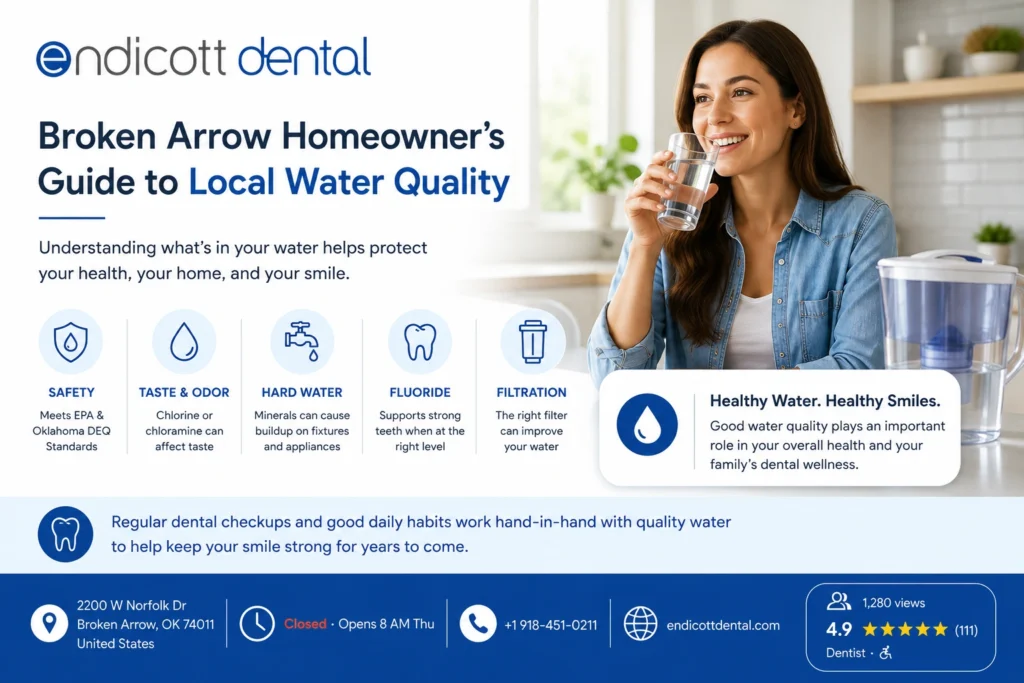
3. Hard water: Why you see white spots and buildup
Broken Arrow-area water can be hard enough for homeowners to notice mineral buildup. One tap-water data source lists Broken Arrow Municipal Authority water hardness at about 145 ppm, which falls in the “hard” range.
Hard water is usually more of a nuisance than a health crisis.
It can cause:
- White spots on dishes
- Scale on faucets and showerheads
- Buildup in water heaters
- Soap not lathering well
- Dry-feeling skin or hair
- Mineral deposits around fixtures
From a dental standpoint, hard water is not usually the villain. The bigger dental concerns are sugar frequency, dry mouth, brushing habits, fluoride exposure, acidic drinks, and whether your child is getting regular preventive care.
What to do
If your main problem is scale, a water softener may be more relevant than a drinking-water filter.
A carbon filter improves taste.
A softener addresses hardness.
A reverse osmosis system treats drinking water more aggressively.
Those are different tools.
4. Fluoride: Helpful for teeth, but dose matters
This is where water quality and dentistry overlap the most.
Broken Arrow’s 2025 Consumer Confidence Report showed fluoride detected in Broken Arrow municipal water at 0.65 ppm, and water purchased from Tulsa at 0.78 ppm, with a reported range of 0.63–0.78 ppm.
Tulsa’s 2025 report lists average fluoride at 0.69 ppm, and notes that the U.S. Public Health Service recommends 0.7 mg/L to maintain cavity-prevention benefits while reducing fluorosis risk.
For most Broken Arrow families drinking city tap water, that means the water is close to the commonly recommended fluoride level for cavity prevention.
What this means for kids
Most kids drinking regular Broken Arrow tap water probably do not need prescription fluoride supplements unless they have unusual cavity risk or low fluoride exposure from another source.
But the answer changes if your child mostly drinks:
- Bottled water
- Reverse osmosis water
- Well water
- Filtered water that removes fluoride
- Water at daycare, school, or another home with different fluoride levels
At Endicott Dental, this is the kind of detail we would want parents to mention. The question is not, “Is fluoride good or bad?” The question is, “How much fluoride is this child actually getting?”
5. Lead: The city source is not the only issue
Lead is different from many water quality concerns because it often comes from the plumbing between the treatment plant and your glass.
The CDC says the most common sources of lead in drinking water are lead pipes, faucets, plumbing fixtures, solder, and pipe fittings, especially older materials.
Tulsa’s report also warns that lead in drinking water can cause serious health effects, especially for infants and children, and notes that lead is primarily from materials and components associated with service lines and home plumbing.
So even if the utility is meeting standards, an older home can still deserve extra attention.
Broken Arrow homeowners should pay closer attention if:
- Your home is older
- You have older brass fixtures
- You have unknown service line material
- Water sits in pipes overnight before use
- You are pregnant
- You have infants or young children
- You use tap water for baby formula
- You have recently had plumbing work done
What to do
Use cold water for drinking and cooking, flush stagnant water from the tap before use, and consider certified testing or filtration if you have risk factors.
If you want a filter specifically for lead, do not buy based on vague packaging. The EPA has a consumer tool for point-of-use and pitcher filters certified to reduce lead to 5 ppb or less and particulate reduction under NSF/ANSI Standards 53 and 42.
6. Filters: What should Broken Arrow homeowners actually buy?
Here is the blunt answer: do not buy a filter until you know what problem you are solving.
| Problem | Better fit |
| Chlorine/chloramine taste | Activated carbon filter certified for taste/odor |
| Hard water scale | Water softener |
| Lead concern | NSF/ANSI 53 or 58 certified lead-reduction filter |
| PFAS concern | Certified PFAS-reduction filter or RO system |
| Fluoride removal | Reverse osmosis or specialty fluoride filter |
| Whole-house fixture scale | Softener, not just a fridge filter |
| Better drinking taste | Carbon pitcher, fridge, or under-sink filter |
The NSF says certification helps verify filter performance claims through independent lab testing, which matters because filter marketing can be vague.
For PFAS, the EPA says some filters are certified to reduce certain PFAS chemicals, and it provides guidance for identifying certified filters.
The common mistake
A refrigerator filter may make water taste better, but it may not remove the specific thing you are worried about.
A water softener may reduce scale, but it does not necessarily make drinking water “cleaner” in the way people mean.
Reverse osmosis can remove many dissolved substances, but it also removes fluoride unless remineralization or fluoride intake is addressed elsewhere.
The right system depends on your goal.
7. Dental effects: What your water means for your teeth
From a dental perspective, local water quality matters in three main ways.
Fluoride and cavity risk
Broken Arrow municipal water appears to be near the recommended fluoride range, which is generally helpful for cavity prevention.
If your family drinks mostly bottled or reverse osmosis water, your children may be getting less fluoride than expected.
Dry mouth and taste habits
Some people dislike tap water taste and end up drinking soda, sports drinks, juice, sweet tea, or flavored acidic drinks instead.
That is often worse for teeth than the tap water itself.
If a carbon filter helps your family drink more plain water, that can be a dental win.
Hard water and teeth
Hard water minerals are not usually a major dental problem. The white buildup on your faucet is not the same as tartar on your teeth. Tartar forms from plaque that hardens on tooth surfaces and must be removed professionally.
A softener may help your plumbing. It does not replace brushing, flossing, fluoride toothpaste, or dental cleanings.
When should you test your home’s water?
Consider testing if:
- You live in an older home
- You have infants, young children, or pregnancy in the home
- Your water has a sudden smell, color, or taste change
- You use well water
- You have old plumbing or unknown service line materials
- You are choosing a filtration system and want real baseline data
- You had plumbing replaced or disturbed recently
- You are on the edge of the city or served by a rural water district
For municipal customers, the city report gives the system-level picture. A home test gives the house-level picture.
Those are not the same thing.
What about private wells near Broken Arrow?
Private well water is a different conversation.
Municipal water is tested and treated under public water system rules. Private well owners are responsible for testing and treatment decisions themselves.
If you use well water, do not guess about:
- Bacteria
- Nitrates
- Fluoride
- Hardness
- Metals
- Agricultural runoff
- Seasonal changes
For children’s dental health, fluoride testing matters before anyone considers supplements.
What about PFAS?
PFAS is one of the reasons homeowners are paying closer attention to water filters.
Tulsa’s 2024 water quality data notes that Unregulated Contaminant Monitoring Rule 5 monitoring for lithium and 29 PFAS was completed in 2023, and that results indicated no detectable levels of PFAS and lithium present in drinking water.
That is reassuring for Tulsa-supplied water.
But if PFAS is your main concern, choose a filter certified for PFAS reduction, not just a generic “clean water” claim. The EPA recommends looking for filters certified to remove specific PFAS chemicals.
What about bottled water?
Bottled water is not automatically safer or better for teeth.
Tulsa’s water report notes that the FDA sets limits for contaminants in bottled water, similar to how the EPA sets standards for drinking water.
From a dental perspective, bottled water can be a downside if it replaces fluoridated tap water for kids and the bottled water has little or no fluoride.
That does not mean bottled water is bad. It means it should not be assumed to be better.
A practical homeowner plan
Here is what I would do if I were advising a Broken Arrow homeowner.
If your water tastes fine and you drink city water
You probably do not need to panic-buy a filtration system.
Keep drinking water, use fluoride toothpaste, and review the annual water report when it comes out.
If your water tastes like chlorine
Start with a certified carbon filter.
That is usually the simplest fix.
If you have white scale everywhere
Look into hardness and possibly a water softener.
A drinking-water filter is not the same tool.
If you have young kids
Ask whether they drink mostly tap, bottled, filtered, or reverse osmosis water. That matters for fluoride exposure.
If your home is older
Pay attention to lead risk. Consider testing and use a filter certified for lead reduction if needed.
If you use reverse osmosis
Remember that RO can remove fluoride. That may be fine for adults, but for kids it should be part of the dental conversation.
If you are on well water
Test the water. Do not assume anything.
Red flags that deserve a call to the city or a professional
Do not ignore:
- Sudden brown, red, or cloudy water
- Strong sewage smell
- Fuel or chemical odor
- Sudden metallic taste
- Water pressure changes with discoloration
- Nearby main breaks or boil notices
- Illness concerns after drinking water
- Persistent staining that suddenly appears
- Any boil advisory or public notice
For city water concerns, contact the city utility department. For in-home plumbing concerns, contact a qualified plumber. For dental concerns related to fluoride, sensitivity, or children’s cavity risk, ask your dentist.
Bottom line for Broken Arrow homeowners
Broken Arrow municipal water is regularly tested and reported as meeting or surpassing EPA and Oklahoma DEQ standards. The city says it performs more than 6,000 tests per year, and Tulsa’s related regional water reporting shows broad ongoing testing and compliance.
For most homeowners, the real decisions are practical:
Do you want better taste? Use carbon filtration.
Do you have scale? Look at hardness and softening.
Do you have an older home? Think about lead testing or certified lead filtration.
Do your kids drink filtered, bottled, or RO water? Talk to your dentist about fluoride exposure.
Are you on well water? Test it.
At Endicott Dental in Broken Arrow, the water-quality conversation usually comes back to one simple question: is your family getting the right balance of clean water, fluoride exposure, and daily habits to protect teeth without overdoing anything?
If you are not sure, bring it up at your child’s next cleaning. A few details about what your family actually drinks can make the recommendation much more accurate.
FAQs
Is Broken Arrow tap water safe to drink?
Yes, based on the city’s public reporting. Broken Arrow says its water surpasses EPA and Oklahoma DEQ standards and is monitored with more than 6,000 water quality tests per year.
Does Broken Arrow water have fluoride?
Yes. Broken Arrow’s 2025 Consumer Confidence Report showed fluoride at about 0.65 ppm for Broken Arrow municipal water and 0.78 ppm for water purchased from Tulsa, with a reported range of 0.63–0.78 ppm.
Is Broken Arrow water hard?
Broken Arrow-area water is commonly reported as hard. One tap-water data source lists Broken Arrow Municipal Authority hardness around 145 ppm.
Do I need a water filter in Broken Arrow?
Not automatically. If your goal is taste, a carbon filter may help. If your concern is lead, PFAS, or fluoride, you need a filter certified for that specific contaminant. If your issue is scale, you may need a softener instead of a drinking-water filter.
Does reverse osmosis remove fluoride?
Reverse osmosis can remove fluoride and many other dissolved substances. That may be desirable for some homeowners, but if children drink mostly RO water, ask your dentist whether their fluoride exposure is still appropriate.
Should kids in Broken Arrow take fluoride supplements?
Most kids drinking regular Broken Arrow city water probably do not need fluoride supplements. The answer may change if they drink mostly bottled, RO, filtered, or well water.
Is bottled water better than tap water?
Not necessarily. Bottled water is regulated, but it is not automatically safer or better for teeth. Some bottled water has little or no fluoride, which may matter for children.
What filter should I buy for lead?
Look for a filter certified for lead reduction under NSF/ANSI standards. The EPA has a tool for identifying point-of-use and pitcher filters certified to reduce lead to 5 ppb or less.
