

Table of Contents
You go out for dinner.
Someone orders a bottle of wine.
A couple of hours later, you look in the mirror and notice the familiar purple-gray stain across your front teeth.
That is what most people mean when they joke about having “wine teeth.”
The obvious concern is cosmetic.
Your teeth look darker. The spaces between them seem stained. Maybe you reach for a napkin, drink some water, or wonder whether anyone else has noticed.
But staining is not the only dental issue associated with wine.
There is another problem that is easier to miss because it develops gradually:
Acid wear.
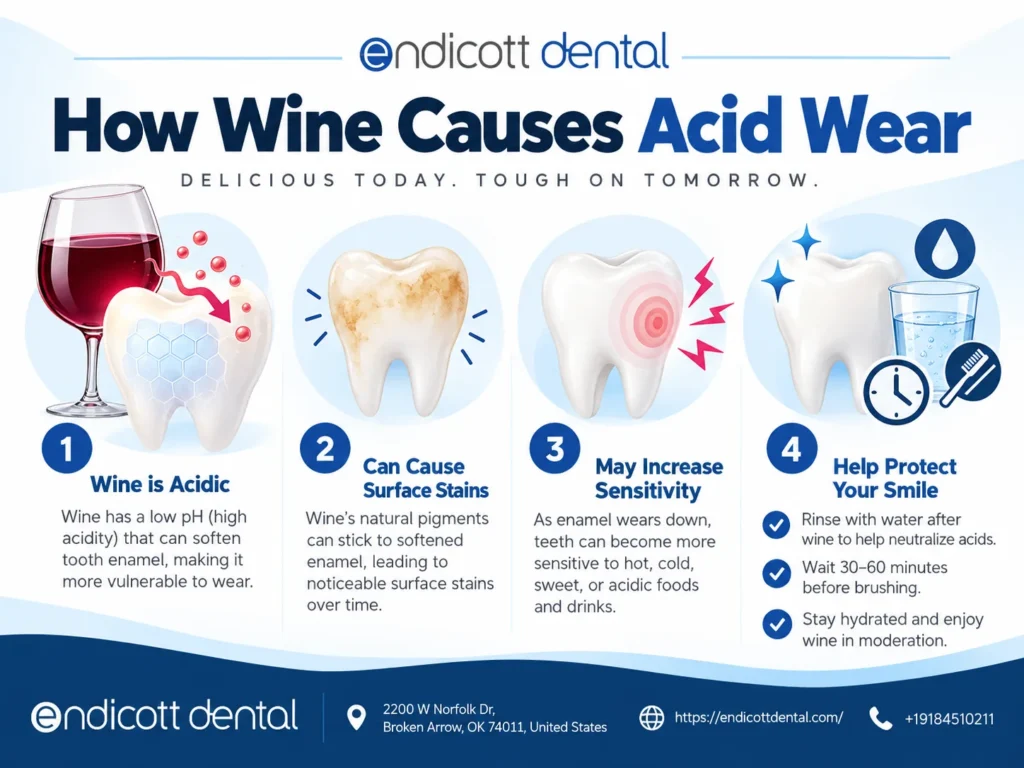
Wine is naturally acidic. When acidic beverages repeatedly contact the teeth, they can temporarily soften the enamel surface. If that exposure happens frequently enough—or is combined with other acid sources such as sparkling water, citrus, soda, reflux, or frequent snacking—it can contribute to dental erosion, also called erosive tooth wear.
Unlike surface stain, enamel that has physically worn away does not simply grow back.
That is the part people should take seriously.
At Endicott Dental in Broken Arrow, we are not interested in telling adults they can never enjoy a glass of wine at dinner, a wedding, a fundraiser, a holiday party, or a night out with friends.
That would not be particularly realistic or helpful.
We would rather explain what actually raises your risk, which habits are worth changing, what signs to watch for, and when discoloration is simply a whitening issue versus evidence that tooth structure is being lost.
Here is what you should know before your next pour.
What Exactly Are “Wine Teeth”?
“Wine teeth” is not a dental diagnosis.
It is an informal term people often use to describe teeth that become temporarily stained after drinking wine, particularly red wine.
Those stains can happen because pigmented compounds in wine attach to the tooth surface and existing plaque.
But there is an important distinction:
Staining changes the color of a tooth. Erosion changes the tooth itself.
Surface stains can often be removed through professional cleaning or improved with whitening.
Eroded enamel cannot simply be polished off or whitened back into existence.
The American Dental Association defines dental erosion as the progressive chemical loss of hard tooth structure from acids that are not produced by cavity-causing bacteria. Once significant mineralized tooth structure is lost, that loss is considered irreversible.
So if you drink wine regularly, the question should not be only:
“Are my teeth getting stained?”
It should also be:
“Am I exposing my enamel to acid often enough that it is beginning to wear?”
Does Wine Really Damage Tooth Enamel?
Potentially, yes.
But context matters.
Wine is naturally acidic. Research on wine and oral health has long recognized that frequent or prolonged exposure to wine acids can soften enamel and contribute to erosive wear.
That does not mean a glass of wine with dinner automatically causes permanent enamel damage.
The ADA specifically notes that wine, although acidic, is not usually considered as major a risk factor for erosion as beverages that people often consume much more frequently, such as sodas or sports drinks. Frequency matters enormously.
Someone who has one glass of wine with dinner a few times a month has a very different exposure pattern from someone who:
- Sips wine slowly over four hours several nights a week
- Attends frequent wine tastings
- Swishes wine around the mouth
- Drinks acidic beverages throughout the day
- Has chronic dry mouth
- Has acid reflux
- Regularly drinks sparkling water with citrus between glasses
- Brushes immediately after acidic drinks
That is why we do not diagnose erosion based on the word wine.
We look at the entire pattern.
Why Is Acid Wear Different From a Cavity?
Patients often assume any damaged enamel must be a cavity.
They are not the same process.
Cavities Involve Bacteria
Dental decay occurs when oral bacteria metabolize fermentable carbohydrates and produce acids that demineralize the tooth.
Plaque plays a major role.
Erosion Comes From Direct Acid Exposure
Dental erosion happens when acids directly dissolve minerals from the teeth without bacteria being the primary cause.
Those acids can come from outside the body, including:
- Wine
- Soda
- Sports drinks
- Energy drinks
- Fruit juice
- Citrus
- Acidic candies
They can also come from inside the body.
Stomach acid associated with conditions such as gastroesophageal reflux disease can be a significant contributor to dental erosion.
You can also have both processes happening at once.
A patient can have cavities and erosive tooth wear.
That is one reason a dental examination is more useful than assuming every sensitive or discolored tooth simply needs whitening.
Why Can Social Drinking Be Hard on Teeth?
The biggest issue is often not the total number of glasses.
It is how long the teeth stay exposed.
Imagine two people each drink one glass of wine.
Person A drinks it with dinner over 20 or 30 minutes.
Person B attends a reception and takes small sips for three hours.
Both may have consumed roughly the same amount.
But their teeth experienced very different patterns of acid contact.
The ADA notes that the frequency of acid exposure, the pattern of consumption, and the amount of time the acidic substance stays in contact with the teeth all influence erosive tooth wear.
That is why slow social sipping deserves attention.
The “All Evening” Problem
This pattern is common at:
- Weddings
- Charity events
- Dinner parties
- Wine tastings
- Networking events
- Holiday parties
- Country-club events
- Long restaurant dinners
- Backyard gatherings
You are not necessarily drinking heavily.
You may simply be keeping a glass nearby and taking small sips for several hours.
From the enamel's perspective, that repeated exposure can matter.
Your saliva gets a chance to buffer some of the acid.
Then you take another sip.
The mouth becomes acidic again.
Then another.
Then another.
That repeated challenge is more relevant than simply saying, “I only had one or two glasses.”
Does Red Wine Cause More Damage Than White Wine?
This is where appearances can be misleading.
Red wine is more notorious because the stain is visible.
White wine may leave your smile looking relatively normal at the end of the evening, but that does not mean it is harmless to enamel.
Published research has found that white wines can sometimes have greater erosive potential than red wines because of differences in acidity and chemical composition.
That does not mean every white wine is more erosive than every red wine.
Wine composition varies considerably.
The larger point is:
You cannot judge acid risk by color.
Red wine may announce itself with staining.
White wine can be acidic without leaving the same visual clue.
Rosé, sparkling wine, champagne, and wine-based cocktails also expose teeth to acids.
If a cocktail adds citrus juice, soda, tonic, or another acidic mixer, you may be adding several erosive factors together.
What Are the Early Signs of Acid Wear?
One reason acid erosion deserves attention is that early damage can be difficult for patients to notice.
The ADA notes that early diagnosis can be challenging because people may have little or no obvious discomfort initially.
Over time, signs can include:
- Increased sensitivity to cold
- Teeth looking smoother or shinier than before
- Rounded tooth edges
- Flattened biting surfaces
- Small depressions or “cupping” in chewing surfaces
- Teeth becoming shorter
- Front teeth appearing thinner
- Yellowing that does not improve the way you expect with whitening
- Small chips along weakened edges
- Increased sensitivity around exposed areas
- Old fillings appearing to stand above the surrounding tooth surface
The ADA describes eroded teeth as potentially developing a smooth, glossy or “melted” appearance, with cupping or flattening of chewing surfaces as wear progresses.
Why Can Eroded Teeth Look More Yellow?
This surprises people.
They assume yellow teeth simply need stronger whitening.
Sometimes they do.
But enamel is naturally somewhat translucent.
Underneath it is dentin, which is generally more yellow in color.
As enamel becomes thinner, more of that underlying dentin can show through.
So the tooth may look yellower even though the problem is not primarily surface stain.
That distinction matters because bleaching enamel does not rebuild enamel.
Can Wine Make Your Teeth Sensitive?
It can contribute if repeated acid exposure leads to enamel loss or exposed dentin.
The ADA notes that progressive erosive tooth wear can result in dentin hypersensitivity.
A person may start noticing:
- Cold water feels sharper than it used to
- Ice cream causes a quick electric sensation
- Wine itself feels uncomfortable
- Citrus causes sensitivity
- Teeth hurt briefly during brushing
But sensitivity does not automatically mean acid erosion.
It can also be caused by:
- Gum recession
- Cavities
- Cracked teeth
- Grinding
- Aggressive brushing
- Recent whitening
- Dental procedures
If one specific tooth suddenly becomes sensitive, especially if the discomfort lingers or hurts when you bite, do not assume the solution is sensitive toothpaste.
That deserves an examination.
Endicott Dental's own guidance on sensitive teeth makes the same distinction: generalized surface sensitivity may respond to desensitizing toothpaste, while sharp pain in one tooth, lingering temperature sensitivity, or pain with biting should be evaluated rather than simply masked.
Is Red-Wine Staining Permanent?
Often, no.
External staining and enamel erosion are two different things.
Red wine can stain the outer surface of teeth, especially when there is plaque or preexisting surface staining for pigments to attach to.
Professional cleaning may remove some external staining.
Whitening may help address deeper discoloration in natural tooth structure.
But there is an important warning:
Do not assume every darker or yellower smile is a whitening problem.
If your teeth have changed color because enamel has become thinner, simply bleaching them repeatedly may not address the underlying issue.
You need to know why the color changed first.
Should You Brush Your Teeth Right After Drinking Wine?
Usually, not immediately.
This is probably one of the most useful things in this article.
If you come home from a dinner or event and your teeth look stained, the instinct is understandable:
“I need to scrub this off.”
The problem is that immediately after acidic exposure, the enamel surface may be temporarily softened.
The ADA recommends rinsing with water rather than brushing immediately after consuming acidic foods or beverages.
So after wine:
Rinse with water first.
Give your saliva time to neutralize the acidic environment before brushing.
This does not mean you should skip brushing before bed.
It means aggressive immediate scrubbing is not the best response to acid exposure.
Do Not Try to “Polish Off” Wine Stains
Another mistake is brushing harder because you see discoloration.
Harder is not cleaner.
Aggressive brushing can add mechanical wear to teeth already experiencing chemical erosion.
Use a soft toothbrush and normal technique.
If staining is persistent, let your dentist or hygienist determine what is stain and what is actual tooth change.
Should You Swish Wine Around Your Mouth?
If protecting enamel is your priority, minimizing unnecessary contact time makes sense.
The ADA specifically recommends avoiding behaviors that increase exposure to acidic drinks, including holding or swishing acidic beverages around the teeth.
Wine tasting is different from simply having wine with dinner because tasting traditionally involves intentionally moving the liquid around the mouth.
For someone who does that occasionally, the total risk may still be relatively modest.
For someone who attends tastings frequently or works around wine professionally the cumulative pattern becomes more relevant.
Older research on professional wine tasters has specifically identified erosive wear as a potential occupational concern from frequent, prolonged wine exposure.
Is Drinking Wine With Food Better for Your Teeth?
Generally, it can be.
Again, the goal is not to create a list of rigid rules.
The goal is to reduce prolonged acid exposure.
Eating stimulates saliva.
Saliva helps buffer and clear acids.
Some research on wine and erosion suggests that consuming wine with meals is less concerning than repeated isolated tasting because food and salivary flow help reduce the acid challenge.
So from a dental standpoint, a glass consumed with dinner is generally a more tooth-friendly pattern than slowly sipping the same wine between meals for hours.
What Should You Do While Drinking Wine to Protect Your Teeth?
You do not need a complicated dental routine at the restaurant.
A few simple habits make more sense.
Drink Water Alongside the Wine
This is probably the easiest change.
Alternate wine with plain water.
The ADA recommends drinking water with meals and rinsing with water after acidic food or drinks.
Water helps clear acids and pigments from the mouth.
It is also useful for hydration, which supports normal saliva production.
Do Not Hold Every Sip in Your Mouth
Enjoy the wine.
You do not need to bathe every tooth in it longer than necessary.
Avoid Turning One Drink Into Four Hours of Exposure
When practical, consume acidic drinks during a defined period rather than continuously sipping them throughout the evening.
Have the Wine With Food
Meals stimulate saliva and shorten the amount of time your teeth spend dealing with isolated acid exposure.
Consider Sugar-Free Gum Afterward
Saliva is one of your mouth's natural defenses against acid.
The ADA notes that sugar-free gum can help stimulate saliva flow, which assists in clearing and buffering acids.
Do not chew gum if you have a jaw condition that makes chewing painful, and remember that gum does not replace brushing.
What About Sparkling Water Between Glasses?
Plain water is the simpler choice.
Sparkling water is acidic to varying degrees because carbonation forms carbonic acid.
A sparkling water consumed quickly may present relatively little concern for many people, but if you are already exposing your teeth to wine and then spend the rest of the evening sipping a carbonated beverage with lemon or lime, you are creating more acid exposure.
The pattern matters.
If your goal is to neutralize and clear wine from your mouth, still water is the straightforward option.
Is Lemon Water Actually Making the Problem Worse?
It can.
People often think of lemon water as the “healthy” option after alcohol.
For your overall diet, that may be a separate conversation.
For enamel, lemon contains acid.
If you spend an entire evening alternating wine with lemon water, the teeth do not necessarily get much of a break from acidic exposure.
Plain water is less complicated.
Again, we are not suggesting one squeeze of lemon destroys your enamel.
We are looking at repeated exposure over time.
That is the theme throughout this entire issue.
Can Whitening Fix “Wine Teeth”?
It depends on what you mean by wine teeth.
If the Problem Is Stain
Whitening may be very effective.
Professional whitening can improve discoloration in natural teeth, and Endicott Dental offers in-office whitening as part of our cosmetic dentistry services in Broken Arrow.
If the Problem Is Erosion
Whitening does not replace missing enamel.
If significant enamel has been lost, the treatment plan may involve protecting remaining tooth structure or restoring areas that have changed shape.
That could include options such as:
- Dental bonding
- Veneers in selected cosmetic cases
- Inlays or onlays
- Crowns when more extensive structural protection is needed
Endicott Dental offers several of these restorative and cosmetic options, but the right choice depends on how much healthy tooth remains and whether the erosive process has been brought under control first.
Do Not Restore Teeth Until You Understand Why They Wore Down
This is important.
Putting beautiful new restorations on teeth without addressing ongoing erosion is a poor long-term strategy.
If wine is part of the problem, change the exposure pattern.
If reflux is the real cause, the reflux deserves medical attention.
If aggressive brushing is adding wear, change the technique.
If dry mouth is reducing your natural protection, address that.
A restoration fixes lost structure.
It does not eliminate the habit or condition that caused the loss.
Can Acid Wear Be Reversed Naturally?
Early mineral changes at the enamel surface may be stabilized or remineralized to some extent with saliva, fluoride, and reduced acid exposure.
But once actual tooth structure has physically disappeared, your body does not grow a new layer of enamel.
The ADA describes established erosive tooth wear as progressive and irreversible loss of mineralized tooth tissue.
That is why early identification matters.
Dentistry is much easier when our job is:
“Let's keep this from getting worse.”
It becomes more complicated when the conversation is:
“We now need to rebuild several teeth.”
Does Fluoride Help With Acid Erosion?
Fluoride is still useful.
It helps strengthen enamel and supports remineralization.
Research reviewed by the ADA suggests that some fluoride treatments may help make enamel more resistant to erosive challenges, although fluoride cannot be assumed to completely prevent erosion in someone who continues having frequent significant acid exposure.
In plain English:
Fluoride helps. It does not make your teeth acid-proof.
Brush twice daily with fluoride toothpaste.
If you have significant sensitivity or erosion risk, your dentist may recommend a toothpaste or fluoride strategy tailored to your situation.
Is “Enamel Repair” Toothpaste Enough?
Be careful with the wording on toothpaste packaging.
Some toothpastes are designed to support remineralization and reduce sensitivity.
That can be useful.
But no over-the-counter toothpaste can regrow a chunk of enamel that has physically worn away.
At Endicott Dental, we generally view sensitivity toothpaste as appropriate for certain surface-level sensitivity problems, while pain limited to one tooth or persistent symptoms deserve diagnosis rather than indefinite self-treatment.
Use toothpaste as prevention and support.
Do not use it to avoid figuring out why the teeth are changing.
Could Acid Reflux Be Causing More Damage Than the Wine?
Absolutely.
This is one of the reasons we do not blame wine automatically.
Stomach acid is highly erosive.
GERD can repeatedly expose the teeth to gastric acid, sometimes without the patient realizing how often reflux is reaching the mouth.
The ADA recognizes gastroesophageal reflux as an important predisposing factor for dental erosion.
Possible clues include:
- Frequent heartburn
- Sour or acidic taste
- Hoarseness
- Nighttime reflux
- Chronic throat clearing
- Erosion concentrated on certain inner tooth surfaces
If your dentist sees a wear pattern that looks more consistent with gastric acid than dietary acid, the appropriate next step may involve both dental protection and medical evaluation.
More whitening is not the answer to untreated reflux.
Could Dry Mouth Make Wine-Related Erosion Worse?
Yes.
Saliva is important because it buffers acids, washes the teeth, and provides minerals involved in remineralization.
A person with healthy saliva flow may recover from an acidic challenge more effectively than someone with chronic dry mouth.
Dry mouth can result from:
- Certain medications
- Dehydration
- Mouth breathing
- Medical conditions
- Alcohol consumption
- Age-related factors
- Other lifestyle factors
If your mouth frequently feels dry during social events, that matters.
Make water part of the routine rather than waiting until the end of the evening.
What About People Who Already Have Veneers, Bonding, or Crowns?
Wine can still matter.
Restorative materials do not behave exactly like natural enamel.
For example, composite bonding may accumulate stains over time, and Endicott Dental advises patients with bonding that beverages such as red wine can contribute to discoloration.
Whitening is another consideration.
Dental restorations do not generally whiten the same way natural teeth do.
So if you bleach the surrounding natural teeth, an older veneer, crown, or bonded area may become more noticeable because its shade does not change in the same way.
This is why cosmetic dentistry is better planned than improvised.
Before repeatedly whitening stained teeth, ask whether you have restorations that could affect the final color match.
When Is Acid Wear Mostly a Cosmetic Issue?
Very early wear may create little functional discomfort.
You may simply notice:
- Slight thinning
- A change in translucency
- More yellow color
- Rounded edges
- Minor changes in shape
At that stage, the best treatment may not involve drilling or restorations at all.
If we can identify the source and stabilize the wear, monitoring may be the smartest approach.
That is worth emphasizing.
Not every eroded tooth needs a veneer.
Sometimes prevention is enough.
Good dentistry should preserve healthy natural tooth structure whenever reasonable.
When Does Acid Wear Need Restorative Treatment?
Treatment becomes more likely when erosion causes:
- Significant sensitivity
- Noticeable loss of tooth height
- Weak or fragile edges
- Repeated chipping
- Major cosmetic changes
- Exposed dentin
- Functional problems with the bite
- Extensive thinning of teeth
The ADA notes that advanced erosion may require restorative treatment after the underlying source of acid exposure is addressed.
What that treatment looks like depends on the individual tooth.
A small worn edge may be manageable with conservative bonding.
Extensive structural loss may require something more protective.
The most aggressive option should not automatically be the first option.
What Should You Do the Morning After a Wine Event?
Keep it simple.
If the evening is already over and enough time has passed since the last acidic drink:
- Brush gently with fluoride toothpaste.
- Floss normally.
- Drink water.
- Do not aggressively scrape at staining.
- If discoloration remains, give it time or ask about professional cleaning or whitening.
- If you notice a new sensitivity, monitor it.
- If sensitivity persists, schedule an examination.
One night of wine staining does not mean your enamel is destroyed.
Look for patterns, not panic.
Who Should Be More Concerned About Wine and Acid Wear?
Wine may deserve more attention if you:
- Drink wine frequently
- Attend regular tastings
- Sip acidic drinks for long periods
- Have chronic reflux
- Have dry mouth
- Already have visible erosion
- Have naturally thin enamel
- Grind or clench your teeth
- Brush aggressively
- Frequently consume other acidic drinks
- Have significant sensitivity
- Already have extensive cosmetic dental work
Often, acid wear is not caused by one thing.
It is the combination.
Wine plus reflux.
Wine plus sparkling water.
Wine plus lemon water.
Wine plus dry mouth.
Acid-softened enamel plus aggressive brushing.
Dentistry becomes much more useful once we stop searching for one villain and look at the whole pattern.
The Best Advice for Wine Drinkers Is Surprisingly Simple
You do not need a complicated “wine teeth” protocol.
If you enjoy wine socially, the practical approach is:
- Drink it with food when possible.
- Avoid swishing or holding it against the teeth unnecessarily.
- Drink plain water throughout the evening.
- Reduce continuous sipping over many hours.
- Rinse with water afterward.
- Do not aggressively brush immediately after acidic exposure.
- Brush normally later with fluoride toothpaste.
- Address dry mouth.
- Do not ignore reflux.
- Keep regular dental examinations so early wear can be spotted before it becomes significant.
That is more realistic than telling every patient to give up every acidic beverage permanently.
Keep the Dinner Invitations Let Endicott Dental Help Protect the Smile
You should not have to choose between enjoying your social life and taking care of your teeth.
You do, however, need to know the difference between a temporary stain and a slowly developing structural problem.
At Endicott Dental, we can evaluate changes in the color, shape, sensitivity, and enamel thickness of your teeth and help determine what is actually happening.
Sometimes the answer is simple:
“This is mostly surface staining. A cleaning or whitening discussion makes sense.”
Sometimes it is:
“We are seeing early erosion. Let's change a few habits and monitor them.”
And sometimes there is enough enamel loss that bonding, veneers, or another restorative option may be worth discussing.
Our cosmetic dentistry services in Broken Arrow include whitening, bonding, veneers, inlays and onlays, and other options—but we believe the first step should be understanding the problem before choosing the procedure.
If your teeth are becoming more sensitive, thinner, yellower, or more worn and you are not sure whether wine, reflux, grinding, diet, or something else is responsible, Endicott Dental can help you understand what is happening before you commit to cosmetic or restorative treatment.
The goal is not to make your social calendar smaller.
It is to keep your natural teeth strong enough to keep smiling through it.
Frequently Asked Questions About Wine and Acid Wear
Does drinking wine ruin your enamel?
Not automatically.
Wine is acidic and can contribute to enamel erosion, particularly when exposure is frequent or prolonged. But occasional wine consumed with a meal is different from repeated sipping or professional wine tasting. The ADA emphasizes that frequency, contact time, saliva, and the overall pattern of acid exposure all influence erosion risk.
Is red wine worse for teeth than white wine?
Red wine is more likely to create obvious dark staining, but that does not necessarily mean it is more erosive.
Some research has found white wines to have greater erosive potential than reds because of differences in acidity and composition. Individual wines vary, so color alone is not a reliable indicator of acid risk.
Why do my teeth look purple after red wine?
Pigments in red wine can adhere to tooth surfaces and plaque, producing temporary dark or purple staining.
That is primarily a staining issue and is different from enamel erosion.
Can I brush the red-wine stain away immediately?
It is better to rinse with water first rather than immediately brushing after an acidic beverage.
The ADA recommends avoiding immediate brushing after acid exposure because the enamel surface may be temporarily softened.
Does wine permanently stain teeth?
Not all wine staining is permanent.
Some external stains can be removed during professional cleaning, while whitening can improve certain types of discoloration in natural teeth.
Existing crowns, veneers, and bonding do not necessarily respond to whitening the same way natural teeth do, so cosmetic treatment should be planned carefully.
Can professional whitening fix damage from wine?
Professional whitening can improve color.
It cannot replace enamel that has physically eroded.
If the problem is true tooth wear rather than staining, your dentist should first determine the extent and cause of the structural loss.
What does early enamel erosion look like?
Early erosion may be difficult to see.
As it progresses, teeth can become smoother, shinier, thinner, more yellow, rounded, flattened, or cupped. Sensitivity may also develop.
Can enamel grow back after acid erosion?
Once enamel structure has physically been lost, it does not naturally regenerate.
Very early mineral changes can sometimes be stabilized through saliva, fluoride, dietary changes, and reduced acid exposure, but established structural loss is considered irreversible.
Does fluoride protect against wine?
Fluoride can support remineralization and may improve enamel resistance to erosive challenges, but it does not make teeth immune to repeated acid exposure.
Should I use sensitive toothpaste if wine makes my teeth hurt?
A sensitivity toothpaste may help if the discomfort comes from generalized exposed dentin or enamel wear.
But if one tooth has sharp pain, pain with biting, or lingering sensitivity, schedule an examination rather than assuming toothpaste will solve the problem.
Does drinking water after wine help?
Yes.
The ADA recommends drinking or rinsing with water after acidic beverages. Water can help clear acids and pigments and gives saliva a chance to restore a healthier oral environment.
Is drinking wine through a straw better for teeth?
Reducing the amount of acidic liquid that bathes the teeth may reduce direct contact. The ADA notes that placing a straw behind the front teeth can help minimize exposure with acidic beverages.
Whether using a straw with wine is socially practical is another question.
For most people, water, limiting prolonged sipping, and consuming wine with meals are easier habits to maintain.
Can acid reflux cause the same type of enamel damage as wine?
Yes.
Stomach acid is an important cause of dental erosion, and GERD is a recognized risk factor. If your dentist identifies a wear pattern suggestive of reflux, medical evaluation may be appropriate in addition to dental management.
Does sparkling wine cause acid erosion?
Sparkling wine is acidic and therefore has the potential to contribute to erosion, particularly with repeated or prolonged exposure.
Risk depends on the specific beverage, frequency, drinking pattern, saliva, and other sources of acid in the diet.
Is it better to drink wine with dinner than by itself?
From an erosion standpoint, generally yes.
Food stimulates saliva, and shorter periods of acid exposure are preferable to repeatedly sipping an acidic beverage for hours. Research discussing wine-related erosion has noted that wine consumed with meals is less concerning than frequent prolonged tasting.
Do I need veneers if my enamel is worn?
Not necessarily.
Mild erosion may only require monitoring, prevention, and changes to the habits causing the wear.
More advanced damage may be treated with bonding, veneers, inlays/onlays, crowns, or other restorative options depending on the amount and location of tooth structure lost.
When should I see a dentist about possible acid erosion?
Schedule an evaluation if you notice persistent sensitivity, thinning edges, increased yellowing, frequent chipping, smooth or cupped surfaces, significant changes in tooth shape, or unexplained wear.
It is particularly worth investigating if you also have reflux, dry mouth, frequent acidic-drink consumption, or a history of grinding.
Finding the cause early gives you the best chance to protect the natural enamel you still have.
