

Table of Contents
Mail-order clear aligners are easy to understand from a consumer’s point of view.
You want straighter teeth.
You see an ad promising clear trays, fewer appointments, a lower upfront price, and treatment you can manage mostly from home.
You take photos or impressions.
The trays show up.
It feels like you found the convenient version of Invisalign.
Sometimes treatment may appear to go reasonably well.
But here is the problem we want patients in Broken Arrow and across Oklahoma to understand:
Clear aligners are not just cosmetic trays. They are orthodontic appliances that physically move teeth through bone.
That movement affects your bite, roots, gums, bone, existing fillings and crowns, and the way your upper and lower teeth meet.
That is why the FDA's current patient guidance says clear aligners are prescription devices intended to be used under the supervision of a licensed dentist or orthodontist. The FDA specifically warns that clear aligners sold directly to consumers without appropriate prescription and professional supervision have not been authorized for that use, and inadequate supervision can increase the risk of unintended tooth movement, bite problems, pain, and even tooth loss.
At Endicott Dental, we are not against clear aligners.
We provide them.
We also provide braces.
The distinction is not:
Aligners are bad.
The distinction is:
Moving teeth without a complete diagnosis and meaningful professional monitoring can be a very expensive shortcut.
And that is where the "$5,000 mistake" comes from.
In Broken Arrow and across Oklahoma, professionally supervised Invisalign treatment commonly falls around $4,500 to $6,000 for many cases, although simpler treatment may cost less and complicated cases can cost more.
So if someone first spends money on an at-home treatment that does not produce a healthy, stable result and then needs professional orthodontic retreatment afterward, the total financial hit can easily move into the thousands.
The "$5,000 mistake" is not a promise that every failed mail-order case costs exactly $5,000 to repair.
It is the very real possibility of paying once for inexpensive treatment and paying again for the treatment you should have received in the first place.
Here is what patients should know before putting a mail-order aligner over their teeth.
What Is the Difference Between Mail-Order Aligners and Professionally Supervised Clear Aligners?
They may look very similar when they are sitting in your hand.
Both are typically clear plastic trays.
Both are designed to place controlled forces on teeth.
Both may be changed periodically as treatment progresses.
The important difference is not the plastic.
It is the diagnosis, treatment planning, monitoring, and ability to intervene when something goes wrong.
Professionally Supervised Treatment Starts With the Patient, Not the Tray
With in-office clear aligner treatment, a dentist or orthodontic provider evaluates more than whether your front teeth look crooked.
At Endicott Dental, orthodontic planning can include evaluation of:
- Your teeth
- Your bite
- Gum health
- Bone support
- Existing dental restorations
- Jaw relationships
- Crowding and spacing
- Whether aligners are actually appropriate for your case
Our Broken Arrow orthodontic services include Invisalign, clear aligners, traditional braces, and other approaches because not every orthodontic problem should be treated with the same appliance.
That last point is important.
Sometimes the best aligner treatment is to not use aligners.
Problem #1: A Photo of Your Smile Cannot Show Everything That Matters
Take a selfie and smile.
What can you see?
Mostly the front surfaces of the teeth.
Now think about what you cannot see.
You cannot reliably evaluate:
- Bone levels around the roots
- Cavities between teeth
- Infection around a root
- Root shape
- Impacted teeth
- Significant periodontal bone loss
- Some types of root resorption
- The full relationship of the upper and lower jaws
This is one of the central problems with an aligner model built around photographs alone.
The FDA's 2026 guidance recommends evaluation by a dentist or orthodontist, preferably in person, before clear aligner treatment and notes that X-rays may be part of treatment planning. Periodic in-person visits can also help ensure teeth are moving safely and as intended.
The American Association of Orthodontists has raised similar concerns about mail-order systems in which patients begin moving teeth without an in-person examination or appropriate radiographs.
Why X-Rays Can Matter Before Orthodontics
The purpose is not to take X-rays simply because orthodontics is being discussed.
Imaging should have a clinical reason.
But when indicated, radiographs provide information that photographs and surface scans simply cannot.
You might have straight-looking front teeth sitting over compromised periodontal bone.
You could have a tooth with an abnormal root.
You may have an unerupted tooth.
You may have decay that needs treatment before trays cover the teeth most of the day.
Orthodontic movement should be planned around what is happening under the gums, not just what looks crooked in a photo.
Problem #2: Straight Front Teeth Do Not Automatically Mean a Healthy Bite
This may be the biggest misunderstanding about mail-order orthodontics.
Patients understandably judge the result by looking in the mirror.
The front teeth look straighter.
Success, right?
Not always.
Orthodontics is three-dimensional.
When one tooth moves, its relationship with other teeth changes.
When several teeth move, the entire way your bite fits together can change.
The FDA reports receiving adverse-event reports involving direct-to-consumer aligners that included:
- New or worsening dental pain
- Jaw pain
- Bite problems
- Worsening misalignment
- New spaces between teeth
A published analysis of the FDA's MAUDE adverse-event database found that among identified reports involving direct-to-consumer sequential aligners, bite problems were among the most frequently reported issues, along with orofacial pain and periodontal complications. The study does not tell us the overall rate of complications among every person who has used mail-order aligners, because adverse-event databases cannot establish incidence. But it does document the types of problems that have been reported.
Your Front Teeth Can Look Better While Your Back Teeth Fit Worse
That is a terrible trade.
You do not chew photographs.
Your teeth need to function together.
A cosmetic improvement that leaves you unable to comfortably bite into food is not a successful orthodontic result.
Problem #3: Moving Teeth With Gum Disease Can Be a Serious Mistake
Suppose your teeth are crowded.
You assume the crowding is the problem.
But underneath the gums, you also have active periodontal disease.
Now you begin orthodontic treatment without addressing it.
That changes the conversation significantly.
Orthodontic treatment places forces on the structures supporting the teeth.
Healthy bone and periodontal tissues are therefore important.
A comprehensive periodontal examination is particularly important in adults undergoing orthodontic treatment. Research has emphasized the need to monitor periodontal health rather than assuming tooth movement occurs independently of gum and bone conditions.
Clear Aligners Themselves Are Not the Problem
This is an important distinction.
Research comparing professionally managed clear aligners with braces has sometimes found favorable periodontal outcomes with aligners, largely because the trays can be removed for cleaning. However, a 2026 systematic review found that the certainty of current evidence remains low to very low for several periodontal and oral-hygiene outcomes and that results depend heavily on patient compliance.
So we are not saying:
"Aligners ruin gums."
We are saying:
Moving teeth without knowing the condition of the gums and supporting bone is poor treatment planning.
Those are very different statements.
Problem #4: Cavities Do Not Disappear Because You Want Straighter Teeth
This seems obvious.
Yet it is surprisingly important.
Imagine that you have a cavity between two teeth.
You begin wearing clear trays 20 or more hours per day.
Months pass.
The cavity continues progressing.
Now you may need restorative treatment during orthodontics.
If the tooth shape changes because a filling or crown is placed, the aligner may no longer fit properly.
The FDA specifically warns that existing dental restorations such as fillings, crowns, and implants may be affected during clear aligner treatment and, in some situations, may loosen or require repair or replacement.
This is one advantage of receiving orthodontic care in an environment where general dental health is considered before movement begins.
At Endicott Dental, general dentistry and orthodontic care can be coordinated rather than treated as completely separate worlds.
Problem #5: Some Teeth Need Movements That a Simple Tray Cannot Reliably Produce
Clear aligners are impressive tools.
They are not magic.
A 2025 systematic review found that clear aligner therapy is commonly indicated for mild to moderate malocclusions, while severe skeletal discrepancies, impacted teeth, and certain complicated orthodontic problems may fall outside straightforward aligner treatment.
Some cases need:
- More complex attachments
- Space creation
- Interproximal reduction
- Elastics
- Expansion
- Braces
- A combination of braces and aligners
- Other orthodontic strategies
A generic treatment plan may try to fit the patient into the product.
Good orthodontics does the opposite.
The product should fit the patient.
What Are Attachments and Why Do They Matter?
If you have seen someone undergoing Invisalign treatment, you may have noticed small tooth-colored bumps attached to certain teeth.
Those are attachments.
They give the aligner a better surface to push or pull against during particular movements.
Think of them as handles.
Without the right mechanics, a tray may move a crown differently from the way we want the root to move.
That is important because orthodontic success is not simply making the visible part of each tooth look straight.
We care where the entire tooth ends up.
What Happens When a Tooth Does Not “Track” Properly?
A treatment simulation may show beautiful movement on a computer.
Biology does not always follow animation perfectly.
One tooth may lag.
An aligner may stop fitting.
A rotation may not correct as expected.
A space may appear.
This is normal enough that professional aligner treatment includes monitoring and, when needed, adjustment.
Endicott Dental's Invisalign approach includes ongoing professional evaluation so treatment can be changed if teeth are not moving as planned.
What Can a Dentist Do When Treatment Goes Off Track?
Depending on the problem, we may:
- Rescan the teeth
- Order refinement aligners
- Change attachments
- Modify the treatment sequence
- Add elastics
- Address a dental problem
- Change treatment methods
That ability to intervene is one of the biggest differences between orthodontic treatment and simply receiving more plastic trays in the mail.
What Does the FDA Now Say About Direct-to-Consumer Aligners?
This is important because the conversation has changed significantly.
As of September 2026, the FDA's current clear-aligner guidance explicitly states that:
Clear aligners are prescription devices.
The FDA says it has not authorized clear aligners marketed directly to consumers without prescription and supervision by a dentist or orthodontist.
It also says lack of appropriate professional supervision can increase the risk of complications and recommends an evaluation preferably in person before treatment.
That does not mean telehealth itself is inappropriate.
It means remote technology should support legitimate clinical care rather than replace the parts of dentistry that require direct examination.
Is Teledentistry Legal in Oklahoma?
Yes, when it is practiced within Oklahoma's legal requirements.
That is another distinction worth making.
Remote dental care is not automatically “mail-order dentistry.”
Oklahoma's State Dental Act, currently as of July 1, 2026, states that someone diagnosing or prescribing dental treatment through internet or telecommunications for a patient physically located in Oklahoma must hold an Oklahoma dental license.
It also states that an Oklahoma-licensed dentist may use synchronous or asynchronous telecommunications to consult, diagnose, and treat a patient of record, and the dentist must maintain an Oklahoma office location available for follow-up treatment and records.
That local requirement is useful for consumers.
Ask One Simple Question
Before accepting remote orthodontic treatment in Oklahoma, ask:
"Who is the Oklahoma-licensed dentist responsible for my treatment, and where can I see that person in Oklahoma if something goes wrong?"
If getting a clear answer is difficult, that should concern you.
Remote Monitoring Is Not the Same as No Monitoring
We want to be fair about this.
Technology can make orthodontic treatment more convenient.
Virtual check-ins can reduce unnecessary trips.
Photos can help monitor certain changes.
Digital scans are incredibly useful.
The FDA itself acknowledges that teledentistry can be part of clear-aligner care. Its concern is that periodic in-person examination can help detect problems such as unwanted movement, bite changes, pain, and other complications.
So the issue is not:
Remote = bad.
The issue is:
Remote care needs a real clinician, a real diagnosis, and a way to receive hands-on care when hands-on care is necessary.
Why Do People Choose Mail-Order Aligners Anyway?
Because the appeal is legitimate.
Usually it comes down to three things.
Price
The advertised upfront cost may look lower.
That matters.
Orthodontics can be expensive.
Convenience
People do not want to leave work for appointments.
Parents have schedules.
Tulsa-area commuters already spend enough time driving.
Appearance
Most adults do not want visible braces if they can avoid them.
Those concerns are reasonable.
The problem is when convenience and price cause the clinical part of treatment to become an afterthought.
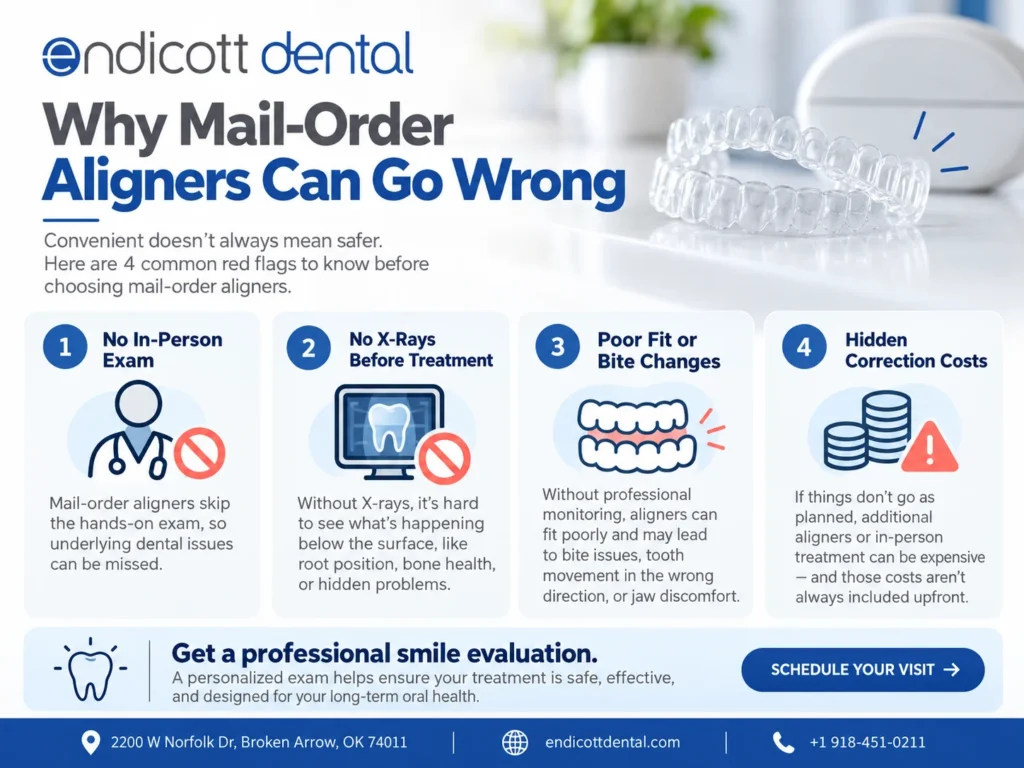
Where Does the “$5,000 Mistake” Actually Come From?
Let's make the math clear.
Endicott Dental currently estimates that many Invisalign cases around Broken Arrow and Oklahoma fall around $4,500 to $6,000, depending on complexity and other treatment factors.
Imagine that you first pay for direct-to-consumer treatment.
Your front teeth improve somewhat.
But your bite worsens.
You then visit an in-office provider.
Now you need a professionally planned orthodontic course that costs around $5,000.
You did not save money.
You purchased two rounds of orthodontics.
That does not happen to every mail-order patient, and $5,000 is not a universal retreatment price.
But retreatment is not a theoretical concern.
Orthodontists Report Seeing It
In an AAO member survey conducted in late 2021 and early 2022, 77% of the 260 responding orthodontists said they had seen patients seeking retreatment after using mail-order or direct-to-consumer orthodontic services. Sixty-one percent reported seeing such patients at least quarterly.
That survey has limitations.
It was a professional-member survey, not a population-wide study establishing the percentage of mail-order patients who fail treatment.
So we should not turn it into:
"77% of mail-order aligner patients fail."
That would be inaccurate.
What it does show is that retreatment after direct-to-consumer orthodontics was a common enough experience among responding orthodontists to generate substantial professional concern.
What If Mail-Order Aligners Already Made Your Teeth Straighter?
Good.
We are not rooting for treatment to fail.
If your teeth look better, that matters.
The next question is whether the result is healthy and stable.
Ask:
- Does your bite feel normal?
- Can your back teeth contact appropriately?
- Is there new jaw pain?
- Are there spaces you did not have before?
- Are any teeth unusually loose?
- Have your gums receded?
- Do you have pain?
- Have you had a dental examination since finishing?
If the answer to all of that is reassuring, you may simply need an evaluation and long-term retention plan.
We do not automatically redo treatment simply because it happened remotely.
What If Your Bite Feels Worse After Mail-Order Treatment?
Do not keep advancing through trays hoping the problem fixes itself.
Call a dentist or orthodontic provider.
Signs worth evaluating include:
- Back teeth no longer touching
- Only front teeth contacting
- New crossbite
- New jaw pain
- Difficulty chewing
- New spaces
- A tooth moving in the wrong direction
- Increasing pain
- Significant gum changes
The FDA specifically recommends contacting a dental professional for new or worsening symptoms during clear-aligner treatment.
What If Your Teeth Become Loose?
A small degree of mobility can sometimes occur during normal orthodontic movement because the supporting tissues are remodeling.
Significant mobility is different.
If a tooth feels dramatically loose, painful, or unstable, particularly without close professional monitoring, stop guessing and get it evaluated.
The question becomes:
Is this expected orthodontic mobility?
Is periodontal support compromised?
Is there excessive force?
Is something else happening?
That cannot be answered through a customer-service email alone.
What If the Aligners Hurt?
Some pressure and temporary soreness can be normal when you switch trays.
Severe or worsening pain deserves attention.
A 2026 systematic review of professionally managed removable orthodontic aligners found that discomfort tends to peak early often within the first day and generally decreases substantially over the following days. The review also documented a range of potential adverse effects associated with aligner treatment more broadly, including root resorption, periodontal changes, speech effects, and other issues.
Again, that does not mean clear aligners are unsafe.
Every orthodontic treatment has risks.
The point of professional supervision is to manage those risks.
Are Mail-Order Aligners Okay for “Just a Tiny Gap”?
Maybe the actual orthodontic problem really is small.
But you cannot determine that solely from the size of the visible gap.
The gap may be associated with:
- Tooth-size discrepancies
- Missing teeth
- Gum disease
- Tongue habits
- Bite problems
- Skeletal relationships
A tiny cosmetic problem can have a simple solution.
It can also be the visible part of a more complicated diagnosis.
That is why we would rather examine first and keep treatment small when the problem truly is small.
Aren't Dentists Just Against Mail-Order Aligners Because They Cost Less?
Patients are justified in asking this question.
Dental professionals do have a financial interest in providing orthodontic treatment.
You should know that.
But the safety concerns around direct-to-consumer aligners are not coming only from individual practices trying to sell Invisalign.
They are also being raised by the FDA, which now explicitly warns against unsupervised direct-to-consumer clear-aligner treatment.
The relevant question should not be:
"Who makes money?"
Almost every healthcare service involves payment.
The more useful question is:
"What safeguards am I receiving for that money?"
Is Professionally Supervised Invisalign Risk-Free?
No.
This is important.
Teeth can still move differently than expected.
Patients can fail to wear trays enough.
Root resorption can occur during orthodontic treatment.
Gums can change.
A bite can require refinement.
Treatment can take longer.
Clear aligners can be lost.
Crowns or restorations can complicate planning.
Professional supervision does not eliminate biology.
It gives us a better chance of recognizing problems and responding to them.
Who Is a Good Candidate for Clear Aligners?
Clear aligners may work well for many patients with:
- Mild to moderate crowding
- Spacing
- Selected bite problems
- Relapse after previous orthodontic treatment
- A strong willingness to wear trays consistently
More difficult cases may still be treatable with aligners, depending on the provider and mechanics used.
Others are better managed with braces or combined approaches.
At Endicott Dental, we offer both aligner and braces options specifically because we do not want the appliance to dictate the diagnosis.
Who Might Be a Poor Candidate for At-Home-Only Treatment?
We would be especially cautious if you have:
- Active gum disease
- Untreated cavities
- Significant bite problems
- Severe crowding
- Impacted teeth
- Missing teeth
- Complex restorative dentistry
- Significant tooth mobility
- Severe jaw discrepancies
- A history of major orthodontic complications
- Significant gum recession or bone loss
The more complicated the mouth, the less reasonable it is to treat orthodontics as a mail-order cosmetic product.
What Should You Ask Before Starting Any Clear-Aligner Treatment?
Whether you choose Invisalign, another professionally managed aligner, or a remote-heavy treatment model, ask these questions:
- Who is the dentist responsible for my case?
- Is that dentist licensed in Oklahoma?
- Will someone examine my teeth and gums in person?
- Will appropriate X-rays be taken if clinically indicated?
- What happens if my bite gets worse?
- Where do I go if an aligner does not fit?
- Who evaluates my gums during treatment?
- What happens if a tooth does not track?
- Are refinements included?
- What happens if I develop a cavity?
- Does the plan include retainers?
- What is the total expected cost?
- What treatment is available if aligners turn out not to be appropriate?
If the answers are vague, keep asking.
Orthodontics lasts months.
The person responsible for moving your teeth should not be a mystery.
What If You Already Started Mail-Order Aligners?
You do not need to panic.
And you do not automatically need to throw the trays away tonight.
Get an examination.
Bring:
- Your current aligners
- Previous trays if you still have them
- Your treatment plan
- Any before-and-after images
- The name of the treating dentist or provider
- Details about symptoms
We can evaluate where your teeth are now.
There Are Several Possible Outcomes
Everything may be stable.
Good. We can discuss monitoring and retention.
The movement may be incomplete.
Professional refinements may be possible.
The bite may need correction.
We can explain what retreatment would involve.
There may be a dental problem unrelated to the aligners.
That needs its own treatment.
The goal is not to shame you for trying to save money.
The goal is to decide what makes sense from where you are today.
When Should You Stop Treatment and Get Checked Quickly?
Seek professional evaluation if you develop:
- Severe or increasing dental pain
- Significant tooth mobility
- Swollen or bleeding gums that are worsening
- Pus or signs of infection
- A bite that suddenly feels substantially different
- Back teeth that no longer meet
- New jaw pain
- A tooth moving dramatically out of position
- Significant gum recession
- An aligner that suddenly cannot seat
These are not problems we would recommend solving by simply moving on to the next tray.
Why Retainers Matter No Matter Where You Get Treatment
Orthodontic treatment is not finished when the teeth look straight.
Teeth have a tendency to move after treatment.
That is called relapse.
Retention is therefore part of responsible orthodontic planning.
Your retainer plan should answer:
- What type of retainer will you receive?
- How often should you wear it?
- What happens if it breaks?
- How often should fit be checked?
- What happens if your teeth start shifting?
Saving money on alignment and then skipping retention is a good way to eventually pay to straighten the same teeth again.
Cheap Orthodontics Becomes Expensive When You Pay Twice Let Endicott Dental Help You Check the Plan First
The attraction of mail-order aligners is understandable.
You want straighter teeth without spending more than necessary.
We agree with the second half of that sentence.
The disagreement is over what “necessary” means.
At Endicott Dental in Broken Arrow, our orthodontic options include Invisalign, clear aligners, and braces. We evaluate the health of the teeth, gums, bone, and bite before deciding which approach makes sense.
Sometimes Invisalign is a good fit.
Sometimes braces make more sense.
Sometimes a person needs dental treatment before either one.
And sometimes a patient with a very small problem needs a simpler treatment plan than they expected.
That is the advantage of diagnosis before purchasing the product.
If you are considering mail-order aligners because the price looks attractive, come in and find out what your mouth actually needs before you start moving teeth.
And if you have already tried at-home aligners and something does not feel right, bring the trays with you.
We can evaluate the result and explain your options without pretending that every case needs to be started from scratch.
Spending less is smart.
Paying twice because the first treatment skipped the diagnosis is not.
Frequently Asked Questions About Mail-Order Clear Aligners
Are mail-order aligners illegal in Oklahoma?
Not simply because care involves remote technology.
Oklahoma allows teledentistry, but current state law requires a person diagnosing or prescribing dental treatment for a patient physically located in Oklahoma to hold a valid Oklahoma dental license. An Oklahoma dentist providing teledentistry also must have an Oklahoma office available for follow-up treatment and records.
The exact legality of an individual service depends on how that service is structured.
Are direct-to-consumer clear aligners FDA-approved?
The FDA says it has not authorized clear aligners marketed directly to consumers without a prescription and supervision by a dentist or orthodontist. Clear aligners are prescription devices.
Does FDA registration mean an aligner is FDA-approved?
No.
The FDA specifically warns that a company describing itself or its facility as “FDA registered” is not the same thing as a specific product receiving FDA authorization.
Are all at-home aligners dangerous?
No.
We would not make that blanket claim.
Some orthodontic treatment can appropriately incorporate telehealth and remote monitoring.
The concern is treatment that lacks adequate diagnosis, professional supervision, in-person access, and appropriate follow-up.
Is Invisalign the same as mail-order aligners?
No.
Both use clear plastic trays to move teeth, but Invisalign provided through a dentist or orthodontic provider includes professional diagnosis, treatment planning, monitoring, and the ability to intervene when treatment does not progress correctly.
Are clear aligners safe?
Clear aligners can be a safe and effective orthodontic option when appropriately prescribed and monitored.
Like all orthodontic treatment, they have potential complications and limitations.
What problems can unsupervised aligners cause?
Reported concerns include unintended tooth movement, bite changes, dental pain, jaw pain, periodontal problems, new spaces, and worsening alignment.
That does not mean every user develops these complications.
Why do I need an examination if my teeth only look slightly crooked?
Because orthodontic suitability depends on more than appearance.
Your dentist may need to evaluate gum health, bone support, bite relationships, cavities, existing restorations, root considerations, and the type of movement required.
Do I need X-rays before Invisalign or clear aligners?
Appropriate imaging depends on the individual case.
The FDA states that X-rays may be part of evaluation and treatment planning. A dentist or orthodontic provider should determine what imaging is clinically necessary rather than skipping evaluation by default.
Can aligners cause gum recession?
Gum changes can occur during orthodontic treatment, particularly depending on existing anatomy, periodontal health, and the type and amount of tooth movement.
Professional planning and monitoring help identify patients who may be at greater risk.
Can aligners cause root resorption?
Some degree of orthodontically induced root resorption is a recognized potential adverse effect of orthodontic treatment, including clear aligners.
A 2026 systematic review found generally small average amounts in the aligner studies it analyzed, but individual responses vary.
Can mail-order aligners ruin your bite?
Bite problems have been reported with direct-to-consumer aligners, and the FDA specifically identifies uneven bite and unintended tooth movement as concerns when proper professional supervision is lacking.
My front teeth look straight but my back teeth no longer touch. Is that normal?
That deserves evaluation.
A change in posterior tooth contact can affect chewing and may indicate that your bite needs correction.
Do not continue assuming appearance alone means treatment is successful.
Why does my aligner suddenly not fit?
The tooth may not have moved as predicted.
You may not have worn previous trays enough.
The tray may be distorted.
Or the treatment plan may need adjustment.
Professionally supervised aligner treatment allows the provider to determine which explanation applies.
Should I move to the next tray if the current one does not fit?
Do not advance blindly.
Contact the dentist or orthodontic provider responsible for your treatment.
Progressing when teeth are not tracking can compound the mismatch.
Can you fix teeth after mail-order aligners?
Often, yes.
Correction may involve professional clear aligners, refinements, braces, restorative care, periodontal treatment, or another approach depending on what went wrong.
How much does it cost to fix failed mail-order aligners?
There is no universal retreatment price.
Endicott Dental currently estimates that Invisalign commonly costs around $4,500 to $6,000 for many Oklahoma cases, with simpler and more complicated cases falling outside that range.
Retreatment cost depends on how much correction is required.
Does every failed mail-order case cost $5,000 to repair?
No.
The "$5,000 mistake" is an illustration of how quickly costs can grow when a patient first pays for one orthodontic course and then needs a professionally supervised course afterward.
Some corrections will cost less.
Some complex cases may cost more.
Are braces better than clear aligners?
Not universally.
Each system has advantages.
Clear aligners can be excellent for appropriately selected cases.
Braces may provide better control for certain complex movements.
Endicott Dental offers both because treatment should be chosen according to the orthodontic problem rather than simply according to which appliance is less visible.
Can severe crowding be treated with aligners?
Some more complicated cases can be managed with clear aligners in experienced hands, but severe crowding, skeletal discrepancies, impactions, and other complex problems may require different treatment. A 2025 systematic review identified mild-to-moderate malocclusion as a common clear-aligner indication while noting important limitations for severe cases.
How many hours per day do I need to wear clear aligners?
Wear recommendations depend on the system and your prescribed plan.
Many professionally managed aligner systems require roughly 20–22 hours of daily wear.
Endicott Dental currently advises around 22 hours daily for Invisalign patients.
Do clear aligners work if I only wear them at night?
Most standard comprehensive aligner systems are not designed for occasional nighttime-only wear.
Follow the schedule prescribed by the clinician managing your specific treatment.
What happens if I have a cavity during aligner treatment?
Have it evaluated.
If restorative treatment changes the shape of the tooth, your trays may need to be modified or remade.
This is one reason general dental monitoring remains important during orthodontics.
Can I use aligners if I have gum disease?
Active periodontal disease usually needs to be assessed and stabilized before elective orthodontic movement.
The safety of moving teeth depends partly on adequate periodontal support.
Are mail-order impressions accurate?
A home impression may produce a model of the visible tooth surfaces.
That does not replace a complete diagnosis of bone, roots, gum health, bite function, and underlying dental disease.
Can digital scans replace X-rays?
No.
They provide different information.
A surface scan creates a detailed representation of visible tooth and gum contours.
Radiographs can show structures beneath the visible surface when imaging is clinically indicated.
Do I need retainers after clear-aligner treatment?
Yes, in most orthodontic cases.
Without retention, teeth can shift after treatment regardless of whether they were moved with braces or clear aligners.
Why are professional aligners more expensive?
Part of the cost is the appliance.
A substantial portion also reflects:
- Diagnosis
- Examination
- Treatment planning
- Professional monitoring
- Adjustments
- Refinements
- Staff and clinical care
- Managing complications
That is what you should compare when evaluating price—not just the number of plastic trays.
Is mail-order orthodontics cheaper if it works?
Potentially.
The advertised treatment may cost less than traditional in-office orthodontics.
The risk is that savings can disappear quickly if you need additional correction afterward.
What should I do before buying mail-order aligners?
At minimum, have your teeth, gums, and bite evaluated by a licensed dental professional.
Ask who will be responsible for your orthodontic care and how you will receive in-person help if the treatment stops progressing normally.
What should an Oklahoma patient specifically ask?
Ask:
“Who is my Oklahoma-licensed treating dentist, and where is the Oklahoma office I can visit for follow-up care?”
Oklahoma's current teledentistry statute requires an Oklahoma license for remote dental diagnosis/treatment of patients located in the state and requires an Oklahoma office for follow-up by the treating teledentist.
Should I get a second opinion before starting aligners?
If you are uncertain about whether aligners are appropriate, the cost seems unusually low, you have a complicated bite, or you have existing dental problems, a second opinion can be a very reasonable investment.
You may discover that aligners are exactly right for you.
You may also discover that the cheapest-looking plan was never designed to solve your actual problem.
