

Table of Contents
Walk through the children's toothpaste aisle in 2026 and you will find two very different messages.
One tube says:
Fluoride cavity protection.
Another says:
Fluoride-free. Nano-hydroxyapatite. Remineralizes enamel. Safe if swallowed.
Then social media adds another layer.
One parent says fluoride is essential.
Another says their family stopped using it completely.
Someone recommended hydroxyapatite because it is “what teeth are made of.”
Someone else says there is not enough evidence.
And somewhere in the middle is a Broken Arrow parent holding two tubes of toothpaste and thinking:
“I just want to keep my kid from getting cavities. Which one should I buy?”
Here is the short answer.
For most children, fluoride toothpaste remains the more established first choice for preventing cavities. Hydroxyapatite is no longer something we can dismiss as internet hype. It has promising and growing clinical evidence but the evidence base is smaller, and in the United States hydroxyapatite does not currently have the same FDA-recognized anticavity status as fluoride.
The American Academy of Pediatric Dentistry's current 2026–2027 Reference Manual continues to recommend brushing children's teeth twice daily with an appropriate amount of fluoride toothpaste. It identifies fluoridated water and fluoride toothpaste as two of the most effective tools for reducing childhood tooth decay.
At the same time, newer research deserves to be acknowledged.
A 2025 systematic review comparing fluoride-free hydroxyapatite toothpastes with fluoride toothpastes in children and young people found no significant difference in several measures of new or progressing early caries lesions. That is encouraging. But only four studies met the review's eligibility criteria, which tells you how much smaller the clinical evidence base remains.
So this is not really a 2026 battle between a “good” ingredient and a “bad” ingredient.
It is a question of:
How strong is the evidence? What is your child's actual cavity risk? How much fluoride are they already getting? And what are you giving up if you switch?
At Endicott Dental in Broken Arrow, that is how we think parents should make the decision.
What Is Fluoride Actually Doing to Your Child's Teeth?
Fluoride is not simply a coating painted over the tooth.
It changes the way enamel responds to the constant cycle of mineral loss and repair happening in the mouth.
Every day, bacteria in dental plaque metabolize sugars and carbohydrates and produce acids.
Those acids can pull minerals out of enamel.
That is demineralization.
Saliva can return minerals to the enamel.
That is remineralization.
A cavity begins when the balance repeatedly shifts toward mineral loss.
Fluoride helps move that balance back in the right direction by encouraging remineralization and making the repaired mineral structure more resistant to future acid attack. The ADA identifies fluoride compounds such as sodium fluoride, stannous fluoride, and sodium monofluorophosphate as established anticavity ingredients.
Fluoride Works Mostly Where Parents Want It to Work: On the Teeth
This is an important distinction in the modern fluoride discussion.
Much of fluoride's cavity-prevention effect comes from repeated topical exposure at the tooth surface.
That is one reason brushing twice a day with a small amount of fluoride toothpaste can be so useful.
You are repeatedly putting the ingredient directly where early mineral loss occurs.
A child does not need a mouthful of toothpaste.
They need an appropriate amount, consistently used.
What Is Hydroxyapatite?
Hydroxyapatite sounds much more exotic than it actually is.
Hydroxyapatite is a calcium-phosphate mineral closely related to the mineral making up human teeth and bones.
That similarity is the reason it has become attractive as an oral-care ingredient.
The basic idea is biomimicry:
Use a mineral resembling natural tooth mineral to help fill microscopic surface defects and support remineralization.
Hydroxyapatite toothpastes may use particles of different sizes.
Some are marketed as nano-hydroxyapatite, often shortened to nano-HAp or nHAp.
Others use larger or differently engineered hydroxyapatite particles.
Does Hydroxyapatite Really Remineralize Teeth?
There is legitimate evidence that it can contribute to remineralization.
This is no longer a situation where we would tell parents:
“There is no science behind that.”
There is science.
A 2025 systematic review and meta-analysis specifically examining fluoride-free hydroxyapatite toothpaste in children, adolescents, and young adults found comparable results to fluoride toothpastes in the included studies for development and progression of caries lesions. However, the authors found only four studies that met their criteria.
Earlier systematic reviews have also concluded that hydroxyapatite-containing oral-care products can reduce caries risk, although some of those reviews include authors employed by or receiving support from hydroxyapatite-product manufacturers. That does not automatically invalidate the research, but it is a conflict parents and clinicians should know about when evaluating how settled the evidence really is.
That is our 2026 position:
Promising? Yes.
Worth researching? Absolutely.
Equivalent in depth of evidence to decades of fluoride research? Not yet.
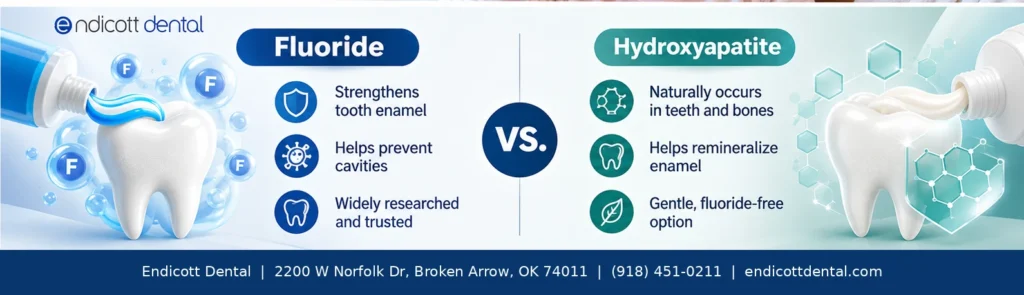
Fluoride vs. Hydroxyapatite: What's the Biggest Difference for Parents?
Here is the simplest useful comparison.
| Question | Fluoride | Hydroxyapatite |
| Long history of cavity-prevention research? | Yes | Smaller but growing evidence base |
| Recommended by AAPD for children? | Yes | Not currently the standard AAPD first-line recommendation |
| FDA-recognized OTC anticavity active ingredient in the U.S.? | Yes | No |
| Supports enamel remineralization? | Yes | Evidence suggests yes |
| Appropriate toothpaste can be used by children? | Yes, with age-appropriate amount and supervision | Product-specific; evidence and formulations vary |
| Risk of dental fluorosis if excessive fluoride is swallowed while permanent teeth develop? | Yes | No fluoride-related fluorosis |
| Strong direct comparative pediatric evidence? | Extensive evidence for fluoride overall | Growing, but fewer trials |
| Reasonable fluoride-free option for a parent unwilling to use fluoride? | Not applicable | Potentially, after discussing cavity risk |
The FDA's OTC anticaries monograph currently recognizes fluoride compounds not hydroxyapatite as active ingredients for over-the-counter cavity-prevention drug claims. In a 2024 warning letter, the FDA specifically noted that hydroxyapatite is not a permitted anticaries active ingredient under the current OTC monograph when companies market it with disease-prevention claims.
That regulatory status does not prove hydroxyapatite is ineffective.
It means something more specific:
The U.S. regulatory evidence pathway for OTC anticavity toothpaste currently recognizes fluoride, while hydroxyapatite has not reached that same status.
So Is Hydroxyapatite Toothpaste Just a Cosmetic Product in the U.S.?
Not necessarily in the way most consumers use the word “cosmetic.”
Hydroxyapatite may have real biological effects on tooth surfaces.
But manufacturers need to be careful about the disease-prevention claims they make in the United States.
The FDA's current anticaries framework lists fluoride ingredients such as sodium fluoride, sodium monofluorophosphate, and stannous fluoride.
That is why you may see a fluoride toothpaste with a formal Drug Facts panel saying “anticavity.”
A fluoride-free hydroxyapatite product may be marketed differently.
For parents, this means the front of the tube is not enough.
Marketing language and regulatory evidence are not the same thing.
Is Nano-Hydroxyapatite Safe?
This is one of the first questions parents ask once they realize the word nano is involved.
The best current answer is more reassuring than some older internet discussions suggest but it should still be product-specific.
In 2025, the European Commission's Scientific Committee on Consumer Safety reviewed specified forms of nano-hydroxyapatite and concluded they were safe at concentrations up to 29.5% in toothpaste under the particle specifications evaluated. The committee also concluded that unintentionally swallowed particles meeting those specifications would rapidly dissolve in gastric fluid and did not raise a nano-specific safety concern.
There is an important fine-print issue.
That conclusion applies to hydroxyapatite particles with specified shapes, dimensions, and surface characteristics.
It does not mean:
“Every nanoparticle called hydroxyapatite is automatically safe in every formulation.”
The European opinion specifically excluded some particle shapes, including needle-shaped forms, from its conclusion.
For parents, that reinforces an ordinary rule:
Use reputable, well-formulated dental products rather than buying mystery toothpaste simply because an influencer recommended it.
If Hydroxyapatite Looks Promising, Why Does Endicott Dental Still Recommend Fluoride First for Most Kids?
Because “promising” and “best-supported first-line option” are different standards.
Fluoride has decades of population-level, clinical, laboratory, and real-world evidence behind it.
The AAPD's current 2026–2027 guidance still states that fluoridated water and twice-daily brushing with appropriate amounts of fluoride toothpaste are among the most effective ways to reduce childhood cavities.
The ADA's toothpaste guidance, updated in February 2026, likewise states that fluoride toothpaste reduces caries incidence in children and requires fluoride for any toothpaste seeking its Seal of Acceptance for an anticavity claim.
Hydroxyapatite research is growing rapidly.
But if your child:
- Has already had cavities
- Snacks frequently
- Drinks sugary beverages
- Has enamel defects
- Wears braces
- Has dry mouth
- Has difficulty brushing effectively
- Has deep grooves in permanent molars
we would be particularly hesitant to give up a proven anticavity strategy without a good reason.
What Does the Newer Hydroxyapatite Research Actually Show?
Parents deserve more than:
“There haven't been enough studies.”
There are studies.
Let's talk about what they found.
The 2025 Systematic Review
A 2025 review focused on fluoride-free hydroxyapatite toothpaste versus conventional fluoride toothpaste in people younger than 25.
The researchers found only four eligible studies, but within those studies, the risk of developing or progressing caries lesions was not significantly different between the hydroxyapatite and fluoride groups. The authors concluded that hydroxyapatite could be an effective alternative and called its results promising.
That is meaningful.
It is not the same as proving equivalence across millions of children, every toothpaste concentration, every cavity-risk level, and years of use.
The 2024 Hydroxyapatite Meta-Analysis
Another updated review found increasing clinical evidence supporting hydroxyapatite products for caries prevention.
However, two authors were senior scientists employed by a manufacturer of hydroxyapatite dental products, and the authors reported travel support from that company.
Again:
Industry involvement does not automatically make a study false.
Many important dental products are researched by companies that manufacture them.
But independent replication matters.
The fact that the newest independent-looking review found only four eligible trials is exactly why we remain more confident in fluoride's overall evidence base.
What About Toothpaste That Contains Both Fluoride and Hydroxyapatite?
This may end up being one of the more interesting directions.
The discussion does not have to remain:
Fluoride OR hydroxyapatite.
Some formulations combine them.
A 2025 randomized clinical trial involving preschool and school-age children compared fluoride-containing hydroxyapatite formulations with standard fluoridated toothpastes over 24 months. Both performed well, and the hydroxyapatite-plus-fluoride formulations showed favorable results for some enamel-cary outcomes.
That does not establish a universal new standard.
It does illustrate something useful:
The future of toothpaste may involve combining mechanisms rather than forcing every ingredient into competing camps.
What About the Fluoride-IQ Debate Parents Keep Hearing About?
This is the section we should not avoid.
In 2024, the U.S. The National Toxicology Program concluded with moderate confidence that higher fluoride exposure particularly exposures approximating drinking-water levels above 1.5 mg/L was associated with lower IQ in children.
The NTP emphasized two important limitations:
First, most of the evidence came from populations outside the United States with substantially higher total fluoride exposure.
Second, the available data were insufficient to determine whether drinking water at the U.S. recommended level of 0.7 mg/L adversely affects children's IQ.
That is more nuanced than either slogan you may see online.
It is not accurate to say:
“Science has proven fluoride lowers IQ at normal U.S. levels.”
It is also too dismissive to say:
“There is absolutely nothing left to study.”
There is active research.
What Has Happened Since the NTP Report?
New studies continue to produce mixed findings.
A U.S. study using the nationally representative High School and Beyond cohort found no adverse cognitive association from childhood exposure to fluoride levels typical of U.S. water fluoridation; adolescents exposed to recommended levels actually had modestly better cognitive performance, although that difference was no longer statistically significant around age 60.
A different U.S. cohort study published in 2026 reported an association between higher estimated prenatal public-water fluoride exposure and lower scores in one area of childhood cognition, with nonlinear findings beginning within the range of regulated U.S. water concentrations. Because this was an observational study using estimated water exposures, it cannot by itself prove that fluoride caused those differences.
That is where the science stands in September 2026:
Higher fluoride exposure deserves legitimate concern and continued study. The evidence at approximately 0.7 mg/L is still being debated and refined.
That uncertainty does not erase fluoride's well-established cavity-prevention benefit.
It means dosage and exposure deserve thoughtful attention.
Fluoride Toothpaste Is Not the Same Exposure as Drinking Fluoridated Water
This distinction gets lost constantly.
Water fluoridation involves regular ingestion.
Toothpaste is intended mainly as a topical dental product.
Young children do swallow some toothpaste, which is why the amount parents place on the brush matters.
You cannot take a study about chronic water fluoride exposure and automatically conclude:
“Therefore my child should never touch fluoride toothpaste.”
Those are not identical exposures.
Likewise, you should not conclude:
“Fluoride prevents cavities, so the more my child swallows the better.”
Also wrong.
The sensible position is controlled exposure.
How Much Fluoride Toothpaste Should a Child Actually Use?
The amount is much smaller than many parents realize.
From the First Tooth Until Age 3
Use approximately a smear the size of a grain of rice.
Not a ribbon across the brush.
Not the giant blob shown in toothpaste commercials.
A grain-of-rice amount.
Ages 3 Through 6
Use approximately a pea-sized amount.
The ADA recommends these quantities specifically to provide topical cavity protection while limiting fluoride ingestion during the years when children are more likely to swallow toothpaste.
Parents Should Be Doing the Dosing
Do not hand a 3-year-old a toothpaste tube and let them decide what “pea sized” means.
Young children commonly use more toothpaste than recommended if adults do not supervise.
The ADA recommends caregiver supervision and encourages children to spit rather than swallow the toothpaste.
That simple habit matters much more than arguing about fluoride in abstract terms.
What Is Dental Fluorosis?
Fluorosis is a change in the developing enamel caused by excess fluoride intake while permanent teeth are forming.
Mild fluorosis may appear as:
- Fine white lines
- Small opaque areas
- Faint white flecks
More significant fluorosis can create more visible changes.
In the United States, mild forms are generally more common than severe forms.
The AAPD says the recommended community-water level of 0.7 ppm is intended to balance cavity prevention with the risk of fluorosis from excessive ingestion during early tooth development.
Again, the lesson is not:
“Fluoride is dangerous.”
It is:
Dose matters.
What Does Broken Arrow Water Have to Do With the Decision?
Quite a lot.
A Broken Arrow child drinking municipal tap water is not starting from the same fluoride exposure as a child whose family drinks private well water or runs every drop through reverse osmosis.
Broken Arrow currently publishes a 2026 Consumer Confidence Report for its municipal water system. Local fluoride concentrations can vary depending on water source and testing period, so parents who want the exact current figure should use the city's latest report rather than an old number found online.
For useful historical context, Broken Arrow's 2025 Consumer Confidence Report showed fluoride at approximately 0.65 ppm in Broken Arrow municipal testing, while water purchased from Tulsa was reported at 0.78 ppm, with a range of approximately 0.63–0.78 ppm. Those values were close to the 0.7 ppm level recommended by the AAPD.
This Is Why We Ask What Water Your Child Actually Drinks
Do they drink:
- Broken Arrow tap water?
- Mostly bottled water?
- Reverse-osmosis water?
- Well water?
- Water at school all day?
- A mixture?
Two children living on the same street can have very different fluoride exposure.
What If Your Family Uses Reverse Osmosis?
Reverse-osmosis systems can substantially reduce fluoride in drinking water.
That does not mean RO water is inherently bad.
It simply changes the calculation.
A child drinking regular municipal tap water and a child drinking almost exclusively reverse-osmosis water should not automatically receive identical advice about fluoride exposure.
Tell us.
What If You Live Outside Broken Arrow on Well Water?
Test the water.
Do not guess.
Well-water fluoride can vary based on local geology.
It may be low.
It may be adequate.
In some locations it can be high.
The AAPD says fluoride supplements should be considered only after evaluating the fluoride concentration in the child's drinking water, other sources of fluoride, toothpaste use, and individual cavity risk.
A bottle of fluoride tablets should not replace a water test.
Is Hydroxyapatite Better for Toddlers Because They Swallow Toothpaste?
This is one of hydroxyapatite's strongest practical appeals.
Parents understandably like the idea of a mineral-based toothpaste without fluoride when their toddler is still swallowing most of what goes on the brush.
And specified nano-hydroxyapatite formulations have reassuring safety data, including the European SCCS evaluation.
But we would separate two questions.
Question 1: Is Hydroxyapatite a Reasonable Toothpaste Ingredient?
Yes.
There is enough evidence in 2026 to take it seriously.
Question 2: Has It Replaced Fluoride as the Best-Supported Cavity-Prevention Strategy for Young Children?
No.
Current AAPD guidance still recommends an age-appropriate smear of fluoride toothpaste beginning when the first tooth erupts.
If the reason you are considering hydroxyapatite is:
“My toddler swallows toothpaste and I'm uncomfortable using fluoride,”
that is a perfectly reasonable conversation to have.
We would rather help you choose the best realistic toothpaste your family will actually use than have you avoid brushing altogether.
Which Child Would Make Us Most Comfortable Staying With Fluoride?
We would lean particularly strongly toward fluoride when the child has higher cavity risk.
Examples include a child who:
- Already has cavities
- Has had several fillings
- Snacks on carbohydrates frequently
- Drinks juice or sweetened beverages throughout the day
- Has weak or developmentally abnormal enamel
- Has dry mouth
- Is undergoing orthodontic treatment
- Has difficulty brushing because of disability or sensory challenges
- Has siblings or parents with significant cavity history
In those situations, you need a compelling reason to remove an intervention with one of the deepest evidence bases in pediatric dentistry.
When Might Hydroxyapatite Be a Reasonable Alternative?
There are families who simply are not going to use fluoride toothpaste.
That matters.
If the real choice is:
Hydroxyapatite toothpaste twice daily
versus
No toothpaste, inconsistent brushing, or an ineffective DIY product
we would rather have a productive conversation about the hydroxyapatite option.
It may be especially reasonable to discuss when:
- A parent strongly prefers fluoride-free products
- The child has low cavity risk
- Brushing habits are excellent
- Sugar exposure is controlled
- Dental checkups are regular
- The child has no active decay
- The family understands that the evidence base is smaller
That is different from telling every family to throw away fluoride tomorrow.
What Would We Not Recommend Instead of Fluoride?
This is where “fluoride-free” marketing can become unhelpful.
Removing fluoride does not automatically turn a toothpaste into good dental care.
We would be cautious about replacing fluoride with:
- Charcoal powder
- Coconut oil
- Essential oils alone
- Homemade baking-soda mixtures
- Toothpaste with no meaningful remineralizing active ingredient
- Products making dramatic cavity-reversal claims without clinical evidence
If your goal is fluoride-free, hydroxyapatite at least has a scientifically plausible mechanism and a growing body of clinical research.
That is very different from brushing with trendy black powder because TikTok called it natural.
What About Hydroxyapatite for Tooth Sensitivity?
Hydroxyapatite has another potential advantage.
The particles can help occlude microscopic dentinal tubules involved in sensitivity.
Research into hydroxyapatite for dentin hypersensitivity has been encouraging, and its mineral-repair mechanism makes biological sense.
That could make a hydroxyapatite formulation interesting for an older child or teenager with generalized sensitivity.
But sensitivity in one specific tooth still deserves diagnosis.
No toothpaste fluoride or hydroxyapatite fixes:
- A cavity
- A cracked tooth
- A leaking filling
- An infected nerve
Do not let the ingredient debate distract you from the diagnosis.
Does the Concentration of Hydroxyapatite Matter?
Yes.
This is another problem with comparing products by the word on the front label.
Not every hydroxyapatite toothpaste contains the same:
- Concentration
- Particle size
- Particle shape
- Formulation
- Abrasive system
Research on one specific 10% or nano-hydroxyapatite formulation does not automatically prove that every toothpaste containing a tiny amount of some form of HAp will produce the same result.
That is exactly the same reason we care about fluoride concentration rather than simply asking:
“Does the toothpaste have fluoride?”
The formula matters.
Should You Look for the ADA Seal?
It can be useful.
The ADA Seal is voluntary, so the absence of a Seal does not automatically mean a toothpaste is ineffective.
But the Seal tells you that the manufacturer submitted evidence for evaluation against defined standards.
As of 2026, all toothpastes carrying the ADA Seal with a cavity-prevention claim contain fluoride.
That is particularly useful when you are standing in the aisle trying to separate established claims from packaging language.
Is Fluoride “Natural”?
Yes.
Fluoride is a naturally occurring mineral ion found in water, soil, rocks, foods, and beverages.
Hydroxyapatite is also naturally related to the mineral structure of teeth.
This is why we do not find the argument:
“One is natural and one is chemical.”
very useful.
Both involve chemistry.
Your teeth involve chemistry.
Water involves chemistry.
The better question is:
What does the evidence say at the dose being used?
What If a Parent Wants Zero Fluoride Exposure?
That is their decision.
Our responsibility is to explain the tradeoff clearly.
Choosing a fluoride-free toothpaste means giving up the cavity-prevention ingredient with the strongest established pediatric track record.
Choosing hydroxyapatite instead is more defensible in 2026 than it would have been years ago because the evidence base has improved.
But we would want that family to be especially serious about:
- Twice-daily brushing
- Effective plaque removal
- Sugar frequency
- Regular examinations
- Appropriate sealants
- Early treatment of demineralization
- Monitoring cavity risk
You should know what you are changing and why.
What If a Parent Wants Both?
That is becoming an increasingly interesting option.
Products combining fluoride and hydroxyapatite may provide benefits from both mechanisms.
Early pediatric evidence is encouraging, including the 2025 two-year clinical trial comparing hydroxyapatite-plus-fluoride formulas with conventional fluoride toothpastes.
We would still evaluate the specific product rather than assuming any two ingredients combined must be better.
More ingredients are not automatically more protection.
Do Kids Still Need Fluoride Varnish if They Use Fluoride Toothpaste?
Sometimes.
Professional fluoride treatment is more concentrated than regular toothpaste and is often recommended according to cavity risk.
The AAPD supports professionally applied fluoride for individuals at increased risk for dental caries.
At Endicott Dental, preventive recommendations are individualized rather than automatically giving every patient exactly the same plan. Our preventive services include fluoride and sealants when they make sense for the patient's cavity risk.
A child who has never had a cavity and brushes beautifully is different from an 8-year-old with six fillings and braces.
Treat them differently.
What About Sealants?
Do not let the toothpaste debate make you overlook an intervention that may matter more for a particular tooth.
Permanent molars have deep pits and grooves where cavities commonly begin.
Sealants physically protect those vulnerable grooves.
For a cavity-prone child, good prevention may include:
- Fluoride toothpaste
- Healthy diet patterns
- Sealants
- Professional fluoride
- Better brushing
- Interdental cleaning
There is rarely one ingredient doing all the work.
The Most Important Cavity Factor May Not Be Either Toothpaste
This is where we disappoint anyone looking for a dramatic winner.
If your child drinks juice every 30 minutes, no toothpaste is going to make that an ideal cavity environment.
Cavity risk is heavily affected by frequency of fermentable carbohydrate exposure.
Constant snacking matters.
Sipping sweet drinks matters.
Sticky crackers matter.
Poor brushing matters.
Dry mouth matters.
A child using hydroxyapatite with excellent hygiene and a low-sugar diet may do far better than a child using fluoride toothpaste who brushes twice a week and drinks soda throughout the afternoon.
Do not let an ingredient argument replace the fundamentals.
What Would We Choose for Our Typical Broken Arrow Child?
For a typical child with ordinary cavity risk, our evidence-based starting point remains:
Fluoride toothpaste twice daily in the correct age-based amount.
That aligns with current AAPD and ADA recommendations.
For a family that is strongly uncomfortable with fluoride despite understanding those recommendations, we would rather discuss a reputable hydroxyapatite product than turn the visit into an argument.
Our next questions would be:
- Has this child had cavities?
- What water do they drink?
- How frequently do they snack?
- How well do they brush?
- Are there enamel defects?
- Do they have braces?
- What does today's examination show?
The answer should be based on the child in front of us.
Fluoride vs. Hydroxyapatite Is Not a Parenting Test
This topic becomes unnecessarily emotional.
A parent using fluoride toothpaste is not ignoring their child's safety.
A parent asking questions about fluoride is not irrational.
A parent interested in hydroxyapatite is not automatically following pseudoscience.
And a dentist should be able to discuss all three of those statements at once.
The evidence has nuance.
Fluoride has a much larger and longer cavity-prevention record.
Hydroxyapatite is building legitimate evidence.
Higher systemic fluoride exposure deserves continued scientific study.
Appropriate fluoride toothpaste use is not the same exposure scenario as drinking high-fluoride water.
Those facts can coexist.
Bring Us the Toothpaste Tube Endicott Dental Will Help You Make the Choice for Your Child
You do not need to win the fluoride debate.
You need to keep your child's teeth healthy.
At Endicott Dental in Broken Arrow, Dr. Drew Endicott and our team can help you look at the things an Instagram post cannot see:
Your child's cavity history.
Their enamel.
Their brushing.
Their diet.
Their water source.
Whether they have early white-spot lesions.
Whether permanent molars need sealants.
Whether their current toothpaste is actually doing the job you think it is doing.
If you use fluoride and want to make sure you are using the right amount, we can help.
If you are considering hydroxyapatite and want an evidence-based discussion instead of a lecture, bring the product with you.
If your family uses bottled, well, or reverse-osmosis water, tell us that too.
The best preventive plan is not the one that wins the loudest argument online.
It is the one that realistically gives your child the lowest cavity risk with the least unnecessary intervention.
If you're not sure which toothpaste makes sense, Endicott Dental can help you understand the evidence, your child's risk, and your options before you commit to one side of the debate.
Frequently Asked Questions About Fluoride and Hydroxyapatite Toothpaste
Is hydroxyapatite toothpaste as good as fluoride toothpaste?
Possibly in some circumstances, but the evidence is not equally deep.
A 2025 systematic review found no significant difference between hydroxyapatite and fluoride toothpastes for several caries outcomes in the included studies involving young people. However, only four studies met the review's criteria.
Fluoride has a much larger long-term evidence base.
Does Endicott Dental recommend fluoride toothpaste for children?
For most children, yes.
That aligns with current AAPD and ADA recommendations for twice-daily brushing with age-appropriate amounts of fluoride toothpaste.
Recommendations may be individualized based on cavity risk and parent concerns.
When should a baby start using fluoride toothpaste?
The ADA recommends beginning with the first erupted tooth.
Use a rice-grain-sized smear until age 3.
How much toothpaste should a 2-year-old use?
Approximately a smear the size of a grain of rice.
More is not better.
How much fluoride toothpaste should a 4-year-old use?
A pea-sized amount is recommended for children ages 3 through 6.
Parents should supervise brushing.
What if my toddler swallows the toothpaste?
Young children commonly swallow some toothpaste.
That is one reason the recommended amount is deliberately tiny.
Use the rice-grain-sized smear and supervise brushing.
Is hydroxyapatite safe if swallowed?
Specified hydroxyapatite formulations have reassuring safety data.
The European Scientific Committee on Consumer Safety concluded in 2025 that certain nano-hydroxyapatite particles meeting specified characteristics were safe in toothpaste at concentrations up to 29.5% and did not raise a nano-specific concern from incidental swallowing.
That conclusion does not automatically apply to every possible HAp formulation.
Is nano-hydroxyapatite dangerous because it is a nanoparticle?
Current European safety evaluation does not support that blanket claim.
Safety depends on particle characteristics. The 2025 SCCS opinion found the evaluated rod-shaped, uncoated hydroxyapatite nanoparticles safe under its specified conditions but did not extend that conclusion to all particle shapes.
Does hydroxyapatite rebuild enamel?
It can support remineralization of early mineral loss and interact with microscopic surface defects.
It does not grow a completely new tooth or replace large amounts of physically missing enamel.
A cavity with structural breakdown still needs dental treatment.
Does fluoride rebuild enamel?
Fluoride promotes remineralization of early weakened enamel.
It cannot regrow a large piece of tooth that has already been destroyed by decay.
Can hydroxyapatite reverse a cavity?
Early non-cavitated mineral loss may potentially remineralize.
Once a cavity has physically broken down tooth structure, toothpaste alone is generally not going to rebuild the missing anatomy.
Have suspicious areas examined.
Does fluoride reverse early cavities?
Fluoride can help arrest or remineralize early non-cavitated lesions.
That is one of its major preventive uses.
Is hydroxyapatite FDA approved for preventing cavities?
Hydroxyapatite is not currently one of the active ingredients permitted under the FDA's OTC anticaries monograph.
The recognized toothpaste anticavity activities are fluoride compounds.
Does that mean hydroxyapatite does not work?
No.
FDA monograph status and emerging clinical effectiveness are related but not identical questions.
There is growing clinical evidence supporting hydroxyapatite. It simply does not currently have the same U.S. OTC anticaries regulatory standing as fluoride.
Does hydroxyapatite toothpaste have the ADA Seal?
As of the ADA's February 2026 toothpaste guidance, toothpastes earning the ADA Seal for an anticavity claim must contain fluoride.
Does fluoride cause fluorosis?
Excess fluoride ingestion while permanent teeth are developing can cause dental fluorosis.
That is why parents should use the correct amount of toothpaste and avoid unnecessary supplementation.
Is dental fluorosis dangerous?
Mild fluorosis is primarily an appearance change, usually involving subtle white markings.
More significant exposure can cause more noticeable enamel changes.
Correct dosing helps reduce risk.
Does fluoride lower children's IQ?
The most accurate 2026 answer is that higher fluoride exposure has been associated with lower IQ in observational research, but the effect of drinking water at the U.S. recommended level of 0.7 mg/L remains scientifically unsettled.
The U.S. National Toxicology Program concluded that evidence was strongest at higher exposures and specifically stated that there were insufficient data to determine whether 0.7 mg/L harms children's IQ.
Have studies found problems at lower fluoride levels?
Some newer observational studies have reported associations within lower exposure ranges, including a 2026 U.S. prenatal cohort study. Other U.S. research has not found adverse cognitive outcomes at recommended fluoridation levels.
The low-exposure question remains an active area of research.
Is brushing with fluoride toothpaste the same as drinking fluoridated water?
No.
Toothpaste is primarily intended for topical use and is used in very small quantities in children.
Drinking water creates systemic exposure because it is swallowed.
Young children may swallow some toothpaste, which is why age-appropriate amounts matter.
Does Broken Arrow have fluoride in the water?
Yes, fluoride has been reported in Broken Arrow municipal water.
The city currently publishes its 2026 Consumer Confidence Report, and concentrations can vary by testing period and water source.
Broken Arrow's 2025 report showed municipal fluoride close to the commonly recommended 0.7 ppm range.
Does my child need fluoride supplements if we live in Broken Arrow?
Most children drinking regular municipal water probably do not automatically need prescription fluoride supplements.
Supplement decisions should consider the child's water source, total fluoride exposure, age, and cavity risk.
What if we use reverse-osmosis water?
Tell your dentist.
Reverse osmosis can significantly reduce fluoride exposure, which may change your child's preventive plan.
What if we drink bottled water?
Fluoride concentration varies by product.
Do not assume bottled water contains the same fluoride concentration as Broken Arrow tap water.
Should I use fluoride toothpaste if my child has never had a cavity?
For most children, current professional guidance still recommends fluoride toothpaste even before cavities occur because the purpose is prevention.
Should my cavity-prone child switch to hydroxyapatite?
We would discuss that carefully before replacing fluoride.
A child with repeated decay has more to lose if a less-established strategy proves insufficient.
Hydroxyapatite may still be part of the conversation, including combined fluoride-hydroxyapatite products, but the entire preventive plan should be reviewed.
Can my child use fluoride and hydroxyapatite together?
Products containing both ingredients exist, and pediatric research is emerging.
A 2025 two-year randomized trial found encouraging results from toothpaste formulations containing both hydroxyapatite and fluoride.
Is hydroxyapatite better for sensitive teeth?
It may help reduce sensitivity by interacting with and blocking exposed dentinal tubules.
However, persistent or single-tooth sensitivity needs a dental examination to rule out cavities, cracks, or other problems.
Is fluoride toothpaste toxic if swallowed?
Dose matters.
The small, recommended toothpaste amounts used for children are intended to limit ingestion while still providing topical cavity protection.
A child swallowing an entire tube is completely different from swallowing a rice-grain smear during normal brushing.
What is the best toothpaste for a Broken Arrow child in 2026?
For most children, our evidence-based starting point remains an age-appropriate fluoride toothpaste used twice daily.
Hydroxyapatite is a reasonable topic to discuss especially for families committed to fluoride-free care but the child's cavity risk, water source, and dental history should influence the decision.
What matters more: fluoride versus hydroxyapatite or brushing correctly?
For many families, consistent brushing and diet will matter more than winning the ingredient debate.
The best toothpaste cannot compensate for frequent sugary drinks, constant snacking, or brushing only a few times per week.
Use an evidence-based toothpaste.
Then actually use it twice a day.
