

Table of Contents
Walk through Broken Arrow today and dentistry feels like a normal part of modern life.
Families can schedule preventive cleanings. Parents ask about fluoride and sealants. Adults have options for implants, crowns, whitening, orthodontics, and cosmetic treatment. Digital imaging can show a problem that a patient cannot see or feel yet. A broken tooth can often be repaired rather than simply removed.
Drive through the Rose District, and it is easy to forget how different healthcare looked when Broken Arrow was a small community growing around a railroad more than a century ago.
But the history is there.
In fact, surviving issues of the Broken Arrow Ledger show that dentists were advertising their services in Broken Arrow while Oklahoma was still Indian Territory.
A 1904 advertisement listed W. D. Tiller, Dentist, offering dental work in Broken Arrow and specifically advertising crown, bridge, and gold work. By 1906, local newspaper pages also carried advertisements for L. J. Sizer, Dentist, with an office over the post office.
That is a remarkable snapshot.
Broken Arrow was still a young railroad town, yet residents were already seeking more than emergency tooth extractions. Dentists were promoting restorative work designed to save or replace damaged teeth.
More than 120 years later, the city looks completely different.
Broken Arrow is now Oklahoma's fourth-largest city, with an estimated 124,991 residents in 2025. The historic downtown has been transformed into the Rose District, and dentistry has moved from upstairs offices in a small agricultural community to modern practices providing preventive, restorative, cosmetic, surgical, and technology-driven care.
At Endicott Dental, we think that history is worth understanding.
Not because dentistry was somehow better in the past.
Quite the opposite.
Looking backward shows just how much has changed and why modern patients have opportunities to keep their natural teeth that previous generations often did not.
Broken Arrow's Health Story Starts Before Broken Arrow Became a City
Before talking about dentists, it is important to start with the community itself.
The history of Broken Arrow did not begin with a railroad depot or downtown storefront.
The area's first permanent residents were Muscogee people who had been forcibly removed from the southeastern United States during the 1800s. According to the City of Broken Arrow's historical account, members of the Thlikachka, or Broken Arrow tribal town, settled in the area during the early 19th century. They established homes and farms throughout what is now southern Broken Arrow.
By the late 1800s, the region included farms, schools, churches, small settlements, physicians, drug stores, and other services.
The town we now recognize as Broken Arrow developed around a railroad line in the early 1900s.
The city traces its formal beginnings to 1902–1903, when land was platted around a railroad depot. Early Broken Arrow remained strongly agricultural, and city historical documents note that the community acquired electricity and running water during this early period.
That matters to the history of healthcare.
Before automobiles, major highways, large medical systems, and modern suburban development, getting professional care required proximity.
If you lived miles outside town on a farm, visiting a dentist was not necessarily something you squeezed into your lunch break.
A dental visit could require travel into town, time away from work, and access to one of a limited number of professionals.
That helps explain why dentistry in small American communities historically focused heavily on treating problems once they became impossible to ignore.
What Did Dentistry Look Like in Early Broken Arrow?
We should be careful here.
There is no complete public record showing every dentist, procedure, office, or patient experience in early Broken Arrow.
But surviving newspapers give us unusually useful clues.
Broken Arrow Had Dentists Before Oklahoma Statehood
The Broken Arrow Ledger, a weekly newspaper that began publication in 1903, carried advertisements from dentists during the Indian Territory period.
In July 1904, dentist W. D. Tiller advertised from Broken Arrow and promoted crown, bridge, and gold work. In 1905, similar advertisements placed his office upstairs in the Laws Building. By February and March 1906, both Tiller and L. J. Sizer appeared in the newspaper's professional listings.
Think about what that tells us.
Broken Arrow was not yet the suburban community we know today.
The city was newly established.
Oklahoma would not become a state until 1907.
Yet local residents already had access to dental professionals offering procedures beyond pulling painful teeth.
Early Dental Offices Were Part of Downtown Life
Those advertisements also tell us where dental care happened.
One dentist advertised an office above the post office.
Another worked upstairs in a commercial building.
That was typical of early professional life in small towns.
Dentists, physicians, lawyers, merchants, banks, and drug stores were concentrated around the commercial center because that was where people came to conduct business.
Today's Rose District is known for restaurants, boutiques, arts, events, and walkability.
More than a century ago, downtown was less about entertainment and more about necessity.
It was where you might buy groceries, visit the bank, see a physician and have dental work done.
Was Early Dentistry Mostly About Pulling Teeth?
Across the United States, extraction was once much more common than it is today.
At the beginning of the 20th century, widespread tooth decay was a major public-health problem. The CDC's historical review of American dental health notes that effective population-level preventive measures were limited and extraction was often the most common treatment for severe dental disease.
But the Broken Arrow newspaper advertisements show that the local story was already more complicated.
W. D. Tiller specifically advertised:
- Crown work
- Bridge work
- Gold dental work
- General dental services
That means residents had at least some access to restorative dentistry designed to preserve function or replace missing tooth structure.
Still, expectations were different.
Modern patients often arrive asking:
"Can this tooth be saved?"
"What will look most natural?"
"Can you replace it with an implant?"
"Can we stop this cavity before it hurts?"
Those questions depend on technologies and preventive strategies that either did not exist or were not widely available to early Broken Arrow residents.
The Birth of Oklahoma Also Changed the Dental Profession
Oklahoma became a state in 1907.
That same year was significant for organized dentistry in the state.
According to the Oklahoma Dental Association, representatives of the Oklahoma Territory Dental Association and Indian Territory Dental Association met in Oklahoma City in June 1907. The groups represented 181 dentists from Oklahoma Territory and 188 from Indian Territory and came together as the state's dental profession was taking shape.
That tells us something important about dentistry at the time.
The profession was becoming more organized.
Standards, professional education, public-health responsibilities, scientific knowledge, and the relationship between dentists and the communities they served were all developing.
Broken Arrow's early dentists were therefore practicing during a period of major transition.
The city was becoming part of a new state.
Dentistry was becoming a more standardized profession.
And Americans were gradually moving from a model focused heavily on treating pain toward one that increasingly emphasized preserving teeth.
Broken Arrow Was Still a Small Town for Much of the 20th Century
Modern Broken Arrow's size can distort our view of its past.
A city historical planning document notes that Broken Arrow had only a little more than 2,000 residents in 1940.
Even by 1970, the population was only slightly above 11,000.
That means generations of local families experienced Broken Arrow as a much smaller community than today's residents do.
Dental care would have reflected that reality.
There were fewer providers.
Specialty care was less convenient.
Transportation mattered more.
Families living outside the town center may have postponed care.
And the idea of visiting the dentist every six months for preventive treatment was not always as deeply embedded in American life as it is today.
The biggest change in dental history was not simply better drills or better fillings.
It was the gradual change in what people expected dentistry to accomplish.
The 20th Century Changed Dentistry From Repair to Prevention
If you had to identify one major shift in American dental health during the last century, it would be this:
Dentistry became increasingly focused on preventing disease rather than waiting until a tooth hurt.
Several developments contributed to that change.
Fluoride Changed the Cavity Conversation
Early American dentistry faced an enormous cavity problem.
Researchers eventually noticed that people in some communities had lower rates of tooth decay depending on the natural fluoride content of their water.
That observation led to decades of research.
In 1945, Grand Rapids, Michigan, became the first U.S. city to begin controlled community water fluoridation. By 1950, the American Dental Association, U.S. Public Health Service, and other organizations had endorsed the practice.
Fluoride toothpaste followed.
Crest was released nationally in 1956, and fluoride toothpastes became increasingly common during the following decade.
That was a profound change.
Previous generations often dealt with decay after it became visible or painful.
Fluoride gave families another layer of prevention happening every day.
Modern dentistry still depends heavily on that principle:
It is much better to strengthen enamel and prevent a cavity than to wait until enough tooth structure has been destroyed to require a filling, crown, root canal, or extraction.
What About Broken Arrow's Water?
It is easy to oversimplify local water history, so we will not claim that Broken Arrow followed a specific fluoridation timeline unless historical records document it.
What we can say is that Broken Arrow today operates a modern municipal water system that performs more than 6,000 water-quality tests each year. The city's historical water reports have also documented naturally present fluoride and identify fluoride as a substance associated with strengthening teeth.
The broader national effect of fluoride is well established. CDC describes community water fluoridation as a major contributor to the decline in cavities during the second half of the 20th century.
Tooth Loss Slowly Stopped Being Viewed as Inevitable
This is another major shift that modern patients may not appreciate.
For earlier generations, losing many teeth with age was often treated almost as an unavoidable fact of life.
It is not.
Dental disease is common, but losing all of your teeth is not a normal requirement of getting older.
By the late 20th century, improvements in prevention, fluoride exposure, restorative dentistry, periodontal treatment, oral-hygiene practices, and access to care helped more Americans retain their natural teeth.
The CDC's historical analysis documented a significant decline in complete tooth loss among middle-aged Americans during the second half of the century.
That change represents more than statistics.
It means the goal of dentistry changed.
The expectation increasingly became:
Keep the tooth if we reasonably can.
That principle still guides good dental decision-making today.
As Broken Arrow Grew, Dental Expectations Grew With It
Broken Arrow's dramatic expansion changed the kind of healthcare community it could support.
Today, the city estimates its population at nearly 125,000 residents spread across approximately 60 square miles. From 2010 to 2020 alone, the population grew 14.8%.
Growth creates demand.
A small town may support a handful of general dentists.
A large city can support:
- General dentistry
- Pediatric dentistry
- Orthodontics
- Periodontics
- Oral surgery
- Endodontics
- Implant dentistry
- Cosmetic treatment
- Dental laboratories
- Emergency services
- Advanced restorative care
That does not mean every procedure has to be performed by a specialist.
It means local patients have far more pathways to care than their predecessors did.
The modern dental patient is not simply asking whether someone can stop a toothache.
They are asking what treatment makes the most sense for their health, budget, appearance, timeline, and long-term goals.
That is a much better problem to have.
What Happened to Downtown Broken Arrow?
The city's physical transformation provides a useful parallel to the transformation of dentistry.
Broken Arrow's original commercial center developed around its early railroad-era downtown.
Over time, like many American communities, development spread outward.
Shopping, housing, healthcare, and commercial activity increasingly moved along major roads and into newer parts of town.
Then Broken Arrow made a deliberate effort to reinvest in its historic center.
The Rose District Was Not Always the Rose District
The name is newer than many people realize.
On October 9, 2012, Broken Arrow's Downtown Advisory Board voted to recommend "Rose District" as the name of its arts and entertainment district.
The City Council approved the recommendation on October 16, 2012, formally creating the Rose District identity.
The name itself reached further into the city's history.
Early civic leaders had encouraged residents to beautify Broken Arrow's prairie landscape with trees, flowers, and bushes. Roses became popular enough that travelers reportedly referred to Broken Arrow as the "City of Roses."
So the redevelopment was modern, but the identity was historical.
A Downtown Built Around Cars Became More Walkable Again
The Rose District redevelopment transformed historic Main Street with wider sidewalks, landscaping, pedestrian crossings, gathering spaces, outdoor dining, and other improvements.
The project grew from the city's 2005 downtown planning efforts and ultimately involved millions of dollars in streetscape investment and public-private cooperation.
The result is a downtown intended not merely to move people through but to encourage them to stay.
There is an interesting parallel with dental care.
Old dentistry often focused on solving the immediate crisis.
Modern dentistry increasingly asks what will make the system healthier for the long term.
One is urban planning.
One is healthcare.
But both reflect the same shift:
Do not just repair what failed. Build conditions that help prevent failure in the first place.
What Would a Broken Arrow Dental Patient From 1905 Find Surprising Today?
Quite a lot.
We Can See Problems Before They Hurt
A patient in the early 1900s often knew something was wrong because a tooth hurt, broke, or visibly decayed.
Modern examinations can identify many problems much earlier.
Dental radiographs can reveal disease that is not obvious from simply looking at the tooth.
High-resolution imaging and digital records allow dentists to monitor changes over time.
That means a patient may hear:
"There's a small problem here, and we should deal with it before it becomes painful."
That is a much better conversation than:
"This tooth has hurt for six months. Can it still be saved?"
An Extraction Is No Longer the Automatic Ending
Sometimes a tooth truly cannot be predictably saved.
Extraction still has a legitimate place in dentistry.
But modern care offers far more options before and after that decision.
Depending on the tooth and diagnosis, options may include:
- Fillings
- Crowns
- Root canal treatment
- Periodontal treatment
- Bonding
- Onlays
- Dental implants
- Bridges
- Partial dentures
The important word is options.
Good dentistry is not automatically the most complicated treatment.
It is choosing the treatment that makes sense for that particular patient.
Comfort Has Changed
Early dental treatment had a reputation for discomfort for a reason.
Modern local anesthetics, improved instruments, better treatment techniques, and a much greater understanding of patient anxiety have transformed the experience.
Does that mean every procedure is completely effortless?
No.
But modern patients should expect pain control and should be able to tell their dentist when they are uncomfortable or anxious.
Appearance Matters More Than It Once Did
The earliest Broken Arrow dentists advertised gold work because that was an established restorative material of the era.
Today, many patients expect a repaired tooth to function well and blend naturally with the rest of the smile.
Modern dentistry can use tooth-colored composites, ceramics, veneers, crowns, whitening, orthodontic treatment, and other options to address appearance.
Cosmetic dentistry did not replace health.
It became another part of what patients reasonably care about.
Technology Changed, but the Basic Problems Did Not
Here is the interesting part.
A Broken Arrow dentist practicing in 1905 and a dentist practicing today would recognize many of the same fundamental problems.
People still get cavities.
Teeth still crack.
Gums still become infected.
People still lose teeth.
Children still need help learning good habits.
Patients still put off treatment when they are nervous or worried about cost.
Dental emergencies still happen at inconvenient times.
What changed is our ability to identify those problems earlier and treat them more predictably.
Technology helps.
But prevention still depends on ordinary habits.
Brush.
Clean between the teeth.
Use fluoride appropriately.
Limit constant sugar exposure.
Do not ignore bleeding gums.
Do not wait indefinitely when something hurts.
See a dentist often enough to catch problems before they become emergencies.
Those recommendations are not exciting.
They are effective.
Dental Care Also Became a Family Decision About Cost
Historical dentistry was not free, and modern dentistry is not either.
One thing that has not changed is that cost can determine when people seek care.
But today's treatment choices are generally more complicated.
A patient with a damaged tooth might be choosing between:
- Monitoring
- Filling
- Crown
- Root canal and crown
- Extraction
- Extraction and replacement
- No replacement
Each choice has a different cost, expected lifespan, level of invasiveness, and long-term consequence.
Insurance adds another layer.
So do financing options.
That is why modern dental communication matters.
A patient should understand:
- What is wrong
- Whether treatment is urgent
- What happens if they wait
- What less expensive options exist
- What the ideal option is
- What insurance is likely to cover
- What the limitations of each choice are
The biggest advancement in dentistry should not only be better equipment.
It should also be better information.
What Has Not Improved Equally for Everyone?
A history of dental health should not pretend progress has reached every family equally.
Modern dentistry is dramatically more capable than early 20th-century dentistry.
Access can still be difficult.
Families may delay treatment because of:
- Cost
- Lack of insurance
- Work schedules
- Transportation
- Dental anxiety
- Childcare
- Previous bad experiences
- Limited understanding of what treatment is actually necessary
Those barriers matter.
A technically advanced dental procedure is not very useful to someone who cannot access it.
That is one reason preventive care remains so important.
Catching a small problem generally gives patients more choices than waiting for a large one.
A small cavity and an infected tooth are not financially equivalent problems.
Neither are mild gingivitis and advanced periodontal disease.
Prevention is not only a health strategy.
It is often a cost-control strategy.
Broken Arrow's Dental History Is Really a Story About Expectations
The most interesting change is not that today's dental chairs look different from those of 1904.
It is what patients expect when they sit in them.
A century ago, being able to get professional dental care in a young Oklahoma town was itself valuable.
Today, Broken Arrow patients reasonably expect more.
They expect their dentist to explain the diagnosis.
They expect options.
They expect pain control.
They expect preventive guidance.
They expect restorations to last.
They care about appearance.
They want to know the cost.
They want to know whether insurance will help.
They want to know whether the treatment is truly necessary.
And they should ask those questions.
Modern dentistry works better when the patient understands the decision instead of simply being told what to buy.
From the Railroad Town to the Rose District
There is something fitting about using the Rose District as the endpoint of this story.
The district occupies the historic heart of a city that has repeatedly reinvented itself.
Broken Arrow began as a Muscogee community before the modern town existed.
The railroad helped shape the new commercial center at the beginning of the 20th century.
Farms surrounded a small city.
Dentists advertised from rooms above downtown businesses.
The city acquired infrastructure.
Oklahoma became a state.
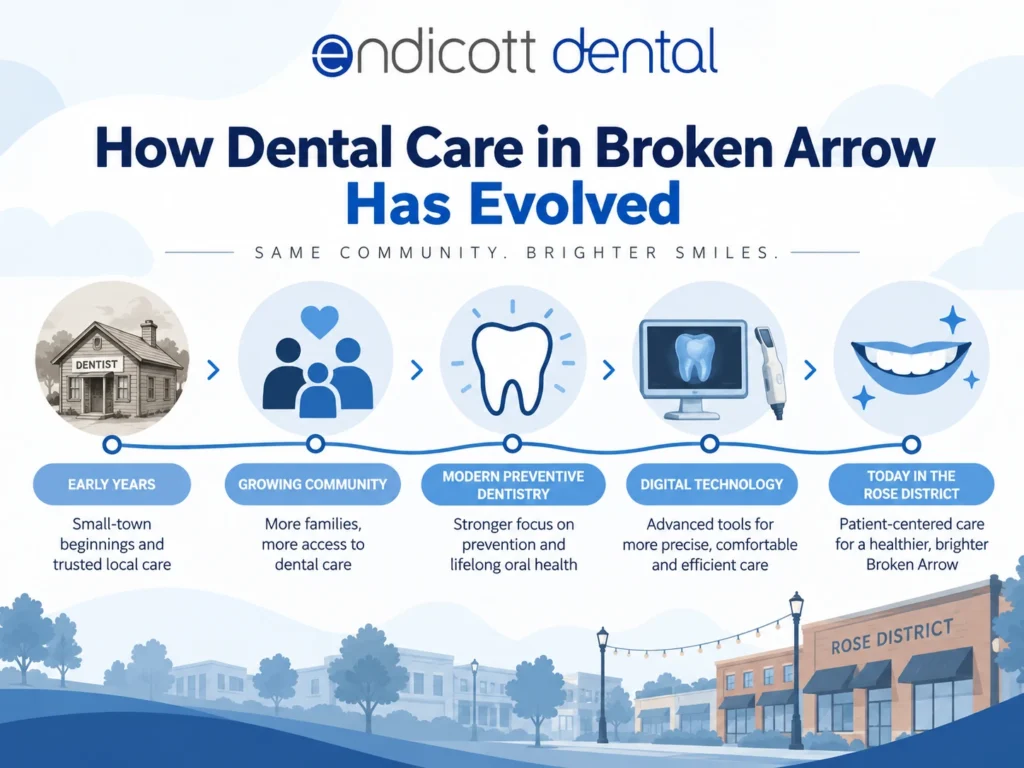
Preventive dentistry grew.
Fluoride changed cavity prevention.
Broken Arrow expanded outward.
The population multiplied.
Healthcare became more specialized.
And eventually, the old downtown itself was reimagined as the Rose District a place that deliberately connects Broken Arrow's history with its future.
Dentistry has followed a remarkably similar path.
The tools changed.
The buildings changed.
The science changed.
But the central purpose remained recognizable:
Help people get out of pain, restore function, and keep their teeth whenever reasonably possible.
The Next Chapter of Broken Arrow Dental Health Is Prevention
For all the technological progress dentistry has made, the future is not simply about doing bigger procedures.
In many ways, success means needing fewer of them.
It means children growing up without experiencing repeated cavities.
It means identifying gum disease before teeth become loose.
It means repairing a cracked tooth before it splits beyond repair.
It means helping someone with dry mouth understand why their cavity risk changed.
It means protecting an athlete before a tooth is knocked out.
It means treating early enamel erosion before teeth become short and sensitive.
It means helping older adults keep natural teeth longer.
And it means being willing to tell a patient when no treatment is necessary yet.
That is a very different definition of progress from simply having the newest machine.
Why Local Dental History Still Matters
You do not need to know the name of a dentist who practiced above the post office in 1906 to take care of your teeth today.
But local history gives us perspective.
A century ago, Broken Arrow residents had fewer options.
Today, patients have more technology, more preventive knowledge, more restorative choices, and more ability to keep natural teeth.
With more choices comes a new challenge:
Figuring out which care is actually right for you.
The answer is not always the most expensive procedure.
Sometimes it is a filling.
Sometimes it is fluoride.
Sometimes it is a crown.
Sometimes the tooth genuinely cannot be saved.
Sometimes a cosmetic concern can wait.
Sometimes doing nothing for now is a reasonable clinical decision.
The ability to make those distinctions is one of the most valuable developments in modern dentistry.
Keep Your Family's Place in Broken Arrow's Dental Story With Endicott Dental
Broken Arrow has changed enormously since local dentists first advertised crown and bridge work in the pages of the Broken Arrow Ledger.
Dental care has changed with it.
At Endicott Dental, led by Dr. Drew Endicott, our role is not simply to provide modern procedures because modern dentistry makes them possible.
It is to help Broken Arrow families understand which procedures they actually need, which problems should be handled now, which can safely be monitored, and what they can do to avoid more complicated dentistry later.
That may mean routine preventive care.
It may mean repairing a tooth.
It may mean discussing replacement options for missing teeth.
Or it may mean explaining that everything looks stable and no treatment is needed beyond normal maintenance.
That is the part of dental progress we value most:
Better information gives patients better choices.
If it has been a while since your last dental examination, or you are dealing with a problem and are unsure what should happen next, Endicott Dental can help you understand your options before you commit to treatment.
Broken Arrow's dental story has been unfolding for more than a century.
The next part is about helping today's families keep their teeth healthier for longer.
Frequently Asked Questions About the History of Dentistry in Broken Arrow
When was Broken Arrow founded?
The modern town developed around a railroad depot at the beginning of the 20th century. City historical sources date the community's establishment to 1902–1903, before Oklahoma became a state in 1907.
The area's history is older, however. Muscogee people were the first permanent residents of what is now the Broken Arrow area, arriving during the early 1800s after forced removal from the southeastern United States.
Were there dentists in Broken Arrow before Oklahoma statehood?
Yes.
Surviving copies of the Broken Arrow Ledger show local dental advertisements before statehood.
Dentist W. D. Tiller advertised dental services in Broken Arrow as early as 1904, including crown, bridge, and gold work. By 1906, L. J. Sizer was also advertising a local dental office.
Where were early Broken Arrow dental offices located?
Newspaper advertisements suggest that dentists commonly worked in upstairs commercial spaces in the downtown area.
W. D. Tiller advertised an upstairs office in the Laws Building, while L. J. Sizer advertised an office over the post office.
Did early Broken Arrow dentists only pull teeth?
The available historical advertisements suggest they did more than extractions.
W. D. Tiller specifically promoted crown, bridge, and gold work, indicating that restorative and replacement dentistry was available in early Broken Arrow.
However, extraction was much more common nationally during that era because severe decay was widespread and preventive options were limited compared with today.
When did fluoride become important in American dentistry?
Researchers spent decades studying the relationship between naturally occurring fluoride and tooth decay.
Grand Rapids, Michigan, became the first U.S. city to begin controlled community water fluoridation in 1945. Major dental and public-health organizations endorsed the practice by 1950. Fluoride toothpaste became widely available during the 1950s and 1960s.
Does Broken Arrow have fluoride in its water?
Broken Arrow's published water-quality reports have documented fluoride in the municipal water supply. Historical reports identify both natural deposits and water treatment as possible fluoride sources.
Residents who need the current concentration should check the city's most recent Consumer Confidence Report rather than relying on an older measurement because water-system data can change over time. The city publishes updated reports through its water-treatment website.
When was the Rose District created?
The Rose District name was formally approved in October 2012.
The district grew from earlier downtown revitalization planning, including a 2005 Downtown Plan that helped shape redevelopment of the historic Main Street area.
Why is it called the Rose District?
According to the City of Broken Arrow, early civic leaders encouraged residents to beautify the area's prairie landscape with vegetation. Roses became particularly popular, and travelers reportedly nicknamed Broken Arrow the "City of Roses."
City leaders later drew on that history when naming the downtown arts and entertainment district.
How much has Broken Arrow grown?
Broken Arrow had only a little more than 2,000 residents in 1940 and just over 11,000 in 1970, according to city historical planning documents.
The city now estimates its population at 124,991 as of 2025, making Broken Arrow the fourth-largest city in Oklahoma.
Why did tooth extractions become less common over time?
Several changes contributed:
- Fluoride reduces decay.
- Home oral hygiene improved.
- Dental examinations became more preventive.
- Restorative materials and techniques improved.
- Root canal therapy allowed some infected teeth to be retained.
- Periodontal treatment improved.
- Patients began seeking care earlier.
- The expectation shifted toward preserving natural teeth whenever reasonably possible.
Extraction remains appropriate when a tooth is badly fractured, infected beyond predictable restoration, severely compromised by periodontal disease, or otherwise not reasonably salvageable.
Did people in the past really expect to lose their teeth as they aged?
Tooth loss was once much more common.
CDC historical data show that complete tooth loss declined substantially in the United States during the second half of the 20th century as preventive and restorative dental care improved.
Aging itself does not require losing your teeth.
Is dentistry today mostly about prevention?
Prevention is a major part of modern dentistry.
The goal is to identify risk and disease early enough that patients can avoid more complicated treatment whenever possible.
That includes:
- Regular examinations
- Professional cleanings
- Fluoride
- Appropriate sealants
- Good brushing and interdental cleaning
- Dietary guidance
- Gum-disease screening
- Monitoring wear and cracks
- Evaluating changes before they become painful
Treatment is still necessary when disease occurs, but preventing a problem is generally better than rebuilding a tooth afterward.
Is modern dentistry always better because it offers more procedures?
More options are useful.
More treatment is not automatically better.
A modern dentist may have the ability to place an implant, veneer, crown, or other restoration, but the important question is whether that procedure makes sense for the patient.
Sometimes a smaller restoration is sufficient.
Sometimes monitoring is appropriate.
Sometimes preserving existing tooth structure is better than pursuing a cosmetic procedure.
The advantage of modern dentistry should be better choices, not simply more treatment.
What does Broken Arrow's dental history teach us today?
Probably the most important lesson is that dental expectations have changed.
Earlier generations often sought care when something hurt.
Modern dentistry gives patients a much better opportunity to prevent disease, detect problems earlier, preserve natural teeth, and understand treatment alternatives before making a decision.
That shift from crisis treatment toward informed prevention is one of the biggest improvements in the history of oral health.
