

Table of Contents
If your toothpaste makes your mouth burn, your gums feel irritated, or your canker sores seem worse every time you brush, you may have already stumbled across the advice:
“Try a sulphate-free toothpaste.”
That advice can be useful.
It can also be oversimplified.
First, in the United States you will usually see the word spelled “sulfate.” More importantly, when people talk about sulfate-free dental products, they are usually concerned about sodium lauryl sulfate, or SLS.
SLS is a detergent used in many toothpastes to help spread ingredients around the mouth and create the foamy feeling people associate with brushing.
For most people, SLS is not a problem.
If you use a regular toothpaste, your mouth feels comfortable, and you do not have recurring irritation, there is usually no compelling reason to avoid it.
But some people have a different experience.
They tell us:
- “Toothpaste burns my tongue.”
- “My mouth peels after I brush.”
- “Strong mint makes my mouth miserable.”
- “I keep getting canker sores.”
- “Everything feels too harsh since I developed a dry mouth.”
- “Sensitive toothpaste helps my teeth but irritates the rest of my mouth.”
For those patients, an SLS-free toothpaste or rinse may be worth trying.
At Endicott Dental in Broken Arrow, we do not believe there is one universally “best” toothpaste.
The product that makes sense for someone with exposed roots and cold sensitivity may be completely different from the one we would choose for a patient struggling with medication-related dry mouth or recurrent mouth ulcers.
So instead of giving you a giant list of products and telling you they are all great, let's break down which sulfate-free products make the most sense for different problems and which ones we would be more cautious about.
What Does “Sulphate-Free” Actually Mean in Toothpaste?
Most American product labels use the spelling sulfate-free.
In oral-care discussions, the main ingredient people are trying to avoid is usually sodium lauryl sulfate (SLS).
SLS is a surfactant.
In plain English, it helps toothpaste spread, mix with saliva, and foam.
That foam makes brushing feel productive, but foam itself is not what cleans your teeth.
Your toothbrush, toothpaste ingredients, brushing technique, and the amount of time you brush matter much more.
Is SLS Dangerous?
For most people using toothpaste normally, SLS should not automatically be treated as a dangerous ingredient.
That point matters because there is plenty of exaggerated information online.
The concern is not that every person needs to remove SLS from their bathroom.
The concern is individual irritation.
Research has reported possible oral effects from SLS in susceptible people, including mucosal irritation, inflammation, peeling, and irritation around oral ulcers. A 2022 scoping review found possible adverse effects involving the oral lining but also emphasized that the available evidence has limitations.
So our advice is straightforward:
If your current toothpaste works well and does not bother you, you do not need to panic about SLS.
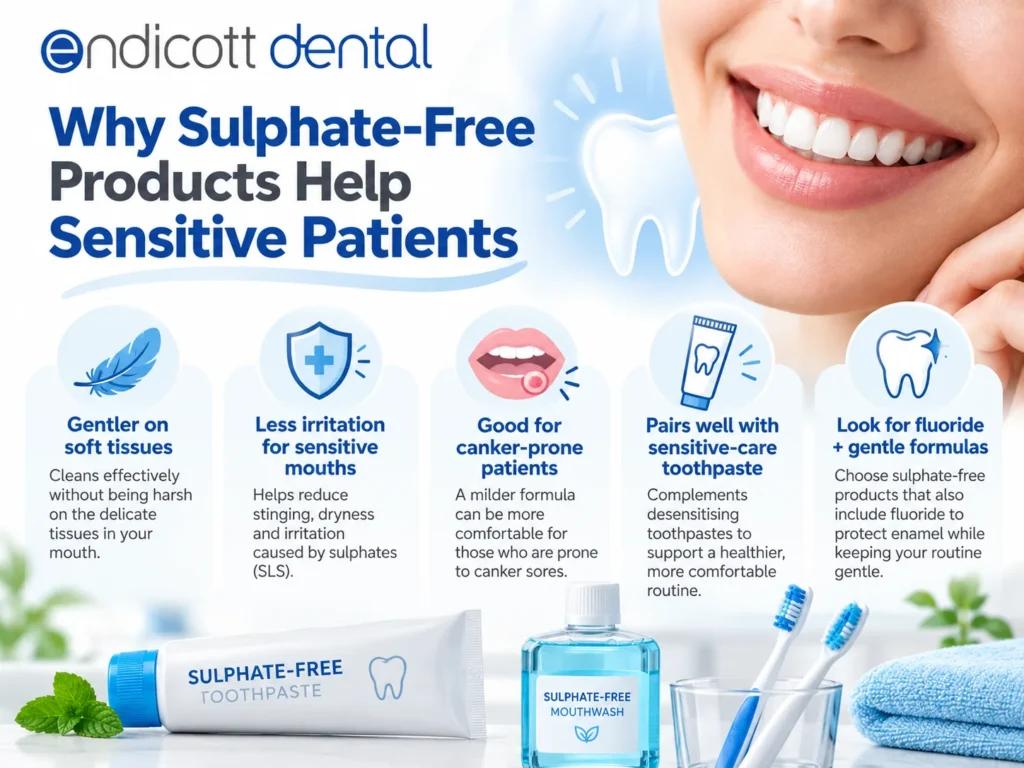
If brushing repeatedly causes burning, peeling, ulcers, or irritation, trying an SLS-free product is reasonable.
Can SLS-Free Toothpaste Really Help Canker Sores?
This is one area where switching may be genuinely useful for some patients.
A systematic review examining SLS-free toothpaste in people with recurrent aphthous stomatitis commonly called recurrent canker sores found that SLS-free toothpaste was associated with reductions in ulcer number, duration, episodes, and pain in the included studies. However, the authors also noted that more high-quality research is needed.
Not every individual study has found the same result.
For example, one randomized trial found that SLS-free toothpaste did not significantly reduce how many ulcers patients developed, although ulcer duration and pain improved.
That tells us something important.
SLS-free toothpaste is not a cure for canker sores.
But if you repeatedly develop them, it is a relatively simple variable to change.
You are brushing anyway.
Trying a gentler formulation for several weeks may tell you whether it makes a meaningful difference for your mouth.
Who Should Consider Sulfate-Free Dental Products?
You may want to consider them if you deal with:
- Recurrent canker sores
- Burning during brushing
- Peeling or sloughing tissue inside the cheeks
- A chronically sensitive mouth
- Dry mouth
- Sensitivity to strong mint or heavily foaming toothpaste
- Oral irritation during certain medical treatments
- Difficulty tolerating conventional mouthwash
- Tooth sensitivity combined with soft-tissue irritation
But there is a crucial distinction.
Sensitive Teeth and a Sensitive Mouth Are Not the Same Problem
This is probably the most important concept in the article.
A sensitive tooth may hurt because dentin is exposed.
That can happen due to:
- Gum recession
- Enamel wear
- Aggressive brushing
- Acid erosion
- Grinding
- Certain dental procedures
A sensitive mouth may react to flavoring, detergents, dryness, mouthwash, or other ingredients.
A toothpaste can be excellent at treating dentin sensitivity while still feeling too harsh for a particular person's oral tissues.
The ADA notes that ingredients with evidence for reducing dentin hypersensitivity include potassium-containing formulations, stannous agents, and arginine-containing products.
That means when choosing an SLS-free toothpaste, we should ask two questions:
Is it gentle enough for the mouth?
And:
Does it contain the active ingredients needed for the actual dental problem?
Those are not always the same thing.
Our Best Overall SLS-Free Pick for Sensitive Teeth: Sensodyne Pronamel
For a patient who tells us:
“Cold water hurts my teeth, but regular toothpaste also irritates my mouth,”
a Sensodyne Pronamel formulation is one of the first products worth considering.
Several U.S. Pronamel products are labeled as SLS/sulfate-free while containing 5% potassium nitrate for sensitivity and sodium fluoride for cavity prevention. Current U.S. drug labeling for Pronamel Daily Protection, Multi-Action, Fresh Breath, and Gentle Whitening identifies those active ingredients and specifically states that the formulations do not contain SLS/sulfates.
Why We Like Pronamel for This Patient
It addresses more than the sulfate question.
It provides:
- Fluoride for cavity prevention
- Potassium nitrate for tooth sensitivity
- An SLS-free formulation
- Protection geared toward acid-weakened enamel
That makes it useful for patients with both sensitive teeth and concerns about acidic wear.
That may include people who frequently consume:
- Soda
- Sports drinks
- Wine
- Citrus
- Sparkling beverages
- Other acidic foods or drinks
What We Do Not Like About Calling It “Perfect”
No toothpaste is perfect.
Some patients still dislike the flavor.
Some people are sensitive to ingredients other than SLS.
And if one specific tooth is suddenly painful, switching toothpaste may delay treatment you actually need.
The Pronamel labeling itself tells consumers to seek dental care if sensitivity persists or worsens, including if symptoms remain after four weeks of use.
That warning is worth following.
Sensitive toothpaste is for dentin sensitivity not for hiding a cracked tooth or cavity.
Best SLS-Free Toothpaste for a Very Sensitive Mouth: CloSYS Sensitive Toothpaste
Some patients do not primarily complain about tooth sensitivity.
They say:
“Everything burns.”
For that person, CloSYS Sensitive Toothpaste is worth considering.
The current formula is specifically marketed as low-foaming and is listed by the manufacturer as SLS-free and sulfate-free. It contains sodium fluoride for cavity prevention and is designed around a gentler brushing experience.
Why CloSYS Can Make Sense
The major benefit is simplicity.
Someone who dislikes the big foamy mouthful produced by conventional toothpaste may find a low-foaming formulation much easier to tolerate.
CloSYS Sensitive contains fluoride, which is important.
The ADA notes that fluoride toothpaste strengthens enamel, helps prevent cavities, and supports remineralization during the early stages of decay. Fluoride is also required for an anticavity toothpaste to earn the ADA Seal for that claim.
That is one reason we generally prefer an SLS-free fluoride toothpaste for everyday use rather than automatically recommending a fluoride-free alternative.
Who Might Prefer CloSYS?
We would especially consider it for someone who says:
- “Foam makes me gag.”
- “Mint toothpaste burns.”
- “My mouth feels raw after brushing.”
- “I want something very mild.”
- “I have recurrent irritation and want fewer potential irritants.”
The Tradeoff
If your primary complaint is severe cold sensitivity, we may prefer a toothpaste with a dedicated anti-sensitivity active ingredient.
CloSYS Sensitive is gentle and fluoride-containing, but the ingredient profile is different from something like Pronamel with 5% potassium nitrate.
Again, match the product to the problem.
Best SLS-Free Toothpaste for Dry Mouth: Biotène Fluoride Toothpaste
If dry mouth is the main issue, Biotène Fluoride Toothpaste deserves a separate category.
Biotène's current fluoride toothpaste is explicitly SLS-free and is formulated for people experiencing dry-mouth symptoms. It also contains fluoride to help protect against cavities.
Why Dry Mouth Changes the Recommendation
Saliva is not just water in your mouth.
It helps:
- Wash away food particles
- Neutralize acids
- Control the oral environment
- Lubricate tissues
- Protect teeth
When saliva decreases, patients can experience more:
- Burning
- Irritation
- Difficulty swallowing
- Bad breath
- Cavities
- Oral discomfort
A toothpaste that feels completely normal to someone with healthy saliva flow can feel surprisingly harsh to someone whose mouth is chronically dry.
That is why a formulation designed around dry-mouth comfort can make sense.
Who Should Consider Biotène Toothpaste?
Patients with dry mouth related to:
- Certain medications
- Cancer therapy
- Autoimmune conditions
- Mouth breathing
- Dehydration
- Other medical conditions
may prefer it.
But do not assume the toothpaste solves the underlying cause.
Persistent dry mouth deserves investigation.
Sometimes medication is involved.
Sometimes dehydration is involved.
Sometimes there is a medical cause that needs attention.
The toothpaste can make home care more comfortable while that bigger question is being addressed.
Best Sulfate-Free Mouth Rinse for People Who Hate Mouthwash: CloSYS Ultra Sensitive
Some patients can tolerate toothpaste but absolutely cannot tolerate traditional mouthwash.
They describe it as:
- Burning
- Too minty
- Painful
- Drying
- Harsh
If that sounds familiar, CloSYS Ultra Sensitive Mouth Rinse is one of the more interesting options.
The manufacturer lists it as:
- Sulfate-free
- Alcohol-free
- Dye-free
- Unflavored
Its ingredient list is also unusually short compared with many rinses.
Why We Like the Unflavored Option
People often assume dental products need to burn to work.
They do not.
Burning is a sensation.
It is not a score showing how many bacteria were killed.
For patients who avoid mouthwash because the experience is miserable, a non-burning rinse may actually be more useful because they are willing to use it consistently.
Does Everyone Need Mouthwash?
No.
This is another area where marketing can outrun reality.
Mouthwash is not a replacement for:
- Brushing
- Fluoride toothpaste
- Cleaning between the teeth
- Professional dental care
For many healthy adults, brushing effectively with fluoride toothpaste and cleaning between the teeth are the foundation.
A rinse can be added for a specific reason.
Do not build a complicated seven-product routine just because the oral-care aisle says you should.
Best Gentle Rinse for Dry Mouth: Biotène Dry Mouth Gentle Oral Rinse
For patients whose main concern is dry mouth rather than plaque or gingivitis, Biotène Dry Mouth Gentle Oral Rinse is another reasonable option.
It is alcohol-free and designed to lubricate and relieve dry-mouth symptoms. The current ingredient list includes moisturizing ingredients such as glycerin, xylitol, and sorbitol.
Biotène also states that its product range is SLS-free.
What We Like
This is a comfort-focused product.
That is useful when a patient is not asking:
“What is the strongest mouthwash?”
They are asking:
“How do I make my mouth stop feeling like sandpaper?”
Those are very different goals.
What It Does Not Replace
A dry-mouth rinse does not correct a cavity.
It does not treat a dental infection.
It does not cure the underlying medical reason saliva production has changed.
Use it for the problem it is designed to address.
What About Fluoride-Free SLS-Free Toothpaste?
You will see plenty of products advertising both:
SLS-free. Fluoride-free.
Those phrases are often placed next to each other as though removing both ingredients makes the toothpaste automatically healthier.
We would not make that assumption.
SLS and fluoride have completely different jobs.
SLS is primarily a surfactant.
Fluoride is an anticavity active ingredient.
The ADA explains that fluoride compounds including sodium fluoride, sodium monofluorophosphate, and stannous fluoride help prevent cavities by strengthening teeth and remineralizing early enamel damage.
So for the average patient who wants to eliminate SLS because it irritates their mouth, our first question would be:
Why remove the fluoride too?
There are individual circumstances where a dentist may recommend something different.
But “SLS-free” does not logically require “fluoride-free.”
Those are separate decisions.
What About “Natural” Sulfate-Free Toothpaste?
Natural is one of the least useful words on a toothpaste package.
It sounds reassuring.
It tells us very little about whether the product will solve your dental problem.
A product can be naturally derived and still irritate your mouth.
Essential oils can bother some patients.
Cinnamon flavoring can be irritating.
Strong mint can feel terrible in a dry mouth.
A naturally sourced abrasive can still be abrasive.
Conversely, an ingredient with an intimidating chemical name may have decades of evidence supporting its safety and effectiveness.
The better questions are:
- Does it contain fluoride?
- Does it address my sensitivity?
- Is it SLS-free if I need that?
- Does it irritate my mouth?
- Is it excessively abrasive?
- Will I actually use it twice every day?
That is much more useful than judging the front of the box.
What Should You Look for on the Ingredient Label?
If you are specifically trying to avoid SLS, look for:
Sodium lauryl sulfate
Some labels may use related terminology, so checking the manufacturer's current ingredient information is worthwhile.
Do not rely entirely on the brand name.
Even products from the same company can have different formulations.
Sensodyne is a good example.
The company's current U.S. FAQ states that many Sensodyne varieties are SLS-free while other lines including some Rapid Relief, Sensitivity & Gum, Complete Protection, and Repair & Protect formulations contain SLS.
So:
“I buy Sensodyne” does not automatically mean “I use an SLS-free toothpaste.”
Read the specific box.
Formulas can also change over time.
If avoiding SLS is important to you, recheck the label when you buy a new tube.
Is SLS the Only Ingredient That Can Irritate Your Mouth?
Definitely not.
This is where some patients switch to an SLS-free toothpaste, continue experiencing irritation, and understandably become frustrated.
Other possible triggers can include:
- Strong flavorings
- Cinnamon compounds
- Peppermint or menthol
- Certain essential oils
- Whitening ingredients
- Peroxides
- Detergents other than SLS
- Preservatives
- Abrasive formulations
Research into toothpaste-associated oral irritation is complicated, and individual reactions vary.
In one study examining potential toothpaste allergens in patients with recurrent aphthous stomatitis, SLS, titanium dioxide, and menthol were among the more frequent positive patch-test findings, but the researchers did not find evidence that toothpaste allergens clearly caused the recurrent ulcers in their study population.
That is why dentistry sometimes involves experimentation.
If SLS-free does not fix the problem, do not conclude:
“Nothing works.”
The trigger may simply be something else.
What If Toothpaste Makes the Inside of My Mouth Peel?
Do not ignore repeated peeling.
Occasional minor tissue shedding may occur after irritation, but persistent sloughing or peeling deserves a closer look.
Try noting:
- Which toothpaste you use
- How quickly peeling begins
- Whether it improves when you stop that product
- Whether mouthwash triggers it
- Whether spicy or acidic foods worsen it
An SLS-free product may be worth trying.
But if the problem continues despite changing products, let a dentist examine the tissue.
What patients assume is “toothpaste allergy” can sometimes be another oral condition.
What If I Keep Getting Canker Sores?
Switching toothpaste may be reasonable.
It should not be the end of the investigation if sores are severe or frequent.
Typical minor canker sores generally heal on their own.
Talk to a dentist or physician if you develop:
- Very large ulcers
- Ulcers that repeatedly return
- Sores that persist unusually long
- Significant difficulty eating or drinking
- Fever or systemic symptoms
- Multiple unexplained oral lesions
Do not self-diagnose every sore as a canker sore indefinitely.
There are many reasons lesions can develop inside the mouth.
What If My Teeth Are Sensitive but My Mouth Isn't?
Then SLS-free may not be the main feature you need.
Concentrate first on the cause of the sensitivity.
The ADA's review of sensitivity toothpaste evidence supports agents including potassium, stannous compounds, and arginine for dentin hypersensitivity.
But even then, toothpaste is only appropriate if the diagnosis really is dentin hypersensitivity.
Sensitivity That Deserves a Dental Examination
Call a dentist if you have:
- Sharp pain limited to one tooth
- Sensitivity that lingers after cold or heat
- Pain when biting
- A visible crack
- A broken filling
- Significant gum swelling
- Pain that wakes you at night
- Symptoms that are getting worse
That may not be a toothpaste problem.
It may be a cavity, crack, damaged restoration, inflamed nerve, or another condition requiring treatment.
Are Whitening Toothpastes a Good Choice for Sensitive Mouths?
Sometimes.
But they would not usually be our first experiment for someone already complaining that their mouth feels irritated.
Some whitening toothpastes depend more heavily on polishing or stain-removing ingredients.
Other whitening products use ingredients that can increase temporary tooth sensitivity.
If your priorities are:
- Stop the burning.
- Reduce sensitivity.
- Protect against cavities.
we would handle those first.
You can address whitening later.
A slightly darker smile with comfortable, healthy teeth is a better starting point than painfully sensitive teeth being scrubbed aggressively in pursuit of a whiter shade.
Should Sensitive Patients Avoid Strong Mouthwash?
If it hurts, there is rarely a prize for continuing to use it.
Many people grew up believing mouthwash is supposed to burn.
It is not.
An alcohol-free, gentle formulation may be easier for patients with dry mouth or irritated tissues.
CloSYS, for example, lists its formulations as alcohol-free and sulfate-free.
Biotène's dry-mouth rinse is also alcohol-free and specifically formulated around oral lubrication and comfort.
The best rinse is not necessarily the one that creates the strongest sensation.
It is the one that performs the job you need without making you avoid using it.
Our Practical Product Shortlist
If a patient asked us to simplify everything in this article, we would think about it this way.
For Cold, Heat, or Sweet Sensitivity
Start by considering Sensodyne Pronamel.
Why:
- SLS/sulfate-free formulations are available
- 5% potassium nitrate targets hypersensitivity
- Fluoride protects against cavities
- Appropriate for patients concerned about enamel wear
For a Mouth That Burns Easily
Consider CloSYS Sensitive Toothpaste.
Why:
- SLS-free
- Sulfate-free
- Low foaming
- Contains fluoride
- Designed around a gentler brushing experience
For Dry Mouth
Consider Biotène Fluoride Toothpaste.
Why:
- SLS-free
- Fluoride-containing
- Formulated specifically with dry-mouth patients in mind
For Someone Who Cannot Tolerate Strong Mouthwash
Consider CloSYS Ultra Sensitive Mouth Rinse.
Why:
- Unflavored
- Alcohol-free
- Sulfate-free
- Designed for very sensitive mouths
For Dry Mouth That Needs More Moisture Support
Consider Biotène Dry Mouth Gentle Oral Rinse.
Why:
- Alcohol-free
- Formulated with lubricating and moisturizing ingredients
- Designed for dry-mouth symptom relief
Are These Products More Expensive?
They can be.
Specialty sensitivity and dry-mouth products often cost more than basic toothpaste.
But this is one of those areas where we would not choose entirely based on the lowest shelf price.
If a $2 toothpaste makes your mouth hurt badly enough that you brush for 30 seconds instead of two minutes, the cheaper product is not actually serving you very well.
At the same time, you do not need to collect every specialty product on this list.
Start with the actual problem.
A single appropriate fluoride toothpaste may be all you need.
Add mouth rinse or dry-mouth products only if there is a reason.
How Long Should You Test an SLS-Free Toothpaste?
Give it enough time to notice a pattern.
If you are switching because brushing causes immediate burning, you may notice an improvement relatively quickly.
If you are trying to determine whether it affects recurrent ulcers, you may need several weeks or multiple ulcer cycles to see whether there is a meaningful difference.
Change one major variable at a time when practical.
If you simultaneously switch toothpaste, mouthwash, floss, diet, toothbrush, supplements, and three medications, you will have no idea what made the difference.
Do You Still Need to Brush Twice a Day?
Yes.
Gentle does not mean optional.
The goal of finding a better toothpaste is to make consistent home care easier.
Use a soft-bristled toothbrush and fluoride toothpaste twice daily unless your dentist has given you different instructions.
Clean between the teeth as well.
An SLS-free product cannot compensate for brushing once every three days.
What Would We Avoid?
For a patient with a sensitive mouth, we would be cautious about unnecessarily complicated products.
That can include:
- Extremely strong flavors
- Products that repeatedly burn
- Aggressive whitening formulas when sensitivity is already severe
- Fluoride-free toothpaste chosen solely because “fluoride-free” sounds healthier
- Products promising to cure chronic mouth sores
- Abrasive DIY powders
- Brushing with baking soda mixtures without understanding the overall routine
- Essential-oil mixtures applied directly to irritated tissues
The goal is not to find the most unusual product.
It is to find the simplest effective routine your mouth tolerates.
A Sensitive Mouth Shouldn't Make Brushing Miserable Let Endicott Dental Help You Simplify It
If every trip down the toothpaste aisle leaves you confused, you are not alone.
One tube says enamel repair.
Another says it's natural.
Another says SLS-free.
Another says whitening.
Another says dry mouth.
Another says sensitive.
They are solving different problems.
At Endicott Dental in Broken Arrow, we would rather help you figure out why your mouth or teeth are sensitive first.
If the issue appears to be irritation from SLS or a strongly flavored product, switching to a gentler formulation may be all you need.
If the real problem is dry mouth, we may approach your routine differently.
If one tooth hurts every time you drink something cold, we may need to make sure you are not masking a cavity, crack, or damaged restoration with sensitive toothpaste.
And sometimes the best news is that nothing serious is wrong, you simply need a product your mouth tolerates better.
If brushing burns, your mouth keeps developing sores, or you have persistent tooth sensitivity and cannot tell which product makes sense, Endicott Dental can help you identify the likely cause and build a home-care routine around what your mouth actually needs.
You do not need the fanciest toothpaste.
You need the right one.
Frequently Asked Questions About Sulfate-Free Toothpaste
What is SLS in toothpaste?
SLS stands for sodium lauryl sulfate.
It is a surfactant used in many toothpastes to help ingredients spread and create foam.
Most people tolerate it without difficulty, but some patients find that SLS-containing products irritate their oral tissues.
Is sulphate-free the same as SLS-free?
Not always.
“Sulphate-free” or “sulfate-free” is a broader marketing term.
SLS-free specifically means the product does not contain sodium lauryl sulfate.
If SLS is the ingredient you are trying to avoid, check for that exact ingredient rather than relying solely on wording on the front of the package.
Is SLS bad for everyone?
No.
There is no reason to tell every patient they must avoid SLS.
It has a long history of use in oral-care products, and many people tolerate it well.
SLS-free products are most relevant when a person experiences irritation or recurrent oral ulcers and wants to see whether eliminating SLS improves their symptoms. Research suggests a potential benefit for some patients with recurrent aphthous ulcers, although the evidence is not perfect.
What is the best SLS-free toothpaste for sensitive teeth?
For patients with dentin hypersensitivity who also want an SLS-free formulation, Sensodyne Pronamel is a strong option because current U.S. formulations combine 5% potassium nitrate for sensitivity with fluoride for cavity protection and are labeled as SLS/sulfate-free.
The best product still depends on why your teeth are sensitive.
What is the best SLS-free toothpaste for dry mouth?
Biotène Fluoride Toothpaste is specifically formulated for dry-mouth patients and is SLS-free while still providing fluoride cavity protection.
What is the gentlest SLS-free toothpaste?
CloSYS Sensitive Toothpaste is worth considering for patients who dislike heavy foaming or find conventional toothpaste harsh. The manufacturer lists it as low-foaming, SLS-free, sulfate-free, and fluoride-containing.
Does SLS-free toothpaste still clean your teeth?
Yes.
Your toothpaste does not need SLS to clean your teeth.
SLS helps with foaming and dispersion, but SLS-free toothpastes still use cleaning and polishing ingredients along with active ingredients such as fluoride.
Good brushing technique remains essential.
Does SLS-free toothpaste foam less?
Often, yes.
Because SLS is a strong foaming surfactant, some SLS-free formulations produce noticeably less foam.
That can feel strange at first if you have spent decades associating foam with cleanliness.
Less foam does not automatically mean less cleaning.
Can SLS cause canker sores?
The relationship is not absolute.
Research suggests that people with recurrent aphthous ulcers may experience fewer, shorter, or less painful ulcers when using SLS-free toothpaste, but results across individual studies have varied.
So we would say SLS may aggravate ulcers in some susceptible patients rather than claiming it causes every canker sore.
Will switching toothpaste cure my canker sores?
Not necessarily.
Canker sores can have multiple triggers.
If SLS is contributing to irritation, eliminating it may help.
But frequent, severe, unusually large, or persistent oral ulcers deserve professional evaluation.
Is sulfate-free toothpaste better for dry mouth?
It may be more comfortable for certain patients, but sulfate-free alone does not treat dry mouth.
Look for a product designed around dry-mouth comfort, and talk with your dentist or physician about why your saliva production has decreased.
Is fluoride-free toothpaste better for sensitive mouths?
Not automatically.
Fluoride and SLS serve entirely different purposes.
Fluoride helps prevent tooth decay and remineralize early enamel damage.
If SLS bothers you, an SLS-free toothpaste that still contains fluoride is often a sensible starting point.
Is all Sensodyne SLS-free?
No.
Sensodyne's U.S. product line contains both SLS-free and SLS-containing formulas. The company specifically advises consumers to check the formulation because certain Sensodyne varieties contain SLS while others do not.
Always check the specific package you are purchasing.
Is Pronamel SLS-free?
Current U.S. labeling for several Pronamel toothpaste varieties including Daily Protection, Fresh Breath, Gentle Whitening, and Multi-Action states that they do not contain SLS/sulfates.
Because formulations can change, checking the current box remains a good habit.
Is Biotène toothpaste SLS-free?
Yes. Biotène's current fluoride toothpaste is labeled SLS-free, and the company states that its Biotène product range is SLS-free.
Is CloSYS toothpaste sulfate-free?
CloSYS states that its toothpaste products are sulfate-free and SLS-free. Its Sensitive Fluoride Toothpaste is also formulated as a low-foaming option.
What mouthwash is good for an extremely sensitive mouth?
CloSYS Ultra Sensitive is an unflavored, alcohol-free, sulfate-free rinse designed for patients who want a very mild mouthwash experience.
For patients whose primary problem is dry mouth, a moisturizing rinse such as Biotène Dry Mouth Gentle Oral Rinse may make more sense.
Should mouthwash burn?
No.
A burning sensation is not necessary for a mouthwash to be useful.
If your current rinse makes your mouth uncomfortable enough that you dread using it, discuss a gentler alternative with your dentist.
Why does mint toothpaste burn my mouth?
The problem may be the intensity of mint, menthol, another flavoring ingredient, SLS, dryness, existing mouth sores, or another form of irritation.
Switching to an SLS-free product may help, but if symptoms continue, another ingredient or another oral condition may be responsible.
How long should sensitive toothpaste take to work?
It depends on the active ingredient and cause of sensitivity.
Consistent twice-daily use may take time to build protection.
If tooth sensitivity persists, worsens, or is concentrated in one specific tooth, schedule a dental examination rather than continuously changing toothpaste.
Can I use an SLS-free toothpaste every day?
Yes, provided the product is appropriate for your oral-health needs and you follow the label instructions.
For most adults, we generally want an everyday toothpaste to include fluoride unless there is a specific reason to use something else.
When should sensitive teeth be checked by a dentist?
Make an appointment if you have:
- Sensitivity limited to one tooth
- Pain when biting
- Lingering pain after hot or cold foods
- Increasing pain
- A cracked or broken tooth
- Swelling
- A lost filling
- Sensitivity that does not improve with appropriate toothpaste
A toothpaste can reduce dentin hypersensitivity.
It cannot repair every condition that causes tooth pain.
