

Table of Contents
You look in the mirror one morning and notice something strange.
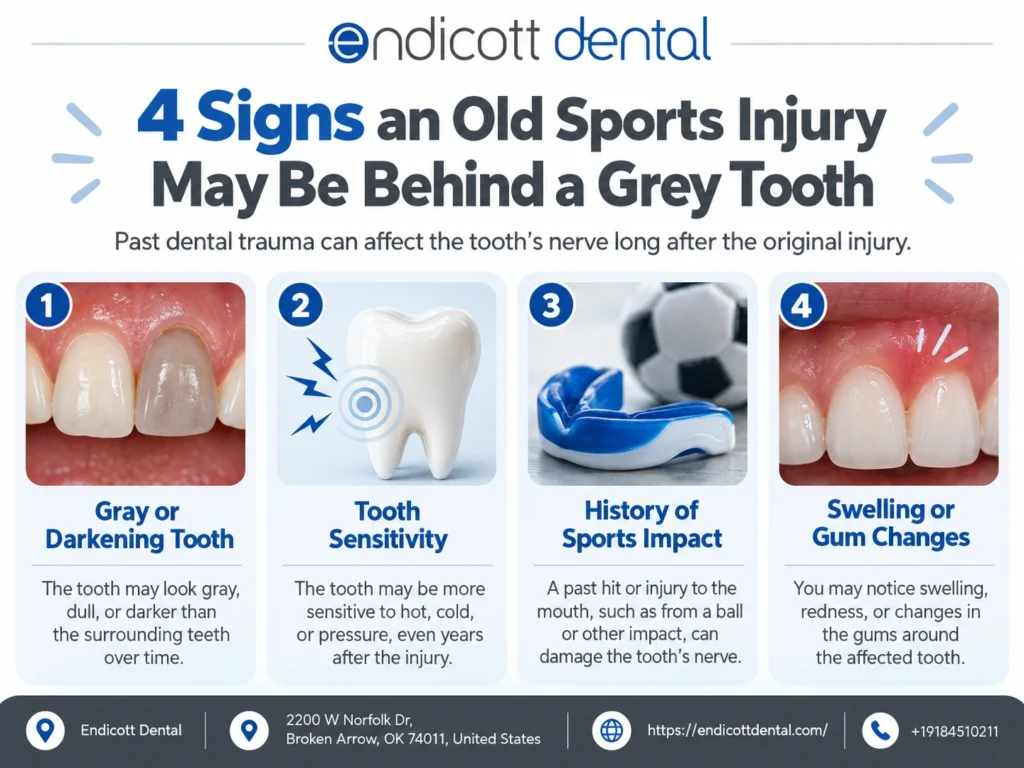
One of your front teeth looks darker than the tooth beside it.
Maybe it is slightly grey.
Maybe brownish.
Maybe you cannot even decide whether the tooth actually changed or whether the lighting is making you imagine it.
Then you remember something you have not thought about in years:
You got hit in the mouth playing sports.
Maybe it was baseball in high school.
An elbow during basketball.
A football collision.
A fall during cheer.
A soccer ball.
A wrestling match.
You remember that the tooth hurt for a few days, but nothing broke. Eventually everything seemed normal, so you forgot about it.
Now, years later, that tooth is changing color.
Can an injury from that long ago really be responsible?
Yes, it can.
Dental trauma does not always announce its full consequences on the day of the accident. A tooth may look normal after the initial injury while the living tissue inside it the dental pulp responds over the following months or years.
Sometimes the pulp heals.
Sometimes it becomes calcified.
Sometimes it slowly loses vitality.
And sometimes the first obvious sign that something changed is a front tooth that no longer matches the rest of your smile.
At Endicott Dental in Broken Arrow, this is one reason we take old sports injuries seriously even when the patient says:
“That happened forever ago.”
The history still matters.
The most important thing to understand is that a grey tooth is a clue, not a diagnosis.
Trauma-related discoloration can occur for different reasons, and the correct treatment may range from simply monitoring the tooth to root canal treatment followed by cosmetic correction.
Here is what may be happening—and why you should have a newly darkened tooth checked before assuming it only needs whitening.
Why Can a Tooth Turn Grey Years After an Injury?
To understand the color change, you need to know what is inside a tooth.
Most people think of a tooth as a solid piece of enamel.
It is not.
Underneath the hard outer enamel is dentin. In the center of the tooth is the pulp, which contains blood vessels, nerves, and other living tissue.
When you take a hard hit to a tooth, the crown does not necessarily have to crack for the pulp to be injured.
The impact can damage the tiny blood vessels entering the tooth through the end of the root.
That is similar to what happens when another part of your body is bruised.
The difference is that the pulp is enclosed inside a rigid tooth.
It does not have much room to swell or recover.
The International Association of Dental Traumatology identifies pulp necrosis, pulp-space obliteration, root resorption, and other delayed changes among the important possible complications following traumatic injuries to permanent teeth. That is why follow-up matters even after the initial pain disappears.
The Tooth May Have Looked Fine After the Injury
This is where patients become confused.
They assume:
“If the injury damaged the nerve, wouldn't the tooth have hurt immediately?”
Not necessarily.
Some injured teeth hurt significantly.
Others barely hurt at all.
A tooth can also temporarily stop responding normally to pulp tests immediately after trauma and later recover. Dental-trauma guidelines specifically warn that a lack of response shortly after an injury does not automatically mean the pulp has died.
That unpredictability is why monitoring traumatized teeth is important.
The tooth may recover.
It may remain stable for years.
Or changes may become apparent much later.
Does a Grey Tooth Mean the Nerve Is Dead?
It can, but we should not diagnose pulp death based on color alone.
This is one of the most important points in the article.
Progressively grey or brown discoloration after trauma can be associated with pulp necrosis, meaning the living tissue inside the tooth has died.
When blood cells and pulp tissue break down inside the tooth, pigments can enter the microscopic tubules within dentin. That internal discoloration can make the entire crown appear grey, brown, or darker than surrounding teeth.
Current endodontic literature recognizes grey or brown discoloration as a common feature of pulp necrosis following trauma or other pulpal injury.
But the European Society of Endodontology cautions that crown discoloration alone does not provide enough information to decide whether root canal treatment is necessary. Dentists need to combine the tooth's history with clinical testing and radiographic findings.
In plain English:
A grey tooth deserves an examination. It does not automatically deserve a root canal.
What Actually Happens When the Pulp Dies?
A tooth with a necrotic pulp may cause no pain at first.
That surprises people.
The nerve tissue is no longer functioning normally, so the tooth may actually feel quieter rather than more painful.
The problem develops when bacteria infect the root canal system.
Once infection spreads through the root toward the surrounding bone, symptoms may develop.
These can include:
- Pain when biting
- Tenderness when tapping the tooth
- Swelling
- A small gum bump or draining sinus tract
- Pressure
- Bad taste
- Darkening of the tooth
- Changes visible on a dental X-ray
In other cases, there may still be almost no noticeable symptoms.
That is why waiting until a dark tooth hurts is not a particularly good diagnostic strategy.
Could the Tooth Have Been Bleeding Inside Without Dying?
Yes.
Trauma can cause bleeding within the pulp.
Blood pigments can move into the dentin and create a pink, reddish, grey, or dark appearance.
Some of those changes can be temporary.
Recent endodontic reviews note that trauma-related intrapulpal bleeding can cause temporary discoloration and that the color may improve if blood supply and pulp health recover.
That is another reason dentists should not rush into irreversible treatment based only on tooth color.
The timeline matters.
The examination matters.
Pulp testing matters.
X-rays matter.
Why Do Some Injured Teeth Turn Yellow Instead of Grey?
A yellow or yellow-brown tooth after trauma can represent a very different biological response.
Sometimes the pulp does not die.
Instead, the tooth begins laying down large amounts of hard tissue inside the pulp chamber and root canal.
This is commonly called pulp canal obliteration or calcific metamorphosis.
As more dentin forms inside the tooth, the crown can become less translucent and appear increasingly yellow or yellow-brown.
Current endodontic literature describes pulp canal obliteration as a healing response commonly associated with luxation injuries.
Does a Yellow Traumatized Tooth Need a Root Canal?
Not automatically.
In fact, an asymptomatic tooth with pulp canal obliteration often should not receive root canal treatment simply because the canal has become narrow or the tooth looks yellow.
The European Society of Endodontology specifically states that pulp canal obliteration following trauma is generally a sign of a vital pulp and that root canal treatment is not indicated in an asymptomatic tooth unless there is evidence of pulp disease or inflammation around the root.
That distinction matters because a heavily calcified canal can also make root canal treatment technically more challenging.
We should not create that problem unnecessarily.
How Can an Injury From High School Cause a Problem in Your 30s?
This is where dental trauma becomes frustrating.
Biological responses do not always happen on your timeline.
A traumatized tooth may undergo gradual changes for years.
Long-term studies of traumatized permanent teeth with calcifying changes have followed patients for more than a decade and documented that some teeth remain healthy while others later develop pulpal or periapical disease.
That means an injury does not have to be recent to remain relevant.
When we evaluate a discolored front tooth, one of the first questions we may ask is:
“Have you ever been hit in this tooth?”
Patients sometimes say no.
Then after thinking:
“Oh, wait. I took a baseball to the face when I was 14.”
That information can completely change what we investigate.
What Types of Sports Injuries Can Damage a Tooth Without Breaking It?
A tooth does not need to be knocked out to sustain meaningful trauma.
The American Association of Endodontists notes that traumatic dental injuries can range from relatively minor chips to displacement and complete avulsion. Sports accidents are one of the common causes.
A tooth may have been:
- Hit directly
- Loosened temporarily
- Pushed backward
- Pushed forward
- Intruded slightly into the socket
- Partially displaced
- Cracked
- Chipped
- Injured at the root
- Injured without any visible crown damage
Sometimes a teenager takes an elbow to the mouth, notices that the tooth feels sore for a few days, and never tells anyone.
Ten years later, history becomes relevant.
What Other Symptoms Can Show Up Years After Dental Trauma?
Color change may be the most visible sign, but it is not the only possible delayed problem.
Pain When Biting
A traumatized tooth may develop inflammation around the root or an old crack may become symptomatic.
Pain when biting deserves evaluation.
A Gum Bump Above the Tooth
Patients sometimes describe a little “pimple” on the gum.
That can represent a draining sinus tract from a chronic dental infection.
It may appear, disappear, and return.
Because pressure drains through the gum, the tooth itself may not hurt very much.
That does not mean the infection is harmless.
Swelling
Swelling around a previously traumatized tooth can indicate infection and deserves prompt dental attention.
Tooth Mobility
A tooth that begins feeling loose years after trauma should be evaluated.
Several conditions can cause mobility, including periodontal disease and root problems.
Changes on an X-Ray
You may feel absolutely normal while a routine dental image shows inflammation around the root.
That is one reason regular dental examinations remain useful even when nothing hurts.
Gum Tenderness
Tenderness above the root of a discolored front tooth may be another clue that the tissues surrounding the tooth are involved.
Why Would a Sports Injury Damage the Tooth's Blood Supply?
The tooth receives its blood supply through a very small opening at the tip of the root.
Imagine the tooth being suddenly displaced during an impact.
Even if it moves only slightly, the tiny neurovascular tissues entering through the root can be stretched or damaged.
Different traumatic injuries carry different risks.
A simple enamel chip is biologically different from a tooth that was luxated—or displaced—from its socket.
This is one reason the International Association of Dental Traumatology recommends structured follow-up after many types of traumatic injuries rather than assuming that repositioning or repairing the visible damage ends the story.
Does a Grey Tooth Always Come From an Old Injury?
No.
There are other possible explanations.
A tooth can appear darker because of:
- Deep decay
- Previous root canal treatment
- Internal bleeding
- Pulp necrosis unrelated to remembered trauma
- A large old restoration
- Certain developmental defects
- Internal resorption
- External staining
- Differences in enamel thickness
- Previous dental treatment
That is why searching “grey tooth” online and deciding you need a root canal is not enough.
We need to determine whether the discoloration is coming from inside the tooth or is simply on the surface.
How Do We Diagnose a Grey Tooth?
This is where dentistry becomes much more useful than a mirror.
The color is only the starting point.
We Ask About the Tooth's History
You may be asked:
- When did you first notice the color?
- Has it changed gradually or quickly?
- Did the tooth ever experience trauma?
- Did you play contact sports?
- Was it chipped or loosened?
- Has the tooth ever hurt?
- Has it previously had dental work?
- Is it sensitive to hot or cold?
- Does it hurt when you bite?
Do not dismiss an injury because it happened 20 years ago.
Tell us.
We Compare the Tooth With Its Neighbors
A subtle color difference may be obvious when the affected tooth is viewed beside the corresponding tooth on the opposite side.
Photographs can also help document whether the color is changing over time.
Trauma literature recommends photographic documentation as one useful part of long-term monitoring.
We Test the Pulp
A dentist may use cold or another pulp sensibility test to see whether the tooth responds.
The response is compared with neighboring healthy teeth.
This is not a perfect test.
It tells us whether sensory nerves are responding not directly whether blood is flowing through the pulp.
That distinction is particularly important after recent trauma, when temporary false-negative responses can occur. Endodontic guidelines recommend combining pulp testing with clinical and radiographic information rather than relying on a single result.
We Tap and Examine the Tooth
A dentist may check for:
- Tenderness
- Mobility
- Swelling
- Gum changes
- Cracks
- Changes in bite
These clues help us determine whether inflammation has spread to tissues around the root.
We Take Dental X-Rays
Radiographs can show:
- Infection around the root
- Changes in the periodontal ligament
- Root fractures
- Pulp canal narrowing
- Internal or external resorption
- Previous dental work
No single image reveals everything.
In selected complicated trauma cases, three-dimensional imaging may be considered when standard images do not provide enough information and the result would change treatment. Current endodontic guidance recommends reserving CBCT for cases where it adds meaningful diagnostic value.
If the Tooth Is Grey but Tests Healthy, Do You Have to Treat It?
Not necessarily.
This is exactly why diagnosis comes before cosmetics.
Suppose a tooth is slightly darker after an old injury but:
- Has no symptoms
- Responds appropriately to pulp testing
- Shows no infection
- Has no concerning root changes
- Remains structurally sound
Depending on the diagnosis, monitoring may be reasonable.
The biggest mistake would be deciding that every grey tooth requires root canal treatment purely because of the color.
Professional endodontic guidance specifically warns against making treatment decisions based on crown discoloration alone.
Sometimes the appropriate conversation becomes cosmetic rather than medical.
When Does a Grey Tooth Need Root Canal Treatment?
Root canal treatment may be recommended when the evidence indicates the pulp has become necrotic or infected.
That diagnosis usually depends on several findings rather than one.
Possible evidence includes:
- Repeated lack of normal pulp response
- Progressive discoloration
- Pain
- Tenderness
- Swelling
- A draining gum lesion
- Changes around the root on X-rays
- Other signs of pulp necrosis or apical disease
The American Association of Endodontists advises that post-traumatic pulp necrosis should be diagnosed using multiple signs or symptoms rather than relying on one isolated finding.
What Does the Root Canal Actually Do?
Root canal treatment removes infected or necrotic tissue from inside the tooth.
The root canal system is cleaned, disinfected, shaped, and sealed.
The purpose is not primarily to change the tooth's color.
It is to treat disease inside the tooth and help preserve the natural tooth when possible.
Cosmetic correction can be considered afterward.
Will a Root Canal Make the Grey Tooth White Again?
Not automatically.
Root canal treatment treats the internal biological problem.
Color is a separate issue.
Once the tooth is healthy and stable, options may include:
- Internal bleaching
- External professional whitening
- Dental bonding
- A veneer in selected cases
- A crown when structural protection is also needed
The correct choice depends on why the tooth is dark, how healthy tooth remains, and whether there are existing restorations.
Internal Bleaching May Be an Option
For certain darkened root-canal-treated teeth, dentists can place a whitening agent inside the tooth rather than trying to bleach the discoloration only from the outside.
This can sometimes provide significant cosmetic improvement without covering the entire tooth.
Not every tooth is a candidate.
The root canal and surrounding tissues should be evaluated first.
Bonding Can Help Some Teeth
Composite bonding may help when there is a combination of discoloration and minor structural damage.
But simply covering a dark tooth without making sure the pulp and root are healthy is not a good strategy.
Does a Grey Tooth Automatically Need a Crown?
No.
A crown should be recommended because the tooth needs structural protection or because it provides an appropriate restorative solution not simply because the tooth is grey.
If the front tooth remains structurally strong, a more conservative cosmetic approach may be possible.
Can Regular Teeth Whitening Fix a Trauma-Darkened Tooth?
Sometimes conventional whitening can improve the overall appearance, but a single internally darkened tooth may respond differently from neighboring healthy teeth.
This creates a common problem:
You whiten every tooth.
The healthy teeth get brighter.
The traumatically darkened tooth barely changes.
Now the color difference is even easier to see.
That does not mean whitening was performed incorrectly.
The discoloration may be coming from deeper inside the tooth.
This is why a single grey tooth should be evaluated before repeatedly buying stronger whitening products.
You need to understand the cause first.
What If the Tooth Has Been Grey for 15 Years and Never Hurt?
Have it checked.
That does not mean we automatically treat it.
A long-standing stable grey tooth may not represent an active emergency.
But “it doesn't hurt” cannot tell us whether:
- The pulp is healthy
- The pulp is necrotic but not yet symptomatic
- There is chronic inflammation around the root
- The tooth has undergone calcific changes
- There is a resorptive process
- The tooth is completely stable
An examination and appropriate imaging give us much more useful information.
What Is Root Resorption After Trauma?
Root resorption is one of the less familiar delayed complications of dental trauma.
In simple terms, parts of the root can begin breaking down due to abnormal activity of cells involved in tissue remodeling.
Different types of resorption behave differently.
Some trauma-related surface changes are temporary and heal.
Other inflammatory resorptive processes can threaten the tooth if they continue.
The International Association of Dental Traumatology includes several forms of root resorption among important potential complications following traumatic injury.
This is another reason we care about follow-up.
You cannot see the root in your bathroom mirror.
Why Didn't My Dentist Tell Me This When the Injury Happened?
They may have.
But there is another possibility:
You never saw a dentist after the injury.
That is extremely common with sports trauma.
If the tooth did not break, many athletes assumed there was nothing to treat.
They went back into the game.
The soreness disappeared.
Life moved on.
Modern traumatic-dental-injury guidance takes a different approach.
The American Association of Endodontists recommends having an injured tooth examined even when the injury initially appears relatively minor because neighboring teeth and internal structures may have been affected without obvious signs.
That is the lesson we want Broken Arrow athletes and parents to hear:
A tooth does not have to be knocked out for the injury to matter.
Why Is Follow-Up After a Sports Injury So Important?
Because the first appointment tells us what the tooth looks like today.
Follow-up tells us what direction it is going.
A traumatized tooth may initially:
- Feel normal
- Look normal
- Fail to respond to cold
- Later regain normal sensation
- Gradually calcify
- Develop discoloration
- Develop pulp necrosis
- Develop root changes
The IADT guidelines specifically emphasize follow-up because early identification of complications improves the chance of managing them successfully.
If you or your child takes a significant hit to a permanent tooth during sports, do not make the dental visit a one-and-done event if follow-up is recommended.
What If a Child's Baby Tooth Turns Grey After an Injury?
Baby teeth require a somewhat different conversation.
Dark discoloration after trauma is relatively common in primary front teeth.
But once again:
Color alone should not dictate treatment.
AAPD-endorsed trauma guidance recognizes that traumatized primary teeth can become discolored and emphasizes monitoring for other signs of pulpal infection or disease.
Older research also demonstrates why diagnosis can be complicated: dark grey discoloration in primary teeth is often associated with pulp changes, yet not every darkened tooth immediately develops clinical infection.
Parents should call if a grey baby tooth develops:
- Swelling
- A gum bump
- Increasing mobility
- Pain
- Tenderness
- Other signs of infection
Do not assume a grey baby tooth automatically needs extraction.
And do not assume it is harmless.
Let the dentist evaluate it.
What If You Cannot Remember Ever Injuring the Tooth?
That happens all the time.
Not every traumatic event feels important at the time.
Maybe you:
- Fell off a bicycle at age 12
- Got hit by a basketball
- Bit down hard during an accident
- Fell on the playground
- Took an elbow during recreational sports
- Were involved in a car accident
You may remember hurting your lip and completely forget that a tooth was involved.
We still evaluate the tooth based on what we see today.
The absence of a remembered trauma does not eliminate other possible causes of discoloration.
When Is a Grey Tooth an Emergency?
A slowly darkening tooth without pain usually does not require the hospital emergency department.
It does deserve a dental evaluation.
Call sooner if you have:
- Significant swelling
- Severe or increasing pain
- Fever associated with dental swelling
- A rapidly enlarging gum or facial swelling
- Difficulty swallowing
- Difficulty breathing
- Trauma that just occurred
- A tooth that has been knocked out or significantly displaced
Endicott Dental provides emergency evaluation for sports-related dental trauma in Broken Arrow and encourages patients with chipped, cracked, loose, displaced, or knocked-out teeth to contact the office promptly.
Can a Mouthguard Prevent This From Happening?
No mouthguard can prevent every dental injury.
But appropriate mouth protection can significantly reduce the risk of dental and orofacial trauma during sports.
At Endicott Dental, our sports dentistry services include custom mouthguards as well as evaluation and treatment of traumatic dental injuries.
If you or your child regularly participates in:
- Football
- Wrestling
- Basketball
- Baseball or softball
- Soccer
- Lacrosse
- Cheerleading
- Martial arts
- Other contact or high-impact activities
a properly fitted sports mouthguard is worth discussing.
We would much rather protect a healthy front tooth now than investigate why it turned grey ten years after an avoidable injury.
Why This Topic Matters to Dr. Drew Endicott
Sports dentistry is a natural fit for Endicott Dental because athletics are part of Dr. Drew Endicott's own background.
Before dentistry, Dr. Endicott played college baseball and later professional baseball in the Kansas City Royals organization.
That does not mean every sports injury can be prevented.
Athletes collide.
Baseballs take bad hops.
Elbows happen.
What experience with sports does reinforce is the value of preparation and follow-up.
If a knee is injured, athletes understand that the story may not end the moment the swelling disappears.
Teeth deserve the same respect.
A tooth that feels fine after a collision can still benefit from evaluation and appropriate monitoring.
What We Would Tell a Broken Arrow Patient Who Just Noticed One Grey Tooth
Do not panic.
Do not immediately schedule a veneer.
Do not assume you need a root canal.
And do not spend six months bleaching it at home without knowing why it is dark.
Start with the diagnosis.
We want to determine:
- Is the discoloration internal or external?
- Is the pulp still healthy?
- Was there previous trauma?
- Does the X-ray show any changes around the root?
- Is the tooth structurally sound?
- Is there evidence of infection or resorption?
- Is this primarily a health problem, a cosmetic problem, or both?
Those answers determine what comes next.
When Is Doing Nothing Actually the Right Treatment?
This may surprise patients.
Sometimes monitoring is appropriate.
If an old traumatically affected tooth is stable, asymptomatic, healthy on examination and imaging, and shows no evidence of progressive disease, intervention may not be necessary.
Good dentistry is not finding a procedure for every unusual-looking tooth.
It is knowing when a procedure improves the prognosis and when it does not.
You can always revisit cosmetic options if the color bothers you.
But irreversible treatment should have a reason.
When Can Waiting Make Things Worse?
Waiting becomes more concerning when we have evidence that the pulp is necrotic, infection is present, root resorption is progressing, or the tooth is structurally compromised.
An infected root canal system will not become healthy because the tooth happens not to hurt.
And infection around a permanent front tooth can eventually affect the surrounding tissues and bone.
That is why the safest approach is:
Do not treat color blindly. Do not ignore color blindly either.
Diagnose it.
One Dark Tooth Deserves an Explanation—Not Just More Whitening
A single grey front tooth can be frustrating because it affects the part of your smile everyone sees.
But before trying to make the tooth white again, we want to understand why it changed color.
At Endicott Dental, Dr. Drew Endicott and our Broken Arrow team can evaluate the tooth, ask about old injuries, perform appropriate pulp testing, take dental images when necessary, and determine whether the issue is primarily cosmetic or whether something is happening inside the tooth.
Sometimes the answer may be:
“The tooth is healthy. Let's monitor it and talk about cosmetic options.”
Sometimes it may be:
“The old injury caused calcification, but there is no evidence of infection.”
And sometimes it may be:
“The nerve did not survive the trauma, and we need to address the infection before we worry about color.”
Those are three very different situations.
They should not receive the same treatment.
If you have one tooth that is becoming grey, brown, or noticeably darker than the rest—especially if you remember a sports injury from years ago—Endicott Dental can help you find out what is happening before you commit to whitening, veneers, or more extensive treatment.
Your tooth may be telling the story of an injury you stopped thinking about years ago.
It is worth finding out how that story ends.
Frequently Asked Questions About Grey Teeth After Sports Injuries
Why did my tooth suddenly turn grey?
A grey tooth can develop when blood products or damaged pulp tissue discolor the dentin from inside the tooth.
Trauma is one possible cause.
Pulp necrosis, deep decay, previous dental treatment, restorations, and other conditions can also change tooth color.
A dental examination is needed to determine the cause.
Can a sports injury make a tooth turn grey years later?
Yes.
Traumatic dental injuries can produce delayed complications involving the pulp and root.
Some changes become apparent months or years after the original event, which is why a history of trauma remains relevant even when the injury happened long ago.
Does a grey tooth mean it is dead?
Not automatically.
Progressive grey discoloration can be associated with pulp necrosis, but professional guidance recommends combining color with pulp testing, symptoms, examination findings, and radiographs before making that diagnosis.
Can a dead tooth have no pain?
Yes.
A necrotic tooth may be completely painless, particularly before infection causes inflammation in the tissues surrounding the root.
That is why absence of pain does not prove that a discolored tooth is healthy.
If the nerve is dead, why doesn't the tooth hurt?
The sensory tissue inside a necrotic pulp is no longer functioning normally.
Pain may develop later if infection spreads through the root canal system and inflames the surrounding tissues.
What does it mean if my tooth turns yellow after an injury?
Yellow or yellow-brown discoloration after trauma may be associated with pulp canal obliteration, sometimes called calcific metamorphosis.
The tooth responds to trauma by producing additional hard tissue inside the pulp space.
Does a yellow traumatized tooth need a root canal?
Not necessarily.
An asymptomatic tooth with pulp canal obliteration generally does not require root canal treatment solely because the canal has calcified or the crown looks yellow. Root canal treatment becomes appropriate if pulpal or periapical disease develops.
Can a grey tooth become white again naturally?
Some trauma-related discoloration associated with pulpal bleeding can fade if the pulp recovers.
Progressive discoloration caused by pulp necrosis is less likely to resolve on its own.
The diagnosis needs to come first.
Can regular whitening fix one grey tooth?
It may improve some discoloration, but an internally darkened tooth may respond differently from surrounding healthy teeth.
If only one tooth has changed color, have it evaluated before starting repeated whitening treatments.
What is internal bleaching?
Internal bleaching is a whitening technique used in selected root-canal-treated teeth.
Whitening material is placed inside the tooth to address internal discoloration.
It is not appropriate until the health and quality of the root canal treatment have been evaluated.
Does every grey tooth need a veneer?
No.
A veneer is primarily a cosmetic restorative treatment.
If the problem is inside the pulp, that health issue should be addressed first.
Depending on the diagnosis, cosmetic options may include whitening, internal bleaching, bonding, a veneer, or sometimes no treatment at all.
Does every grey tooth need a crown?
No.
A crown may be appropriate when the tooth also needs structural protection, but color alone is not automatically a reason to remove healthy tooth structure for a crown.
What tests will a dentist do on a grey tooth?
Depending on the situation, evaluation may include:
- Visual examination
- Comparison with neighboring teeth
- Cold or other pulp sensibility testing
- Percussion and palpation
- Mobility testing
- Dental X-rays
- Assessment of previous trauma
- Additional imaging in selected cases
No single test should necessarily be interpreted in isolation after dental trauma.
Can a damaged tooth nerve heal after an injury?
Yes, depending on the injury and the tooth.
Some traumatized pulps recover, especially in younger permanent teeth where root development is incomplete.
Other pulps eventually become necrotic.
The response depends heavily on the type and severity of trauma.
What is pulp necrosis?
Pulp necrosis means the living tissue inside the tooth has died.
It can occur after trauma, deep decay, infection, or other damage.
If the root canal system becomes infected, root canal treatment may be necessary to preserve the tooth.
What is a pulp test?
A pulp sensibility test assesses how the nerves inside the tooth respond to a stimulus, commonly cold.
The result helps dentists evaluate pulpal status, although trauma can temporarily alter the response. That is why dentists interpret the test along with symptoms, radiographs, and other examination findings.
Can a tooth die from being hit even if it never cracked?
Yes.
A strong impact can damage the blood supply entering the root without causing a visible fracture in the crown.
What sports commonly cause dental trauma?
Dental injuries can occur in football, basketball, baseball, softball, soccer, wrestling, lacrosse, hockey, cheerleading, martial arts, and other activities involving contact, falls, projectiles, or high-speed movement.
Endicott Dental provides sports-dentistry services for Broken Arrow athletes participating in many of these activities.
Should I see a dentist after getting hit in the mouth if nothing broke?
Yes, after a meaningful impact.
The American Association of Endodontists recommends examination of traumatized teeth because additional injury may exist even when visible damage seems minor.
How long should an injured tooth be monitored?
The schedule depends on the type of injury.
Some traumatic injuries require follow-up over months or longer because pulp, root, and bone changes may develop later.
Following the schedule recommended for your specific injury rather than assuming one normal appointment means the tooth can never develop a complication.
What if my child's baby tooth turns grey?
A grey baby tooth after trauma should be evaluated, particularly if it develops pain, swelling, a gum bump, or increasing mobility.
However, discoloration alone does not automatically mean the tooth needs treatment or extraction. Management of traumatized primary teeth differs from management of permanent teeth.
Can an old tooth injury affect the root?
Yes.
Traumatic injuries can be associated with root fractures, inflammatory changes, pulp canal obliteration, and different forms of root resorption.
Some of these problems are only visible with dental imaging.
What is the small pimple above my grey tooth?
A recurring gum bump near the root of a dark tooth may be a sinus tract draining a chronic dental infection.
It should be evaluated even if it does not hurt.
When is a grey tooth urgent?
Contact a dentist promptly if the tooth is accompanied by increasing pain, swelling, a gum abscess, significant tenderness, new mobility, or another concerning change.
Facial swelling associated with difficulty swallowing or breathing requires urgent medical attention.
Can the tooth still be saved if the nerve has died?
Often, yes.
If the tooth is structurally restorable and surrounding tissues can be treated successfully, root canal therapy can frequently allow a necrotic tooth to remain in the mouth.
The exact prognosis depends on the tooth, infection, root condition, cracks, and other factors.
What should I do if I notice one front tooth getting darker?
Take a photograph if useful for comparison and schedule a dental evaluation.
Do not assume it is just stain.
And do not assume the worst.
The important step is determining whether the color change is cosmetic, trauma-related, pulpal, restorative, or caused by another dental condition.
What is the biggest mistake people make with a grey tooth?
Treating the color before diagnosing the tooth.
A grey tooth may need nothing more than monitoring and cosmetic discussion.
It may also represent pulp necrosis or another condition requiring treatment.
Find out why the tooth changed before deciding how to make it white again.
