

Table of Contents
The best dental apps for tracking a child’s brushing habits are Philips Sonicare for Kids, Disney Magic Timer by Oral-B, and Pokémon Smile. Each takes a slightly different approach, from detailed parent dashboards to rewards, streaks, reminders, and brushing games.
At Endicott Dental, we see brushing apps as tools rather than substitutes for parental supervision. The real goal is still simple: help children brush thoroughly twice a day, use fluoride toothpaste appropriately, and build a routine they can eventually manage without needing a game or reminder.
Why Use a Brushing App for Kids?
Most parents do not need an app to understand that their children should brush their teeth.
The harder part is getting children to actually do it consistently.
A child may:
- Brush for 20 seconds and claim it was two minutes
- Forget morning brushing
- Avoid the back teeth
- Get distracted halfway through
- Need repeated reminders
- Resist brushing before bed
- Rush because they want to return to a game or television
A brushing app can turn an abstract instruction such as “brush longer” into something children can see and follow.
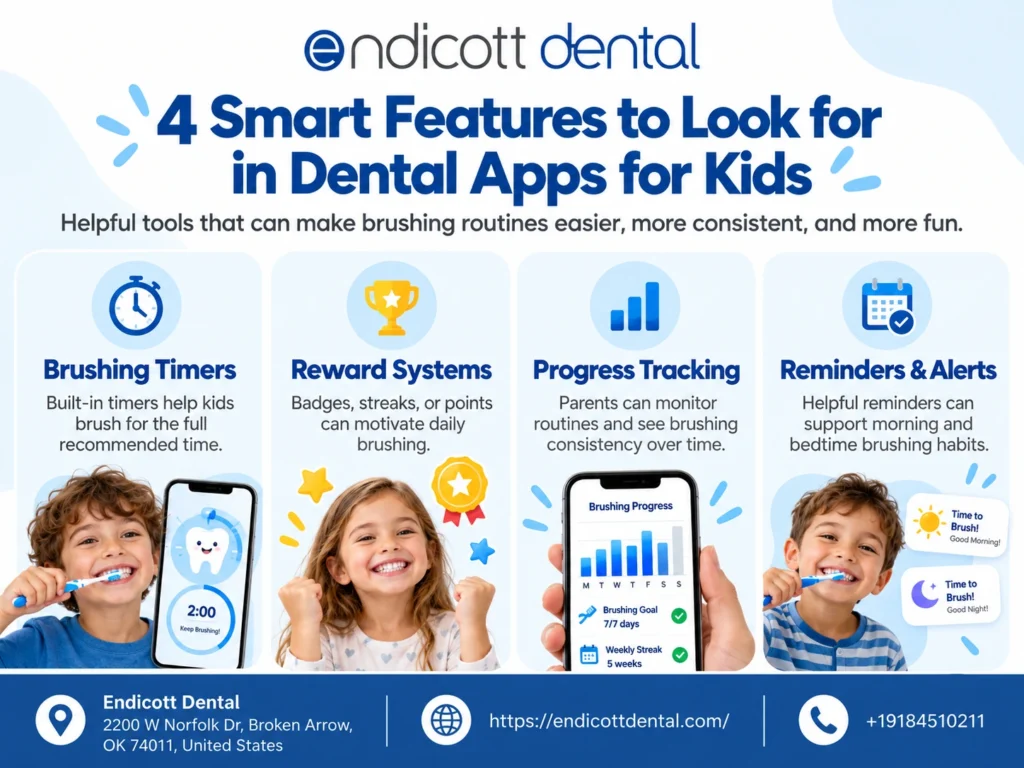
Depending on the app, it may provide:
- A two-minute timer
- Visual brushing instructions
- Morning and evening reminders
- Rewards
- Streak tracking
- Calendars
- Parent reports
- Multiple child profiles
- Brushing history
The American Dental Association recommends brushing for two minutes twice daily with fluoride toothpaste. For young children, caregivers should continue helping or supervising until the child has developed adequate brushing skills.
The best app is therefore not necessarily the one with the most animations. It is the one that helps your child consistently reach that basic goal.
1. Philips Sonicare for Kids
Best for Parents Who Want Detailed Brushing Tracking
If the main reason you want an app is to actually track your child's brushing habits, Philips Sonicare for Kids offers one of the strongest feature sets.
The app uses a character called Sparkly to guide children through brushing while providing coaching, rewards, and challenges.
When paired with a compatible Bluetooth-connected Philips Sonicare for Kids toothbrush, the system can automatically record brushing activity. Philips says the toothbrush can store data for up to 20 brushing sessions before syncing with the app.
For parents, the standout feature is the Parent Dashboard.
The current app allows parents to:
- Track brushing progress
- Review brushing habits
- Monitor more than one child
- Provide rewards or credits
- Preserve brushing history
- Follow twice-daily brushing streaks
The app was still actively maintained in 2026, with its Google Play listing showing an update on June 25, 2026.
How Does It Motivate Children?
The app turns brushing into a relationship with Sparkly.
Children can earn rewards after completing brushing sessions and use those rewards to feed, dress, and interact with the character.
More importantly, the app coaches children about where to brush, not simply how long to keep the toothbrush running.
That distinction matters.
A child can technically brush for two minutes while repeatedly cleaning only the front teeth. A guided app can help teach them to move systematically around the mouth.
Philips also uses a gradual KidTimer function that builds brushing duration toward two minutes instead of expecting very young users to immediately tolerate the full routine.
Is There a Downside?
To get the most useful automatic tracking features, families need a compatible Sonicare for Kids connected toothbrush.
That means this option requires more than simply downloading a free app.
If your child already has a toothbrush they like, buying a connected brush purely for app tracking may not be necessary.
Endicott Dental's practical view is similar when it comes to electric toothbrushes generally: app tracking can be helpful, but features such as proper brushing duration, technique, supervision, and consistent use matter more than having Bluetooth.
Best For
Philips Sonicare for Kids may be a particularly good fit for:
- Parents who want measurable brushing history
- Children who respond well to rewards
- Families with multiple children
- Kids learning how to brush each area of the mouth
- Parents already considering an electric toothbrush
2. Disney Magic Timer by Oral-B
Best for Kids Motivated by Familiar Characters
If asking your child to brush produces an immediate negotiation, Disney Magic Timer may make the routine easier.
The app uses characters from Disney, Pixar, Marvel, and Star Wars to keep children engaged throughout brushing.
Current versions include characters from franchises such as:
- Mickey and Minnie Mouse
- Frozen
- Disney Princesses
- Marvel
- Star Wars
- Toy Story
- The Lion King
- Cars
The app rewards completed sessions by unlocking characters, stickers, and interactive content.
That makes it especially useful for younger children who may not care about a numerical brushing score but absolutely care about unlocking a favorite character.
Can Parents Track Brushing With Disney Magic Timer?
Yes.
This is one reason Disney Magic Timer makes this list rather than being treated as just another toothbrush timer.
The current version includes a Brushing Progress Chart and Report Card so parents can review their child's brushing habits.
Oral-B also describes a brushing calendar and parent portal that can be used to track progress and reinforce the routine.
That means parents can use the app for both motivation and accountability.
Instead of asking:
“Did you brush?”
they can build a visible pattern of completed sessions.
Does It Require an Oral-B Electric Toothbrush?
Not necessarily.
The app uses compatible Crest or Oral-B Kids products to unlock character content through the device camera, but the core idea is not limited to monitoring a Bluetooth electric toothbrush.
That can make it more accessible to families who want an app experience without investing in a connected brush.
Best For
Disney Magic Timer may work especially well for:
- Preschool and elementary-age children
- Disney, Marvel, Pixar, or Star Wars fans
- Kids who resist brushing because it feels boring
- Parents who want a visible brushing chart
- Families looking for motivation without a sophisticated smart toothbrush
3. Pokémon Smile
Best Free Gamified Option Without Special Toothbrush Hardware
Pokémon Smile approaches toothbrushing as a game.
While brushing, children work to defeat fictional cavity-causing bacteria and rescue Pokémon. Successful brushing gives them opportunities to catch characters, fill their Pokédex, collect decorative caps, and earn brushing awards.
For a child already interested in Pokémon, that can turn brushing from something a parent demands into something the child actively wants to start.
The app remained active in 2026, with its Google Play listing showing an update on March 15, 2026.
What Does Pokémon Smile Track?
Pokémon Smile is not as parent-dashboard-focused as Sonicare for Kids, but it still includes useful habit-building tools.
Parents can set up to three daily brushing reminders, while children can earn brushing awards based on regular use.
The current app also supports up to three separate user profiles, allowing siblings to maintain their own progress.
Parents can choose brushing sessions of:
- One minute
- Two minutes
- Three minutes
For most children who are old enough to brush normally, the standard dental recommendation remains two minutes.
The app also visually guides users through different areas of the mouth instead of operating as a simple countdown timer.
One Important Limitation
The developer explicitly states that Pokémon Smile is not designed to prevent or treat cavities and does not guarantee that a child will develop a brushing habit. It also recommends that parents or guardians remain present while younger children use the app for toothbrushing.
We agree with that distinction.
The game can motivate brushing.
It cannot tell whether your child has removed plaque effectively, whether a cavity is developing, or whether the child needs professional dental care.
Best For
Pokémon Smile may be particularly useful for:
- Pokémon fans
- Younger children who respond to collecting games
- Families that do not want to buy a smart toothbrush
- Siblings who need separate profiles
- Children who need reminders to begin brushing
- Kids who struggle to remain engaged for two minutes
Which Kids' Brushing App Is Best?
The best choice depends on what problem you are actually trying to solve.
| App | Best For | Parent Tracking | Special Brush Needed? | Main Motivation |
| Philips Sonicare for Kids | Detailed habit monitoring | Strong Parent Dashboard | For full tracking features | Sparkly, rewards, streaks |
| Disney Magic Timer | Reluctant younger brushers | Progress chart and report card | No connected brush required for basic use | Disney/Marvel/Star Wars rewards |
| Pokémon Smile | Free gamified brushing | Basic habit/progress features | No | Catching Pokémon and awards |
Parents who want the most detailed automatic tracking may prefer Sonicare.
Children who are strongly motivated by favorite characters may respond better to Disney Magic Timer.
Pokémon Smile is particularly attractive for families looking for a free motivational tool that does not depend on buying connected hardware.
What About Brush DJ?
Brush DJ is another option worth knowing about, particularly for an older child who has grown out of cartoon brushing games.
Instead of characters, Brush DJ plays two minutes of music from the user's device.
It also lets users set reminders for:
- Twice-daily brushing
- Flossing
- Mouthrinse
- Dental appointments
- Hygienist appointments
- Orthodontic appointments
The app states that its age-specific oral-health information is based on NHS guidance.
However, Brush DJ is more of a timer and reminder system than a detailed parent brushing tracker.
For that reason, we would view it as a useful alternative rather than one of our top three choices specifically for parents who want to monitor habits.
Can a Brushing App Tell Whether Your Child Is Brushing Properly?
Not completely.
Even sophisticated connected toothbrushes have limitations.
A recorded two-minute session does not automatically prove that:
- Every tooth surface was cleaned
- Enough fluoride toothpaste was used
- The gumline was brushed adequately
- Pressure was appropriate
- The child cleaned between the teeth
- Plaque was actually removed
Apps can improve structure and consistency.
Parents still need to look at how the child is brushing.
This is especially important with younger children.
The CDC advises parents to help children brush until they have developed good brushing skills and specifically recommends supervising children younger than six while they brush.
How Long Should Children Brush Their Teeth?
For most children, the target is two minutes twice a day.
The ADA recommends using a soft-bristled toothbrush and fluoride toothpaste.
That is why a good brushing app usually includes either a two-minute timer or a guided routine that works toward two minutes.
But the goal is not merely to keep the toothbrush in the mouth for 120 seconds.
Children should learn to brush:
- Outer surfaces
- Inner surfaces
- Chewing surfaces
- Around the gumline
- Upper teeth
- Lower teeth
The app should eventually teach a routine that the child can repeat even when the phone is no longer present.
How Much Toothpaste Should a Child Use?
Apps usually focus on brushing time, but the amount of toothpaste matters too.
The ADA recommends a smear roughly the size of a grain of rice for children younger than three and a pea-sized amount for children from three to six years old. Caregivers should supervise brushing and teach children to spit out excess toothpaste rather than swallow it.
Using more toothpaste does not make brushing more effective.
For young children, appropriate amounts matter.
Should Parents Reward Children for Brushing?
Rewards can be useful when they reinforce the habit rather than turn brushing into a permanent negotiation.
Apps work well because the reward typically occurs immediately after the desired behavior.
Your child brushes, then:
- Unlocks a character
- Earns a sticker
- Extends a streak
- Receives an award
- Collects an item
That immediate feedback is often easier for younger children to understand than saying:
“You will appreciate healthy teeth when you're 40.”
Parents can build on the app by using simple non-food rewards such as:
- Choosing the bedtime story
- Picking tomorrow's breakfast
- Choosing a family activity
- Adding a sticker to a physical calendar
- Extra story time
Eventually, the external reward should become less important as brushing becomes automatic.
Should Children Use a Phone Every Time They Brush?
Not necessarily forever.
If an app solves the current problem, it can be valuable.
But the eventual goal should be a child who understands:
Morning + bedtime = brush teeth.
The app should support the habit rather than become a permanent requirement.
One approach is to use the app consistently for several weeks and then gradually introduce occasional app-free brushing.
Ask the child to follow the same sequence independently.
If they can maintain two minutes and cover all areas of the mouth, the app has done its job.
What If Your Child Still Refuses to Brush?
An app is not going to solve every brushing battle.
If brushing consistently causes distress, try identifying the specific reason.
Your child may dislike:
- Toothpaste flavor
- Foaming toothpaste
- The feeling of an electric toothbrush
- A brush head that is too large
- Strong vibration
- Cold water
- Someone brushing for them
- Certain textures
- The bedtime transition itself
Sometimes changing the toothbrush or toothpaste helps more than downloading another app.
Other times, children simply need a predictable routine.
Brush in the same place, at roughly the same times, using the same steps every day.
When Should Parents Stop Helping With Brushing?
There is no magic birthday when every child suddenly develops perfect brushing ability.
Coordination and maturity differ.
A child may be perfectly capable of dressing independently but still struggle to maneuver a toothbrush around the back molars.
The ADA advises caregivers to assist or supervise children until they can appropriately manage brushing and spit out excess toothpaste.
For many families, responsibility can gradually shift.
The child brushes first.
The parent checks.
If necessary, the parent finishes areas the child missed.
Over time, the checking becomes less necessary.
Can Brushing Apps Prevent Cavities?
No app can guarantee cavity prevention.
Cavity risk also depends on factors such as:
- Fluoride exposure
- Diet
- Frequency of sugary snacks and drinks
- Plaque removal
- Tooth anatomy
- Saliva
- Existing dental conditions
- Sealants
- Regular dental care
A brushing app only influences part of that equation.
That said, improving twice-daily brushing is valuable because brushing with fluoride toothpaste is one of the basic measures recommended for reducing tooth-decay risk.
When Should Your Child See the Dentist?
Good app data does not replace dental exams.
A brushing streak may show that a child picked up the toothbrush twice a day. It cannot show parents what is happening between the teeth or inside the grooves of back molars.
Professional dental visits allow the dentist to check for:
- Early cavities
- Plaque buildup
- Gum inflammation
- Tooth-development concerns
- Bite problems
- Areas the child repeatedly misses
- Whether fluoride or sealants may be appropriate
Endicott Dental provides preventive and family dentistry for children, teenagers, and adults in Broken Arrow, including cleanings, examinations, personalized fluoride recommendations, and dental sealants when appropriate.
FAQs About Dental Apps for Kids
What is the best app for actually tracking a child's brushing?
Philips Sonicare for Kids provides one of the most detailed parent-focused tracking systems when paired with its connected toothbrush. Its Parent Dashboard records progress and can manage multiple children.
What is the best free toothbrushing game for kids?
Pokémon Smile is a strong option because it provides brushing guidance, reminders, rewards, multiple profiles, and collecting mechanics without requiring a special connected toothbrush.
Is Disney Magic Timer still available?
Yes. As of September 2026, Disney Magic Timer by Oral-B remains available, and its current version includes brushing progress charts, report cards, rewards, and character-based content.
How long should my child brush?
The ADA recommends brushing for two minutes twice daily using fluoride toothpaste.
Should I let my young child brush alone if an app gives instructions?
Not necessarily. Young children still need adult assistance or supervision because an app cannot verify that every surface is actually being cleaned properly.
What if my child brushes every day but still gets cavities?
Brushing is only one part of cavity prevention. Diet, fluoride exposure, tooth anatomy, brushing technique, plaque between teeth, and individual risk all matter. A dental evaluation can help identify what is contributing to repeated decay.
Turn the App Into a Habit, Not Just Another Game
Brushing apps can make a surprisingly big difference for children who rush, forget, or simply find oral hygiene boring.
For parents who want detailed brushing tracking, Philips Sonicare for Kids offers the strongest monitoring features of these three. Disney Magic Timer can be especially useful when favorite characters are the motivation a reluctant brusher needs. Pokémon Smile offers a fun, accessible option for children who enjoy collecting and gaming.
But whichever app your family chooses, remember what success actually looks like.
Two minutes. Twice a day. Fluoride toothpaste. Thorough brushing. Adult supervision while your child still needs it.
At Endicott Dental, we help Broken Arrow families turn those everyday habits into healthier smiles. Our team provides preventive dental exams, professional cleanings, fluoride recommendations, sealants, and practical home-care guidance tailored to children at different ages.
