

Table of Contents
If you are a parent in Broken Arrow and you suspect your teenager may be vaping, you may be looking for obvious evidence: a device in a backpack, a sweet smell in their room, or a sudden change in behavior.
But sometimes the first clues show up somewhere else.
Their mouths.
Persistent dry mouth. Gums that look irritated or bleed more easily. New cavities in a teenager who previously had very few. Mouth sores. Bad breath that does not improve with brushing. Complaints that food tastes different. Increased sensitivity.
None of these signs proves that a teenager is vaping. Each can have other explanations, and parents should be careful not to turn a dental symptom into an accusation.
But they are worth paying attention to.
That is especially true in Oklahoma.
According to the 2023 Oklahoma Youth Risk Behavior Survey, 21.8% of Oklahoma public high school students reported using an electronic vapor product during the previous 30 days, and 46% reported having used one at some point in their lives.
So when we talk about vaping and teenagers, we are not discussing a rare problem happening somewhere else.
It is already part of the health conversation for Oklahoma families.
At Endicott Dental, our role is not to interrogate teenagers or lecture parents. It is to look at what is happening in the mouth, explain what we see, treat problems that need treatment, and help families understand what could be contributing to them.
Here is what parents and teens should know about vaping and oral health.
What Does Vaping Actually Do to a Teenager's Mouth?
The short answer is that vaping repeatedly exposes the mouth to heated aerosol-containing substances that can irritate oral tissues and potentially change the environment around the teeth and gums.
One misconception we hear is that vaping is essentially inhaling flavored water vapor.
It is not.
The CDC states that e-cigarette aerosols can contain nicotine, cancer-causing chemicals, volatile organic compounds, tiny particles, and metals including nickel, tin, and lead. Most e-cigarettes contain nicotine, although product contents vary.
And before that aerosol reaches the lungs, it passes directly through the mouth.
That means the gums, tongue, cheeks, teeth, saliva, and other oral tissues are repeatedly exposed.
The FDA says people who use e-cigarettes have reported oral symptoms including:
- Dryness
- Burning
- Irritation
- Bad taste
- Bad breath
- Oral pain or discomfort
The FDA also notes that aerosol residue can collect on oral surfaces and may encourage bacterial adhesion, potentially contributing to tooth decay and other oral problems.
Research specifically involving teenagers and young adults is still developing. A 2026 systematic review found associations between vaping and increased cavity risk, gingival inflammation, changes in saliva, altered oral bacteria, and changes in oral tissues. However, the authors rated the overall certainty of the available evidence as low and emphasized that current research cannot prove that vaping alone caused every observed problem.
That distinction matters.
We have enough evidence to take vaping seriously.
We do not have enough evidence to blame every cavity, gum problem, or mouth sore in a teen on vaping.
What Are the Most Common Oral Warning Signs Parents Should Watch For?
There is no single "vaper's mouth" that lets a dentist or parent look at a teenager and know with certainty that they use an e-cigarette.
Instead, we look for patterns.
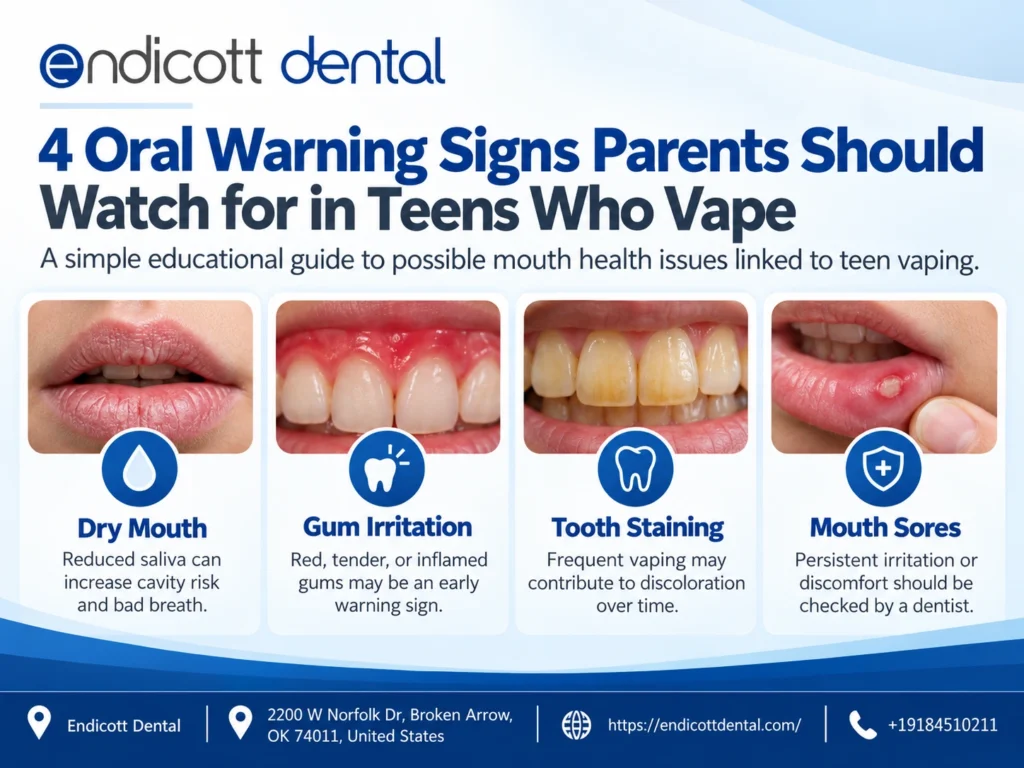
1. Persistent Dry Mouth
Dry mouth is one of the more commonly reported oral complaints among people who vape.
A teenager may describe:
- Always needing water
- Waking up with an unusually dry mouth
- A sticky feeling inside the mouth
- Difficulty swallowing dry foods
- Dry or cracked lips
- A burning feeling on the tongue
- More bad breath than usual
Why does this matter?
Saliva does much more than keep your mouth comfortable.
It helps wash food particles away, control microorganisms, neutralize acids, and supply minerals that help protect tooth enamel.
The National Institute of Dental and Craniofacial Research explains that persistent dry mouth can increase a person's risk for tooth decay and oral infections because the protective effects of saliva are reduced.
Dry mouth can also come from dehydration, medications, anxiety, mouth breathing, certain medical conditions, caffeine, and other factors.
So dry mouth alone does not mean your teenager is vaping.
But persistent dry mouth deserves an explanation.
2. Red, Puffy, Tender, or Bleeding Gums
Healthy gums generally should not be chronically swollen, sore, or bleeding.
Bleeding occasionally after suddenly starting to floss again is one thing.
Gums that repeatedly bleed, appear red or puffy, or feel tender deserve a closer look.
Research involving e-cigarette users has identified associations between vaping and gingival inflammation and other periodontal changes, although the strength of the evidence varies between studies.
That does not mean vaping is always the cause.
In teenagers, irritated gums are also commonly related to:
- Plaque buildup
- Inconsistent brushing
- Not flossing
- Braces or orthodontic appliances
- Hormonal changes
- Mouth breathing
- Certain medications
If we see inflamed gums during an examination, our first job is to determine what factors are contributing.
Vaping should simply be part of that conversation when it is relevant.
3. An Increase in Cavities or Early Enamel Damage
A teenager who suddenly develops several areas of decay after years of relatively stable dental health deserves a closer look at what changed.
Sometimes the answer is obvious.
More soda.
Energy drinks.
Frequent sports drinks.
Late-night snacking.
Poorer brushing habits.
Orthodontic treatment that makes cleaning more difficult.
Sometimes there may be another factor, including dry mouth or vaping.
Recent reviews of studies involving young people have found associations between e-cigarette use and dental caries, although researchers continue to emphasize that diet, hygiene, tobacco use, and other behaviors can make it difficult to determine exactly how much of the risk comes from vaping itself.
From a dental standpoint, we are less interested in assigning blame than understanding the environment around the tooth.
If a teen's mouth is becoming drier, plaque is increasing, brushing has fallen off, and sugary or acidic drinks are being consumed frequently, the cavity risk can add up quickly.
4. Frequent Mouth Sores or Areas of Irritation
A single canker sore is common.
Repeated irritation is different.
Young people who use e-cigarettes have reported oral ulcers, mucosal discomfort, and other changes to the tissues inside the mouth in published studies.
Watch for:
- Sores that keep returning
- Red or irritated patches
- Burning sensations
- Tender areas along the cheeks or gums
- Cracked corners of the mouth
- Tongue irritation
- A sore that does not heal normally
Again, there are many possible causes.
A sharp tooth, braces, cheek biting, stress, nutritional deficiencies, viral infections, and other conditions can all produce mouth sores.
But any oral sore that persists for roughly two weeks without healing should be evaluated rather than ignored.
5. Bad Breath That Keeps Coming Back
Teenagers get bad breath.
Adults do too.
One morning of bad breath is not a medical mystery.
Persistent bad breath is different.
Dry mouth, bacterial buildup, gum inflammation, cavities, tongue coating, tonsil issues, certain foods, and vaping may all contribute.
The FDA includes bad breath and bad taste among reported oral complaints related to e-cigarette exposure.
If brushing, flossing, tongue cleaning, and drinking water do not improve the problem, a dental examination can help determine what is going on.
6. Changes in Taste
Some vape users report changes in taste or an unpleasant taste in the mouth.
That can show up as a teenager saying:
- Food tastes "off"
- Their mouth tastes bitter
- Their favorite foods suddenly seem different
- They constantly want gum or mints
Taste changes are not specific to vaping. Illness, medication, sinus problems, dry mouth, infections, and other conditions can alter taste.
But if vaping is occurring, it becomes one possible piece of the puzzle.
7. Increased Tooth Sensitivity
Sensitivity to cold drinks, sweets, or brushing can occur for many reasons.
Possible explanations include:
- Cavities
- Enamel erosion
- Gum recession
- Grinding or clenching
- Cracks
- Recent dental treatment
- Aggressive brushing
Vaping should not automatically be blamed for sensitivity.
But if we find sensitivity together with dry mouth, plaque accumulation, new decay, or irritated gum tissue, it makes sense to discuss all of the teen's habits—including vaping.
Can a Dentist Tell if My Teen Is Vaping?
Sometimes we can see changes that make us ask the question.
We cannot look inside someone's mouth and determine with certainty that they vape.
That is important for parents to understand.
Dentists are trained to recognize disease and risk factors, not to perform a "vape test."
If a teenager has dry mouth, several new cavities, irritated gums, recurrent sores, and significant plaque buildup, vaping may be one possible contributing factor.
But so might medication, diet, dehydration, orthodontics, oral hygiene, or another medical issue.
That is why an honest health history matters.
If a dentist asks whether your teenager vapes, uses nicotine, drinks energy drinks, smokes, or uses other substances, the purpose should not be punishment.
The answer may change how we understand what is happening in the mouth.
Why Are Oklahoma Parents Hearing So Much About Teen Vaping?
Because even though youth cigarette smoking has fallen dramatically, vaping remains common.
In 2023, 54% of Oklahoma public high school students reported never having vaped, which is encouraging. At the same time, nearly 22% reported using an electronic vapor product during the previous 30 days.
Both facts can be true.
Most Oklahoma high school students were not current users.
But enough were vaping that parents, dentists, pediatricians, schools, and coaches cannot reasonably ignore it.
There is another reason vaping can be difficult for parents to spot.
Modern e-cigarettes can be small and discreet. The CDC notes that devices may resemble pens, USB drives, toys, and other everyday objects. They also do not necessarily produce the lingering smell associated with traditional cigarettes.
That makes vaping relatively easy to hide.
Isn't Vaping Better Than Smoking Cigarettes?
This question needs context.
For an adult who already smokes combustible cigarettes, completely switching away from cigarettes may reduce exposure to many of the toxic chemicals found in cigarette smoke. That is part of why discussions about vaping in adult smokers can be complicated.
That is not the same situation as a teenager who does not smoke cigarettes starting to vape.
The CDC specifically states that e-cigarettes should not be used by youth or young adults.
So when a teenager says, "At least I'm not smoking," the useful response is not to argue that vaping and cigarettes are identical.
They are not.
The better response is:
You do not need cigarettes to make vaping a bad trade for your health.
For a teenager who otherwise would not use nicotine, there is no health advantage to becoming dependent on a vape.
Why Is Nicotine a Bigger Concern for Teens?
Oral damage is only part of this conversation.
Most e-cigarettes contain nicotine, and adolescents are particularly vulnerable to nicotine dependence.
According to the CDC, brain development continues until around age 25. Nicotine exposure during adolescence can affect areas involved with attention, learning, mood, and impulse control. Young people can also begin showing signs of nicotine addiction relatively quickly, even before use becomes daily.
Signs of dependence can include:
- Strong cravings
- Feeling like vaping is necessary just to feel normal
- Difficulty going through school or activities without vaping
- Using more frequently over time
- Becoming irritable when unable to vape
- Trouble concentrating when trying to stop
- Continuing despite wanting to quit
This is why "Just stop doing it" is often not useful advice.
Once nicotine dependence develops, quitting may require planning and support.
Are Flavored Vapes Easier on the Teeth?
Do not assume a product is safe for the mouth because it tastes like fruit, mint, candy, or dessert.
Flavoring does not cancel out exposure.
The FDA notes that flavored and sweet e-liquids may contribute to conditions that allow bacteria to adhere to oral surfaces.
More importantly, "tastes good" and "safe for oral tissues and lungs" are completely different standards.
Something that is safe to consume as food is not automatically safe to heat, aerosolize, inhale, and repeatedly expose to the mouth and lungs.
Does Vaping Cause Gum Disease?
We need to be precise here.
Research increasingly suggests an association between e-cigarette use and poorer periodontal health.
That does not mean we can say vaping is guaranteed to cause gum disease in every user.
A 2026 review found that cross-sectional studies generally showed poorer periodontal findings among e-cigarette users than never-users, while also noting inconsistencies in the evidence and a continued shortage of strong long-term studies.
That is a much more accurate answer than saying either:
"Vaping definitely destroys your gums."
or:
"There is no proof, so it does not matter."
The evidence is concerning enough that we should not dismiss the risk, while the science is still developing.
Does Vaping Cause Oral Cancer?
We would not tell a teenager or parent that vaping has been proven to cause oral cancer in teens.
Current research has identified potentially harmful chemicals and cellular changes associated with e-cigarette exposure, but vaping products have not existed long enough for researchers to have the same decades of long-term cancer data that exist for combustible tobacco.
The CDC also notes that scientists are still learning about the long-term health effects of e-cigarette use.
That uncertainty should not be interpreted as proof of safety.
It simply means the responsible answer is:
We do not yet know the full long-term oral consequences of repeated vaping exposure.
What If My Teen Only Vapes Occasionally?
Occasional use is not the same as heavy daily use.
But "only sometimes" deserves more discussion than it usually gets.
Teenagers can develop nicotine dependence surprisingly quickly. The CDC notes that young people may begin showing signs of addiction even before regular or daily vaping begins.
There is also a practical question:
Is "once in a while" staying once in a while?
If usage is becoming more frequent, happening first thing in the morning, occurring during school, or becoming difficult to stop, those are more concerning signs than experimentation that truly stopped.
The goal should not be to win an argument over terminology.
The goal should be to understand what is actually happening.
What Should Parents Do if They Suspect Their Teen Is Vaping?
Start with a conversation rather than a prosecution.
A teenager who expects punishment may become better at hiding the behavior.
That does not mean parents should ignore it or pretend vaping is harmless.
It means useful questions are often more effective than accusations.
Ask:
- How often are you vaping?
- Does the vape contain nicotine?
- When did you start?
- Are your friends using it too?
- Have you tried stopping?
- What happens when you cannot vape?
- Do you feel like you need it when you are stressed?
- Is there anything making you want to quit?
Then listen.
You may learn that it happened twice at a party.
You may learn your teenager is vaping multiple times every school day.
Those are very different situations.
Should I Bring My Teen to the Dentist if I Find Out They Vape?
Yes, particularly if it has been a while since their last examination or they are experiencing oral symptoms.
This does not mean they automatically need extensive treatment.
A dental visit can help establish where things currently stand.
We can evaluate:
- Tooth decay
- Early enamel changes
- Gum inflammation
- Plaque and tartar buildup
- Dry-mouth symptoms
- Oral sores
- Changes to the tongue or soft tissues
- Areas that are not healing normally
- Oral hygiene concerns
Sometimes the result may be reassuring.
Perhaps there is no permanent damage, and what the teenager needs most is better hygiene, hydration, fluoride exposure, and help stopping the vape.
Other times we may find a cavity, gingivitis, or another problem that should be treated before it becomes more serious.
Finding a problem early generally gives us more options.
Can Oral Damage From Vaping Be Reversed?
Some problems can improve.
Others cannot simply be undone.
Gum Inflammation May Improve
Early gingivitis is often reversible when the causes are addressed and plaque is brought under control.
That may involve:
- Professional cleaning
- Better brushing
- Daily interdental cleaning
- Removing contributing irritants
- Stopping vaping
- Regular follow-up care
Dry Mouth May Improve
If vaping is contributing to dryness, reducing or stopping the exposure may help.
But persistent dry mouth should still be evaluated because vaping is only one possible cause.
Early Enamel Damage May Sometimes Be Managed
Very early demineralization may sometimes be stabilized with improved hygiene, fluoride, dietary changes, and better control of risk factors.
A True Cavity Does Not Disappear Because You Quit
Once decay has created a physical cavity in the tooth, quitting vaping is still valuable—but the tooth may still require dental treatment.
Stopping the behavior prevents continued exposure.
It does not rebuild missing tooth structure.
That is why prevention and early detection matter.
What Can a Teen Do Right Now to Reduce Oral Damage?
The best step is to stop vaping.
While working toward that, do not use good dental habits as an excuse to continue.
Brushing does not make vaping harmless.
But protecting the mouth still matters.
A teen who has been vaping should:
- Brush twice daily with fluoride toothpaste.
- Clean between the teeth every day.
- Drink water regularly.
- Limit frequent sugary and acidic drinks.
- Avoid constantly sucking on sugary candy for dry mouth.
- Use sugar-free gum if appropriate to stimulate saliva.
- Keep regular dental visits.
- Tell the dentist about persistent sores, dryness, bleeding, or sensitivity.
- Get help quitting nicotine rather than assuming willpower is the only option.
The National Institute of Dental and Craniofacial Research recommends water, good oral hygiene, regular dental visits, and avoiding tobacco as important strategies for patients dealing with dry mouth.
Where Can Oklahoma Teens Get Help Quitting Vaping?
This is one of the most important parts of the article.
Finding out your teenager is addicted to nicotine does not mean your family has to figure out quitting alone.
Oklahoma teens ages 13–17 can access My Life, My Quit, a free and confidential program that offers one-on-one support by text, web chat, and phone. Teens can text "Start My Quit" to 36072 to connect with the program.
For adults and older teens who qualify, the Oklahoma Tobacco Helpline also provides free quit support. As of July 2026, Oklahomans can contact 1-800-QUIT-NOW or text READY to 21586 for enrollment information.
For minors, medication or nicotine-replacement decisions should be discussed with an appropriate healthcare professional rather than started casually without guidance.
Quitting nicotine may take more than one attempt.
That does not mean the attempt failed.
It means nicotine is addictive.
When Should an Oral Problem Be Checked Quickly?
Do not wait for the next six-month cleaning if your teenager has:
- Significant facial or gum swelling
- Severe tooth pain
- A tooth that feels loose without an injury
- Persistent unexplained bleeding
- A mouth sore that does not heal
- Increasing facial pain
- Difficulty opening the mouth
- Pus or signs of infection
- Fever with dental swelling
- Difficulty swallowing
And if vaping is followed by severe breathing problems, chest pain, loss of consciousness, or another serious medical symptom, that is not simply a dental issue. Seek appropriate emergency medical care.
What Should Parents Avoid Doing?
Do Not Assume Every Dental Problem Means Your Teen Is Vaping
A cavity is not proof.
Dry mouth is not proof.
Bleeding gums are not proof.
Ask questions and look at the entire situation.
Do Not Shame Them During the Dental Appointment
If a teenager believes honesty will immediately lead to humiliation, they may stop being honest.
That makes healthcare harder.
Do Not Minimize It Either
"Everybody does it" is not an accurate reason to ignore nicotine exposure.
In fact, the 2023 Oklahoma data showed that the majority of public high school students were not current vape users.
Vaping may be common.
That does not make it harmless or inevitable.
Do Not Wait for Major Damage
You do not need to wait until your teenager has several cavities, severe gum inflammation, or chronic mouth pain before asking for help.
Prevention is easier than repairing damage after it progresses.
How Should Teens Think About Vaping and Their Teeth?
If you are a teenager reading this rather than a parent, here is the part we would want you to hear.
We are not going to tell you that one hit from a vape means your teeth are ruined.
That is not true.
We are not going to tell you every person who vapes develops gum disease.
That is not true either.
But vaping is also not just flavored air.
Your mouth is the first part of your body exposed to that aerosol.
If you are noticing that your mouth is constantly dry, your gums bleed, your breath has changed, you are developing cavities, or you keep getting irritation, those symptoms deserve attention.
And if you have tried to quit but keep going back, that does not mean you lack discipline.
Nicotine is highly addictive.
Getting help is more useful than pretending you are not dependent.
What Will We Do if You Tell Us You Vape?
Our first response should not be:
"How could you do that?"
It should be:
"Okay. Let's look at what's happening."
At Endicott Dental, knowing about vaping gives us useful information.
It may affect the questions we ask about:
- Dry mouth
- Gum inflammation
- New cavities
- Oral hygiene
- Diet
- Healing
- Mouth sores
- Nicotine dependence
Our responsibility is to give you accurate information and help protect your oral health.
You should not have to hide a health habit from your healthcare provider because you are afraid of a lecture.
Honesty gives us a better chance of helping.
A Dental Visit Can Be a Better Starting Point Than a Lecture
For some families, vaping becomes a battle.
Parents are angry.
The teenager gets defensive.
Everyone has already heard a dozen warnings.
Sometimes looking at what is actually happening in the mouth creates a more productive conversation.
A photograph of irritated gums is real.
A new cavity is real.
Visible plaque is real.
Dry mouth symptoms are real.
Instead of arguing abstractly about whether vaping is "that bad," we can talk about the teenager sitting in front of us.
What do their teeth look like?
What do their gums look like?
What needs treatment?
What is still healthy?
What can we protect?
That is a much more useful conversation.
Let Endicott Dental Help You Start With Facts, Not Fear
If you are a parent in Broken Arrow and you recently discovered that your teenager is vaping, you do not need to arrive at the dentist already knowing how much damage has occurred.
That is what the examination is for.
At Endicott Dental, we can evaluate your teen's teeth, gums, saliva-related symptoms, and oral tissues and explain what we actually see.
If everything looks healthy, we will tell you.
If there are early problems that can be corrected with better prevention, we will explain that too.
And if something needs treatment, we can discuss the options without turning the appointment into a punishment.
Our goal is straightforward:
Find problems early, protect healthy teeth, give your teenager accurate information, and help your family understand what should happen next.
If your teen has been vaping and you are concerned about dry mouth, bleeding gums, new cavities, mouth sores, or another oral change, Endicott Dental can help you get a clearer picture before the problem becomes harder to manage.
Frequently Asked Questions About Teen Vaping and Oral Health
Can vaping cause cavities in teenagers?
Research has found an association between vaping and increased cavity risk in adolescents and young adults, but current studies cannot prove that vaping alone causes every cavity. Dry mouth, diet, plaque, oral hygiene, fluoride exposure, and other factors also affect decay risk.
Does vaping make your gums bleed?
Vaping has been associated with gingival inflammation and other changes in periodontal health. However, bleeding gums can also result from plaque buildup, gingivitis, braces, hormonal changes, and poor flossing habits. Persistent bleeding should be evaluated rather than automatically blamed on vaping.
Why does vaping make my mouth feel dry?
Dry mouth is commonly reported by vape users. Reduced moisture matters because saliva helps wash the teeth, manage bacteria, neutralize acids, and protect against decay. Persistent dry mouth should be discussed with a dentist because many other conditions and medications can cause it as well.
Can a dentist know for sure if someone vapes?
No. A dentist may see oral findings that are consistent with vaping exposure, but there is no unique dental sign that proves someone vapes. A truthful health history is more reliable than trying to diagnose vaping from the appearance of the mouth.
Does vaping stain teeth like cigarettes?
The effects of vaping and traditional smoking are not identical. Cigarette smoke is particularly well known for staining. Some research and clinical reports describe tooth or restoration discoloration among vape users, but staining should not be considered the main oral-health concern or a reliable way to identify vaping.
Can vaping cause mouth sores?
Studies involving young vape users have reported oral ulcers, irritation, and mucosal discomfort. However, mouth sores have many possible causes. A sore that does not heal normally should be professionally evaluated.
If a teen stops vaping, will their mouth heal?
Some conditions, such as early gum inflammation or dryness, may improve when contributing factors are removed and good dental care is restored. Existing cavities, broken teeth, or advanced disease may still require treatment. Quitting helps reduce continued exposure but does not automatically reverse established damage.
Is vaping nicotine-free e-liquid safe for teeth?
"Nicotine-free" does not automatically mean harmless to the mouth. E-cigarette aerosols can contain multiple substances besides nicotine, and product composition varies. Long-term effects are still being studied.
Is vaping safer than cigarettes for a teenager?
That is the wrong comparison for most teenagers. An adult cigarette smoker switching completely away from combustible cigarettes presents a different risk-benefit question. For a teenager who otherwise would not use tobacco or nicotine, public-health guidance recommends not starting e-cigarettes.
How common is teen vaping in Oklahoma?
In the 2023 Oklahoma Youth Risk Behavior Survey, 21.8% of public high school students reported using electronic vapor products during the previous 30 days, while 46% reported ever having used one.
Where can an Oklahoma teenager get help quitting vaping?
Oklahoma teens ages 13–17 can use My Life, My Quit, a free confidential service offering text, phone, and web-based support. Teens can text "Start My Quit" to 36072 or access the program online.
Should I schedule a dental visit immediately if I discover my teenager vapes?
It does not necessarily require an emergency appointment if your teen has no symptoms, but it is worth making sure they are current on preventive dental examinations. If they are experiencing pain, swelling, persistent sores, significant gum bleeding, new sensitivity, or other concerning changes, schedule an evaluation sooner.
