

Table of Contents
Nobody gets excited about scheduling a filling.
In fact, most people do the same mental calculation when a dentist tells them they have a cavity:
"It's not hurting yet. Maybe I can wait."
That's understandable.
Life gets busy. Budgets get tight. Dental treatment rarely feels urgent when there's no pain involved.
The problem is that cavities don't get better with time.
And what starts as a relatively simple, affordable repair can eventually turn into a much larger and much more expensive problem.
If you're debating whether to fix a cavity now or wait until it's causing trouble, here's what you should know.
Fast Answer
A small cavity that could be treated with a filling may cost a few hundred dollars or less depending on the tooth, insurance, and treatment needed.
If that cavity continues to grow, it can eventually lead to:
- A root canal
- A dental crown
- A dental infection
- An emergency visit
- Tooth extraction
- Tooth replacement
At that point, treatment costs can easily climb into the thousands.
The cheapest cavity is almost always the one you treat early.
What Actually Happens When You Ignore a Cavity?
Many people imagine a cavity as a hole that simply stays the same size until they decide to fix it.
That's not how tooth decay works.
A cavity is an active disease process.
The bacteria causing the decay continue breaking down the tooth structure day after day.
Think of it like a small leak in your roof.
You may not notice a problem immediately, but the damage continues even when you can't see it.
Over time, the cavity gets deeper and larger.
And as it grows, your treatment options become more complicated.
Stage 1: The Small Filling
This is the stage dentists love to find.
The decay is limited.
The tooth is still structurally strong.
The nerve is healthy.
Treatment is straightforward.
Typically:
- The decay is removed
- The tooth is cleaned
- A tooth-colored filling is placed
The appointment is usually quick, relatively comfortable, and significantly less expensive than major restorative treatment.
This is the moment when fixing the problem costs the least.
Stage 2: The Large Filling
If the cavity continues growing, more healthy tooth structure must be removed.
At this point:
- The filling becomes larger
- The tooth becomes weaker
- Future fracture risk increases
The cavity may still be treatable with a filling, but you're beginning to lose options.
The longer you wait, the more tooth structure is permanently lost.
Stage 3: The Crown
Eventually, decay can weaken so much of the tooth that a filling is no longer enough.
Now the tooth may need a crown.
A crown covers and protects the remaining tooth structure.
Crowns are excellent restorations when needed.
But they're also significantly more involved than a filling.
The process often requires:
- More extensive preparation
- Multiple steps
- Laboratory fabrication
- Greater overall investment
At this stage, you're no longer repairing a small problem.
You're rebuilding a damaged tooth.
Stage 4: The Root Canal
This is often the point where patients finally notice something is wrong.
The cavity reaches the nerve inside the tooth.
Symptoms may include:
- Sensitivity to hot or cold
- Lingering tooth pain
- Pain while chewing
- Spontaneous toothaches
- Swelling
Now the decay isn't just affecting the outside of the tooth.
It's affecting the living tissue inside.
To save the tooth, a root canal may be necessary.
Many patients fear root canals, but the reality is that the procedure itself is often far easier than the pain that led them there.
The bigger issue is cost.
A root canal combined with a crown is substantially more expensive than the filling that could have prevented it.
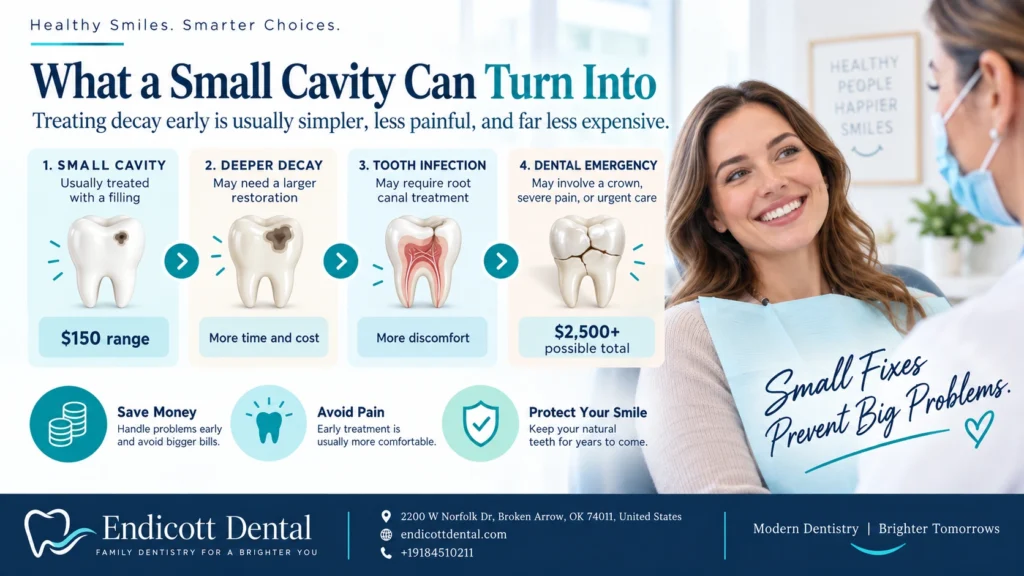
Stage 5: The Dental Emergency
This is where things get ugly.
When untreated decay causes a serious infection, patients often experience:
- Severe pain
- Facial swelling
- Difficulty eating
- Difficulty sleeping
- Missed work
- Emergency appointments
At this point, the decision is no longer whether to fix the cavity.
The decision becomes how to manage a dental crisis.
And emergencies are rarely the cheapest way to receive care.
Stage 6: Tooth Loss
In some cases, the tooth can no longer be saved.
The infection, decay, or structural damage is too extensive.
Now you're looking at:
- Extraction
- Bone loss
- Potential tooth replacement
Replacing a missing tooth may involve:
- A bridge
- A partial denture
- A dental implant
This is how a small untreated cavity can eventually become one of the most expensive dental problems a patient faces.
"But It Doesn't Hurt"
This is the most common reason people postpone treatment.
And unfortunately, it's one of the most dangerous assumptions.
Cavities often cause no symptoms in their early stages.
By the time pain develops, the decay may already be approaching the nerve.
Pain is not an early warning system.
It's often a late warning system.
When Waiting Might Be Reasonable
Let's be fair.
Not every area of concern requires immediate treatment.
Sometimes dentists monitor:
- Very early enamel changes
- Areas that are not actively progressing
- Situations where improved home care may help
A trustworthy dentist should explain:
- What they see
- Why treatment is recommended
- Whether monitoring is a reasonable option
- What risks come with waiting
Not every recommendation is an emergency.
But true cavities do not heal themselves.
The Real Cost Isn't Just Financial
When people think about delaying treatment, they usually focus on money.
But there are other costs too.
Consider:
- Time away from work
- Emergency appointments
- Lost sleep
- Pain medications
- Stress
- Family disruptions
- Missed school events
- Vacation interruptions
Many patients who experience a dental emergency say the inconvenience was worse than the actual treatment.
How to Know If a Filling Can Wait
Ask your dentist these questions:
Is this active decay?
An active cavity behaves differently than a stain or area being monitored.
How deep is the cavity?
The closer decay gets to the nerve, the greater the risk.
What happens if I wait six months?
A good dentist should be able to explain the likely consequences.
Is there any chance this can be reversed?
Very early enamel lesions sometimes can be managed differently than established cavities.
What signs should I watch for?
Understanding warning signs helps you make informed decisions.
The Bottom Line
Most people don't regret fixing a cavity early.
They regret waiting until it becomes painful, urgent, and expensive.
A filling may not feel exciting.
But compared to a root canal, crown, extraction, implant, or dental emergency, it's often one of the smartest investments you can make in your oral health.
The goal isn't to sell treatment.
The goal is to prevent a small, manageable problem from becoming a major one.
That's why dentists recommend treating cavities when they're small—not because they enjoy doing fillings, but because they've seen what happens when people wait too long.
FAQs
Can a cavity heal on its own?
Once a true cavity has formed in the tooth structure, it cannot heal itself. Early enamel changes may sometimes be managed before a cavity fully develops, but established decay requires treatment.
How long can I wait to fix a cavity?
That depends on the size, location, and progression of the decay. Some cavities worsen slowly, while others can advance surprisingly quickly.
Why doesn't my cavity hurt?
Many cavities are painless until they reach deeper layers of the tooth. The absence of pain does not mean the cavity is harmless.
Can a cavity become an emergency?
Yes. Untreated decay can eventually cause infection, swelling, severe pain, or tooth loss.
Is a filling always the best treatment?
Not always. Treatment depends on how much tooth structure has been damaged. Small cavities may need fillings, while larger ones may require crowns or other restorative procedures.
If you've been told you have a cavity and you're unsure whether treatment is necessary now or can safely wait, Dr. Drew Endicott and the team at Endicott Dental can help you understand your options. Sometimes a simple conversation today can prevent a much bigger problem tomorrow.
