

Table of Contents
Let's be honest.
One of the hardest things about bad breath is that you're usually the last person to know you have it.
Friends won't mention it.
Coworkers won't bring it up.
Family members often avoid the conversation.
And unfortunately, your nose gets used to your own breath, making it surprisingly difficult to judge accurately.
That's why many patients ask us:
"How can I tell if my breath smells bad?"
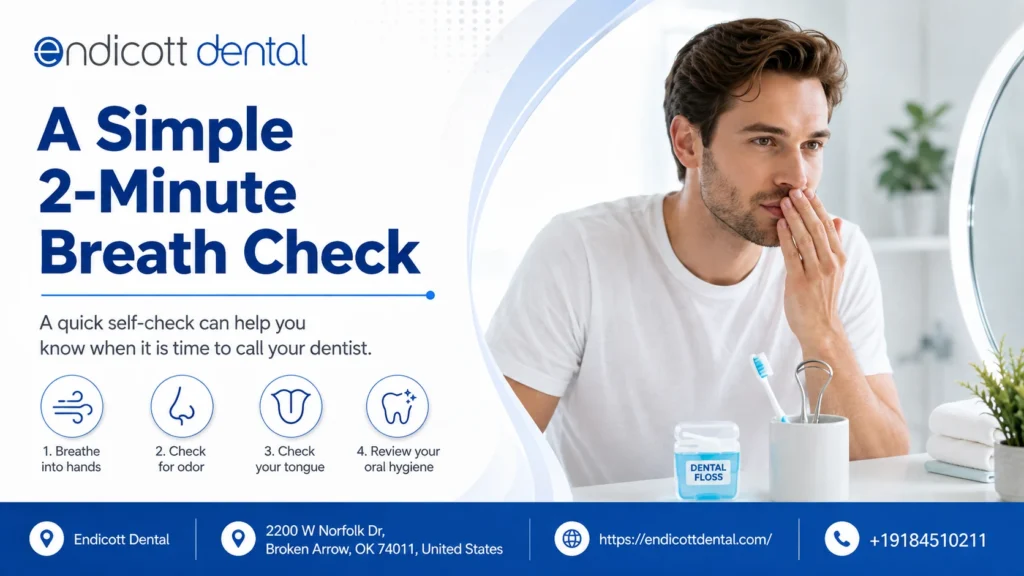
The good news is that there's a simple at-home test you can do in about two minutes.
And while it's not perfect, it's often surprisingly revealing.
Quick Answer: The 2-Minute Breath Test
Here's the easiest method:
- Lick the inside of your wrist.
- Wait about 10–15 seconds for the saliva to dry slightly.
- Smell the area.
What you're smelling is the bacteria and compounds present in your saliva.
If the odor is unpleasant, there's a good chance your breath may be too.
Simple.
Free.
No special equipment required.
Why This Trick Actually Works
Bad breath (also called halitosis) is usually caused by bacteria.
These bacteria break down food particles, dead cells, and other debris inside the mouth.
As they do, they release sulfur compounds.
Those sulfur compounds are what create many of the odors people associate with bad breath.
When you place saliva on your wrist and allow it to dry slightly, you're concentrating some of those compounds enough to detect them more easily.
The Spoon Test: An Even Better Option
If you want a slightly more accurate method, try this:
- Take a clean spoon.
- Gently scrape the back portion of your tongue.
- Wait a few seconds.
- Smell the residue.
Fair warning:
This test can be brutally honest.
But that's because the back of the tongue is one of the most common places where odor-causing bacteria accumulate.
Why Mouthwash Can Fool You
One mistake many people make is checking their breath immediately after:
- Brushing
- Flossing
- Using mouthwash
- Chewing gum
- Eating mints
That's a little like spraying air freshener in a room and assuming the source of the odor disappeared.
Temporary freshness doesn't necessarily mean the underlying cause is gone.
If you're testing your breath, do it before your oral hygiene routine or several hours afterward.
The Most Common Cause of Bad Breath
Most people assume it's food.
Garlic and onions certainly don't help.
But the most common cause is actually bacteria on the tongue.
The tongue's surface contains countless tiny grooves where bacteria can collect.
That's why tongue cleaning is one of the most overlooked parts of oral hygiene.
Many patients see a significant improvement simply by cleaning their tongue daily.
Other Common Causes of Bad Breath
Bad breath isn't always a brushing problem.
Other causes can include:
Dry Mouth
Saliva helps wash away bacteria.
When the mouth becomes dry, odors often increase.
Gum Disease
Persistent bad breath is sometimes one of the earliest signs of periodontal disease.
Cavities
Food and bacteria trapped in cavities can create unpleasant odors.
Tonsil Stones
These small deposits can produce surprisingly strong odors.
Certain Foods
Coffee, garlic, onions, and some spices can linger for hours.
Smoking and Tobacco
One of the most common causes of chronic bad breath.
When Bad Breath Is a Dental Problem
Occasional bad breath happens to everyone.
Morning breath is normal.
Coffee breath is normal.
Garlic breath is definitely normal.
What isn't normal is breath that remains consistently unpleasant despite:
- Brushing
- Flossing
- Tongue cleaning
- Good oral hygiene
When bad breath becomes persistent, it's worth investigating.
Sometimes the issue is oral.
Sometimes it's medical.
Either way, it's usually worth discussing with a healthcare professional.
The Biggest Myth About Bad Breath
Many people think mouthwash fixes bad breath.
Often, it simply covers it.
If the source is:
- Gum disease
- A cavity
- A cracked tooth
- Heavy tongue bacteria
- Dry mouth
the odor typically returns once the mouthwash wears off.
Long-term solutions focus on addressing the cause—not masking the symptom.
What We Tell Patients at Endicott Dental
Here's what we'd honestly tell you.
If you're concerned about your breath, try the wrist test or spoon test.
They're not perfect, but they're often surprisingly accurate.
If the odor is persistent, don't assume it's just something you have to live with.
Bad breath is frequently a symptom of an underlying issue that can be identified and treated.
And sometimes the solution is much simpler than patients expect.
Concerned About Persistent Bad Breath?
If you're brushing, flossing, and still worried about your breath, Dr. Drew Endicott and the team at Endicott Dental can help identify what's actually causing the problem.
Whether it's gum disease, dry mouth, tongue bacteria, cavities, or something else entirely, understanding the cause is the first step toward fixing it—not just covering it up.
Frequently Asked Questions
Is morning breath normal?
Yes. Saliva production decreases during sleep, allowing bacteria to accumulate overnight.
Does mouthwash cure bad breath?
Usually not. Mouthwash often masks odors temporarily but may not address the underlying cause.
Should I brush my tongue?
Absolutely. The tongue is one of the most common sources of odor-causing bacteria.
Why does my breath still smell bad after brushing?
Possible causes include tongue bacteria, gum disease, dry mouth, cavities, tonsil stones, or medical conditions.
When should I see a dentist about bad breath?
If bad breath persists despite good oral hygiene, it's worth scheduling an evaluation to identify the source.
