

Table of Contents
Retirement changes a lot of things.
Your schedule changes. Your income changes. Your healthcare benefits often change too.
For many retirees in Broken Arrow, one of the biggest surprises is discovering that dental problems don't retire when we do.
In fact, missing teeth often become a bigger issue later in life because they affect far more than appearance.
They can affect:
- What you can eat
- Your nutrition
- Your confidence
- Your speech
- Your overall quality of life
That's why many retirees eventually start asking about dental implants.
The challenge is figuring out whether implants are worth the investment at this stage of life.
Here's what we'd honestly tell a retiree sitting in our office.
Quick Answer: Are You Too Old for Dental Implants?
Almost never.
One of the biggest misconceptions about implants is that there's an age limit.
There isn't.
We've seen patients in their 70s and 80s become excellent implant candidates.
In many cases, overall health matters far more than age.
A healthy 78-year-old may be a better candidate than a medically compromised 50-year-old.
The real question isn't:
"Am I too old?"
It's:
"Am I healthy enough for predictable healing?"
Why Many Retirees Consider Implants
Most retirees don't pursue implants for cosmetic reasons alone.
The conversation is usually more practical.
Common concerns include:
"I Can't Chew Like I Used To"
Missing teeth can limit food choices.
Many patients begin avoiding:
- Steak
- Fresh vegetables
- Nuts
- Apples
- Certain meats
Over time, that can affect both nutrition and enjoyment of meals.
"My Denture Moves Around"
This is one of the most common frustrations we hear.
Traditional dentures can:
- Shift during eating
- Move while talking
- Create sore spots
- Reduce confidence in social situations
Implant-supported solutions often provide significantly more stability.
"I Don't Want to Lose More Bone"
When a tooth is lost, the jawbone underneath begins shrinking.
Dental implants are the closest thing we have to replacing the missing root, which helps preserve bone over time.
What Does an Implant Actually Replace?
Many patients think an implant is simply a replacement tooth.
It's more than that.
A complete implant restoration typically includes:
- The implant (artificial root)
- The abutment (connector)
- The final crown (visible tooth)
The implant itself integrates with the jawbone and serves as the foundation for the replacement tooth.
That's one reason implants often feel more natural than removable options.
What Do Dental Implants Cost?
This is usually one of the first questions retirees ask.
And it should be.
For a single missing tooth, a complete implant treatment—from diagnosis through the final crown—typically falls somewhere between:
$3,500 and $6,500+
The actual cost depends on factors like:
- Bone quality
- Whether extraction is needed
- Bone grafting requirements
- Complexity of the case
- Number of teeth being replaced
The important thing is understanding the full cost, not just the advertised implant placement fee.
Retirees are often on fixed incomes, so transparency matters.
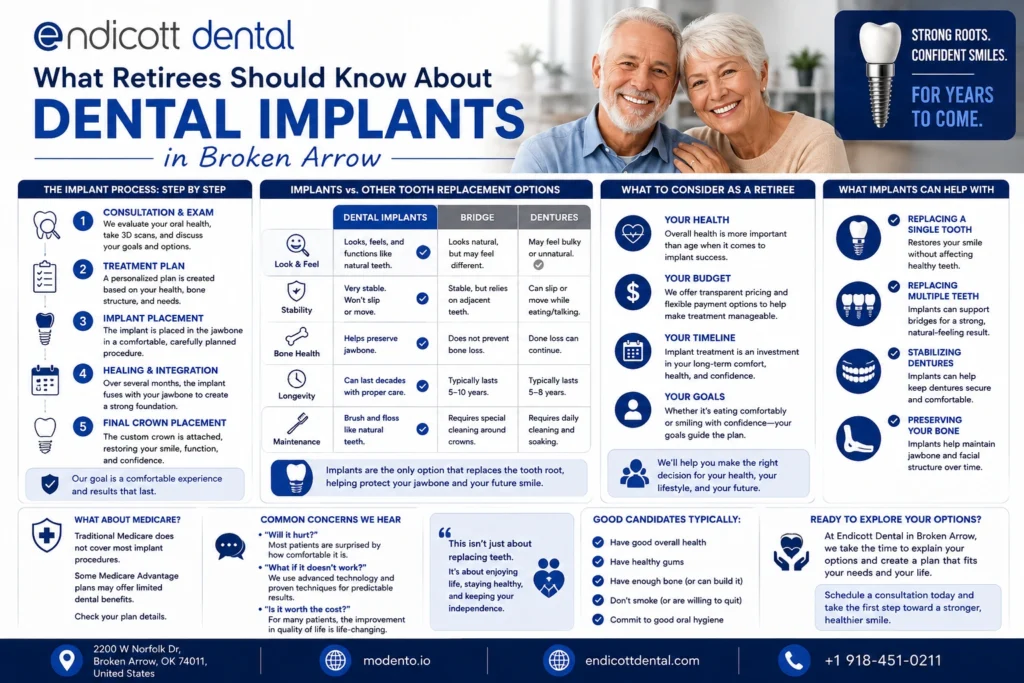
What About Medicare?
This is where many retirees are caught off guard.
Traditional Medicare generally does not cover most routine dental care, including many implant procedures.
Some Medicare Advantage plans may provide limited dental benefits, but coverage varies significantly.
This is why we encourage patients to verify their specific benefits rather than relying on assumptions.
How Long Do Implants Last?
This is one of the biggest reasons retirees consider them.
With proper care, many dental implants can last for decades.
Nothing in dentistry comes with a lifetime guarantee.
However, implants are often one of the longest-lasting tooth replacement options available.
For retirees thinking long-term, that can be an important consideration.
What If You Already Wear Dentures?
You may still be a candidate.
In fact, many of the happiest implant patients are people who have worn dentures for years.
Implants can sometimes be used to:
- Stabilize lower dentures
- Stabilize upper dentures
- Improve chewing ability
- Increase comfort
- Improve confidence
Not every denture wearer needs a full-mouth implant solution.
Sometimes a small number of strategically placed implants can make a dramatic difference.
When Implants May Not Be the Best Choice
This is a conversation many dental websites avoid.
Implants are excellent.
They're not perfect.
They may not be the best option if:
- Significant medical issues affect healing
- Bone loss is severe
- Surgery isn't desired
- Budget limitations are substantial
- A simpler solution would adequately meet your goals
A good dentist should discuss all reasonable alternatives not just implants.
The Lifestyle Question Most Retirees Ask
Eventually, the conversation becomes less about teeth and more about lifestyle.
Questions like:
- "Will I be able to eat comfortably?"
- "Will I worry about my teeth moving?"
- "Will I feel confident in photos?"
- "Will this still work ten years from now?"
Those are often the questions that matter most.
Because implants aren't really about replacing teeth.
They're about preserving independence, comfort, and quality of life.
What We Tell Retirees at Endicott Dental
Here's what we'd tell you if you asked us in person.
Don't rule yourself out because of your age.
And don't assume implants are automatically the right answer either.
The best decision comes from understanding:
- Your health
- Your goals
- Your budget
- Your timeline
- Your alternatives
For some retirees, implants are one of the best investments they make in their health and quality of life.
For others, a bridge or denture may be the smarter choice.
The right answer depends on the individual not their birth year.
Thinking About Dental Implants in Retirement?
If you're considering dental implants in Broken Arrow, Dr. Drew Endicott and the team at Endicott Dental can help you understand exactly what your options are, what treatment involves, and what costs to expect.
Our goal is not to sell you implants.
It's to help you determine whether they're truly the best solution for your situation, both now and in the years ahead.
Frequently Asked Questions
Am I too old for dental implants?
Age alone rarely disqualifies someone from implant treatment. Overall health is usually the more important factor.
Can implants help if I already wear dentures?
Yes. Many denture wearers use implants to improve stability, comfort, and chewing ability.
Does Medicare cover dental implants?
Traditional Medicare generally does not cover most implant procedures, though some Medicare Advantage plans may offer limited dental benefits.
How painful is implant treatment?
Most patients report less discomfort than they expected. Recovery is often compared favorably to a tooth extraction.
How long do implants last?
Many implants can last decades when properly placed and maintained with good oral hygiene and regular dental care.
