

Table of Contents
If you’re an adult in Broken Arrow thinking about straightening your teeth, you probably care about three things more than anything else:
How long will this take? How visible will it be? How much will it interrupt my life?
That is the real decision between FASTBRACES® and Invisalign.
Not “Which one is better?”
The better question is:
Which one fits your teeth, your schedule, your habits, and your tolerance for wearing something every day?
Because for busy adults, the best orthodontic option is not always the prettiest one. It is the one you can actually complete.
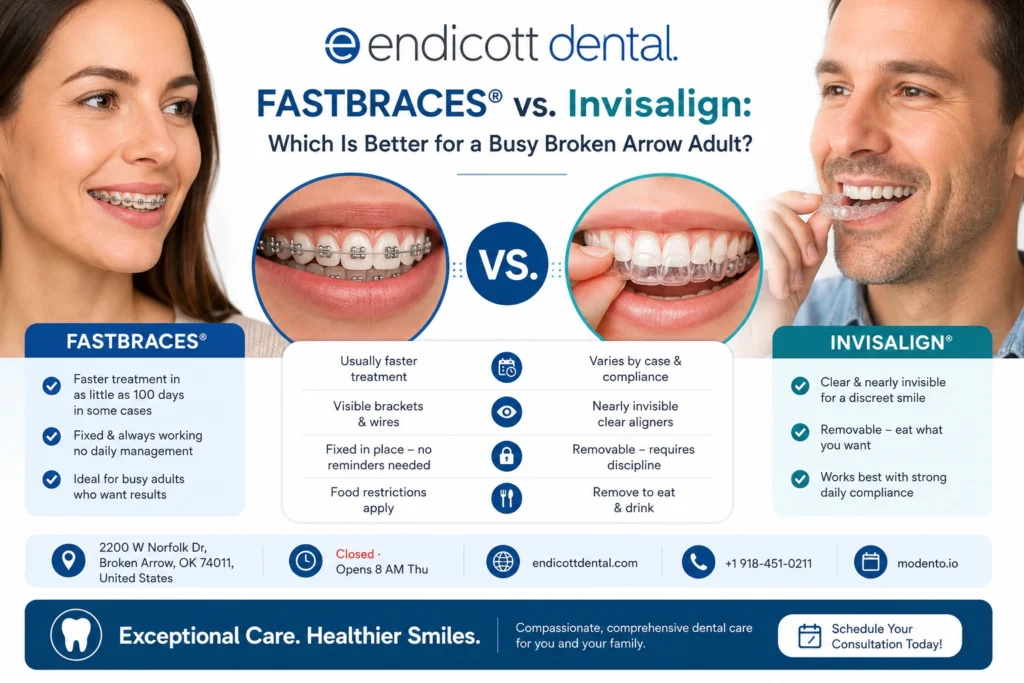
Fast answer: FASTBRACES® is usually better for speed and compliance. Invisalign is usually better for discretion and flexibility.
For a busy adult, here is the practical comparison:
| Option | Best for | Watch out for |
| FASTBRACES® | Adults who want faster treatment, do not want to manage removable trays, and can tolerate visible braces | Brackets are visible, food restrictions apply, cleaning takes more effort |
| Invisalign | Adults who want a discreet, removable option and are disciplined enough to wear trays consistently | Requires strong compliance; removing trays too often can delay treatment |
Endicott Dental offers both FASTBRACES® and Invisalign in Broken Arrow, which matters because this should not be a one-option sales pitch. Your teeth may be better suited for one, the other, or sometimes a different orthodontic plan entirely. Endicott Dental describes its braces and Invisalign options as tailored to the patient rather than one-size-fits-all.
What are FASTBRACES®?
FASTBRACES® are a bracket-and-wire orthodontic system designed to move teeth more quickly than conventional braces in many cases.
The FASTBRACES® company describes the system as patented orthodontic technology designed to move teeth efficiently and safely, with treatment-time estimates based on diagnosis.
Endicott Dental states that FASTBRACES® can move teeth in as little as 100 days in some cases, while more complicated cases may take longer.
That “as little as” phrase is important.
Some adults may be great candidates for a short FASTBRACES® timeline. Others may need more time because of crowding, bite issues, gum health, previous orthodontic relapse, or how much movement is actually needed. For patients weighing treatment speed against the overall financial commitment, understanding the FASTBRACES® cost-to-time investment can also help put the shorter treatment timeline into perspective.
What is Invisalign?
Invisalign is a clear aligner system. Instead of brackets and wires, you wear a series of thin, clear trays that gradually move your teeth.
The American Association of Orthodontists describes clear aligners as nearly invisible plastic shells custom-formed to fit your mouth and apply pressure to reposition teeth over time.
The big appeal is obvious: Invisalign is much less noticeable than braces.
The tradeoff is just as obvious: you are in charge of wearing it.
That is where busy adults can get into trouble.
The real adult-life comparison
Most comparison articles talk about appearance, cost, and treatment length.
That is fine, but it misses the real issue.
Busy adults are not living in a dental brochure. They are drinking coffee in the car, running kids to practice, sitting in meetings, taking client calls, traveling, forgetting lunch, and trying to get through the day without adding one more thing to manage.
So let’s compare these options where it actually matters.
1. Speed: FASTBRACES® often has the advantage
If your main goal is to finish as quickly as possible, FASTBRACES® may have the edge.
Endicott Dental says most traditional braces take 12–24 months, while FASTBRACES® can move teeth in as little as 100 days for some patients.
Invisalign treatment time varies widely. Some mild cases can be relatively quick, but aligners only work when they are worn consistently. Many aligner cases take months to over a year depending on complexity.
For a busy adult, the issue is not just the calendar.
It is the number of months you have to think about orthodontics every single day.
Advantage: FASTBRACES®, if you are a good candidate.
2. Visibility: Invisalign usually wins
If you are in sales, leadership, teaching, healthcare, real estate, public speaking, or customer-facing work, visibility may matter.
Invisalign is popular with adults because it is discreet. The AAO describes clear aligners as nearly invisible, which is the core reason many adults choose them.
FASTBRACES® are still braces. Even if they are smaller or more efficient than traditional systems, they are visible.
For some adults, that is no big deal.
For others, it is the deciding factor.
Advantage: Invisalign.
3. Compliance: FASTBRACES® wins for people who are busy, forgetful, or realistic
This is the part adults need to be honest about.
Invisalign is removable. That sounds like a benefit, and it is. You can remove trays to eat, drink anything besides water, brush, and floss.
But removable also means removable.
You can leave trays in a napkin at lunch. You can forget them at home. You can take them out for coffee and forget to put them back in. You can “just leave them out for this meeting” and suddenly lose hours of wear time.
FASTBRACES® are fixed to your teeth. You do not have to remember to wear them. They are working whether you are in a meeting, driving to Tulsa, or picking up groceries.
That can be a huge advantage for a busy adult who does not want another daily system to manage.
For younger patients balancing classes, activities, and social schedules, FASTBRACES® for BA students can offer the same benefit by reducing the need to keep track of removable trays throughout the day.
Advantage: FASTBRACES®.
4. Eating and drinking: Invisalign wins, but with a catch
With FASTBRACES®, you need to avoid certain foods that can bend wires, break brackets, or make cleaning harder. Sticky, hard, crunchy foods can be a problem.
With Invisalign, you remove the trays to eat, so there are fewer food restrictions.
That sounds easier.
But here is the catch: every snack, coffee, soda, or meal becomes a tray-management event.
Take trays out. Store them. Eat or drink. Brush or rinse. Put trays back in.
If you sip coffee all morning, snack frequently, or attend long business lunches, Invisalign can become more annoying than expected.
Advantage: Invisalign for food freedom. FASTBRACES® for fewer decisions.
5. Cleaning: Invisalign usually makes hygiene easier
Braces require more careful brushing and flossing because food and plaque collect around brackets and wires.
Invisalign trays come out, so you can brush and floss normally. That is a real advantage, especially for adults who already struggle to floss consistently.
But Invisalign has its own hygiene requirement: you have to keep the trays clean and avoid trapping sugar or acid against your teeth.
Putting aligners back in after sipping sweet coffee or soda without rinsing or brushing is not a great habit.
Advantage: Invisalign, if you keep trays clean.
6. Professional schedule: it depends on the type of busy
There are two types of busy adults.
One type says, “I do not want people to see braces.”
The other says, “I do not want to think about this all day.”
Those are different problems.
If you are camera-facing, client-facing, or self-conscious about brackets, Invisalign may fit your work life better.
If you are task-loaded, forgetful, traveling, or already overwhelmed, FASTBRACES® may be easier because you do not have to manage trays.
Cost: which is more expensive?
Costs vary by case, provider, insurance, records, retainers, and complexity.
In general, both FASTBRACES® and Invisalign can land in the several-thousand-dollar range. The real financial question is not just sticker price.
Ask:
- Are exams and records included?
- Are retainers included?
- How many refinement visits are included?
- What happens if treatment takes longer?
- Are emergency visits included?
- Does insurance cover orthodontics for adults?
- Is financing available?
For a busy adult, the “cost” also includes time away from work, rescheduled meetings, childcare, gas, and the mental energy of managing treatment.
A treatment that is slightly more expensive but easier to complete may be the better investment.
Who is usually a better fit for FASTBRACES®?
FASTBRACES® may be the better option if you:
- Want the shortest realistic timeline
- Do not want to manage removable trays
- Are likely to forget Invisalign wear time
- Do not mind visible braces for a shorter period
- Have mild to moderate alignment concerns
- Want a fixed system that works without daily decision-making
- Prefer speed over invisibility
This is often the adult who says:
“I don’t love the idea of braces, but I’d rather get this done and move on.”
That is a reasonable position.
Who is usually a better fit for Invisalign?
Invisalign may be the better option if you:
- Want the most discreet option
- Can wear trays consistently
- Do not snack or sip drinks all day
- Travel often and want fewer food restrictions
- Want easier brushing and flossing
- Are responsible with routines
- Have a case that aligners can predictably treat
This is often the adult who says:
“I’ll wear the trays. I just do not want braces showing at work.”
That is also reasonable.
Who should be careful with Invisalign?
Invisalign may not be ideal if you know you will not wear the trays consistently.
This is not a character flaw. It is just reality.
If you already forget your retainer, lose sunglasses, misplace your keys, and sip coffee for three hours every morning, Invisalign may become frustrating.
The trays cannot work from your pocket, purse, desk drawer, or car console.
Who should be careful with FASTBRACES®?
FASTBRACES® may not be ideal if visible brackets will bother you every day.
They may also be less ideal if you have a case that needs a different kind of orthodontic control, complex bite correction, or specialist-level planning.
Faster treatment is only good if it is the right treatment.
You want teeth that look better, function well, and stay stable afterward.
The uncomfortable truth: both options require retainers
Adults sometimes think the hard part is choosing the treatment.
It is not.
The lifelong part is retention.
After FASTBRACES®, Invisalign, or any orthodontic treatment, teeth can shift if you do not wear retainers as directed. This is especially important for adults who had braces as teens and watched their teeth move back over time.
Straightening teeth is one project.
Keeping them straight is the long game.
A practical decision guide for busy Broken Arrow adults
Here is the blunt version.
Choose FASTBRACES® if your top priority is finishing sooner and you do not want to manage trays.
Choose Invisalign if your top priority is appearance during treatment and you are disciplined enough to wear the aligners consistently.
Do not choose FASTBRACES® just because “fast” sounds good.
Do not choose Invisalign just because “invisible” sounds easy.
Both can work. Both can fail if they are matched to the wrong patient.
What to ask before deciding
Before you commit, ask Dr. Drew Endicott or your dental provider:
- Am I a good candidate for both FASTBRACES® and Invisalign?
- Which option would be faster for my specific case?
- Which option would give the more predictable result?
- Is my bite involved, or is this mostly cosmetic alignment?
- How many appointments should I expect?
- What happens if Invisalign refinements are needed?
- What happens if FASTBRACES® treatment takes longer than expected?
- Are retainers included?
- What will insurance likely cover?
- If this were your mouth, which would you choose and why?
That last question is useful.
Not because the dentist should decide for you, but because it forces a real recommendation.
Bottom line
For a busy Broken Arrow adult, FASTBRACES® is often better if speed and low daily maintenance matter most. Invisalign is often better if discretion and removability matter most.
The right choice depends on your teeth and your life.
If you are disciplined, appearance-conscious, and willing to wear trays consistently, Invisalign can be a great adult option.
If you want to get treatment done quickly and do not want to think about aligners all day, FASTBRACES® may be the more realistic fit.
At Endicott Dental in Broken Arrow, Dr. Drew Endicott and the team offer both FASTBRACES® and Invisalign, so the conversation can start with your actual goals instead of forcing you into one system.
If you’re trying to decide between FASTBRACES® and Invisalign, Endicott Dental can help you compare timeline, cost, visibility, and daily maintenance before you commit to treatment.
FAQs
Is FASTBRACES® faster than Invisalign?
It can be, especially for certain cases. Endicott Dental says FASTBRACES® can move teeth in as little as 100 days in some cases, but not every patient is a short-timeline case.
Is Invisalign better for adults?
Invisalign is often attractive for adults because it is discreet and removable. But it only works well when the aligners are worn consistently. If you will not wear them as directed, it may not be the better option.
Which is less noticeable: FASTBRACES® or Invisalign?
Invisalign is usually less noticeable. Clear aligners are designed to be nearly invisible, while FASTBRACES® use brackets and wires.
Which is easier with a busy schedule?
FASTBRACES® may be easier if you do not want to manage trays. Invisalign may be easier if you want fewer food restrictions and easier brushing. It depends on whether your bigger problem is visibility or compliance.
Can I drink coffee with Invisalign?
You generally remove aligners for drinks other than water. Coffee can stain trays and may trap sugar or acid against teeth if aligners are put back in without rinsing or brushing.
Do FASTBRACES® have food restrictions?
Yes. Like other bracket-and-wire systems, you usually need to avoid hard, sticky, or crunchy foods that can damage brackets or wires.
Which option costs more?
It depends on your case, treatment length, insurance, and what is included. Both can cost several thousand dollars. Ask for a written estimate that includes records, visits, refinements, retainers, and follow-up care.
Do I need a retainer after FASTBRACES® or Invisalign?
Yes. Retainers are needed after either treatment. Teeth can shift after any orthodontic treatment if retainers are not worn as directed.
