

Table of Contents
If you have not been to the dentist in 10 years, you probably already know you “should have gone sooner.”
You do not need a lecture.
You need a way back in.
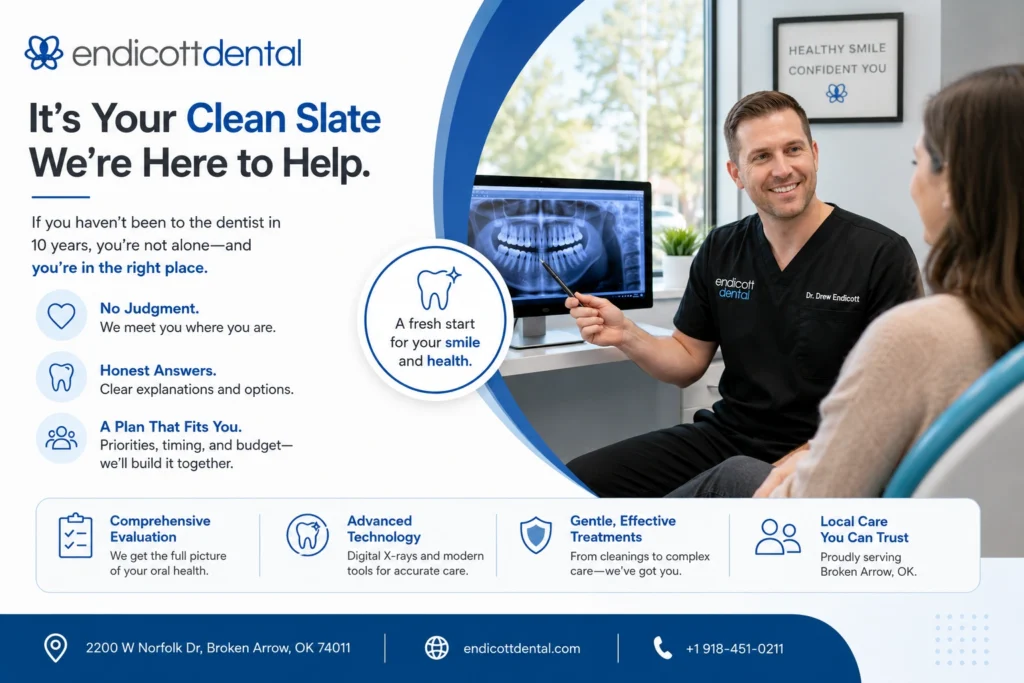
That is what the Clean Slate approach is about. No shaming. No scolding. No dramatic speeches about what you should have done in 2016. Just a calm, honest look at where your mouth is today and what options make sense from here.
Because here is the truth: plenty of people in Broken Arrow have gone years without dental care. Sometimes it is cost. Sometimes it is fear. Sometimes life got busy. Sometimes one bad experience made you avoid the dentist for a decade.
You are not the first person to walk in embarrassed.
And you will not be the last.
Fast answer: What happens if you haven’t seen a dentist in 10 years?
If you have not been to the dentist in 10 years, your first visit should usually focus on evaluation, not judgment.
That may include:
| Step | Why it matters |
| Conversation about your concerns | Helps the dental team understand fear, pain, budget, timing, and priorities |
| Digital X-rays, if needed | Finds cavities, infection, bone loss, and problems below the surface |
| Gum measurements | Checks for gingivitis or periodontal disease |
| Tooth-by-tooth exam | Identifies decay, cracks, old filling problems, wear, or infection |
| Cleaning recommendation | Determines whether you need a routine cleaning or deep cleaning |
| Written treatment plan | Gives you choices, costs, timing, and priorities before treatment |
The first visit is not about fixing everything in one day.
It is about getting clear.
First, let’s clear up the embarrassment
A lot of patients think the dental team is going to be shocked.
They are not.
Dentists see delayed care every week. Dr. Drew Endicott and the team at Endicott Dental are not sitting around waiting to shame someone who has not had a cleaning in years. The job is to help you understand what is going on and what can be done next.
There are many reasons people avoid dental care:
- Dental anxiety
- Cost concerns
- No insurance
- A painful past experience
- Embarrassment about teeth
- Fear of bad news
- Busy work or family life
- Moving and never finding a new dentist
- Depression, grief, or health struggles
- Not wanting to be pressured into treatment
None of those make you a “bad patient.”
They make you human.
The ADA’s MouthHealthy guidance on dental anxiety says delaying care can make future visits harder because dental problems may become more difficult over time, but it also emphasizes that the right dental team should take both your dental and emotional health seriously.
That is the tone you should expect.
Not: “Where have you been?”
More like: “I’m glad you came in. Let’s see what we’re working with.”
What problems are common after 10 years without dental care?
Not everyone who skips the dentist for 10 years has major problems.
Some people have surprisingly stable teeth. Others have several issues happening quietly under the surface.
Common findings include:
1. Tartar buildup
Plaque is soft. Tartar is hardened plaque that cannot be brushed off at home.
After years without professional cleanings, tartar often builds up around the gumline and between teeth. This can irritate the gums and make bleeding worse.
2. Gingivitis or gum disease
Gum disease is one of the biggest concerns after a long gap. The CDC reports that nearly half of adults age 30 and older have some form of periodontitis, and severe periodontitis affects about 8% of adults.
That does not mean you are doomed.
It means gum disease is common, treatable, and worth checking.
3. Cavities between teeth
Cavities between teeth can be hard to see without X-rays. You may feel fine until decay gets deeper.
That is why a “nothing hurts” mouth can still have issues.
4. Old fillings or crowns breaking down
Fillings do not last forever. Crowns can leak. Edges can wear. Small cracks can form.
If you had dental work years ago, part of the visit is checking whether that work is still holding up.
5. Tooth wear from grinding or clenching
A lot of people grind or clench without realizing it, especially during sleep or stressful seasons of life.
Over time, that can cause flattened teeth, cracks, sensitivity, jaw soreness, or headaches.
6. Infection
A dental infection is not always dramatic at first. Sometimes it shows up as a pimple on the gum, a bad taste, pressure, swelling, or a darkened tooth.
This is one reason X-rays may be recommended after a long gap.
The ADA says dental X-rays should be taken only when the dentist believes they will provide needed diagnostic information; they are not automatically required at every visit for every patient.
After 10 years, though, X-rays are often useful because there is a lot the dentist cannot see just by looking.
Will I definitely need a deep cleaning?
No.
But it is possible.
This is one of the biggest surprises for patients who have not been in for years.
A routine cleaning is for a generally healthy mouth. It removes plaque, tartar, and stain above the gumline and slightly below it.
A deep cleaning, also called scaling and root planing, is used when there is gum disease and buildup below the gumline.
The difference matters.
If your gums are healthy enough for a routine cleaning, great. If there are deep pockets, bleeding, bone loss, or tartar below the gums, a routine cleaning may not be the right treatment.
That is not punishment for waiting.
It is the difference between maintenance and treatment.
What if I need a lot of work?
Then the right answer is usually to prioritize.
A good dental plan does not have to mean “do everything immediately.”
At Endicott Dental, the Clean Slate mindset should be:
- Handle pain or infection first
- Stabilize active disease
- Save what can reasonably be saved
- Discuss replacement options for teeth that cannot be saved
- Improve appearance when health and function are under control
- Build a maintenance plan you can actually stick with
That order matters.
If you have a broken front tooth and you are embarrassed, appearance may be urgent to you. If you have an infected molar, infection may be clinically urgent. If money is tight, the plan may need to be phased.
The best plan is not always the “perfect” plan.
It is the plan that protects your health, fits your life, and moves you forward.
What the first visit should not feel like
Your first visit after 10 years should not feel like a courtroom.
It should not include:
- A lecture about flossing
- Surprise treatment without explanation
- A huge treatment plan with no priorities
- Shame about your teeth
- Pressure to do cosmetic work first
- Eye-rolling about your dental anxiety
- Dismissal of cost concerns
- Being told “you need everything” without being shown why
You should be able to ask:
- What is urgent?
- What can wait?
- What happens if I do nothing?
- What is the least invasive option?
- What is the most durable option?
- What does insurance cover?
- What would you do first if this were your mouth?
- Can we phase this over time?
A trustworthy dental team will not be offended by those questions.
The Clean Slate approach: what it means
A Clean Slate appointment means we start with reality, not regret.
No judgment about the past
The only thing we can treat is where you are now.
Whether it has been 2 years, 10 years, or 25 years, the goal is the same: understand your mouth and make a practical plan.
Clear explanations
You should not leave wondering what the dentist saw.
If there is decay, gum disease, infection, bone loss, or a cracked tooth, you should be shown what is going on in plain language.
Prioritized treatment
Not everything has the same urgency.
Some things need attention soon. Some can be monitored. Some are optional. Some may be nice to have but not necessary.
That distinction should be clear.
Cost transparency
Avoiding the dentist often has a cost component.
So cost needs to be part of the conversation, not something hidden until the front desk.
A good plan should include estimates, insurance discussion when applicable, and options for phasing treatment when possible.
Permission to go at your pace
Some patients are ready to do everything quickly.
Others need to start with one cleaning, one tooth, or one conversation.
That is okay.
The important thing is to start.
What if I’m scared of what the dentist will find?
That fear is normal.
But not knowing does not make the problem smaller. It only keeps you stuck.
The most common outcome of a first visit is not, “Everything is terrible.”
It is usually more like:
- “Here is what is healthy.”
- “Here is what needs attention.”
- “Here is what can wait.”
- “Here is what we should do first.”
- “Here is what it may cost.”
- “Here are your options.”
That kind of clarity is usually a relief, even when there is work to do.
What if my teeth look bad?
Dentists are not surprised by stained teeth, broken teeth, missing teeth, tartar, bad breath, cavities, or gum bleeding.
That is literally the work.
And from a patient perspective, this is worth saying plainly:
You do not need to clean yourself up before seeing the dentist.
That is like deep-cleaning your house before hiring a house cleaner because you are embarrassed.
Brush your teeth before the appointment if you can. Bring your concerns. Tell the truth about what hurts, what scares you, and what you can afford.
That is enough.
Can I just get a cleaning and skip the exam?
After 10 years, that is usually not a good idea.
A cleaning without an exam can miss bigger issues, especially gum disease, cavities between teeth, infections, bone loss, or cracked teeth.
The CDC notes that regular dental checkups help with early detection and treatment of gum disease.
If it has been a decade, the exam is not a formality. It is how the dentist figures out whether a standard cleaning is safe and appropriate.
What should you do before the appointment?
You do not need to do much.
But these steps help:
- Write down your biggest concerns.
- Bring your insurance card, if you have one.
- Make a list of medications and health conditions.
- Mention dental anxiety when scheduling.
- Tell the office if you are in pain.
- Ask whether X-rays, exam, and cleaning may happen the same day.
- Ask for cost estimates before treatment.
Do not apologize 12 times.
One honest sentence is enough: “I haven’t been in a long time, and I’m nervous.”
A good dental team will know what to do with that.
When should you not wait any longer?
Schedule as soon as possible if you have:
- Swelling in your face or gums
- Severe tooth pain
- A broken tooth with pain
- A pimple or bump on the gum
- Bleeding that keeps happening
- Loose adult teeth
- Bad taste or drainage
- Pain when biting
- A tooth that turned gray or dark
- Dentures or partials that no longer fit
- A filling or crown that fell out
Those symptoms do not mean you should panic.
They mean it is time to stop guessing.
Bottom line: You are not starting over. You are starting from here.
If you have not been to the dentist in 10 years, the hardest part is usually making the appointment.
Not the cleaning.
Not the X-rays.
Not the treatment plan.
The hardest part is getting past the embarrassment long enough to walk in.
At Endicott Dental in Broken Arrow, Dr. Drew Endicott and the team understand that delayed dental care is usually more complicated than “I forgot.” It often involves fear, money, shame, timing, and past experiences.
The Clean Slate approach means you do not have to explain away the last 10 years before you deserve help.
You can just start.
If you’re dealing with this and you’re not sure what to do next, Endicott Dental can help you understand your options before you commit to treatment.
FAQs
Is it bad that I haven’t been to the dentist in 10 years?
It is not ideal, but it is more common than you think. The important thing is to get evaluated now so you know what is healthy, what needs treatment, and what can wait.
Will the dentist judge me?
A good dental team should not judge you. Their job is to diagnose, explain, and help you move forward. If you feel shamed, rushed, or talked down to, that is a problem with the experience, not with you.
Will I need a deep cleaning after 10 years?
Maybe, but not always. If your gums are healthy, you may only need a routine cleaning. If there is gum disease, deeper pockets, bleeding, or tartar below the gumline, a deep cleaning may be recommended.
What if I need a lot of dental work?
You do not have to do everything at once in most cases. A good dentist should help you prioritize urgent needs, explain what can wait, and phase treatment when appropriate.
Can I be sedated if I’m anxious?
Many anxious patients can be helped with slower pacing, clear communication, breaks, and comfort options. Sedation availability varies by procedure and office, so ask before your visit what options are available.
Should I brush and floss aggressively before the appointment?
No. Brush normally. Do not scrub your gums hard or start aggressive flossing right before the visit. That can make your gums sore or irritated. The goal is not to impress the dentist. The goal is to get an honest baseline.
What if I have bad breath?
Tell the dental team. Bad breath can come from tartar buildup, gum disease, dry mouth, cavities, diet, tobacco, or medical issues. It is a symptom to investigate, not something to be ashamed of.
What if I can’t afford all the treatment?
Say that early. A good office should help you understand priorities, insurance, financing options, and phased treatment when possible. The most urgent care should usually come first.
